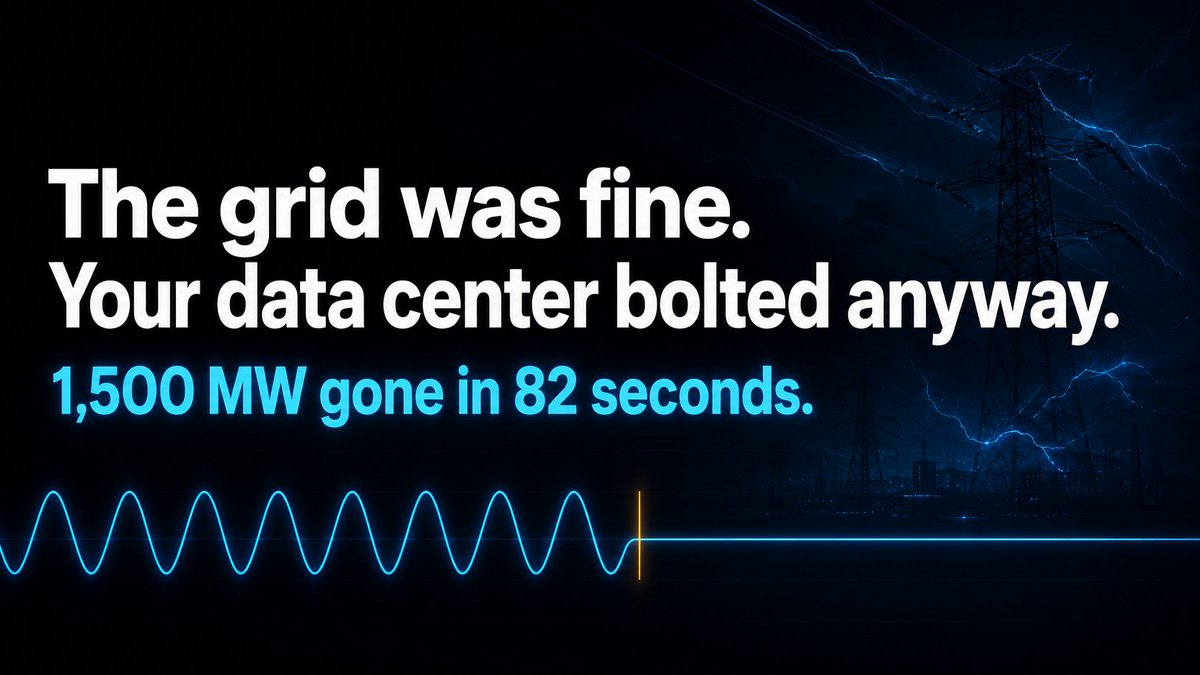
- On July 10, 2024, ~1,500 MW of data center load vanished from Virginia's grid in 82 seconds.
Not a blackout. ~60 data centers decided the grid had failed — when every voltage dip was inside its normal range.
The risk almost no operator is pricing in. 🧵 - The trigger: a lightning arrestor failed on a 230 kV line. The protection system auto-reclosed 3 times — 6 voltage dips in 82 seconds.
Every dip stayed inside ANSI's normal ±10% range. The grid was fine. The data centers weren't. - The culprit: UPS "three-strike" logic — 3 voltage disturbances in a minute, transfer the whole facility to diesel.
The reclosing sequence hit that threshold across ~60 facilities at once. And Eaton, Vertiv & Schneider each count those strikes differently. - Grid operators had zero visibility into this behavior.
When 1,500 MW disappeared, they scrambled to ramp down 600 MW of PA gas and 300 MW from a VA nuclear unit to stop the frequency surge from damaging equipment.
Reconnection took hours. - Now the financial layer. PJM capacity prices went from $28.92 to $329.17/MW-day in 24 months — a 10x.
For a 100 MW facility, the annual capacity obligation jumped from $1.1M to $12M. Data centers drove 63% of that jump — $9.3B onto ratepayers. - And the regulatory wall is landing all at once:
• FERC large-load interconnection rule — final action due Apr 30, 2026
• NERC large-load standards — initial set by end of 2026
• Virginia's GS-5 rate class for loads ≥25 MW — Jan 1, 2027 - Here's the part that should worry every operator:
Under PJM's rules, Non-Capacity-Backed Loads ≥50 MW get curtailed FIRST — before capacity-backed DR. PJM's Jan 2026 board letter is blunt: bring your own generation, or accept interruption. - Flexibility isn't theory — it's proven.
EPRI's DCFlex pilot (NVIDIA, Oracle, a utility) cut data center power 25% for 3 hours during grid stress — no loss in AI performance. First commercial-scale proof, in Nature Energy.
The capability exists. The tooling mostly doesn't. - Today's tools each solve one slice:
Emerald AI ($68M) orchestrates NVIDIA AI factories for single-tenant hyperscalers.
Schneider's FFR drops load for 30 seconds.
GE's GridOS runs the utility side.
Tellingly, Eaton & GE both invested in Emerald rather than build it. - Nobody ships grid-interaction software for how colocation actually works: multi-tenant, mixed workloads, vendor-neutral GPUs.
And nobody orchestrates all five vectors — GPU scheduling, cooling, UPS, grid DR, capacity-market position (~$120K/MW-year). That's what we build. - Honest question for operators: can you state today whether your UPS counts voltage strikes per-phase or aggregate — and hand that ride-through profile to your transmission operator?
Most can't. That gap is the next byte blackout. #DataCenters - We wrote up the full picture — the byte blackout, the capacity math, the regulatory timeline, and what grid-interactive colocation actually requires:
https://veriprajna.com/solutions/data-center-grid-interaction