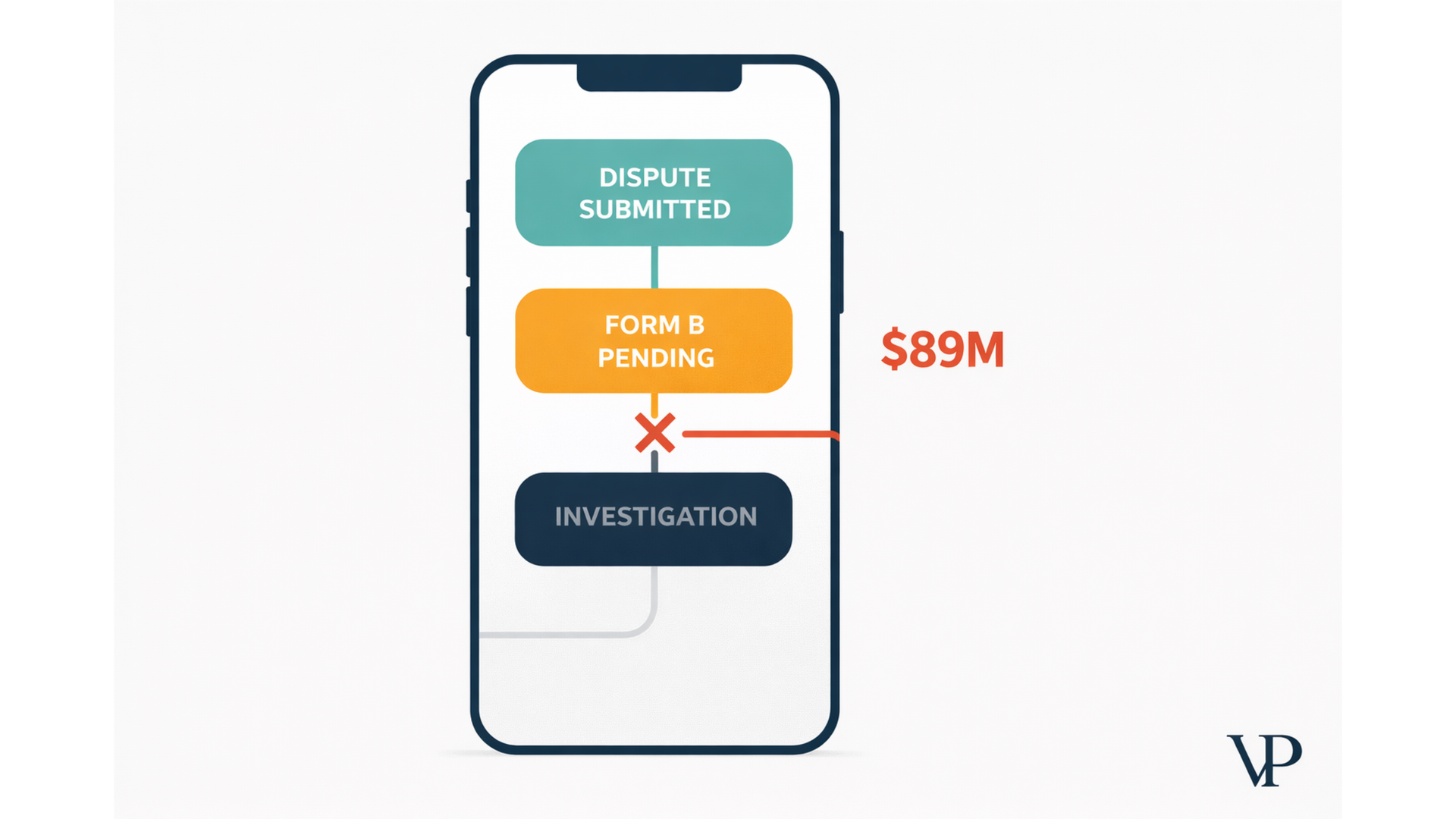
A missing checkbox cost Apple and Goldman Sachs $89 million.
In October 2024, the Consumer Financial Protection Bureau fined both companies for a cascade of failures in the Apple Card program — tens of thousands of consumer disputes that simply vanished into a technical void, interest charges on purchases advertised as interest-free, and acknowledgment notices that were never sent. The root cause wasn't fraud or negligence in the traditional sense. It was a logic error in a user interface that no one caught for months, even after internal teams had raised warnings before launch.
When I first read the CFPB consent orders — all 40-plus pages of them — I didn't see a compliance failure. I saw an engineering failure. And it's the exact kind of failure that the current wave of AI-powered fintech is about to repeat at scale.
A $25 Million Penalty for Clicking "Launch"
The backstory matters. Apple and Goldman Sachs signed a partnership agreement in 2017. Apple would own the consumer experience — the sleek Wallet app, the titanium card, the whole aesthetic. Goldman would be the bank behind it, handling credit decisions, billing, and dispute investigations.
Buried in that agreement was a clause: if Goldman caused a delay of more than 90 days in launching the Apple Card, Apple could claim $25 million in liquidated damages. That single contractual provision created enormous pressure to ship on time, regardless of whether the underlying systems were ready.
The Apple Card went live on August 20, 2019. The message queues between Apple's Wallet app and Goldman's back-end systems were, by the CFPB's account, under-tested and fragile. Internal teams had flagged concerns. The system launched anyway.
A $25 million penalty for delay created a system that would eventually cost $89 million in fines and redress.
The Bug That Ate 380,000 Disputes
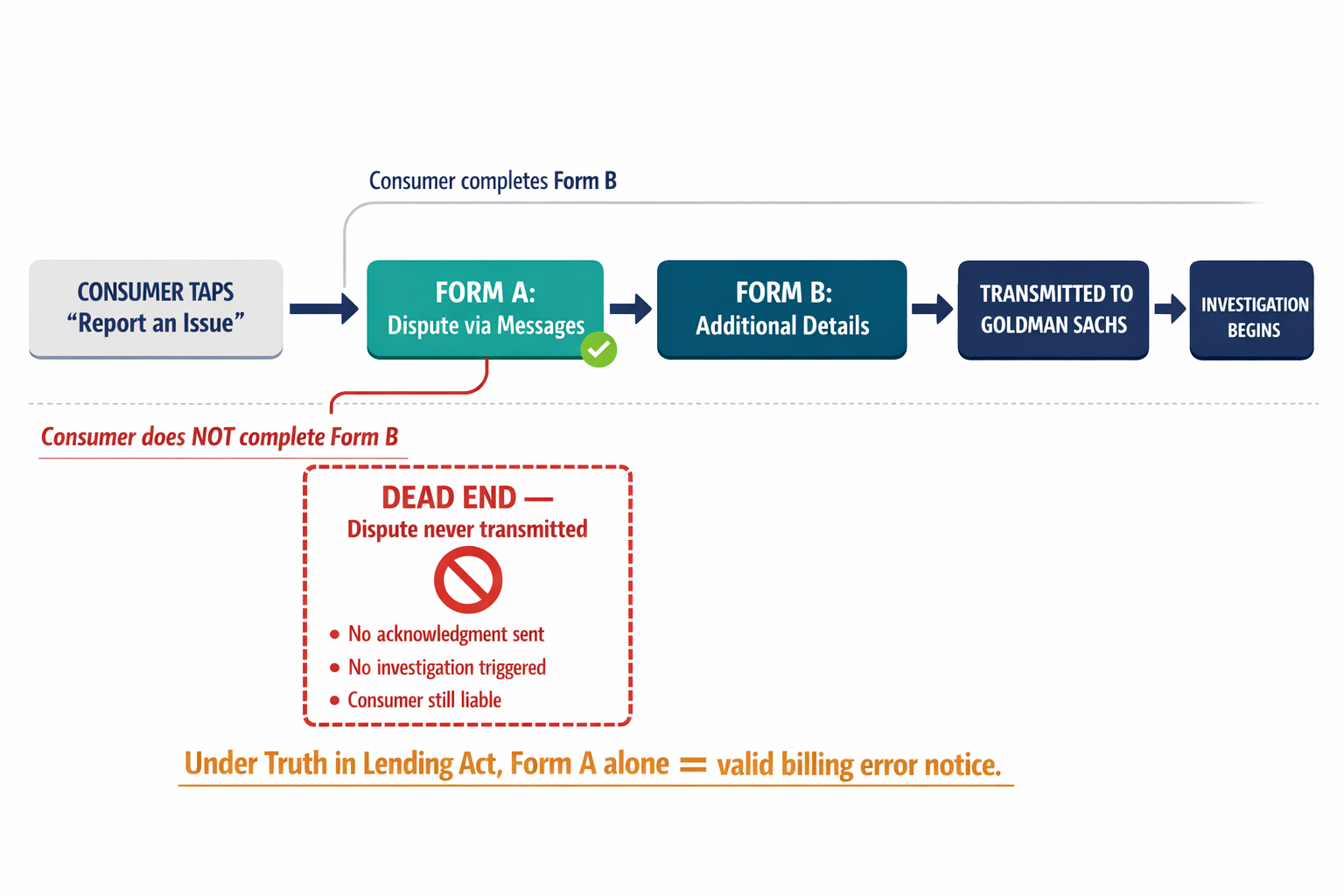
In June 2020, Apple updated the "Report an Issue" feature in the Wallet app. Before the update, a consumer would tap a transaction, hit "Report an Issue," and get connected to Goldman Sachs via Messages. Straightforward.
The update added a secondary form. After submitting the initial dispute through Messages, consumers were asked to fill out additional details on a separate screen. Reasonable enough — except for what happened when they didn't complete that second form.
The system simply stopped. The dispute sat in a limbo state: submitted by the consumer, but never transmitted to Goldman Sachs. No investigation was triggered. No acknowledgment was sent. No resolution was attempted. From the consumer's perspective, they'd reported the problem. From Goldman's perspective, no dispute existed.
Under the Truth in Lending Act, many of these initial Messages submissions legally qualified as valid billing error notices. The law doesn't care whether a consumer clicked through every screen in your app — it cares whether they communicated a dispute. Tens of thousands of consumers were held responsible for charges they had formally disputed because a UI workflow broke a legal obligation.
This is what I mean when I say the failure was architectural, not operational. The system's logic — its state machine, to use the technical term — had a dead end. A path where a dispute could enter but never exit. And nobody built a mechanism to detect that dead end or route around it.
Why "Just Add AI" Makes This Worse
When I talk to financial services teams about this case, someone inevitably says: "Well, an AI system would have caught that." I'm not so sure.
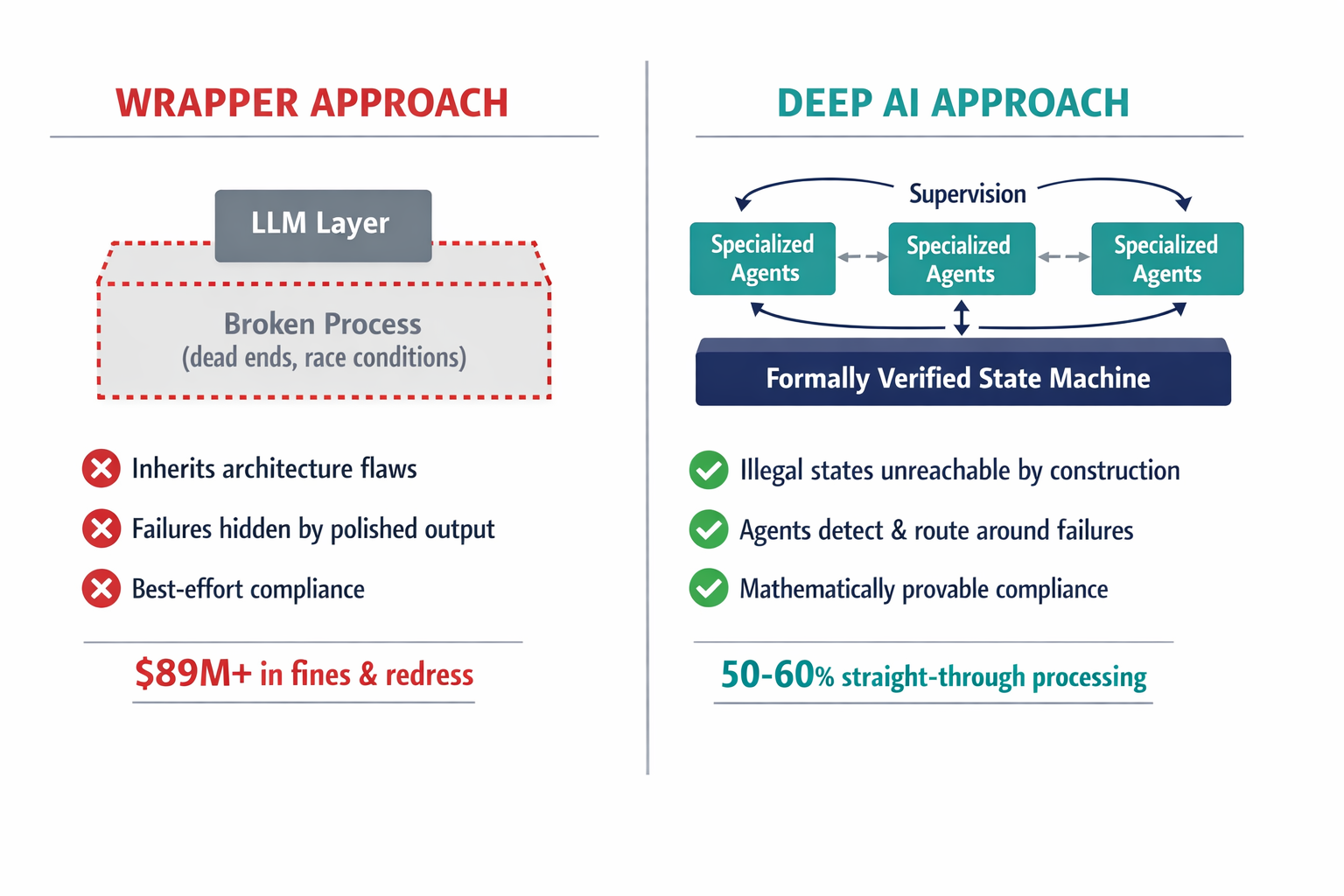
The current dominant approach to AI in financial services is what I'd call the wrapper model. You take a large language model — GPT-4, Claude, whatever's newest — and you feed it your policies, your regulations, your process documentation in one massive prompt. Then you ask it to handle customer interactions, route disputes, make decisions.
The problem is that a wrapper has no structural understanding of the system it's operating within. It doesn't know that a dispute in "Form A Submitted / Form B Pending" state is a legal time bomb. It doesn't know that the Truth in Lending Act doesn't require Form B. It processes whatever data reaches it, and if the data never arrives — because a UI bug prevented transmission — the AI has nothing to process. The wrapper approach doesn't fix the architecture. It inherits the architecture's flaws.
I've seen this pattern across dozens of enterprise AI deployments. Teams bolt a language model onto a broken process and declare the process "AI-powered." The model generates fluent, confident responses. The underlying system still has dead ends, race conditions, and unmonitored state transitions. The AI just makes the failure harder to detect because the output looks polished.
AI that wraps a broken system doesn't fix the system. It makes the breaks harder to find.
What "Provably Correct" Actually Means
My team at Veriprajna has spent years working on a different approach. We call it deep AI, and the core idea is simple to state even if it's hard to build: before you deploy a system that handles legally consequential decisions, you should be able to mathematically prove that it can't enter an illegal state.
That sounds abstract, so let me make it concrete with the Apple Card example.
The dispute resolution process is, at its core, a state machine. A dispute starts in one state (submitted), moves through intermediate states (under investigation, evidence gathered, resolution proposed), and ends in a terminal state (resolved, denied with explanation, refunded). Federal law imposes constraints on this state machine — you must acknowledge within a certain period, you must resolve within 60 days, you must not hold the consumer liable while investigating.
Formal verification is a technique where you build a mathematical model of your state machine and then use automated tools to check whether any possible sequence of events could violate your constraints. Think of it like this: instead of testing your system with a thousand scenarios and hoping you covered the important ones, you prove that no scenario — out of the infinite possible combinations — can lead to a violation.
If Apple and Goldman had formally verified the "forms feature" update, the verification tool would have found the dead-end state in seconds. It would have generated a specific counterexample: "Consumer submits Form A, does not complete Form B, dispute is never transmitted, acknowledgment deadline passes — violation." The deployment would have been blocked before it reached a single consumer.
We explored this failure mode and the architectural alternatives in depth in our interactive analysis of the Apple-Goldman case.
Agents That Check Each Other's Work
Formal verification handles the design phase — making sure the blueprint is sound. But production systems face conditions that no blueprint fully anticipates. Network delays, API timeouts, sudden spikes in dispute volume, partners updating their systems without coordinating.
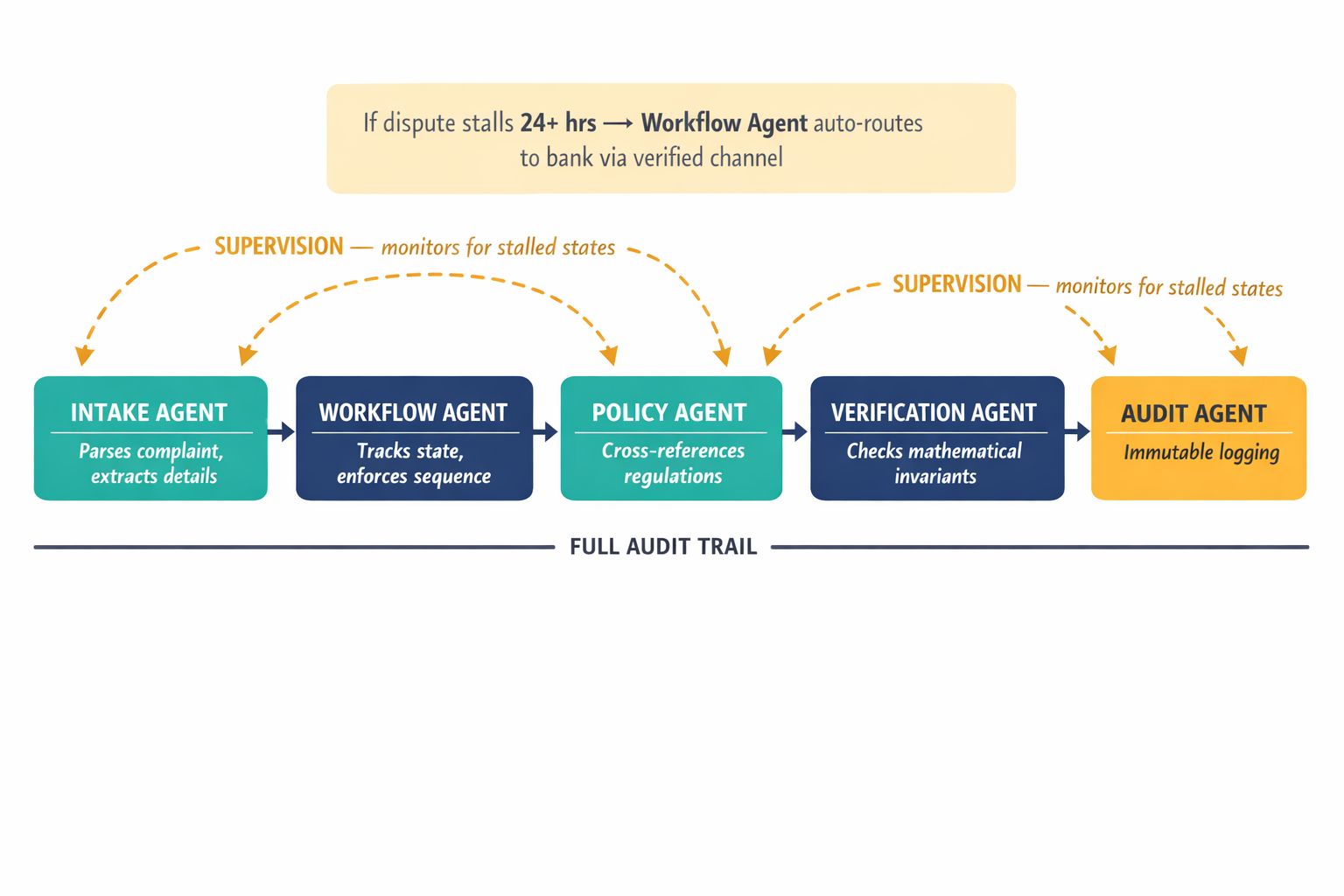
This is where multi-agent architecture comes in. Instead of one monolithic AI handling everything, you deploy specialized agents that each own a narrow responsibility and — critically — monitor each other.
In the system we've built, a dispute flows through a chain of agents. An Intake Agent parses the consumer's natural language complaint and extracts the relevant details — transaction, merchant, date, nature of the error. A Workflow Agent tracks the dispute's state and enforces the legally required sequence of events. A Policy Agent cross-references every proposed action against the applicable regulations. A Verification Agent runs real-time checks to confirm that no mathematical invariant is being violated. And an Audit Agent logs every interaction, every decision, every data handoff in an immutable trail.
The key insight isn't the individual agents — it's the supervision pattern. If the Workflow Agent detects that a dispute has been sitting in a "submitted but not transmitted" state for more than 24 hours, it doesn't wait for a human to notice. It evaluates whether the information already submitted constitutes a valid billing error notice under the law. If it does, the agent packages the data and transmits it to the bank through a verified channel, logging its reasoning for regulators.
The system that failed Apple Card consumers didn't need better AI. It needed AI that could recognize when a process had stalled and autonomously route around the obstruction.
This is what I mean by resilience. Not "the system never fails" — that's impossible in distributed computing. But "when a component fails, the system detects it and maintains its legal obligations anyway."
Proving Your System Won't Miss a Deadline
One detail from the CFPB order that stuck with me: a significant portion of Goldman's fine came from failing to send acknowledgment notices within the legally required timeframe. Not because anyone decided to skip them, but because the system was too slow and too opaque to guarantee timely delivery.
Timing in financial compliance isn't a performance optimization — it's a legal requirement. Regulation Z specifies exact windows for acknowledgment and resolution. Miss them, and you're in violation regardless of whether you eventually get it right.
My team uses a methodology we call symbolic latency analysis. Instead of monitoring your system in production and hoping response times stay within bounds, you model the worst-case timing of every component in the chain — UI processing, message queue delays, bank mainframe response times — and prove mathematically that the total can never exceed the regulatory deadline.
If someone proposes a code change that increases the worst-case latency beyond the legal limit, the deployment pipeline rejects it automatically. You don't find out you've missed a deadline after 10,000 consumers have been affected. You find out before the code ships.
For the full technical methodology — including how we use tools like TLA+ and Imandra for real-time verification — see our detailed technical research.
"But We're Not Apple. We Can't Afford This."
I hear this objection constantly, and I think it gets the economics exactly backwards.
Goldman Sachs paid $45 million in penalties and $19.8 million in consumer redress. Apple paid $25 million. That's $89.8 million total — and it doesn't count the legal fees, the reputational damage, or the cost of Goldman eventually exiting the consumer card business entirely.
The formal verification and multi-agent architecture I'm describing doesn't require you to rebuild your core banking system from scratch. It layers on top of existing infrastructure. We typically work in phases over 18 to 36 months: first mapping the existing architecture and identifying the dead ends, then encoding the regulatory requirements into formal models, then deploying agents in shadow mode alongside existing processes to validate accuracy before taking over.
The early phases — the assessment and formal modeling — take 14 to 20 weeks. That's where you find the bugs that would have cost Apple and Goldman $89 million. The later phases, where agents begin handling routine cases autonomously, are where the ROI compounds: digital straight-through processing rates of 50-60%, meaning more than half of disputes are resolved without human intervention, at consistent quality, with full audit trails.
This isn't a cost center. It's the difference between scaling your compliance team linearly with transaction volume — hire more people every time volume doubles — and scaling computationally, where more volume requires more server capacity but not more humans.
What Keeps Me Up at Night
The Apple-Goldman case involved a relatively simple product — a credit card with a dispute resolution process. The state machine had maybe a dozen states. The regulatory requirements, while strict, are well-documented and decades old.
Now look at what's coming. Embedded finance is putting lending, insurance, and investment products inside every consumer app. Real-time payments are compressing settlement windows from days to seconds. Cross-border transactions are multiplying the number of regulatory jurisdictions a single transaction might touch.
Every one of these trends increases the complexity of the state machines that financial systems must manage. Every one increases the number of dead-end states that can trap a consumer's money or rights. And every one makes the wrapper approach — "just prompt the AI with the rules and hope it figures it out" — more dangerous.
The Apple Card failure happened with two of the most sophisticated, best-resourced companies on earth. They had the engineering talent. They had the money. What they didn't have was an architecture that made compliance provable rather than aspirational.
The era of "ship fast and patch later" is incompatible with an industry whose core promise is "we will protect your money."
What I'd Tell a CTO Reading This
Three things. First, audit your state machines. Every process that touches a consumer's money or rights is a state machine, whether you've modeled it as one or not. Map every state, every transition, every dead end. The Apple Card bug was findable with basic analysis — it just wasn't looked for.
Second, stop treating compliance as a layer you add after building the product. If your compliance checks run after the transaction is processed, you're building in the possibility of violations. Compliance constraints should be encoded into the system's logic so that illegal states are unreachable by construction.
Third, demand proof, not promises. When a vendor or an internal team tells you their AI system is "compliant," ask them: can you show me a formal proof that this system cannot enter a state that violates Regulation Z? If they can't, they're offering you best-effort compliance. And we now have an $89 million data point on what best-effort compliance costs.
The financial services industry is at an inflection point. We can keep wrapping increasingly powerful AI around architectures that were never designed for the complexity they now face. Or we can build systems where correctness is the foundation — not a feature, not an afterthought, but a mathematical guarantee.
I know which approach I'm betting on. I'd be curious to hear how you're thinking about this at your organization — especially if you've been through a regulatory action and had to rebuild trust from the inside out.