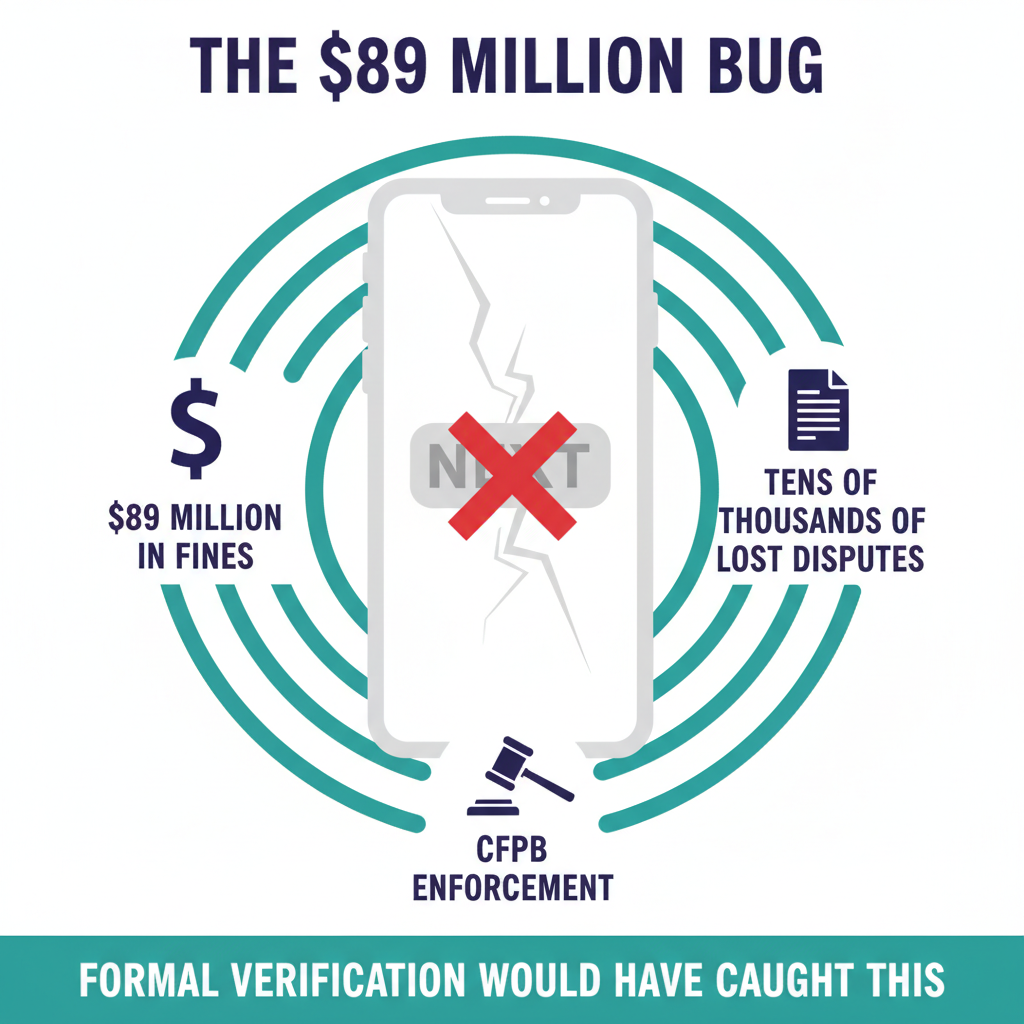
A broken "Next" button cost Apple and Goldman Sachs $89 million in penalties. Not a cyberattack. Not fraud. A state-machine logic error -- a flaw in the rules governing how a transaction moves from one status to the next -- that silently swallowed tens of thousands of consumer disputes and left customers on the hook for charges they never made.
The October 2024 Consumer Financial Protection Bureau (CFPB) enforcement action against Apple and Goldman Sachs is the most expensive UX bug in fintech history. Our team has spent months dissecting the technical and regulatory anatomy of this failure, and the lessons extend far beyond one credit card product. They expose a structural flaw in how the financial industry builds AI-enabled systems: the assumption that speed and compliance can be traded off against each other.
$89 million. One broken button. Zero malicious intent.
What Actually Broke Inside the Apple Card System?
The Apple Card was born from a 2017 partnership. Apple owned the consumer experience through the Wallet app. Goldman Sachs acted as the bank, handling credit decisions and dispute investigations. The integration between these two systems became the single point of failure.
A contractual clause allowed Apple to claim $25 million in liquidated damages for every 90-day delay Goldman caused. So when the system launched on August 20, 2019, the underlying message queues and synchronization protocols were, by internal admission, under-tested and fragile.
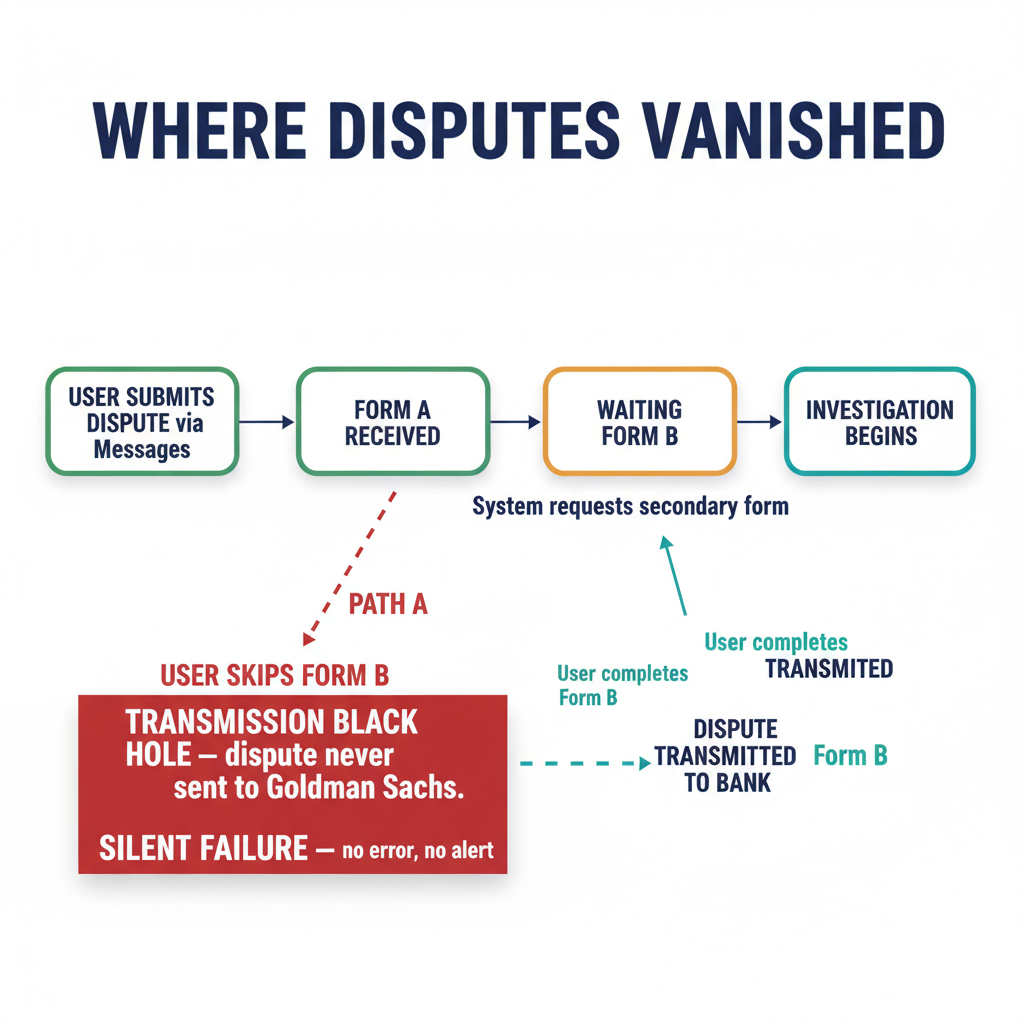
Then in June 2020, Apple updated the "Report an Issue" flow. The new design asked consumers to complete a secondary form after their initial dispute submission. When users submitted a complaint through Messages but skipped the second form, the system simply... stopped. It didn't transmit the dispute to Goldman. It didn't flag an error. It didn't alert anyone.
Tens of thousands of valid disputes under the Truth in Lending Act (TILA) vanished into what we call a transmission black hole. Goldman never investigated them. Consumers were held responsible for unauthorized charges. The CFPB's breakdown of penalties tells the story:
Goldman Sachs: $45 million in civil penalties, $19.8 million in consumer redress
Apple: $25 million in civil penalties
Total: $89.8 million
This wasn't a novel attack vector. It was a logic error in a distributed state machine that no one caught because no one formally checked.
Why Does "Best-Effort" Automation Keep Failing?
The instinct after a failure like this is to add more monitoring, more alerts, more dashboards. But the Apple Card bug existed in the gap between two organizations' systems. Traditional rule-based automation fails when it encounters an unexpected state -- like an incomplete form that the logic never accounted for. The system doesn't crash. It just silently does nothing.
The emerging alternative -- wrapping a large language model (LLM) around the problem with a massive prompt stuffed with documentation -- introduces a different failure. LLMs predict plausible responses. They don't guarantee correct ones. In a dispute resolution workflow, that means an AI might hallucinate a dispute status or fabricate a policy detail that sounds right but violates federal lending law.
The most dangerous systems aren't the ones that fail loudly. They're the ones that fail silently and look like they're working.
We explored this gap in depth in our interactive analysis. Neither the legacy approach nor the wrapper approach addresses the core problem: you cannot test your way to correctness in a distributed system. You have to prove it.
How Does Formal Verification Catch Bugs Before They Ship?
Formal verification uses mathematical proofs to guarantee that a system's behavior matches its specification. Think of it like this: testing checks a thousand paths through your code. Formal verification checks every possible path, including the ones nobody thought of.
Our framework models financial workflows as distributed state machines using tools like TLA+ and Imandra. TLA+ is a specification language that lets us define every valid state a dispute can occupy and every valid transition between states -- essentially a blueprint that says "these are the only things the system is allowed to do." A model checker then exhaustively simulates thousands of possible behaviors -- network failures, user drop-offs, concurrent updates, partial completions.
Applied to the Apple Card system, TLA+ would have found the bug in seconds. It would have generated a trace showing: user submits a message, dispute status changes to "Waiting for Form," user never completes the form, and the bank ledger never records a pending investigation. That violates the safety property that all submitted disputes must be investigated. The design gets flagged as unsafe before a single line of production code is written.
Every path. Every edge case. Every sequence of events a human tester would never think to try -- checked mathematically before deployment.
Imandra extends this into production. It runs a verified "digital twin" of the compliance logic alongside live code. If the production system attempts something the verified model doesn't allow -- like dropping a dispute because of a UI error -- it generates a counterexample and blocks the action in real time.
What Happens When You Can't Rip and Replace?
The obvious objection: "We can't rebuild our systems from scratch." Of course not. Goldman Sachs runs on legacy COBOL mainframes -- systems built in a decades-old programming language that still powers most of the world's banking transactions -- that were never designed for real-time, natural-language-driven transactions. Ripping and replacing core banking infrastructure is a fantasy.
Our deployment model works as an intelligent layer over legacy systems, phased over 18 to 36 months. The first phase catalogs existing APIs and data schemas to identify technical debt and synchronization bottlenecks. A parallel processing phase runs AI agents in "shadow mode," validating mainframe outputs without disrupting live workflows. The full transition shifts routine case handling to autonomous agents while preserving zero-downtime guarantees.
The Apple Card failure was the result of compressing this kind of rigor into a 90-day launch window driven by a penalty clause. The engineering wasn't wrong in concept. It was wrong in timeline.
How Do Multiple AI Agents Prevent a Single Point of Failure?
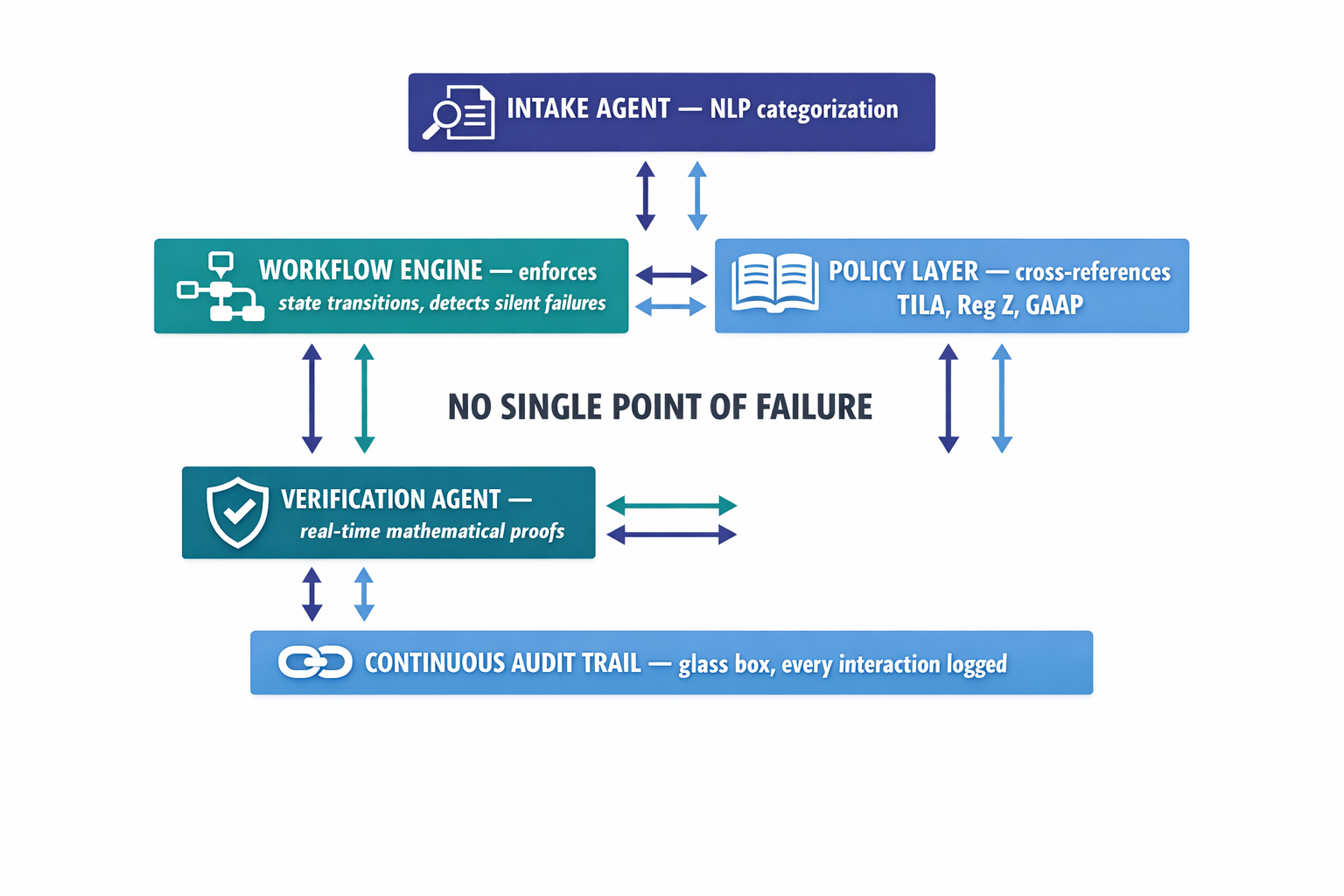
A single monolithic AI processing disputes is a single point of failure -- the same architectural mistake Apple and Goldman made. Our framework uses a multi-agent system (MAS) where specialized agents handle distinct responsibilities with defined boundaries.
The process begins with intake, where natural language processing categorizes each dispute as it arrives. From there, a dedicated workflow engine enforces the correct sequence of operations, watching for exactly the kind of silent failures in state transitions that sank the Apple Card. Every action is simultaneously cross-referenced against TILA, Regulation Z (the federal rule implementing the Truth in Lending Act for credit card billing disputes), and GAAP (Generally Accepted Accounting Principles — the standard rules for financial reporting) requirements by a policy layer that flags conflicts before they propagate. Running in parallel, a verification component executes real-time mathematical proofs to confirm that a proposed resolution doesn't violate any compliance invariant. And threading through all of it, a continuous audit trail records every agent-to-agent interaction, creating what we call a glass box -- the opposite of the opaque system the CFPB criticized.
If Apple's UI form had failed in this architecture, the workflow engine would have detected that a dispute remained in "Form A Submitted / Form B Pending" status for more than 24 hours. It would have evaluated whether Form A alone constituted a valid Billing Error Notice under TILA. If valid, it would have packaged and transmitted the dispute through a verified API. If not, it would have triggered a proactive communication to the consumer. Either way, the 60-day resolution window would never have been missed.
For the full technical methodology behind this architecture, see our detailed research.
Time Is a Legal Requirement, Not a Performance Metric
Regulation Z doesn't just say banks must resolve disputes. It says they must do so within specific timeframes. A significant portion of Goldman's fine came from failing to send acknowledgment notices within legally required periods.
Traditional monitoring tools tell you if a system is slow right now. They don't tell you if a system will be slow under a 10x spike in dispute volume or a new regulatory regime. Our framework uses a methodology called Performal to set mathematically proven upper bounds on worst-case processing time. If a code change -- like adding a secondary form to a dispute flow -- increases the worst-case processing time beyond the regulatory limit, the deployment is automatically rejected by the CI/CD pipeline (the automated build-test-deploy system that pushes code to production) before it reaches production.
"But Does This Actually Prevent Fines?"
The Apple Card failure was predictable and preventable. Every technical root cause the CFPB identified maps to a specific architectural control:
Sentinel agents monitoring state transitions catch silent transmission failures before they propagate. Formal verification flags logic errors in distributed state machines at design time, long before deployment. The architecture also bakes in symbolic latency bounds that prevent missed regulatory deadlines by construction. And where the original system made decisions opaquely, full audit trails of every agent action and data source now make the reasoning transparent end to end.
The financial case is straightforward. Goldman Sachs paid $64.8 million. Apple paid $25 million. The reputational damage continues. A phased AI-native integration costs a fraction of that and transforms dispute resolution from a linear scaling problem -- double the transactions, double the staff -- into a computational one.
The question isn't whether you can afford to build provably correct systems. It's whether you can afford not to.
What This Means for Your Team
If you're leading technology or compliance at a financial institution, the Apple-Goldman case is a template for what regulators will scrutinize next. The CFPB didn't just fine the bank. They fined the technology partner. That precedent changes the risk calculus for every fintech partnership.
Three things worth evaluating now: Can you trace every consumer dispute from submission to resolution with no gaps? Can you mathematically prove your system will meet regulatory deadlines under peak load? And when your next feature update ships, is anyone formally verifying that it doesn't break an existing compliance guarantee?
If those questions are uncomfortable, they should be. The era of "ship fast and patch later" in financial services ended on October 2024 with an $89 million invoice.
We'd welcome hearing how your organization is approaching these challenges -- especially the tension between launch speed and system integrity that sits at the heart of every fintech partnership.