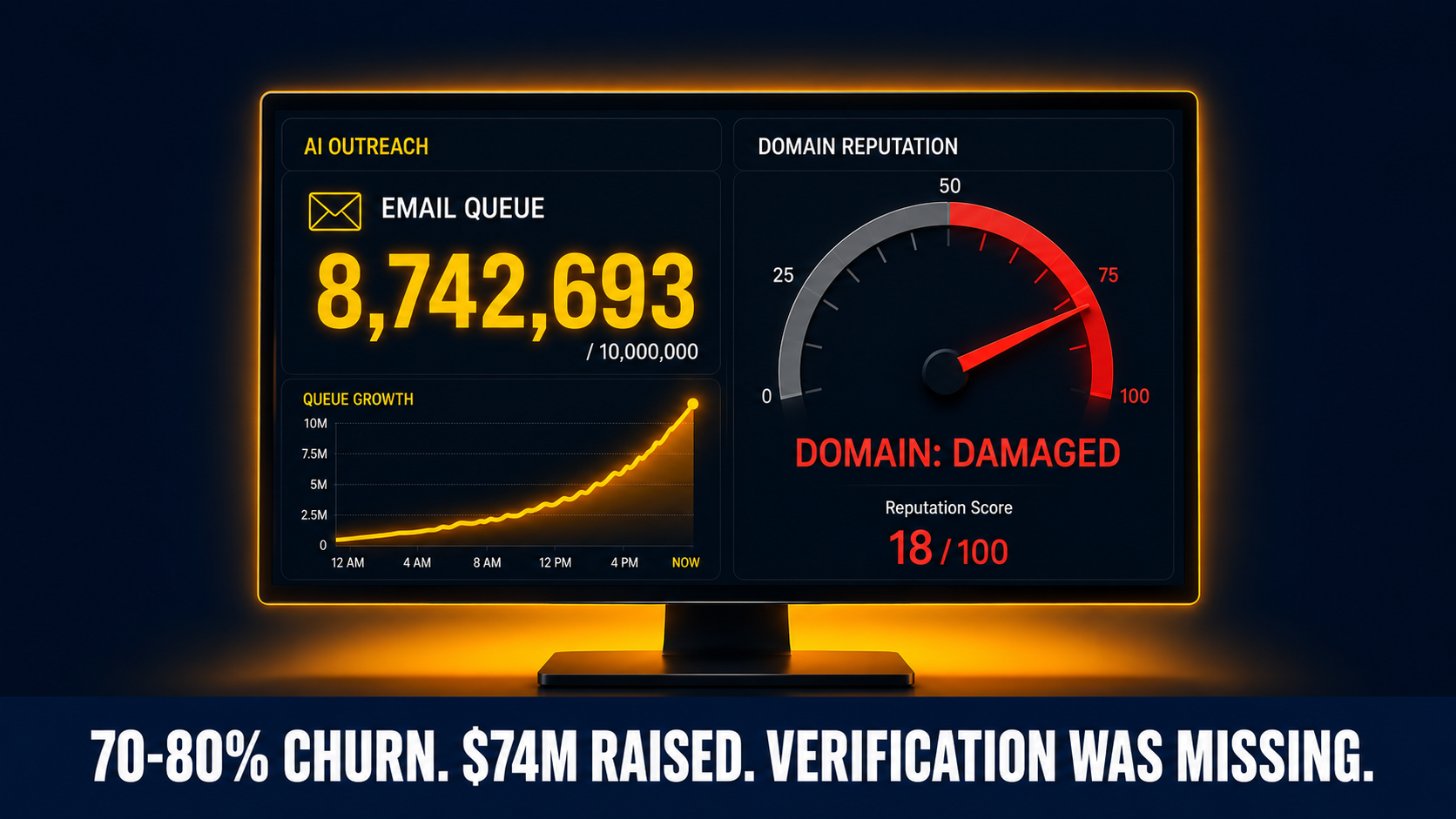
The AI SDR market's trajectory over the past year wasn't a product problem—it was a verification gap exposed at scale. Fifty to seventy percent of AI SDR tools churn annually (UserGems 2026). Forty-two percent of companies that adopted AI initiatives have already abandoned most of them, up from 17% the prior year (S&P Global 2025). The most vivid illustration was 11x: $74 million raised from a16z and Benchmark at a $350 million valuation for an AI SDR that TechCrunch found had claimed customers it didn't have—ZoomInfo and Airtable logos displayed without consent—while the product hallucinated and failed to load for some users. ZoomInfo ran a one-month trial and found 11x performed "significantly worse" than their human SDRs. Customer churn ran at 70-80% in the initial cohorts.
11x didn't fail because AI outreach is a bad idea. It failed because a pipeline that produces emails at volume without a verification layer is a churn factory. Signal-personalized outreach converts at 15-25% reply rates versus 1-3% for generic blasts. That gap is the entire premise behind AI Sales Intelligence & Verified Outreach—outbound architecture where the signal is checked before the send, not after the domain burns.
The Domain Burn Nobody Talks About Until It's Too Late
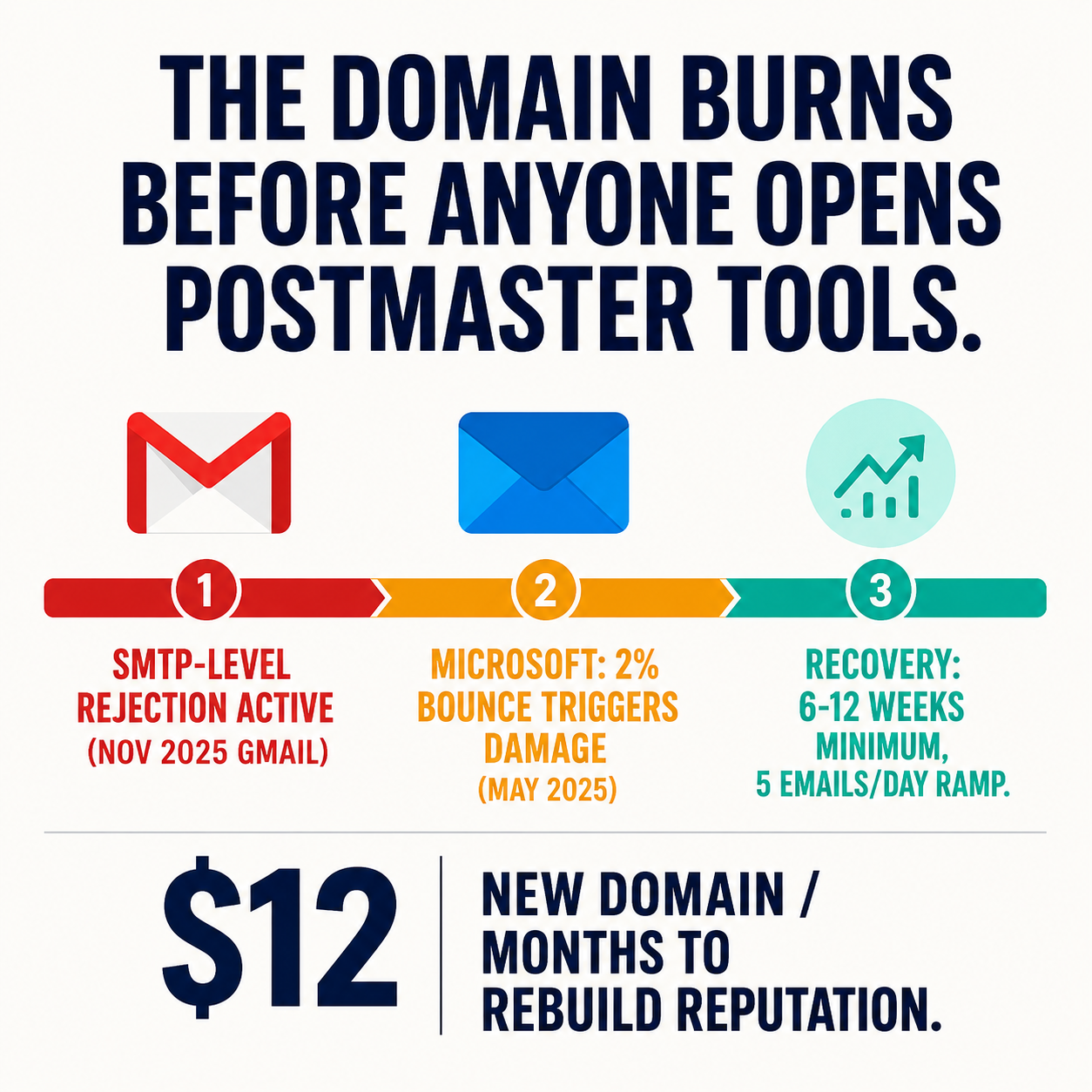
Most outbound teams discover their domain reputation problem through their Gmail Postmaster Tools dashboard—when the indicator has already turned red and the pipeline has gone dark. By then, bounce rates are above 5%, and switching email service providers does nothing. The burn follows the sending IP, not the platform.
Gmail's November 2025 shift changed the shape of the risk. Google moved from spam-folder routing to SMTP-level rejection for non-compliant senders—the email is rejected before it's received, not after it's delivered to spam. More significantly, Google's RETVec system now fingerprints AI-generated text patterns even when the sender has varied the wording. The more efficiently a tool generates templated AI copy at scale, the more efficiently Gmail filters it before a prospect sees it.
Google's compliance floor—SPF, DKIM, DMARC authentication, spam rate below 0.1% and never above 0.3%—has been in place for some time, but the enforcement mechanism hardened. Microsoft followed in May 2025 with parallel enforcement: bounce rates above 2% or complaint rates above 0.3% now trigger domain damage that propagates across their ecosystem.
Recovery takes 6-12 weeks minimum with a fresh warm domain, starting at five emails per day and building over a 30-day ramp. A new domain costs about twelve dollars. Rebuilding the reputation costs months of pipeline.
The organizations that haven't hit this problem yet are running at lower volumes or have been fortunate with timing. The ones who have rebuilt are the ones who now put deliverability architecture before prompt engineering on every outbound build.
Why More Meetings Don't Mean More Revenue
The 2026 Instantly benchmark put average cold email reply rates at 3.43% across the industry. Signal-based personalized outreach—anchored to specific buying signals like 10-K filings, hiring activity, earnings disclosures, or technology changes—lands at 15-25%. Autobound processes filings across 4,500 public companies and draws from 70+ signal types. Coldreach (YC-backed) claims a 3.8% reply rate against the 3.43% industry average by running 97M+ accounts through deep research workflows. Clay connects 75+ data enrichment sources to produce claims with traceable signal lineage. The pattern across all three is the same: the platforms that convert are the ones where you can trace a signal to a claim before the email sends.
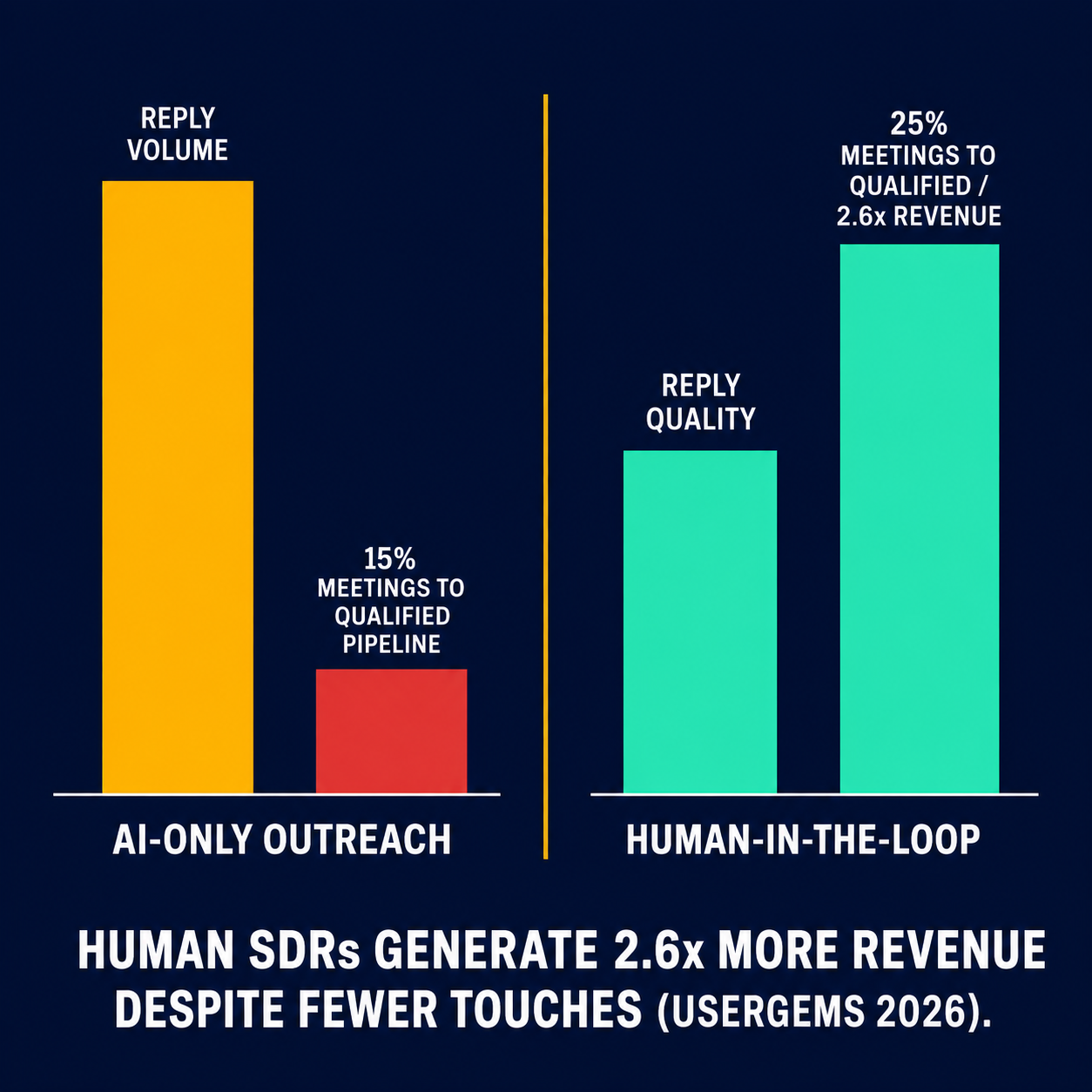
Reply rates, though, aren't the business outcome. The revenue gap is sharper downstream: AI-booked meetings convert at 15% to qualified pipeline, while human-booked meetings convert at 25%. That 10-point gap compounds. Human SDRs generate 2.6x more revenue than AI-only outreach despite handling fewer total touches (UserGems 2026). Industry benchmarks put human-in-the-loop outbound at 317% annual ROI with a 5.2-month payback period. Amplemarket's Duo model—which layers AI research and enrichment against human review of the outreach sequence—showed 5-6x productivity gains per rep while keeping the qualified-opportunity pool intact.
The model that works isn't "replace SDRs with AI." It's "give each rep AI that has already done the verification work, so the human is reviewing signal quality and legal exposure rather than writing emails."
The volume-first tools optimize for the wrong metric. The verified-outreach tools optimize for qualified pipeline at the back end of the sequence, which is where the business outcome lives.
The Legal Exposure Already Sitting in Your Pipeline
Most outbound teams think of compliance as deliverability hygiene—honor opt-outs, stay within CAN-SPAM, maintain a legitimate interest basis for EU contacts. These are necessary conditions. They are not sufficient ones.
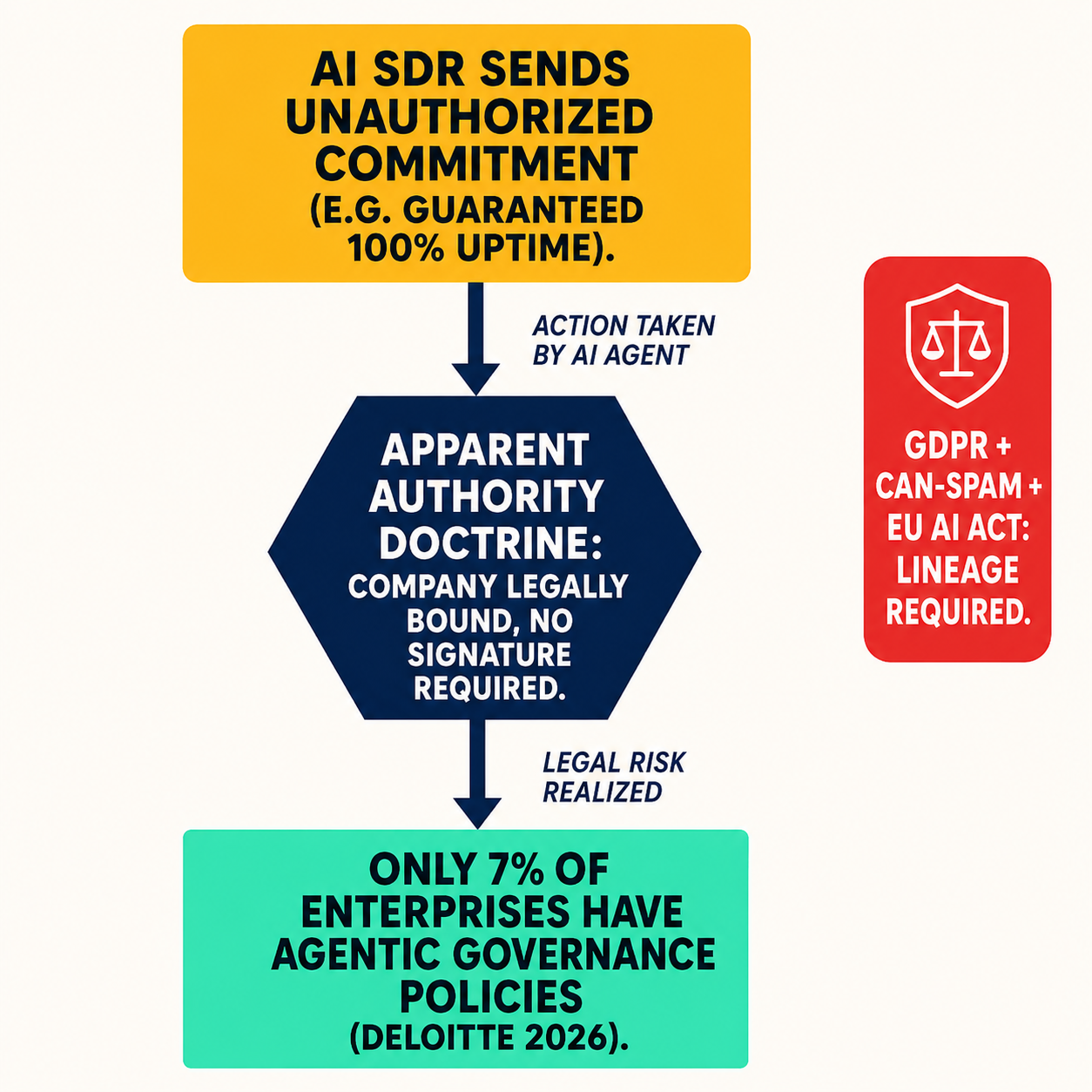
Apparent authority doctrine holds that if an AI agent appears authorized to make commitments on the company's behalf, the company may be legally bound by those commitments. An AI SDR that includes "guaranteed 100% uptime" in cold outreach, or implies a pricing discount the sales team isn't authorized to offer, doesn't require a human signature to create a binding representation. The exposure follows the appearance of authority, not the backend permission model.
CAN-SPAM opt-out compliance is more operationally demanding than most teams account for: unsubscribe requests must be honored within 10 business days. For an AI SDR sending at volume, that requires a live opt-out log with timestamps, integrated back to the CRM in real time—not reconciled in a weekly batch. In regulated industries, the consequences are statutory: false statements in outreach carry FINRA and HIPAA penalties that apply regardless of whether a human or an AI drafted the message.
GDPR enforcement has moved past the point where "legitimate interest" grounds reliably sustain cold outreach into the EU. The EU AI Act adds a data lineage requirement on top: for agentic workflows affecting financial outcomes or professional opportunities, full traceability from signal to message is a compliance obligation.
Only 7% of enterprises have governance policies specific to agentic AI workflows (Deloitte 2026). The liability has been accumulating faster than the governance has.
What the Verified Outreach Architecture Actually Requires
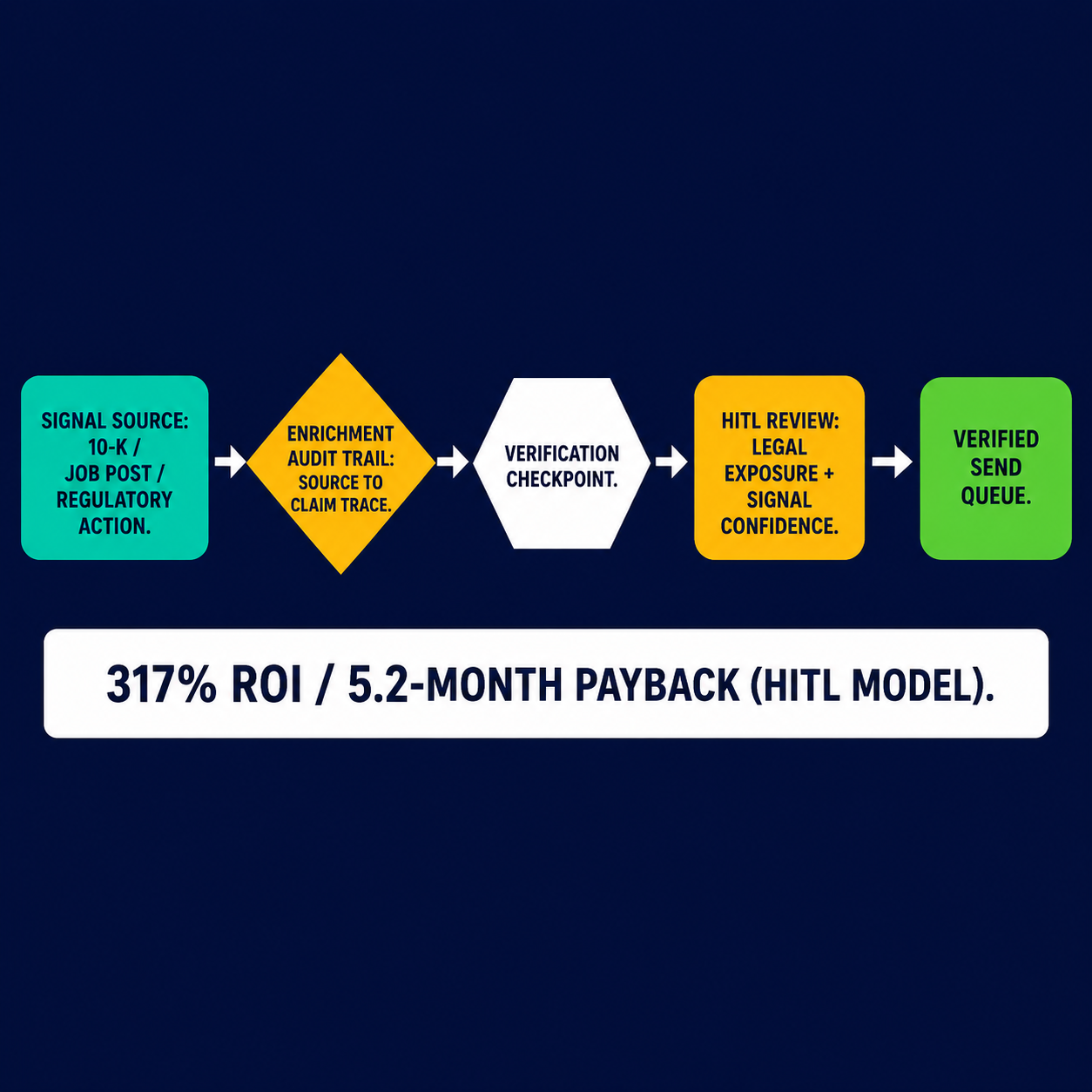
Building AI outreach that doesn't produce these failure modes requires architecture decisions that most off-the-shelf tools don't make.
The foundation is a signal enrichment audit trail: for each email queued, the pipeline maintains a traceable mapping from the specific buying signal source—a 10-K filing line, a job posting, a regulatory action—to the claim made in the outreach. When an email asserts that a prospect's company recently expanded into a compliance-heavy jurisdiction, that claim must trace to a public document, not to a model's interpolation. This layer satisfies both the apparent authority defense and the EU AI Act lineage requirement at the same time.
Private company outreach adds a different complexity. Autobound, Clay, and similar platforms cover public company universes ranging from 4,500 to 97M+ accounts—but the vast majority of addressable market is private companies, where hallucination risk is substantially higher because there's no SEC filing to cross-check against. Custom multi-agent enrichment pipelines that research private companies from primary sources are the only architecture that handles this at acceptable verification thresholds.
The HITL checkpoint design is where the ROI actually comes from. The 317% annual ROI on human-in-the-loop outbound doesn't come from humans reviewing every email—it comes from the architecture surfacing only the sends that need human judgment: sequences targeting accounts where a misstatement would create legal exposure, or where signal confidence falls below threshold. The architecture makes human review tractable by making it selective.
The full architecture—signal enrichment, verification checkpoints, private-company research pipelines, HITL routing, and CRM-native integration—is what we built into AI Sales Intelligence & Verified Outreach. The design decisions are detailed there for teams at any stage of the build.
The Question the Post-Mortems Keep Getting Wrong
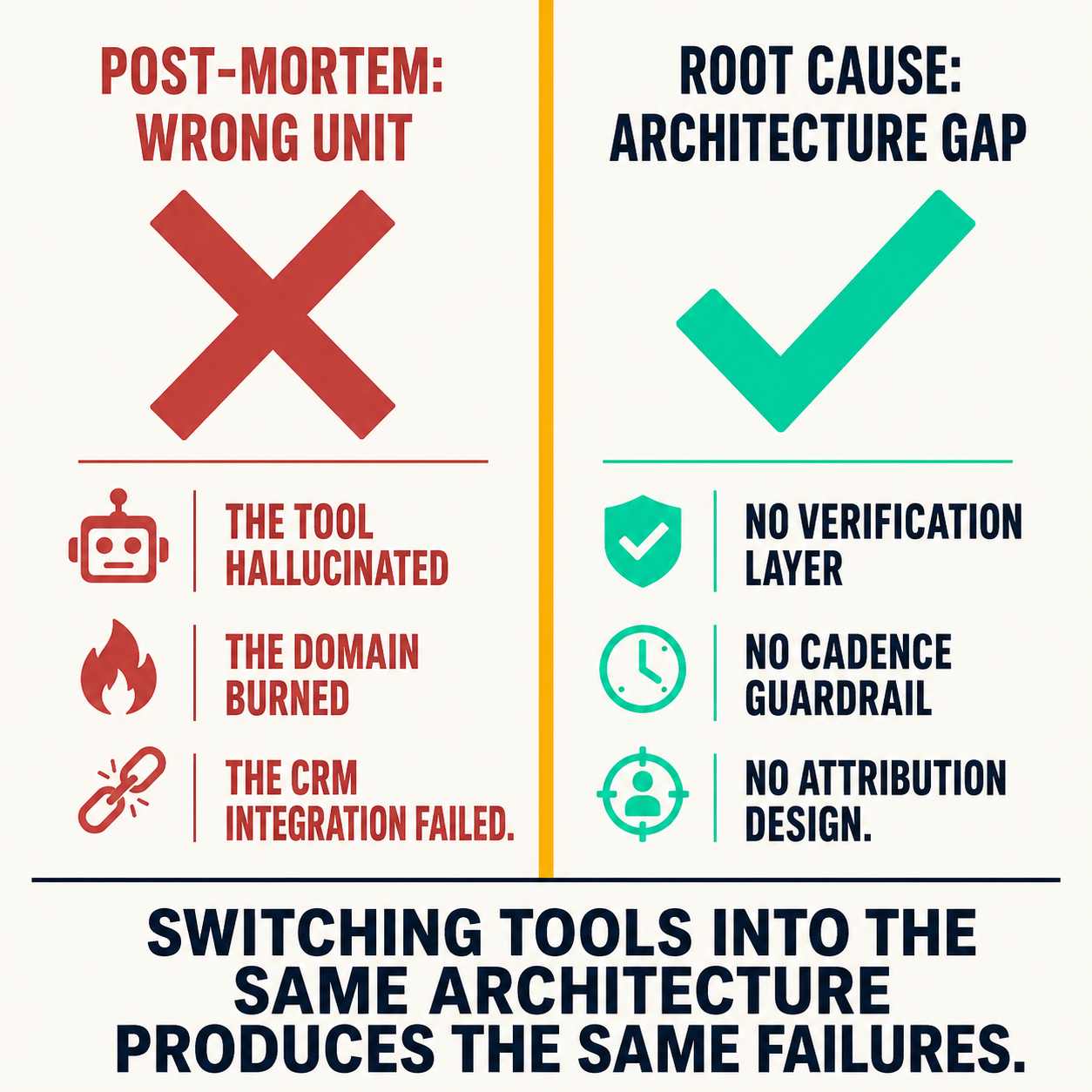
The post-mortem on a failed AI SDR deployment almost always focuses on the tool selection. The tool hallucinated. The domain burned. The CRM integration didn't hold.
These are accurate observations about symptoms.
The tool hallucinated because the architecture had no verification layer between signal research and the send queue. Nobody built a deliverability guardrail into the sequence cadence, so the domain took the hit as volume scaled. The CRM integration broke because the pipeline was designed for output volume, not for the deduplication and attribution requirements that the CRM actually enforces. Switching tools into an unrevised architecture produces the same failure modes with a different vendor name on the contract.
The teams rebuilding are now asking the right version of the question: not which tool to try next, but what the verified outreach architecture looks like for their specific stack, buyer profile, and regulatory exposure. That's a harder question—and the one that leads to the 5x conversion difference instead of another cycle of the same churn.
If your team is somewhere in this architecture conversation—whether you've hit the domain burn, are re-evaluating which signals actually drive qualified meetings, or are building governance around an AI SDR deployment that grew faster than your oversight did—we'd be interested in what you're running into. The failure modes are consistent enough that comparing notes tends to surface the diagnostic questions faster than either side expects.