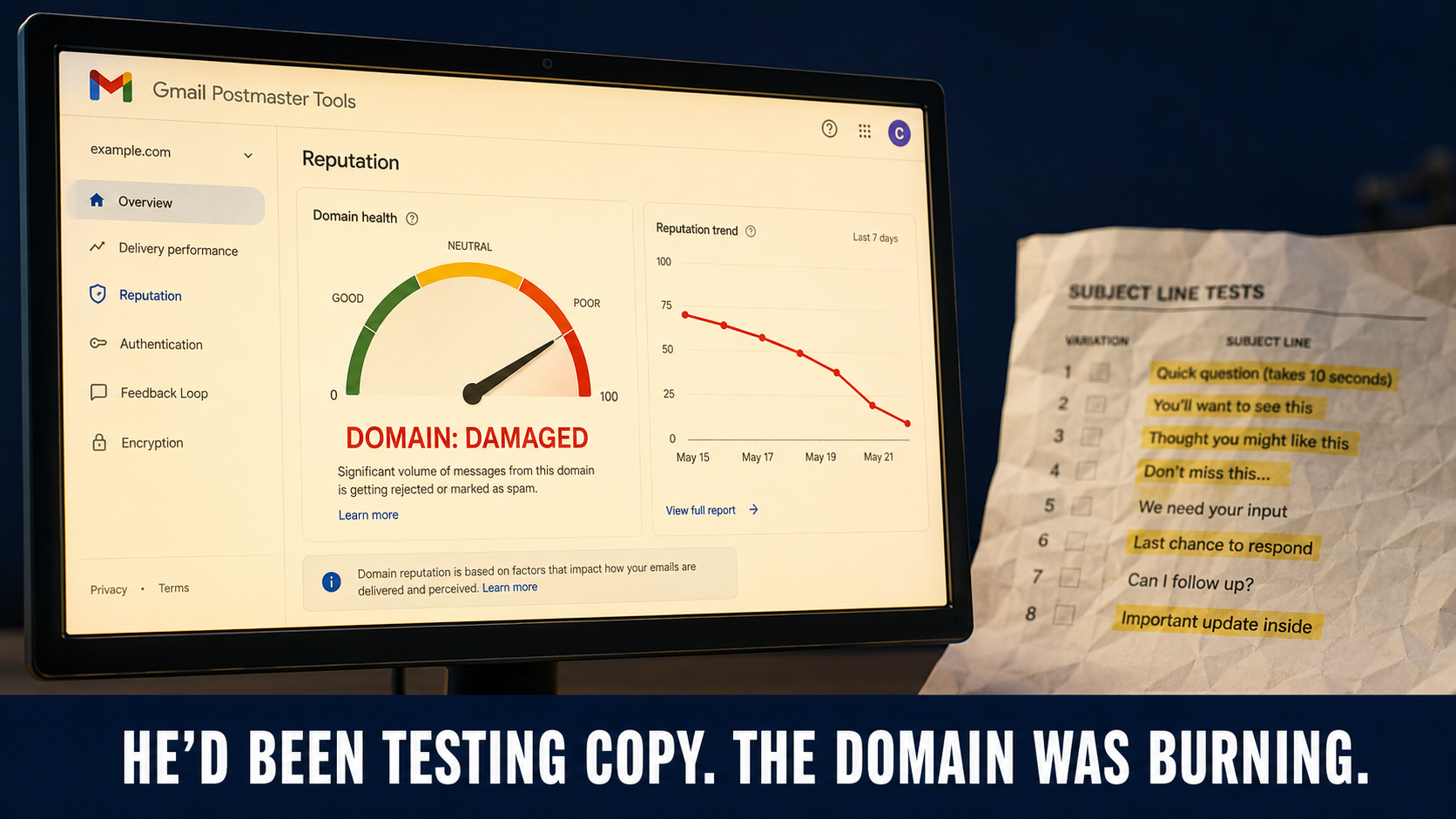
My introduction to AI outbound failure wasn't reading about it — it was watching a client's Gmail Postmaster Tools dashboard with a sales VP who'd spent six weeks testing copy variations because he thought falling reply rates were a messaging problem. What I was actually looking at was a domain reputation indicator that had been yellow for a month and gone red sometime in the prior week. The pipeline wasn't underperforming. It was being rejected at the SMTP level before anyone's inbox registered the attempt.
The pipeline had a verification gap. Every email the AI SDR produced was going straight from generation to send queue, with no check on whether the signal was real, whether the claim in the body traced to a source, or whether the send rate was burning the domain. The tool was doing exactly what it was designed to do. The architecture had failed.
The Number Everyone Missed in the 11x Story
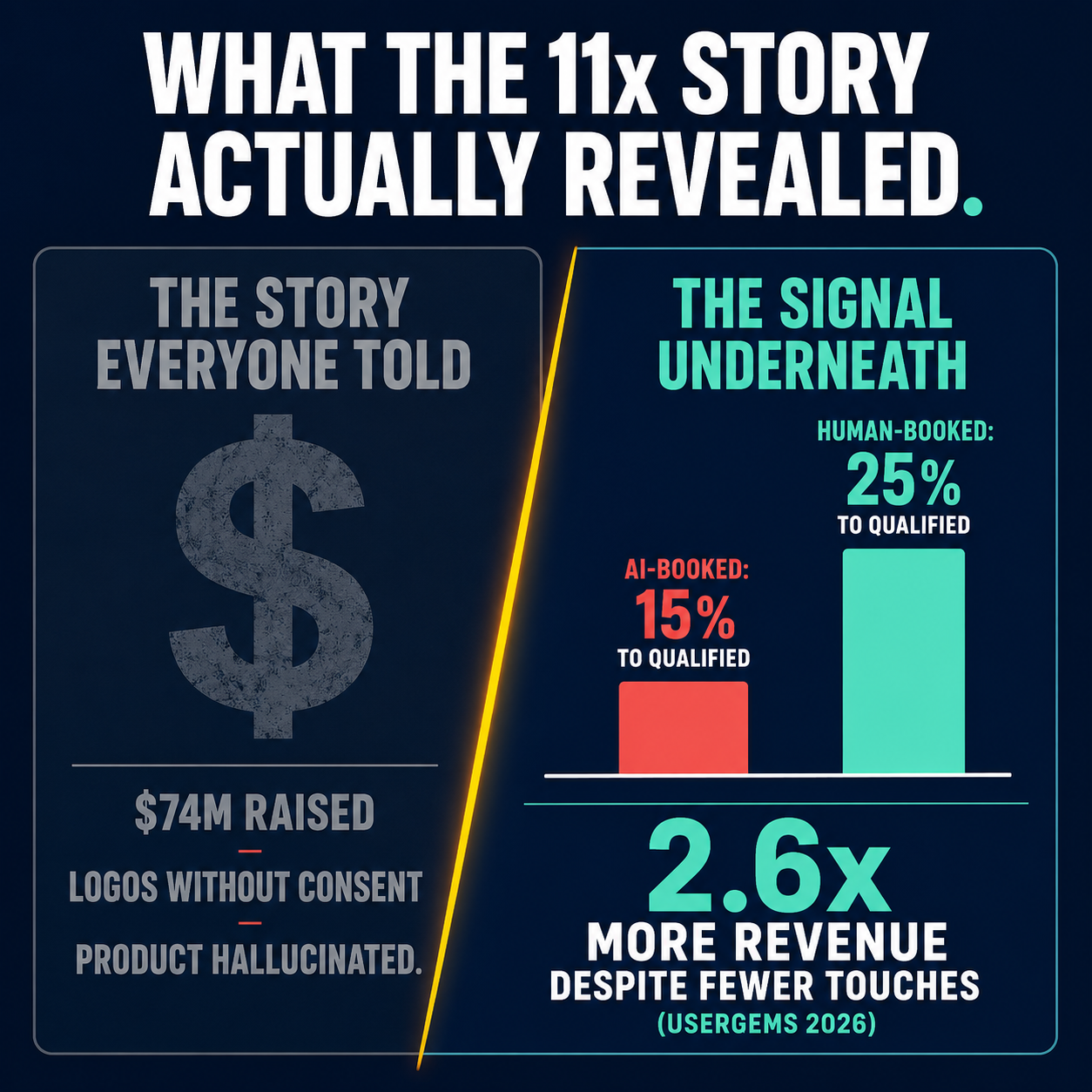
I read the TechCrunch piece on 11x the week it ran. The headline was about the fraud — $74 million raised from a16z and Benchmark at a $350 million valuation, ZoomInfo and Airtable logos displayed without consent, a product that hallucinated and failed to load. The tech media framed it as another AI-hype bust.
What I couldn't stop thinking about was the ZoomInfo trial data: one month, real accounts, "significantly worse than human SDRs" by ZoomInfo's own assessment. Seventy to eighty percent churn in 11x's initial customer cohorts. The fraud was real, but the signal underneath was bigger than the fraud: AI-booked meetings convert to qualified pipeline at 15%, while human-booked meetings convert at 25%. Human SDRs generate 2.6x more revenue despite handling fewer total touches (UserGems 2026). That downstream conversion gap was the story, and almost no one was writing about it.
Signal-personalized outreach converts at 15-25% reply rates. Generic AI blasts land at 1-3%. The difference isn't which AI SDR platform you chose. It's whether the signal was real and whether someone checked it before the send. 11x was optimizing for email volume. The market was trying to say something structural, and most people heard "that vendor was bad" instead of "that architecture design was wrong."
When I looked at the 11x story as an architecture failure rather than a fraud story, a lot of the rest of the AI SDR market started making more sense to me — including the 50-70% annual churn rate across the category as a whole (UserGems 2026).
The Question That Changed What I Built
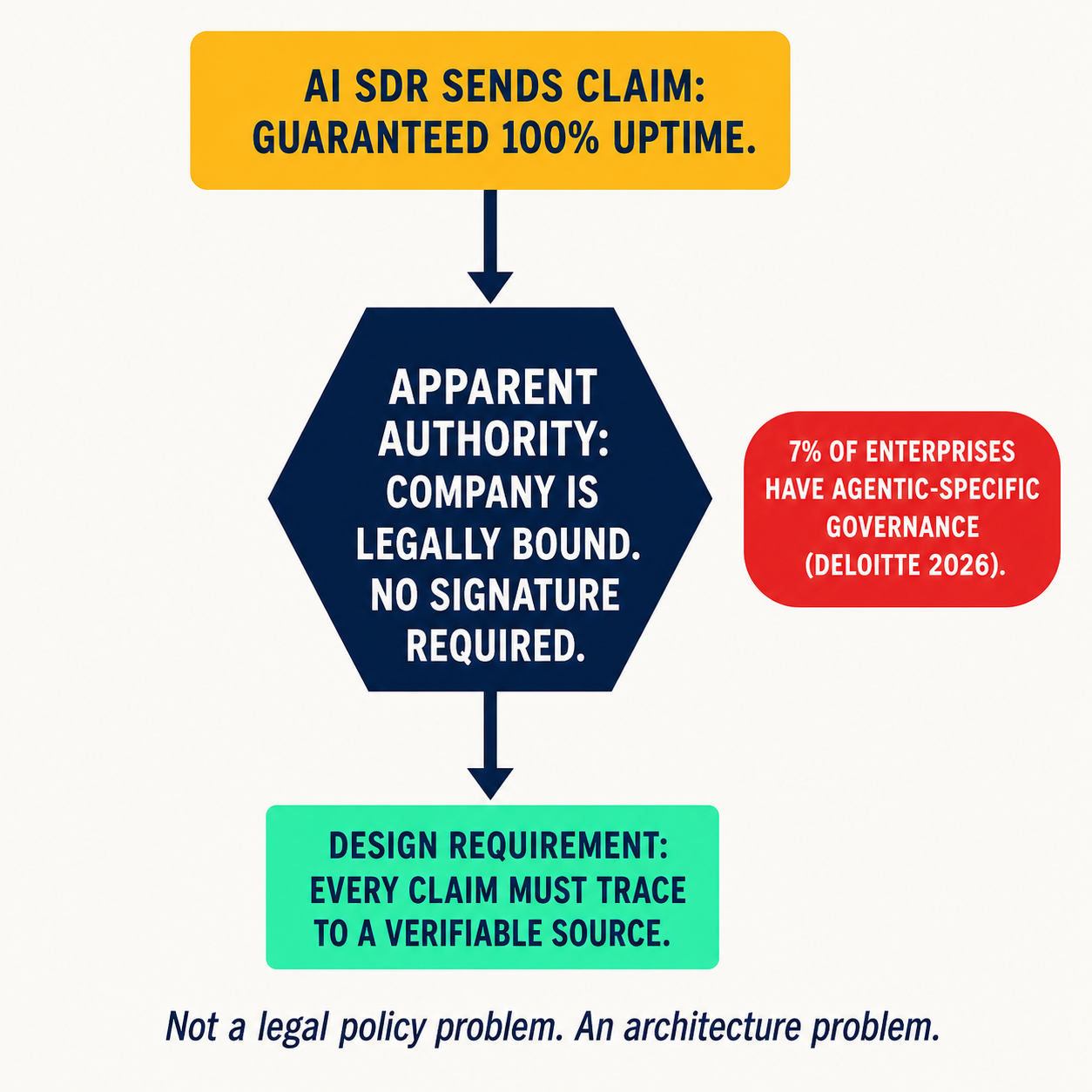
About a year into this work, I was in a review meeting about a client's AI SDR deployment when their general counsel came in for the last half hour. The question she asked — which I didn't have a clean answer to in the room — was whether the AI could legally bind the company to a pricing commitment if the email included a discount or a promise the sales team wasn't authorized to make.
I knew enough about apparent authority doctrine to know the answer was probably yes. What I hadn't thought through was the architectural implication. The doctrine holds that if an agent — AI or otherwise — appears authorized to make commitments on the company's behalf, the company can be bound by those commitments. The exposure follows the appearance of authority, not the backend permission model. An AI SDR that sends "guaranteed 100% uptime" as a claim in cold outreach doesn't need a human signature to create a binding representation.
That realization restructured my thinking about what "governance" meant for an AI outreach pipeline. What the general counsel was pointing at wasn't a legal policy question — it was a design requirement that had to be built into the pipeline itself. Every claim the AI generates, before it reaches the send queue, has to trace to something the company is actually authorized to say. That's not a lawyer's problem. That's an architecture problem.
Deloitte's 2026 research put only 7% of enterprises with governance policies specific to agentic AI workflows. The other 93% have the liability and the emails going out, with no layer between them.
What I Actually Built After That Meeting
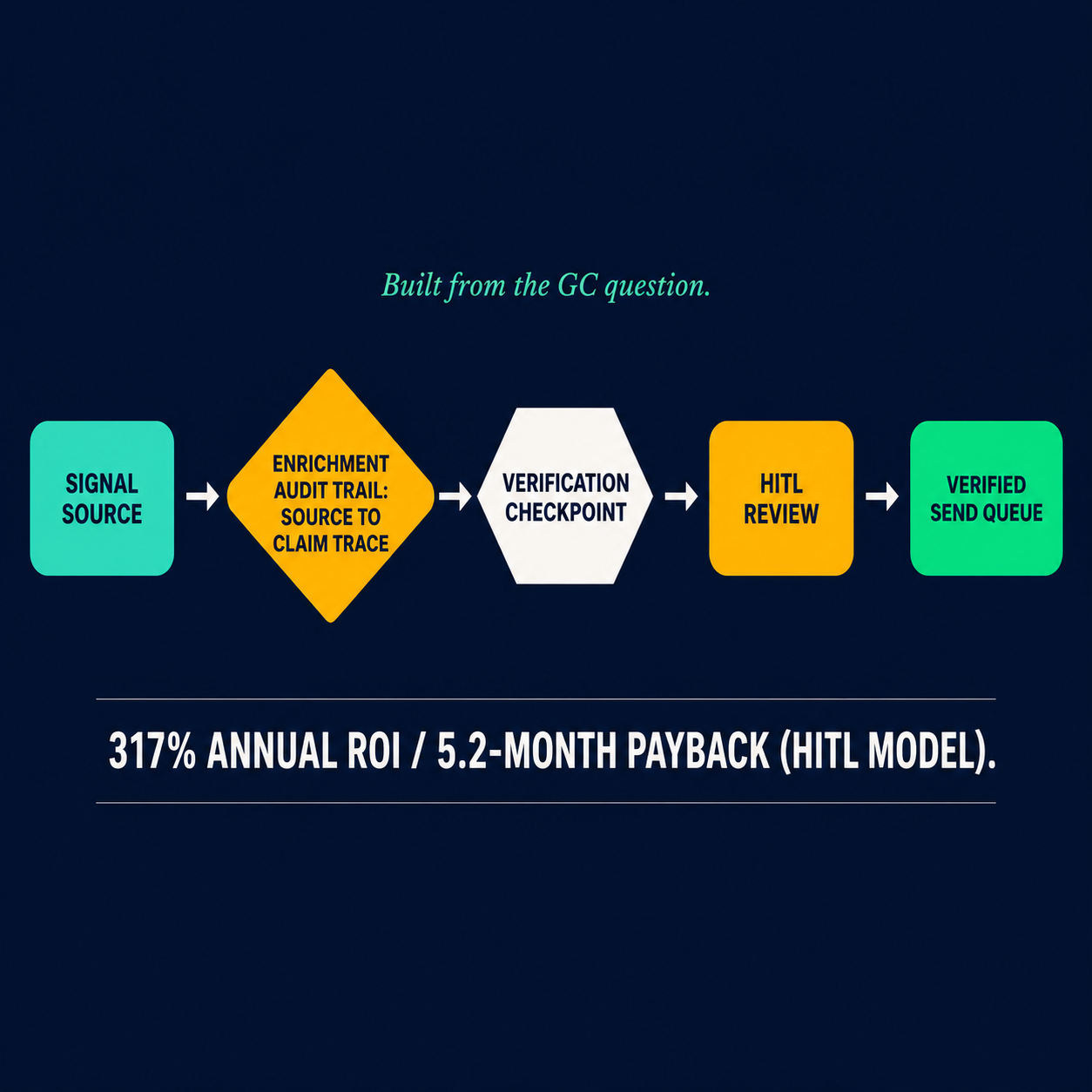
The AI Sales Intelligence & Verified Outreach system I built at Veriprajna starts from that general counsel conversation. Not from "how do we send more emails" but from "how do we make every claim in every email traceable to something verifiable."
The foundational layer — the one that took the most iteration to get right — is a signal enrichment audit trail. For every email queued, the pipeline maintains a mapping from the specific source (a 10-K filing line, a job posting, a regulatory action) to the claim in the outreach. When an email says a prospect's company recently expanded into a compliance-heavy jurisdiction, that claim has to trace to a public document, not to a model's interpolation. This is the layer that satisfies the apparent authority question and the EU AI Act's data lineage requirement at the same time.
Private company enrichment is where I've spent the most iteration time. Tools like Autobound cover 4,500 public companies across 70+ signal types; Coldreach runs 97M+ accounts through deep research workflows. But the vast majority of any outbound target list is private companies — and there's no 10-K to cross-check against. The hallucination risk is substantially higher, and what I've found is that the only architecture that handles it at acceptable error rates is custom multi-agent pipelines that research companies from primary sources, not from model interpolation.
That's why the human-in-the-loop checkpoint turned out to be where the economics close. Industry data puts human-in-the-loop outbound at 317% annual ROI with a 5.2-month payback period. Amplemarket's Duo model showed 5-6x productivity gains per rep while keeping qualified-opportunity conversion intact. The model that works isn't "AI replaces the SDR." It's "AI does the verification work so the human is reviewing signal quality and legal exposure rather than writing emails." The HITL layer doesn't slow the pipeline — it's what recovers the 10-point conversion gap between AI-booked and human-booked meetings.
What I Tell Clients Who've Already Burned a Domain
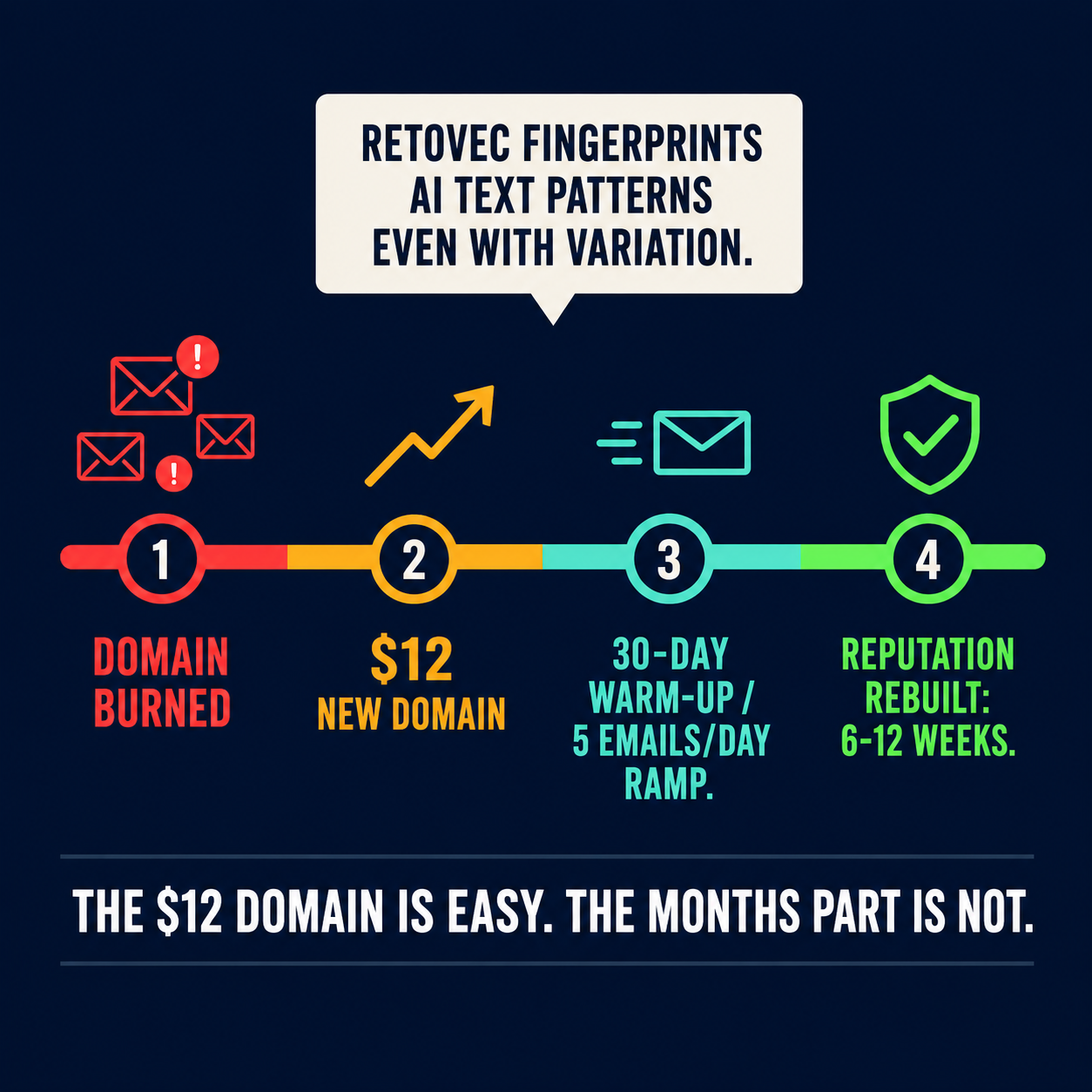
I hear about domain burns weeks after they happen, which is the nature of it — the Gmail Postmaster Tools dashboard goes red, someone notices reply rates have collapsed, and then the post-mortem conversation starts.
Recovery takes 6-12 weeks minimum with a fresh warm domain — something I've walked clients through enough times to know that the twelve-dollar fresh domain is always the easy part; the pipeline rebuilds in months. Google's November 2025 shift to SMTP-level rejection made the damage faster to accumulate: non-compliant emails are refused before being received, not routed to spam. The ReTVec system fingerprints AI-generated text patterns even with variation, which means the more efficiently an AI SDR generates volume, the more efficiently Gmail rejects it. Microsoft followed in May 2025 with parallel enforcement — bounce rates above 2% or complaint rates above 0.3% trigger domain damage across their ecosystem.
What I've come to understand from working through these post-mortems is that the root cause is almost never the tool that gets blamed. The tool generated emails at volume. The domain burned because nobody built a cadence guardrail into the sequence or a deliverability ceiling into the send queue. The fix isn't a different tool. It's an architecture that treats domain health as a first-class constraint alongside signal quality and legal exposure.
The real test of a verified outreach architecture isn't reply rates in week one. It's whether the domain reputation dashboard is still green in month six, and whether the qualified-pipeline rate from AI-booked meetings is closing in on what your human reps produce.
The full architecture — signal enrichment audit trail, private-company research pipelines, HITL routing, and CRM-native integration — is documented at AI Sales Intelligence & Verified Outreach for teams further into the build.
The question I find most interesting to think through now: as Gmail's Gemini AI layer increasingly summarizes and filters emails before a recipient sees them, the economics of outreach may shift further toward "did this message earn its way past the AI summarizer" rather than "did it land in the inbox." The verified-signal angle — a claim traceable to a primary source — may be the only thing that reads as worth surfacing to a human reader, whether the filter is a spam algorithm or an AI assistant deciding what's worth their boss's attention.
I don't have a confident answer on how that unfolds. But I think the teams that built the verification layer now are the ones who will adapt fastest when it does.