At 06:18 in our synthetic trading replay, TECHX and EMFX orders require approval while UTIL and GOLD orders remain allowed. A trading-control review needs to explain both outcomes: why the gate includes those instruments, and why it leaves the others outside.
We built AlgoTier around that requirement. For algorithmic trading compliance and market-risk teams, the useful unit of review is a decision with its inputs, rule evaluations, scope and order outcomes attached. A control label alone leaves too much reconstruction work to the person investigating it.
The AlgoTier walkthrough follows a fixed synthetic replay. Its market observations and sample orders are illustrative. They let us show the control mechanism precisely without presenting a customer deployment or a record of executed trades.
Start with the orders, then follow the scope
The 06:18 decision selects GATE for NKY, TECHX and EMFX. The sample TECHX sell order and EMFX sell order display “Approval Required.” The UTIL buy order and GOLD sell order display “Allowed.” NKY belongs to the selected scope, although the sample blotter contains no NKY order.
That distinction makes the result inspectable. A reviewer can separate the instruments covered by the policy from the orders that happen to be in the example. They can also see that “Approval Required” is a recorded disposition. The demo has no approve/reject action, authenticated approver or execution connection.
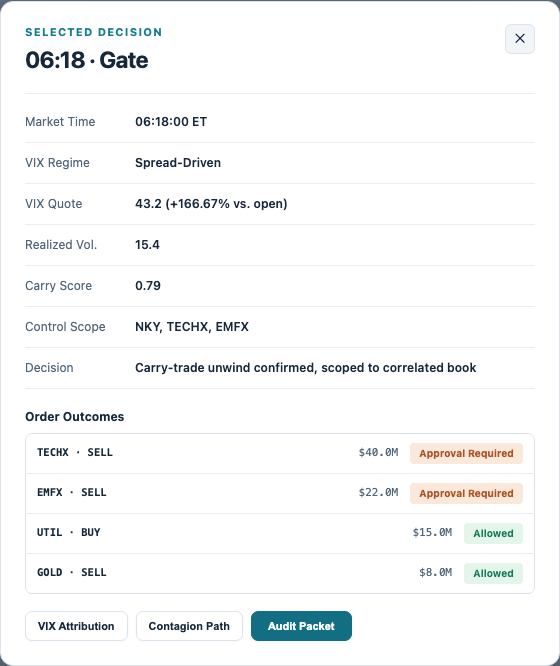 The synthetic 06:18 decision puts TECHX and EMFX under review while UTIL and GOLD remain allowed. The displayed carry score is rounded to 0.79.
We can trace the scope back to explicit assumptions. A fixed synthetic graph propagates a yen-shock input. Eligible instruments with stress at or above 0.25 enter the scope. At this observation, the computed stress values are 0.3979 for NKY, 0.3645 for TECHX and 0.2990 for EMFX. UTIL and GOLD each have zero stress in this fixture.
These are graph outputs under demonstrative assumptions. A risk team reviewing the design can challenge the edges, propagation settings or cutoff and understand which part of the selection it is challenging. The scope is recorded beside the consequence.
The same gate can have a different reason
The carry-unwind score at 06:18 is 0.7913 before display rounding. The policy's R2 rule triggers at 0.60 or above, so it proposes GATE for the affected scope. The VIX classifier also reports SPREAD-DRIVEN, which proposes THROTTLE through R1. Under the defined severity ordering, GATE wins.
That rule evaluation matters because the first gate already appeared at 06:17. The earlier carry-unwind score was 0.542: below the confirmed threshold, inside the 0.30 to below-0.60 ambiguity band. R3 deliberately required review in that band. The affected orders and scope were the same.
A review record should distinguish a gate caused by uncertainty from a gate supported by a confirmed policy threshold, even when the order outcomes match.
Here, “confirmed” means the synthetic score crossed the configured rule threshold. It does not establish that a market event has been independently validated. A reviewer can inspect the decision while keeping that distinction intact.
Earlier in the replay, THROTTLE applies across the book, including UTIL and GOLD. Their allowed status at 06:18 belongs to this scoped GATE decision; it is not a claim that those orders remain unaffected throughout the scenario. Recording each observation prevents the later, narrower control from erasing that history.
Keep the decision evidence together
Our reconstruction starts from the selected record. Its payload includes the market state, advisory scores and contributions, contagion data, all evaluated rules, selected control, simulated order dispositions and engine/scorer versions. Its configuration hash covers selected engine/scorer constants; it does not authenticate the complete deployment configuration.
The HTML Audit Packet gives a readable decision reconstruction. The JSON export also includes the order dispositions, which the HTML packet does not separately tabulate. Exporting the selected packet produces one record, so reviewing the full sequence requires more than that single download.
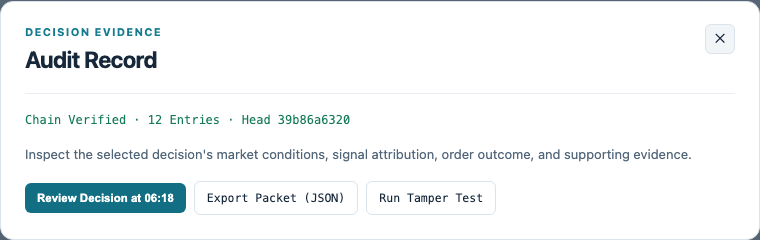 The unmodified chain verifies across all 12 synthetic replay entries. The review and export controls refer to the selected 06:18 decision.
Verification has a specific meaning here. Each in-memory entry contains its payload, the previous hash and a SHA-256 entry hash. Recomputing the chain can identify an altered payload whose stored hash has not been updated.
The controlled tamper exercise changes the selected record's tier from GATE to HALT while leaving its stored hash unchanged. Verification then reports an entry-hash mismatch at sequence 8, the zero-based identifier of the 06:18 decision.
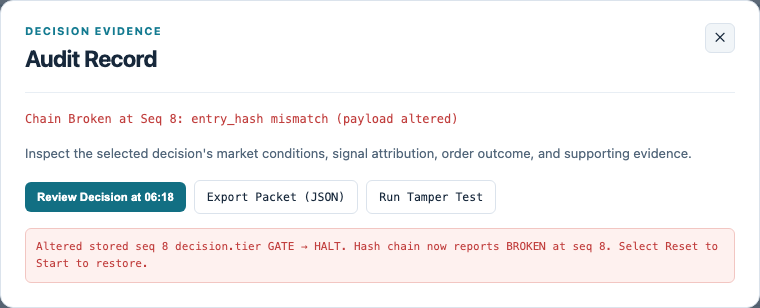 The controlled edit is localized to sequence 8. Reset to Start restores the demo after the exercise.
This is an in-memory, resettable audit mechanism. It does not provide durable retention or independent integrity anchoring, and it cannot establish protection against someone rewriting all records and hashes. Any illustrative regulatory-reference mapping in the packet requires legal validation. Neither the record nor its verified chain establishes legal sufficiency.
Review the boundary as well as the trigger
The engineering value of this example is that a reviewer can follow a held order back through the scope calculation and the rule that selected GATE. The same record explains why the other sample orders remain allowed at that observation. Uncertainty, policy assumptions and order consequences stay connected.
The full breakdown shows that path through the synthetic replay. For a review with trading, risk and engineering colleagues, we would put the 06:17 and 06:18 records side by side: the disposition stays the same while its justification changes. That is a concrete place to examine whether the policy captures the team's intended boundary for human review.