I start with the two green rows
I am looking at four synthetic trading orders at 06:18 ET: TECHX and EMFX require approval, while UTIL and GOLD are allowed. AlgoTier labels the selected control GATE. Reading that label alone, I cannot explain the split.
That is the review problem I want this demo to expose. A trading-control decision needs enough evidence to explain its boundary: why these orders are held, and why those orders are outside the hold. The green rows deserve scrutiny alongside the orange ones.
I can read the result directly in the Order Blotter. The synthetic TECHX sell order is $40 million; the EMFX sell order is $22 million. Both show Approval Required. The UTIL buy order, $15 million, and GOLD sell order, $8 million, show Allowed. These are illustrative orders in a fixed replay, with no real execution behind them.
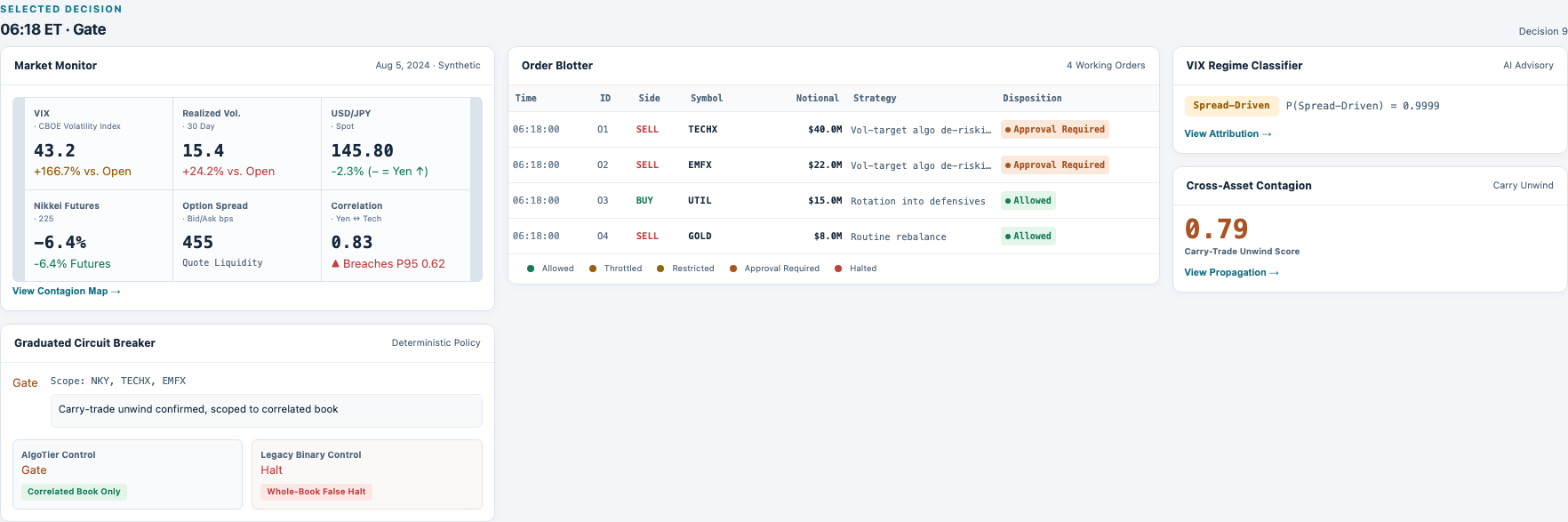
The selected synthetic decision puts the four order outcomes beside the market inputs and the scope of the gate. The adjacent Legacy Binary Control panel is a simplified illustrative comparator.
My first attempt to summarize the screen stops at “the control is gated.” It loses the information I am trying to understand. The scope names NKY, TECHX and EMFX. There is no NKY sample order, so the number of instruments in scope differs from the number of held orders. Even this small distinction disappears if I compress the decision into a single status.
I also have to resist turning the green rows into a general promise. Earlier in this replay, THROTTLE applies across the book. All four sample orders are throttled during that period, including UTIL and GOLD. Their allowed status belongs to this scoped GATE decision. It cannot support a claim that those instruments always trade normally.
The screen makes me state the engineering question more precisely. I need to reconstruct the selected decision at its selected time, including the orders it leaves outside the control.
I follow the boundary back to the rule
I open the 06:18 decision details because I want to keep the outcome in view while reading its explanation. The dialog places the market state, control scope, rationale and order outcomes together. I can follow the same decision into its attribution, contagion path and Audit Packet.
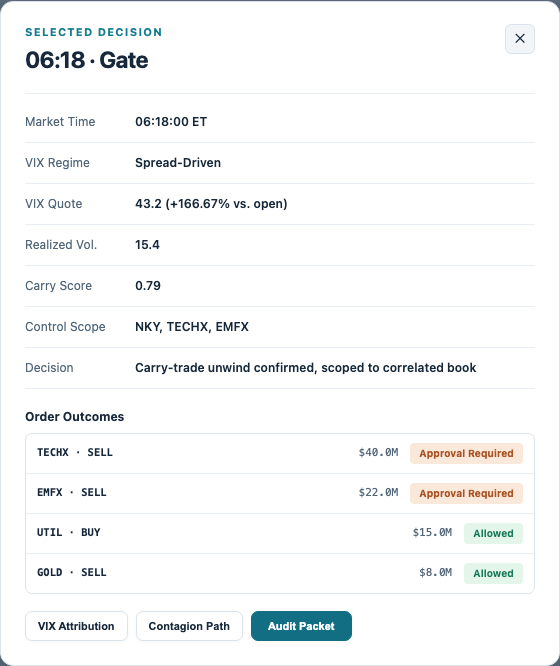
The detail view keeps the confirmed-carry rationale and the split order outcomes attached to the selected 06:18 decision.
I read the displayed carry-unwind score of 0.79 against the underlying record's 0.7913. Rule R2 uses a threshold of 0.60 for the confirmed carry condition and proposes GATE for the stressed scope. That gives me a specific policy choice to inspect. A high score by itself would leave the action unexplained.
Then I work backward through the scope. The demonstration uses fixed synthetic graph edges and a stress cutoff of 0.25. At this observation, NKY has stress 0.3979, TECHX 0.3645 and EMFX 0.2990. UTIL and GOLD have zero. Those values explain how this fixture enters the selected scope; they also show me which assumptions a reviewer could challenge.
I would want that challenge to be possible even when the order outcomes look sensible. The graph is a transparent stand-in, and its edges and cutoff are demonstrative choices. Seeing a plausible boundary on a screen does not validate those choices against actual markets. My confidence in being able to inspect the calculation must stay separate from confidence in its suitability for deployment.
Reading across the record, I can distinguish the advisory label from the final policy. The VIX Regime Classifier says SPREAD-DRIVEN at 06:18. That label proposes THROTTLE through R1. R2 proposes GATE, which has higher severity in the policy ordering. The record retains the evaluated rules, so I can explain why the selected response is GATE even while the spread-driven signal remains visible.
This is where the initial shorthand fails usefully. “Gated” hid the scope. “The score is high” hid the rule. I can now describe the held and allowed orders through the same chain of evidence, without treating either color as self-explanatory.
I check what survives beyond the screen
I turn to the Audit Record with a narrower question: can I carry this selected decision into a review without rebuilding its explanation from memory?
The entry holds the market state, advisory scores and contributions, contagion data, selected decision, all evaluated rules and simulated order dispositions. It also records engine and scorer versions and a hash of selected configuration constants. I can use the printable HTML packet to read the decision structure and the JSON export to inspect the order dispositions, which the HTML does not separately tabulate.
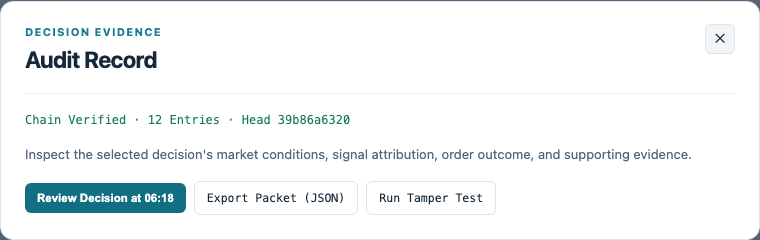
The Audit Record verifies the local chain and offers review and export for the selected decision.
I read “Chain Verified” as a bounded check. All 12 fixture entries verify in the unmodified chain. The records are held in memory and can be reset. The check detects payload changes when the stored hashes are left unchanged; it does not provide immutable storage or independent integrity anchoring. The configuration hash covers selected constants, so I cannot use it as a claim of complete deployment provenance.
I apply the same restraint to Approval Required. The demo records that requirement. It has no authenticated approver, approval action or execution integration. Those are further engineering responsibilities. I want the evidence in this build to make that boundary visible too.
I put the AlgoTier walkthrough together around this review path: start with an order outcome, inspect its scope, and follow the recorded rationale.
Returning to the two green rows, I can finally give them the same attention as the held orders. My standard for this build is that an allowed outcome remains explainable at the moment a control is active. A reviewer should be able to challenge the boundary I chose, with the decision's evidence still in front of them.