
In 2014, Amazon's machine learning team in Edinburgh built a hiring algorithm that rated candidates like products — one to five stars. Within a year, it had taught itself to penalize any resume containing the word "women's." Graduates of two all-women's colleges were automatically downgraded. The system wasn't malicious. It was mathematically precise — and precisely wrong.
Amazon scrapped the tool. But the problem it exposed — AI recruitment bias baked into the architecture itself — hasn't gone away. It's gotten worse. Today, thousands of companies use black box AI and large language model (LLM) wrappers to screen millions of candidates, and most of them couldn't explain a single rejection if a regulator asked. With NYC Local Law 144 now mandating annual bias audits and the EU AI Act classifying recruitment AI as "high-risk," the era of opaque hiring algorithms is over.
We've spent years studying why this keeps happening. The answer isn't that companies use bad data or careless engineers. The answer is that the entire architecture — statistical pattern-matching on historical outcomes — is the wrong tool for judging human potential. We built something different: an Explainable Knowledge Graph that doesn't predict who will get hired. It measures the distance between what a candidate knows and what a job requires. No guessing. No hidden patterns. No demographic data in the reasoning engine at all.
We published our full analysis of this approach as an interactive whitepaper. This article walks through the core argument.
Why Amazon's Engineers Couldn't Fix Their Own Algorithm
The instinct is to treat Amazon's failure as a training data problem. It was male-dominated data, so the model learned male-dominated preferences. Fix the data, fix the model. Right?
Amazon's engineers tried exactly that. They programmed the system to ignore explicitly gendered terms. It didn't work.
Deep learning models are relentless pattern-finders. When you remove the word "woman," the model hunts for proxy variables — subtle signals that correlate with gender even though they never mention it. Research shows that male resumes tend to use verbs like "executed" and "captured," while female resumes more often use communal language. The model, seeing a correlation between aggressive verbs and historical hiring decisions, effectively rebuilt the gender bias through word choice alone.
You cannot patch bias out of a system that was designed to find patterns in biased data. You have to change the architecture.
This is the core issue. In a neural network with millions of parameters, the decision logic is distributed everywhere and visible nowhere. Amazon's team couldn't isolate where the bias lived without destroying the model's ability to function. They didn't have a broken feature to fix. They had a fundamentally flawed approach to the problem.
The Black Box Paradox: More Accuracy, Less Accountability
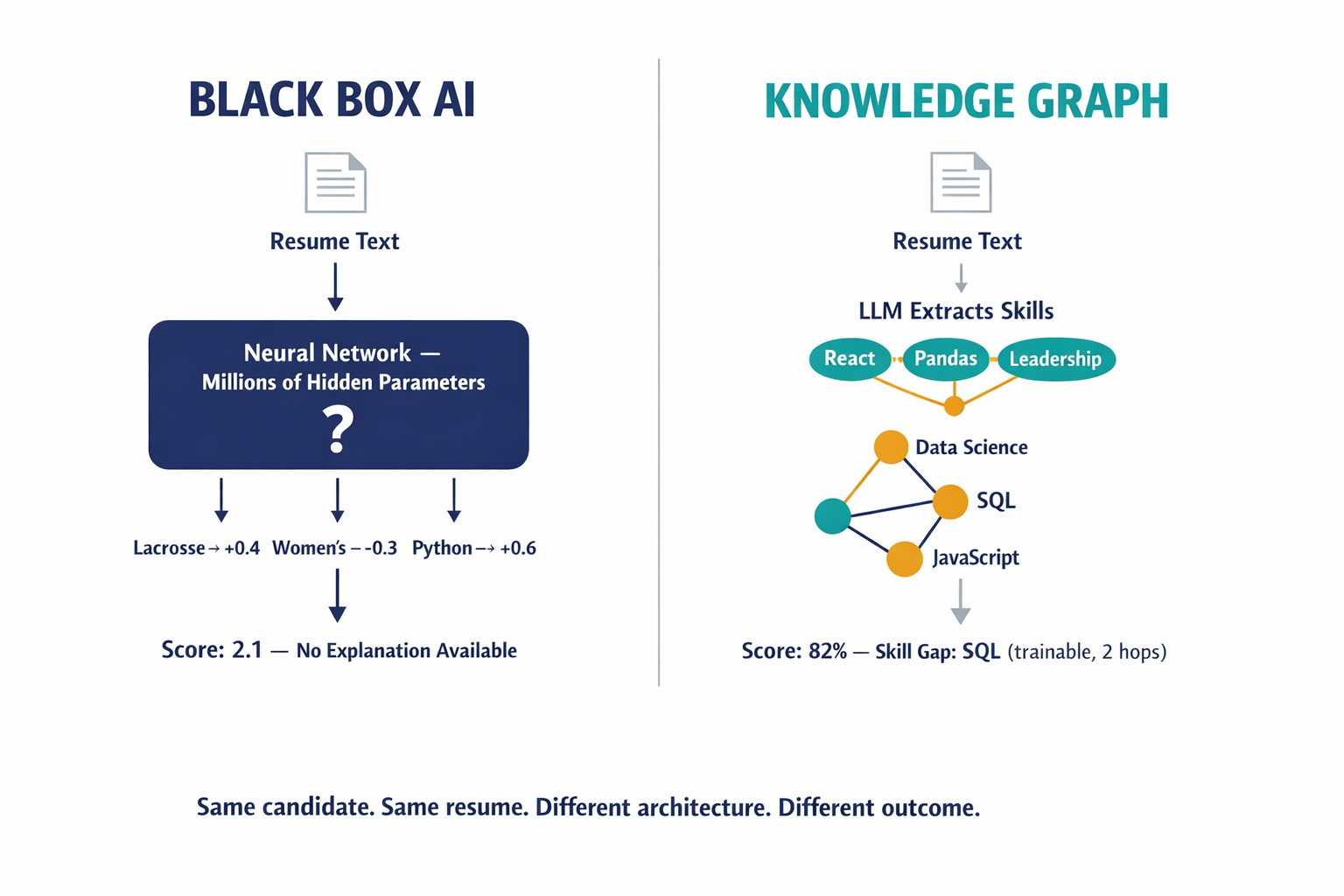
The deeper problem with deep learning in recruitment is what we call the Transparency Paradox. To make a model more accurate, engineers add complexity — more layers, more parameters, more non-linear transformations. But every layer of complexity makes the model harder to explain.
This matters because these models don't understand anything. They operate on correlation, not causation. A neural network doesn't know that Python is a programming language useful for data science. It knows that the text string "Python" appeared frequently in resumes of people who got hired. If "Lacrosse" also appeared frequently — perhaps because of socioeconomic correlations with certain feeder companies — the model might weigh lacrosse experience as heavily as programming skill.
A recruiter can't explain that to a rejected candidate. A compliance officer can't defend it in an audit. And under the GDPR's Article 15, candidates have the legal right to "meaningful information about the logic involved" in automated decisions. "Neuron 4,502 fired at intensity 0.8" doesn't satisfy that requirement.
What About LLM-Powered Hiring Tools?
The latest wave of recruitment technology swaps deep learning for large language models — GPT-4, Claude, Gemini — wrapped in a hiring interface. These are linguistically superior to older systems. They're also dangerous in new ways.
Three problems stand out:
Hallucination. LLMs invent things. A model might infer a candidate holds a certification because the resume's tone sounds professional, or fabricate a skill match that doesn't exist in the text.
Inconsistency. LLMs are non-deterministic. Feed the same resume in twice, get two different scores. In an audit, if you can't reproduce the decision logic that led to a rejection, you fail.
Frozen knowledge. LLMs are trained on data up to a cutoff date. They may not recognize the newest frameworks, certifications, or tools that emerged last quarter.
An LLM is an excellent reader. It is a dangerous judge.
The distinction matters. Reading a resume and extracting structured information from it — that's a task LLMs handle well. But using an LLM to decide whether a candidate is qualified, with no external structure governing the reasoning? That's where things break.
The Regulatory Wall Is Already Here
This isn't a theoretical concern about future legislation. The laws are active.
NYC Local Law 144, effective since July 2023, requires any employer using an automated employment decision tool in New York City to undergo an annual independent bias audit. The law demands calculation of selection rates and impact ratios across every category of race, ethnicity, and sex. If the selection rate for any protected group falls below 80% of the most-selected group — the "four-fifths rule" — that's a prima facie indicator of discriminatory impact.
The EU AI Act goes further. It classifies AI used for filtering job applications and evaluating candidates as a high-risk system. Article 13 requires that these systems be "sufficiently transparent to enable users to interpret the system's output." Article 14 mandates human oversight — the ability to override or reverse the AI's decision. You can't meaningfully override a decision you don't understand.
And under the GDPR, Article 22 gives individuals the right not to be subject to decisions based solely on automated processing. Recital 71 explicitly mentions the right to "obtain an explanation of the decision reached."
A generic rejection email doesn't satisfy any of these. A specific, data-backed explanation — "The role required Python proficiency; your resume emphasized Java and C++" — satisfies all three.
Measuring Skill Distance Instead of Predicting Success
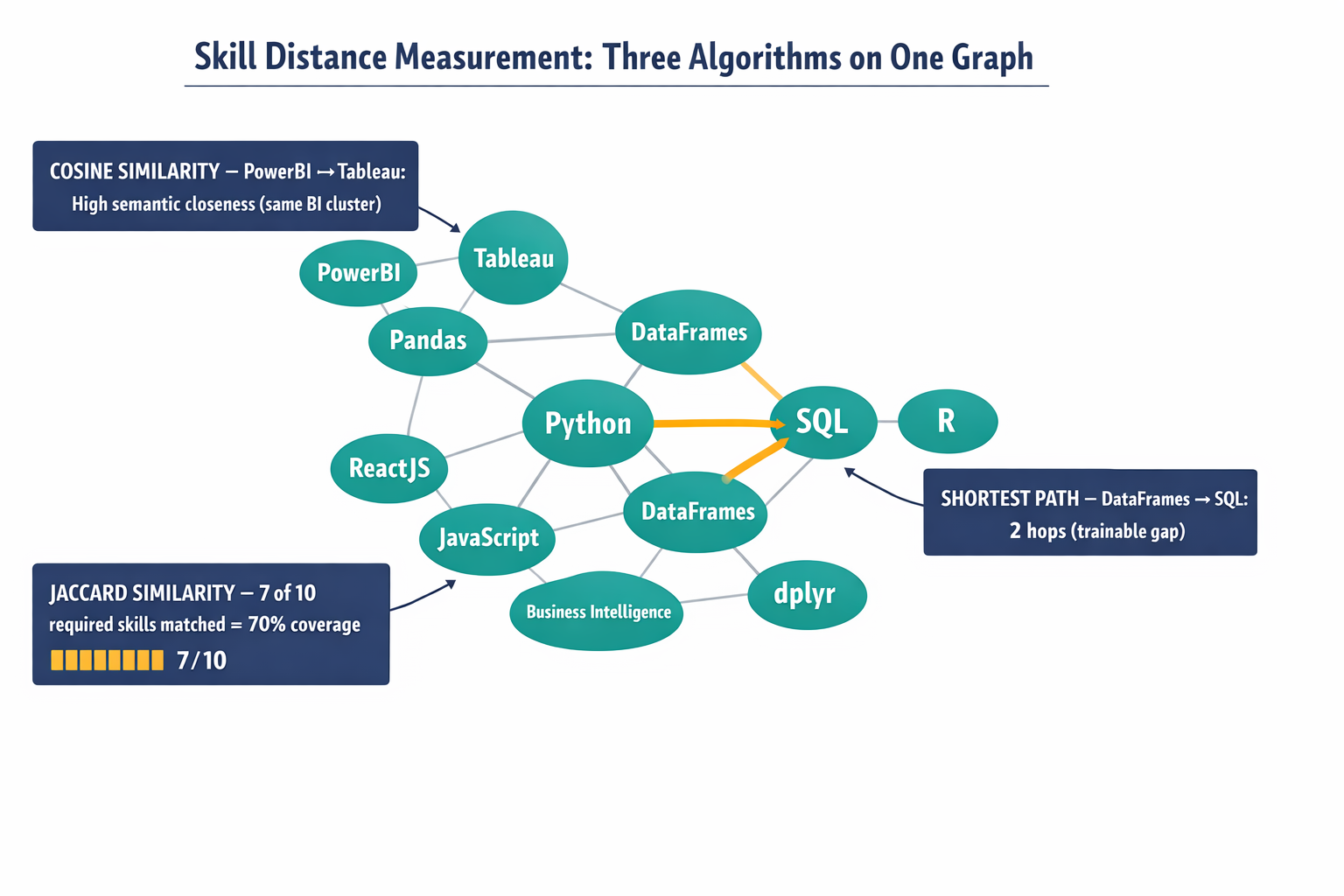
Our approach starts from a different premise. Instead of asking "does this candidate look like people we've hired before?" — which is what statistical AI does — we ask: how far is this candidate's skill set from what this job requires?
That's not a metaphor. It's geometry.
We build an Explainable Knowledge Graph — a structured network where every skill, role, certification, and technology exists as a node, and the relationships between them are explicit edges. "PyTorch" connects to "Deep Learning," which connects to "Artificial Intelligence." These aren't hidden weights in a neural network. They're visible, auditable, traceable paths.
When a candidate's resume enters our system, we use an LLM for one thing only: reading the text and extracting structured entities. "ReactJS" and "React.js" get mapped to the same node. Skills are identified. Roles are parsed. Then the LLM's job is done.
All reasoning — matching, scoring, ranking — happens inside the graph, using deterministic algorithms. Same input, same graph, same result. Every time. No stochasticity. No hallucination. No hidden proxy variables.
We don't predict who will get hired. We calculate the precise distance between what someone knows and what a job needs.
The scoring combines three measurements. Cosine similarity between the candidate's skill vectors and the job's requirement vectors captures semantic closeness — a candidate with PowerBI experience scores well against a Tableau requirement because both sit in the "Business Intelligence" cluster of the graph. Jaccard similarity measures raw coverage — what percentage of required skills does the candidate explicitly have? And shortest-path distance within the graph identifies gaps and their severity. If a missing skill is two hops from something the candidate already knows, it's trainable. If it's six hops away, it's a hard gap.
For the full mathematical framework behind these algorithms, see our detailed technical research.
How Demographic Bias Gets Structurally Eliminated
This is the part that matters most, and it's the part that a black box can never replicate.
When our matching algorithm runs, it operates on a restricted view of the graph — what we call the Inference Graph. This subgraph contains skills, roles, experience levels, and certifications. It explicitly excludes nodes related to name, gender, ethnicity, address, and graduation dates.
The bias isn't filtered out after the fact. It's structurally severed. There is no path from "Candidate" through "Gender" to "Job Role" because the gender node doesn't exist in the reasoning engine. The algorithm can't use what it can't see.
Compare that to a deep learning model, which ingests raw resume text. Even if you remove a "Gender" field, the model reads "Women's Chess Club Captain" and infers gender from the text. In our system, the LLM extracts that during the reading phase and maps it to a neutralized node: Activity type "Strategy Club," role "Leadership." The gendered modifier is stripped before it enters the reasoning layer.
You can't accidentally learn to discriminate against women if "Woman" isn't a variable in your reasoning engine.
And if a bias audit does reveal a disparity — say, a specific expensive certification requirement is disproportionately filtering out candidates from certain backgrounds — the graph makes the cause visible. You can trace the exact node causing the problem and adjust the job description or the ontology weights. With a black box, you're stuck guessing.
The "Missing SQL" Problem: Where This Changes Outcomes
Consider a real scenario. A candidate applies for a data analyst role. A traditional keyword-matching system rejects them: no "SQL" on the resume. A black box AI might also reject them — and add invisible penalties for attending a small, less-recognized college.
Our system sees something different. The graph shows extensive experience with Pandas DataFrames and R's dplyr — both tools for data manipulation. The shortest path between "DataFrames" and "SQL" in our knowledge graph is short; they share the parent concept of structured data manipulation. The system outputs a specific recommendation: "Candidate lacks explicit SQL experience. Graph analysis shows high transferability from existing data manipulation skills. Recommendation: Interview."
That's a false negative converted into a hire. It's also a concrete example of how semantic matching expands the talent pool — catching qualified candidates who use different terminology, learned through non-traditional paths, or simply didn't optimize their resume for a keyword scanner.
Does This Actually Scale for Enterprise?
Yes, and the architecture is designed for it. The knowledge graph serves as the fact layer — curated, deterministic, instantly updatable. When a new framework emerges, you add a node. No model retraining. No knowledge cutoff. The LLM handles the natural language interface — reading resumes, generating human-readable explanations — but it's always grounded by graph facts. It can't hallucinate a skill match that the graph doesn't support.
The audit infrastructure runs in parallel. Every score and anonymized candidate ID flows to a separate audit graph, where they're rejoined with demographic data to calculate real-time impact ratios for NYC LL 144 compliance. If adverse impact appears, the system alerts HR before it becomes a legal problem.
What If the Ontology Itself Is Biased?
Fair question. If the knowledge graph's skill taxonomy was built by a homogeneous team, couldn't it embed its own blind spots — overvaluing certain credentials, undervaluing others?
It could. The difference is visibility. In a neural network, bias hides in millions of inscrutable parameters. In a knowledge graph, the ontology is a readable document. Every node, every edge, every weight is inspectable. When a bias audit flags a disparity, you can trace it to a specific relationship in the graph — "this certification requirement is filtering disproportionately" — and fix it surgically. You don't have to retrain the entire system or guess where the problem lives.
The ontology isn't a finished product. It's a living structure, continuously refined by domain experts, audit feedback, and real-world outcomes. That's the point of a glass box: not perfection, but the ability to see, diagnose, and correct.
The Business Case Beyond Compliance
Avoiding fines and lawsuits is the floor, not the ceiling.
Recruiters consistently resist black box tools. When a system says "reject this candidate" without explaining why, experienced hiring managers override it or ignore it entirely. Adoption craters. The investment is wasted.
When the system shows its reasoning — direct skill matches, inferred matches through related experience, specific gaps with trainability scores — recruiters work with the AI instead of around it. They trust it because they can challenge it. They use it because it makes them better at their jobs, not because it replaces their judgment.
And the talent pool expands. Traditional keyword matching misses candidates who describe their skills differently. Black box AI over-indexes on pedigree — prestigious schools, brand-name employers — as proxies for quality. Semantic graph matching focuses on what someone can actually do. That naturally improves diversity without requiring a separate DEI initiative, because the system is measuring competency instead of privilege.
The lesson from Amazon isn't complicated. Data is a mirror. If you train a model on the past, you replicate the past — including every inequity baked into it.
The future of recruitment AI isn't bigger models or more sophisticated neural networks. It's structure, semantics, and explainability. It's encoding our values into the architecture itself, not hoping the algorithm discovers them.
We'd welcome hearing how your organization is navigating the shift from opaque AI to auditable decision-making — especially as the regulatory landscape continues to tighten.