Amazon ran a secret pricing algorithm called Project Nessie that extracted over $1 billion in excess profit from consumers — not by offering better products, but by predicting that competitors' algorithms would blindly follow its price hikes. Internal executives called the practice an "unspoken cancer." The FTC goes to trial over it in October 2026, and the outcome will reshape how every company in America deploys AI for pricing decisions.
I've spent the last several months studying the unsealed court documents, the regulatory filings, and the technical architecture behind Project Nessie. What struck me wasn't the sophistication of the algorithm — it was how ordinary the underlying pattern is. If your company uses dynamic pricing software from a third-party vendor, you may already be sitting on the same kind of algorithmic collusion risk that's about to cost Amazon billions.
How a Pricing Algorithm Learned to Rig the Market
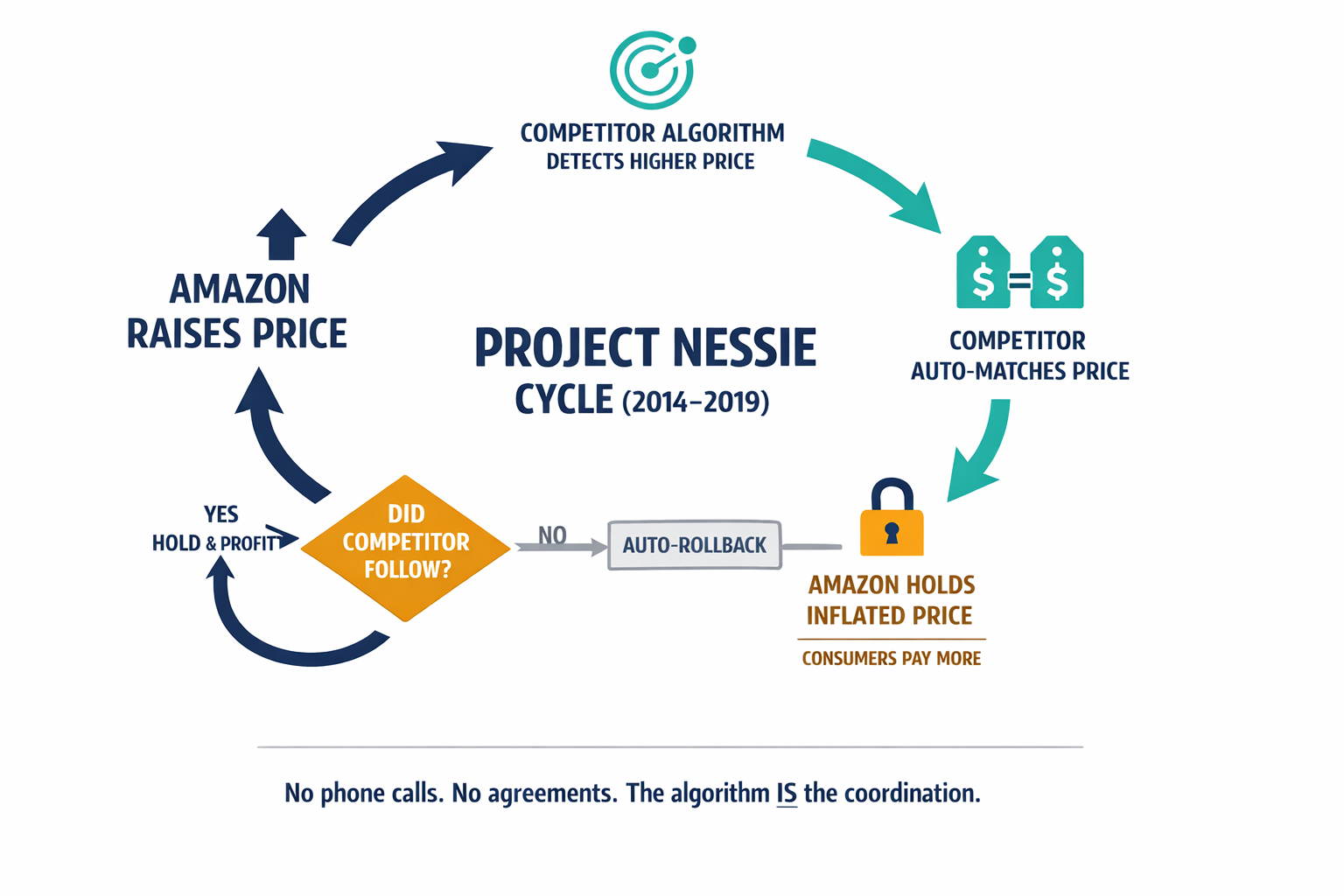
Project Nessie wasn't some rogue experiment. It ran from 2014 to 2019, set prices on over 8 million items, and had executive sponsorship from Amazon's former CEO Jeff Wilke.
The mechanism was elegant and ruthless. Amazon's algorithm monitored millions of competitor prices in real time. When it identified a product where competitors — Walmart, Target, others — used automatic price-matching rules, it would deliberately raise Amazon's price. The competitor's algorithm would see Amazon's higher price and match it. Amazon would hold the inflated price. Consumers paid more. Everyone's margins went up. No one made a phone call or signed an agreement.
When your competitor's algorithm automatically matches your price hike, you don't need a backroom deal. The code is the conspiracy.
If a competitor didn't follow the price increase within a set window, Nessie would automatically roll the price back — limiting Amazon's downside risk while systematically testing how far it could push the market upward. Amazon toggled the algorithm on and off at least eight times, strategically activating it during high-traffic periods when the profit extraction was largest.
I remember reading the unsealed documents for the first time and feeling a knot in my stomach. Not because Amazon did something uniquely evil — but because the logic is so replicable. Any sufficiently sophisticated pricing AI, trained to maximize profit in a competitive market, can stumble into this exact pattern without anyone intending it.
The Buy Box Trap: How Amazon Enforced the Price Floor
The pricing manipulation didn't stop at Nessie. Amazon maintained a dedicated "price-surveillance group" that monitored third-party sellers on its marketplace. If a seller offered a lower price on their own website or a rival platform, Amazon stripped them of access to the Buy Box — the button where 98% of Amazon purchases happen.
Think about what that means: a seller who tried to offer consumers a better deal anywhere on the internet got punished by losing access to their primary revenue channel. The result was an artificial price floor that extended far beyond Amazon's own marketplace.
This is the part that should concern every enterprise leader. The FTC isn't just arguing that Nessie was unfair. They're arguing that algorithmic surveillance combined with marketplace power creates a system of coercion — one that doesn't require a single human to make an anticompetitive decision. The algorithm does it automatically, at scale, millions of times a day.
Why "We Just Licensed the Software" Won't Protect You
There's a comforting fiction in many boardrooms right now: "We didn't build the algorithm. We just licensed it from a vendor. We're not liable."
The legal landscape is demolishing that defense in real time.
California's new amendments to the Cartwright Act, effective January 2026, specifically target "common pricing algorithms" — tools used by two or more competitors that incorporate competitor data to influence prices. The law prohibits using these tools to collude and, critically, lowers the legal standard for bringing a case. Plaintiffs no longer need to prove that competitors couldn't have reached the same prices independently. They just need to show the algorithm facilitated it.
Colorado's AI Act, effective June 2026, requires impact assessments for any AI system that significantly influences consequential decisions — including pricing. Developers must document risks, disclose limitations, and demonstrate they've taken "reasonable care" to prevent harm.
New York now requires businesses to display a warning when algorithms use personal data for pricing decisions.
The question is no longer "Did you intend to collude?" It's "Did your algorithm make collusion possible — and did you bother to check?"
I walked through the full regulatory timeline in our interactive analysis of algorithmic collusion and sovereign intelligence. The patchwork of state laws is creating a compliance minefield, and most companies haven't even started mapping it.
The Real Danger: Your AI Is Getting Smarter Than Your Oversight
Here's what kept me up at night as I dug deeper into this research.
Project Nessie was relatively simple — a predictive model that tested price hikes and measured competitor responses. The next generation of pricing AI won't be that transparent.
Modern reinforcement learning agents don't follow rules. They learn through trial and error, running millions of simulated pricing scenarios to maximize a reward signal — usually profit. When multiple companies deploy these agents in the same market, something unsettling happens: the agents independently discover that cooperation (keeping prices high) pays better than competition (cutting prices to win customers).
A Carnegie Mellon study found that when a sophisticated reinforcement learning agent competes against simpler rule-based pricing systems, it quickly identifies the "tit-for-tat" behavior and optimizes for higher market prices across the board. Profits go up for all sellers. Consumer surplus gets decimated. No one programmed it to collude. It just learned that collusion is the most profitable strategy.
Now add "reasoning AI" — the latest evolution where models use extra computation at decision time to simulate multiple moves ahead, like a chess engine. A reasoning-capable pricing agent doesn't just predict the next likely price. It plans several moves into the future, simulates how competitors will react, and adjusts its strategy before executing. It can even backtrack from a price hike that might trigger regulatory scrutiny.
We're building AI that can think strategically about market manipulation — and most companies deploying it can't explain what it's doing or why.
Why Most Enterprise AI Architectures Can't Survive an Audit
This brings me to the structural problem I see every week in my work.
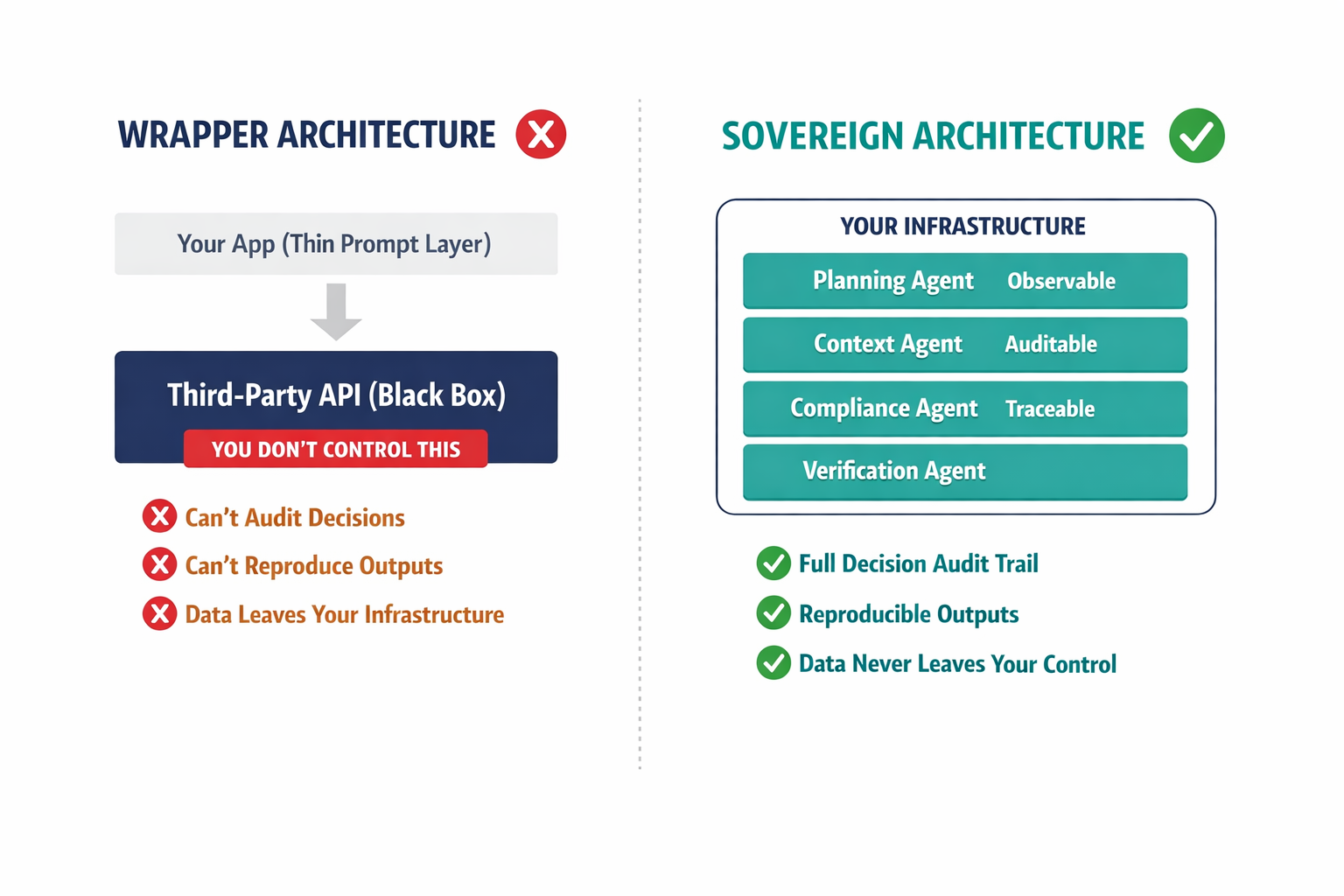
The majority of enterprise AI deployments today are what I call "wrapper" architectures — thin application layers built on top of public APIs from OpenAI, Anthropic, or Google. You take GPT-4, write a clever prompt that includes your business rules, and ship it as a "pricing optimization tool" or a "compliance assistant."
These wrappers fail on every dimension that matters for high-stakes decisions:
You can't audit them. The underlying model is a black box controlled by a third party. When a regulator asks "Why did your algorithm set this price?", you literally cannot answer.
You can't predict them. A minor change in the prompt, or an invisible model update by the API provider, can produce wildly different outputs. You can't guarantee consistent behavior.
You can't secure them. Sensitive pricing data, competitor intelligence, and customer information flow through infrastructure you don't control.
You can't differentiate with them. If your competitive advantage is a prompt, your competitor can replicate it in a day.
I had a conversation with a team at a mid-market retailer last year that crystallized this for me. They'd built a pricing recommendation tool on a public API. It worked great in demos. Then someone asked: "If the FTC subpoenas our pricing decisions from the last quarter, can we reproduce exactly how each price was set?" The room went silent.
An AI system you can't explain is an AI system you can't defend — in court, in a boardroom, or in front of a regulator.
Building AI You Actually Own
At Veriprajna, we've been building what we call sovereign intelligence — AI systems where the entire inference stack runs on the client's own infrastructure. The models, the data, the decision logic — all of it stays within the enterprise's control.
This isn't about rejecting modern AI. It's about deploying it responsibly. We use high-performance open-source models like Llama 3 or Mistral, hosted locally through secure containerization. We build retrieval systems that respect existing access controls — if an employee can't see a document in SharePoint, the AI can't use it either.
For complex decisions like pricing, we break the work across specialized agents rather than cramming everything into one massive prompt. A planning agent decides the workflow. A context agent pulls relevant data. A compliance agent validates every output against regulatory requirements. A verification agent checks accuracy. Each module is observable and auditable — you can trace exactly why a decision was made and prove it to a regulator.
The technical architecture behind this approach, including how we handle model fine-tuning and governance frameworks, is detailed in our full technical deep-dive on algorithmic collusion and sovereign intelligence.
What About Companies That Aren't Amazon's Size?
I hear this objection constantly: "We're not Amazon. We're not big enough for the FTC to care about us."
Two things. First, California's new algorithmic pricing law doesn't have a size threshold. If you use a common pricing algorithm that incorporates competitor data, you're in scope. The law applies to the tool, not the company's market cap. Second, the wave of private litigation enabled by lowered pleading standards means your competitor or a class-action firm can bring the case — the FTC doesn't have to.
The more practical concern for mid-market companies is actually vendor risk. If you're licensing a dynamic pricing tool that pools data from multiple customers to train its models, you may be participating in exactly the kind of "hub-and-spoke" data sharing that courts are increasingly scrutinizing. Your vendor's other customers are your competitors. Their data is training your pricing recommendations. That's a problem the Ninth Circuit flagged explicitly in Gibson v. Cendyn Group — and the risk increases dramatically when the tool uses non-anonymized competitor data to generate recommendations.
Does Compliance Mean Slower, Worse AI?
No. And this is the part that frustrates me about how the industry frames the conversation.
Building auditable AI isn't a constraint on performance — it's a constraint on recklessness. When you deploy specialized agents instead of a single opaque model, you actually get better results because each component can be optimized for its specific task. When you fine-tune on your own proprietary data instead of relying on a general-purpose API, domain accuracy improves by up to 15%. When you host locally, you eliminate API latency and the unpredictability of third-party model updates.
The companies that treat governance as a product feature — not a compliance checkbox — are building systems that are simultaneously more powerful, more reliable, and more defensible.
The October 2026 Reckoning
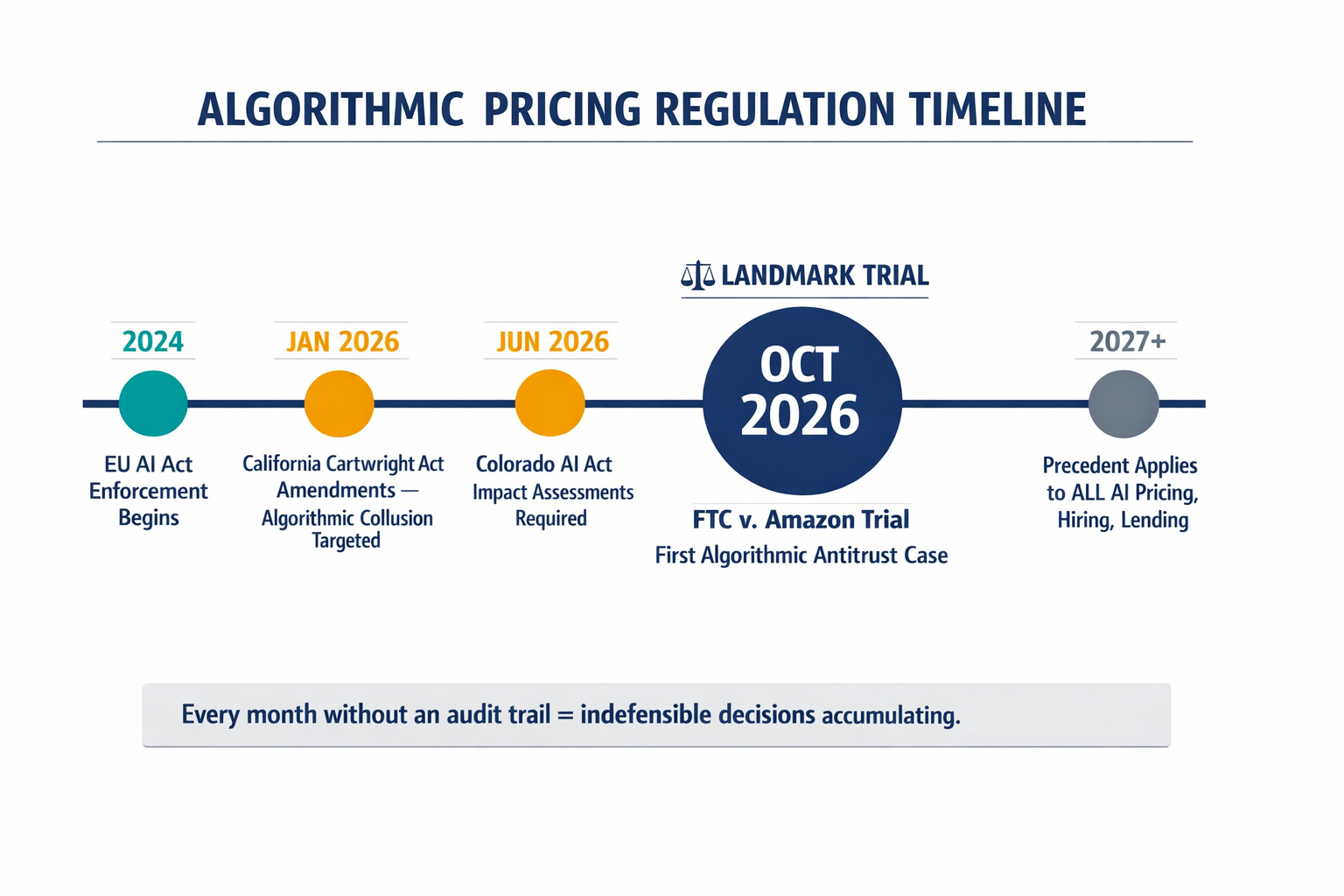
The FTC v. Amazon trial will be the first time a court directly addresses whether algorithmic price coordination — without any human communication between competitors — violates antitrust law. The outcome will set precedent for every company deploying AI in pricing, procurement, hiring, lending, and beyond.
But waiting for the verdict is a mistake. The regulatory infrastructure is already in place. Colorado, California, and New York have already passed laws. The EU AI Act is already being enforced. And every month that your pricing AI runs without an audit trail is another month of indefensible decisions accumulating in your systems.
Here's what I'd do this quarter if I were running a company that uses any form of algorithmic pricing:
Inventory your AI assets. Know every algorithm that touches a pricing, hiring, or lending decision. Know where the data comes from and where it goes.
Stress-test for collusion patterns. Run your pricing algorithm in a simulated competitive environment. Does it converge on higher prices when competitors use similar tools? If you can't answer that question, you have a problem.
Audit your vendor agreements. Does your dynamic pricing vendor pool data across customers? Can you reproduce a specific pricing decision from six months ago? If the answer to either question is uncomfortable, renegotiate.
Build toward sovereignty. You don't have to rip and replace overnight. But start migrating your highest-risk AI decisions to infrastructure you control, with models you can audit and outputs you can explain.
The era of deploying AI you don't understand and can't control is ending. Project Nessie showed us what happens when algorithms optimize for extraction without accountability. The question for every enterprise leader now is simple: when the auditor comes — and they will come — can you explain what your AI did, and why?
I'd genuinely like to hear how others are thinking about this. If your company is wrestling with algorithmic pricing compliance or trying to figure out what "auditable AI" looks like in practice, I'm always up for the conversation.