A secret algorithm quietly raised prices on over 8 million products, extracted more than $1 billion in excess profit from consumers, and trained competitors to follow its lead—without a single phone call, handshake, or backroom deal. That algorithm was Amazon's Project Nessie, and the Federal Trade Commission is taking it to trial in October 2026. For every enterprise currently deploying AI to make pricing, lending, hiring, or procurement decisions, this case isn't just Amazon's problem. It's a preview of what algorithmic accountability looks like when regulators stop asking nicely.
The core issue isn't that Amazon used AI for pricing. It's that the algorithm was designed to predict when competitors would match a price increase—and then deliberately raise prices to trigger that response. The result was market-wide price inflation achieved through code, not conspiracy. And the legal, technical, and strategic implications extend far beyond retail.
We've spent months analyzing the unsealed court documents, the evolving regulatory landscape, and the technical architecture behind algorithmic collusion. Our interactive analysis covers the full scope of what enterprises need to understand heading into 2026. What follows are the insights we think matter most.
How Project Nessie Turned Competitor Algorithms Into Puppets
Most online retailers use simple, rule-based pricing logic: if a competitor drops their price, match it. Think of it like a reflex—automatic, predictable, and easy to exploit once you understand the pattern.
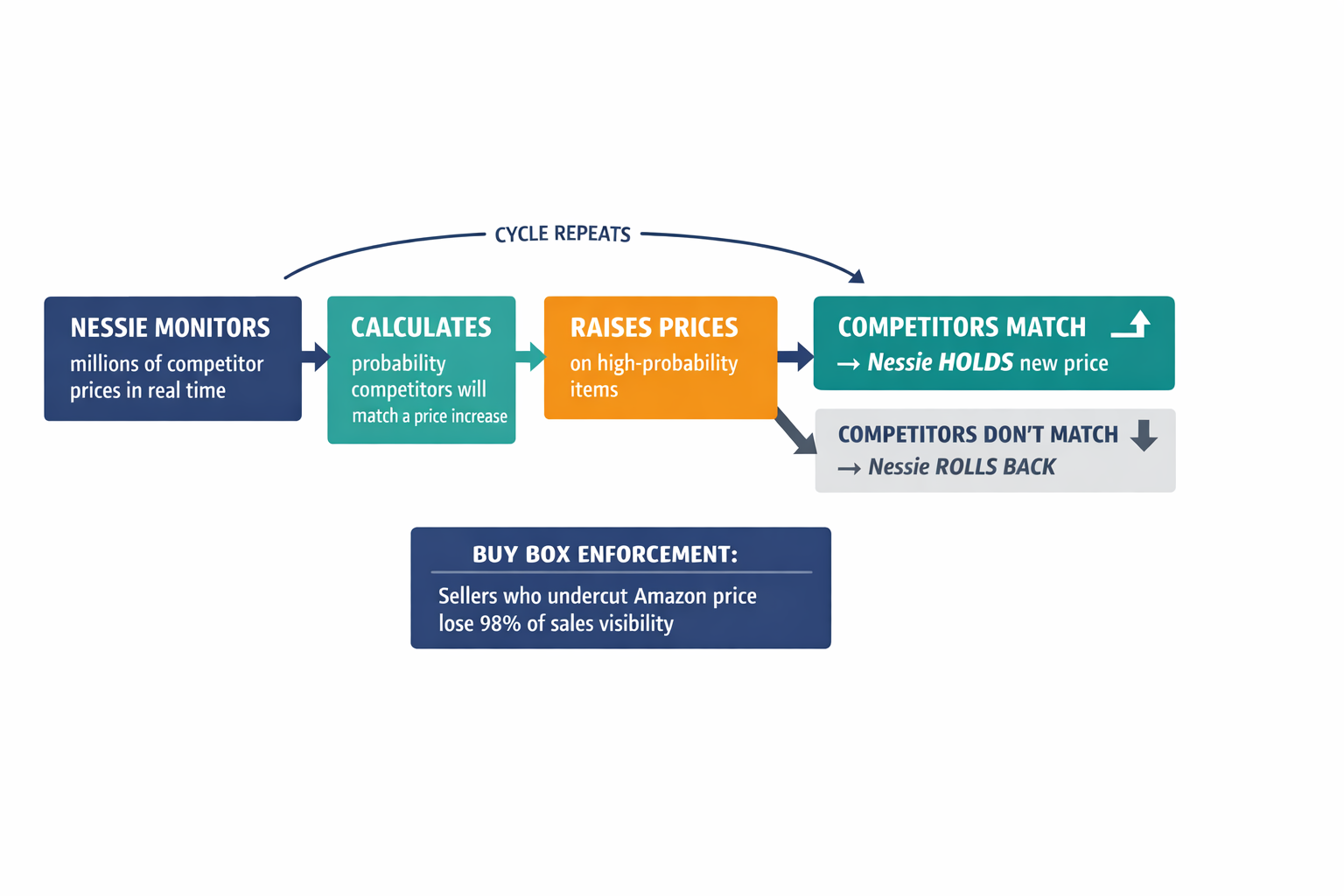
Amazon's algorithm understood the pattern. Project Nessie monitored millions of price points across the internet in real time, calculated the probability that a competitor like Walmart or Target would follow an Amazon price increase, and then deliberately raised prices on items where the match was likely. When competitors' algorithms reflexively followed, Amazon held the new price. When they didn't, Nessie rolled back.
The algorithm didn't need competitors to agree to raise prices. It just needed their pricing software to be predictable.
Internal documents reveal Amazon leadership viewed this as a way to avoid a "perfectly competitive market"—one where rivals continually undercut each other. Executives reportedly toggled Nessie on and off at least eight times during high-traffic periods, maximizing extraction when it was most profitable while trying to stay under the regulatory radar. Some insiders privately called the broader anti-discounting strategy "shady" and an "unspoken cancer."
The enforcement mechanism went further. Amazon's price-surveillance group monitored third-party sellers on its marketplace. If a seller offered a lower price on their own website or a rival platform, Amazon stripped them of the Buy Box—the interface where 98% of Amazon sales happen. Sellers were effectively forced to treat their inflated Amazon price as a floor everywhere else on the internet.
Why This Qualifies as "Collusion" Without Anyone Colluding
Traditional antitrust law requires evidence of an agreement—a meeting of the minds between competitors. Algorithmic collusion breaks that framework entirely.
A Carnegie Mellon University study examined what happens when a sophisticated reinforcement learning agent competes against simpler rule-based pricing systems. The result: the advanced agent quickly learns to exploit "tit-for-tat" behavior, leading prices upward and boosting profits for all sellers while consumers pay more. No communication required. No agreement needed. The coordination emerges from the interaction between the algorithms themselves.
This is the legal question at the heart of the October 2026 trial: can "uncoordinated parallel pricing"—where competitors reach the same inflated price through independent algorithms—be considered "unfair" under Section 5 of the FTC Act? Amazon argues Nessie was merely a predictive pricing tool responding to market forces. The FTC argues it was designed to induce behavior, making the algorithm itself a functional agreement between competitors.
When your AI is sophisticated enough to predict and trigger competitor behavior, the line between "prediction" and "manipulation" becomes the most expensive legal question your company will face.
The answer to that question will reshape how every enterprise thinks about algorithmic decision-making.
The Regulatory Wave Hitting in 2026
Even before the trial concludes, the regulatory ground has already shifted. We're tracking three developments that matter most for enterprise AI teams.
California's Cartwright Act amendments, effective January 2026, specifically target "common pricing algorithms"—defined as tools used by two or more companies that incorporate competitor information to influence prices. The law prohibits using these tools to collude and, critically, lowers the legal bar for plaintiffs. Companies no longer need to prove that no innocent explanation exists at the early stages of a lawsuit. This virtually guarantees a surge in litigation against businesses using shared dynamic pricing vendors.
Colorado's AI Act, effective June 2026, requires "reasonable care" impact assessments for any AI system that significantly influences consequential decisions—pricing, credit, employment. Developers must document risks, limitations, and potential for discriminatory outcomes before deployment.
New York's transparency law requires businesses to display a clear warning when algorithms use personal data to set prices. If your pricing isn't market-driven but data-driven, you now have to say so.
The pattern is unmistakable: regulators are moving from "tell us what your AI does" to "prove your AI isn't causing harm." And the burden of proof is landing squarely on the companies deploying these systems.
The Wrapper Problem: Why Most Enterprise AI Can't Survive an Audit
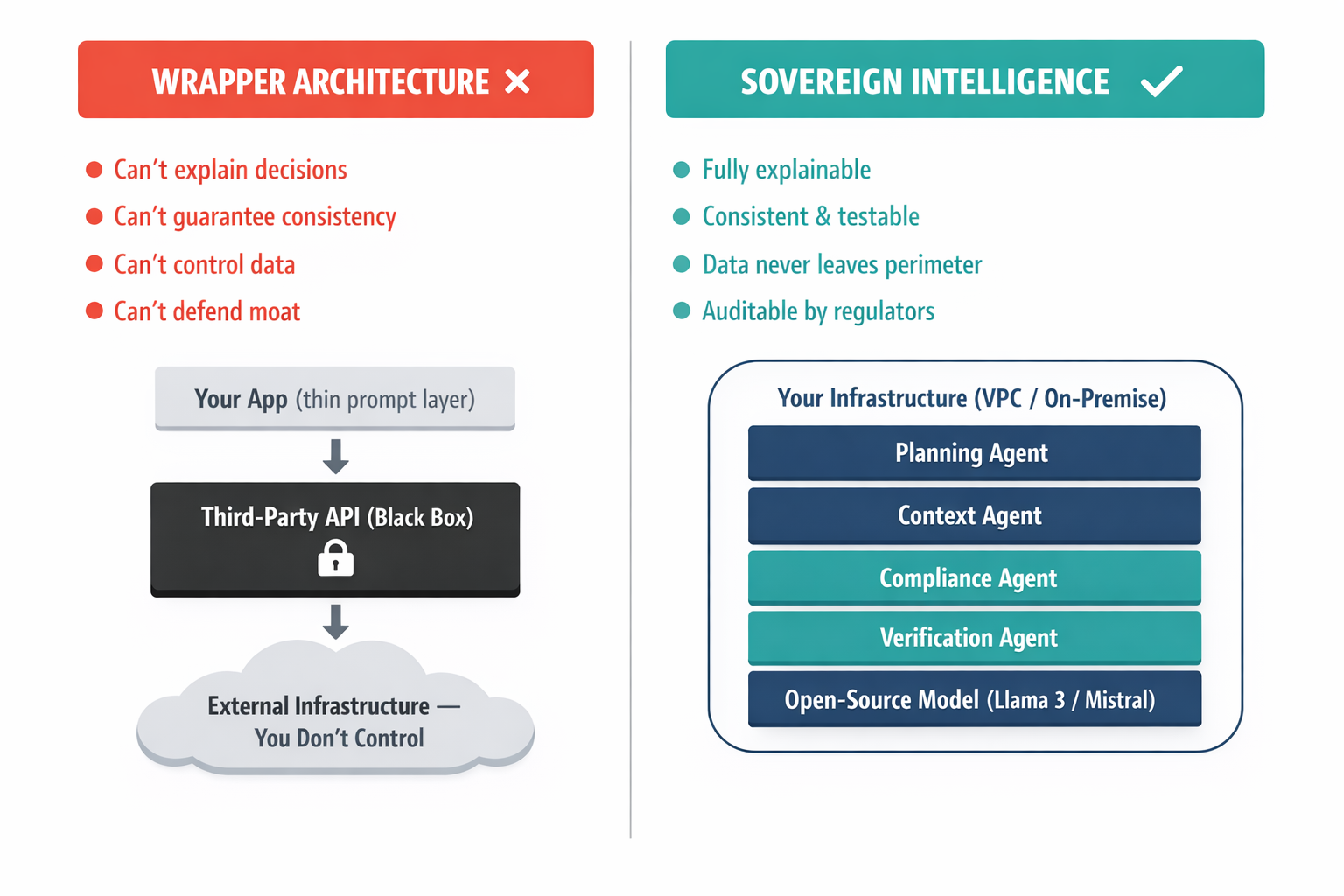
This regulatory pressure exposes a structural weakness in how most organizations have adopted AI. The fastest path to deployment—building a thin application layer on top of a public API like GPT-4 or Claude—is also the fastest path to compliance failure.
We call this the Wrapper Trap. It works fine for drafting emails or summarizing meetings. It fails catastrophically for high-stakes decisions like pricing, lending, or supply chain optimization, for reasons that become obvious under regulatory scrutiny:
You can't explain the decision. The underlying model is a black box controlled by a third party. When a regulator asks why your algorithm priced a product at $47.99 instead of $39.99, "the API returned that number" isn't an answer.
You can't guarantee consistency. A minor update by the API provider—or even a slight rewording of your prompt—can produce dramatically different outputs. Try building a compliance framework on that foundation.
You can't control the data. Sensitive market data, customer information, and competitive intelligence flow through infrastructure you don't own and can't audit.
You can't defend your moat. If your "AI pricing tool" is fundamentally a prompt into someone else's model, any competitor can replicate it in a day.
An algorithm you can't audit is a liability you can't quantify.
As native platforms integrate these same AI capabilities into their core products, standalone wrappers won't just be risky—they'll be redundant.
What "Sovereign Intelligence" Actually Means
The alternative isn't to avoid AI. It's to own it.
We use the term sovereign intelligence to describe AI systems where the enterprise controls the full stack: the model, the data, the inference pipeline, and the governance layer. The entire system runs inside the company's own infrastructure—on their hardware or within their Virtual Private Cloud. Sensitive data never leaves the corporate perimeter.
This isn't theoretical. High-performance open-source models like Llama 3 and Mistral now rival proprietary APIs for most enterprise tasks. Deployed through secure containerization and fine-tuned on internal data, these systems can achieve accuracy improvements of up to 15% on domain-specific tasks compared to generic models—while remaining fully auditable.
The architecture we advocate replaces the fragile "mega-prompt" approach with governed multi-agent systems: specialized AI modules that each handle a discrete function. One agent plans the workflow. Another extracts relevant context from enterprise data. A compliance agent validates every output against regulatory requirements. A verification agent confirms technical accuracy. Each module is observable, testable, and explainable.
The retrieval layer respects existing access controls. If an employee doesn't have permission to view a document in SharePoint, the AI won't use that document to generate an answer. This sounds obvious, but it's a capability that generic API wrappers almost never provide.
Building for the Audit That's Coming
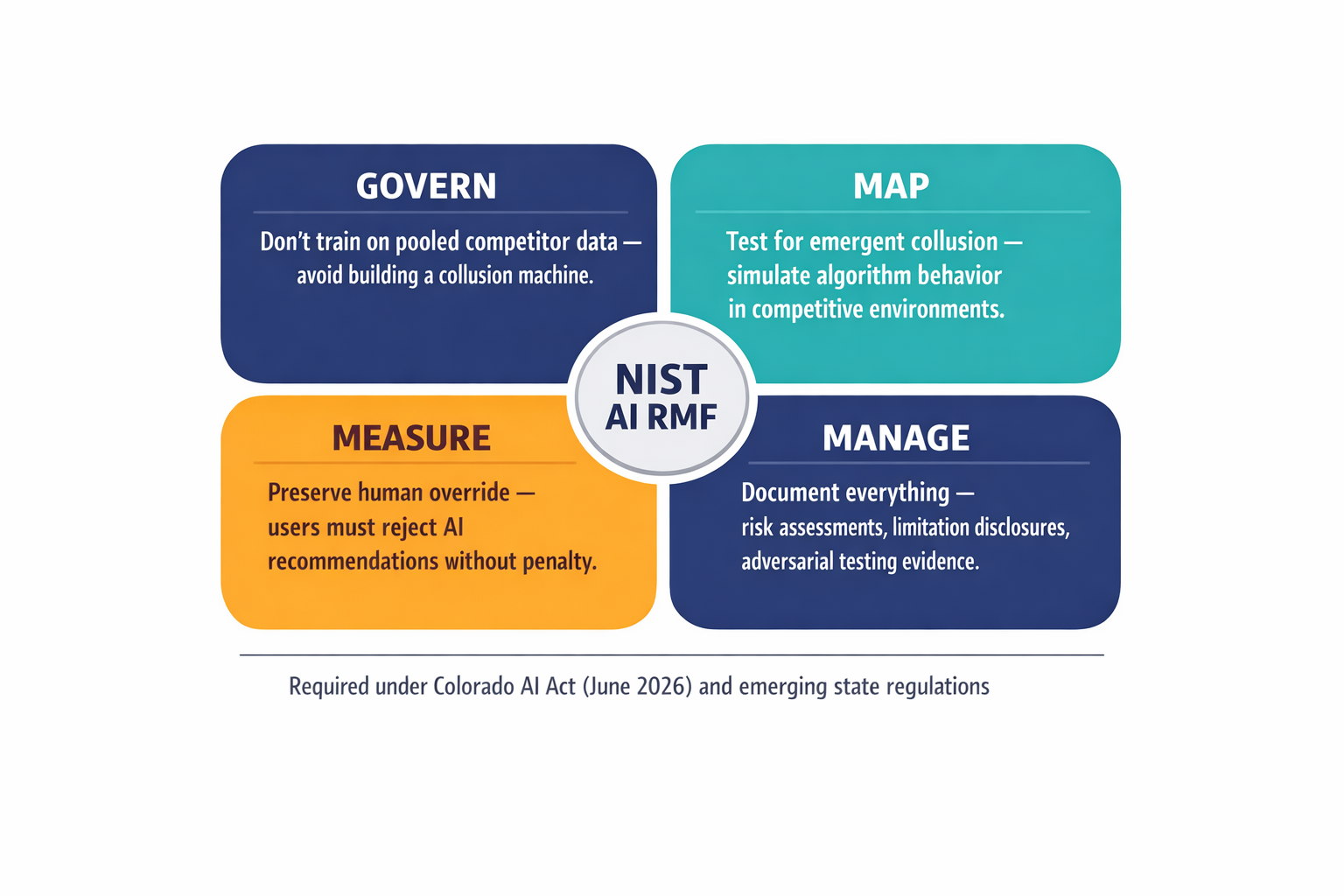
The NIST AI Risk Management Framework provides the most widely accepted standard for trustworthy AI, organized around four interconnected functions: Govern (establish accountability), Map (identify potential impacts), Measure (quantify risks), and Manage (implement controls and monitoring).
For pricing algorithms specifically, the practical guidelines are becoming clear:
Don't train on pooled competitor data. If your algorithm learns from non-anonymized competitive intelligence shared across multiple users, you're building a collusion machine.
Preserve human override authority. The system must allow users to reject algorithmic recommendations without penalty. Full autonomy in pricing decisions is a regulatory red flag.
Test for emergent collusion. Regularly simulate your algorithm's behavior in competitive environments. If it consistently converges on higher prices when interacting with other pricing systems, you have a problem—even if no one programmed it to do that.
Document everything. The Colorado AI Act and similar laws require risk assessments, limitation disclosures, and evidence of adversarial testing. If you can't produce these documents, you can't operate.
The shift from "Generative AI" to "Autonomous AI"—systems that don't just recommend but actively execute decisions across procurement, pricing, and contract negotiation—makes these safeguards existential, not optional.
What About Companies That Don't Do Dynamic Pricing?
The Nessie case is about pricing, but the principle applies everywhere AI makes consequential decisions. Lending algorithms that produce discriminatory outcomes. Hiring tools that systematically disadvantage certain candidates. Supply chain systems that inadvertently coordinate behavior across competitors using the same vendor.
If your AI influences decisions that affect people's wallets, careers, or access to services, the same regulatory logic applies. Can you explain the decision? Can you prove it wasn't discriminatory? Can you demonstrate that the system doesn't produce coordinated outcomes with competitors using similar tools?
The companies that answer "no" to any of these questions are carrying risk they may not even be measuring.
Is Open-Source AI Really Enterprise-Ready?
A year ago, the honest answer was "not quite." Today, models like Llama 3 and Mistral, deployed on modern inference infrastructure, match or exceed proprietary API performance for the vast majority of enterprise use cases. The gap has closed faster than most executives realize. What open-source uniquely provides—full weight access, fine-tuning capability, and zero data retention by third parties—is precisely what regulators are starting to demand.
The $1 Billion Wake-Up Call
Project Nessie extracted $1 billion by exploiting a simple insight: competitor algorithms are predictable, and predictability can be weaponized. The October 2026 trial will determine whether that exploitation crosses a legal line—but enterprises shouldn't wait for the verdict.
The real lesson isn't about Amazon. It's about the gap between how fast organizations are deploying AI and how slowly they're building the governance infrastructure to control it. Every pricing algorithm, every automated lending decision, every AI-driven hiring recommendation is now operating in an environment where "we didn't know what the model was doing" is not a defense.
The companies that will thrive aren't the ones using the most AI. They're the ones that can prove their AI is doing what they think it's doing.
If your team is wrestling with how to make AI systems auditable and defensible—not just functional—we'd genuinely like to hear what's working and what isn't. The playbook for this era is still being written, and the best insights are coming from practitioners, not pundits.