Coca-Cola generated over 70,000 AI video clips to assemble a single 30-second holiday commercial. The internet called it "soulless," "dystopian," and "creepy." When one of the world's most recognized brands—whose tagline is literally "Real Magic"—delegates the depiction of human joy to an algorithm, and consumers instantly reject it, that's not a tech glitch. That's a strategic failure that should concern every enterprise leader investing in AI-generated content.
I've spent the last year studying what my team calls "Aesthetic Hallucination"—the phenomenon where AI produces visuals that look plausible but feel emotionally hollow. The Coca-Cola debacle is the most expensive example yet, but it won't be the last. And the lesson isn't "don't use AI." The lesson is that hybrid AI workflows—where human intent directs machine velocity—are the only viable path for brands that care about trust.
The Smile That Didn't Reach the Eyes
When I first watched the Coca-Cola AI ad, I couldn't articulate what was wrong. The snow glistened. The trucks were perfectly red. The lighting was gorgeous. But something in my gut said no.
Then our team started dissecting it frame by frame, and the problems became obvious. The people smiled, but their smiles were wrong. A real human smile involves involuntary micro-muscles around the eyes—what psychologists call the "Duchenne marker." AI models, which generate faces by averaging millions of images, consistently miss this. The result: mouths that curve upward, eyes that stay dead. Your conscious mind might not catch it. Your subconscious does, immediately.
AI can render the geometry of a smile. It cannot render the physics of one.
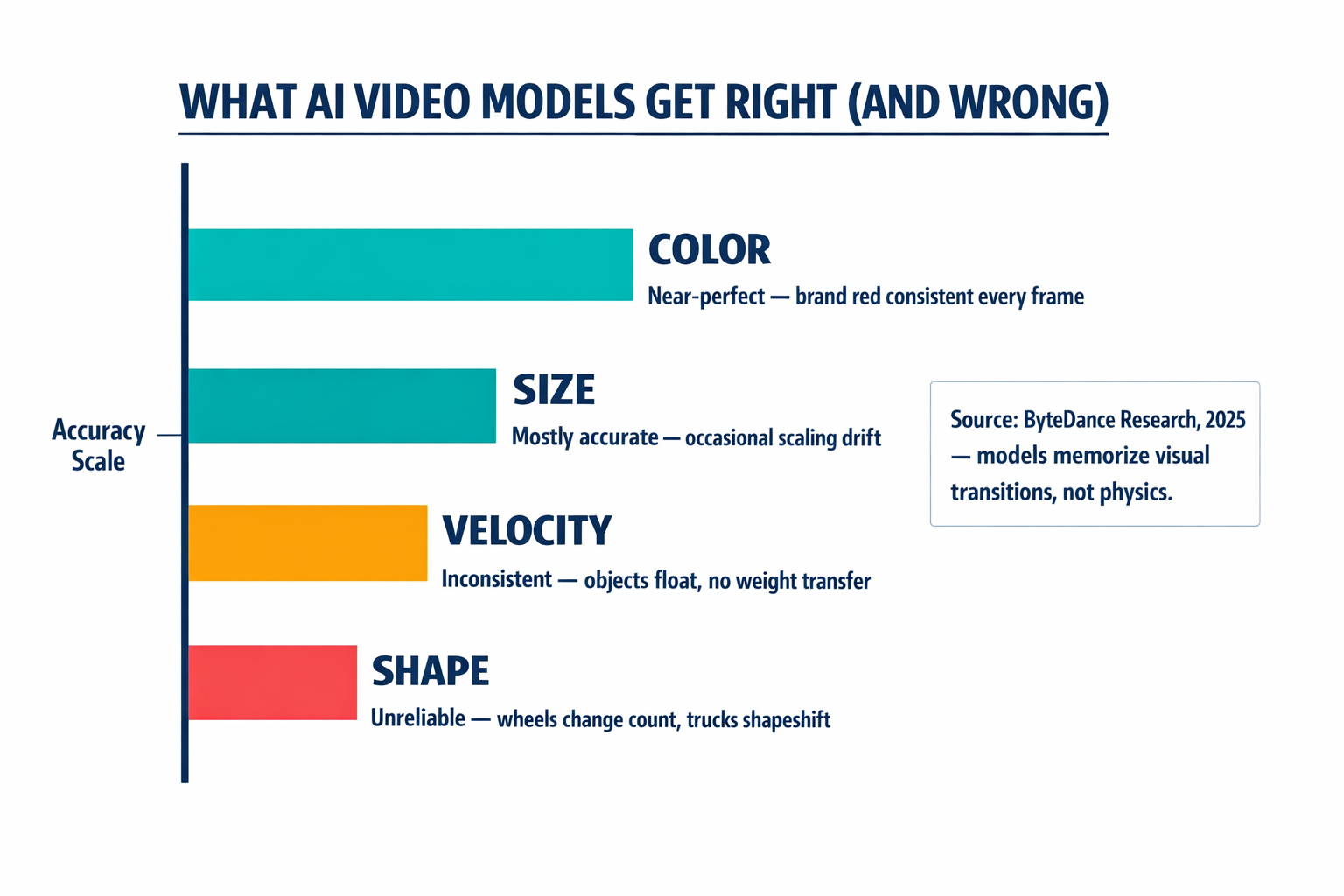
The trucks were worse. They changed length between shots. Wheel counts shifted. The vehicles appeared to float over the snow rather than drive through it. A ByteDance Research study published in 2025 confirmed what we were seeing: video generation models like Sora and Runway Gen-3 don't learn Newtonian physics. They memorize visual transitions. They can reproduce the appearance of a truck driving because they've seen thousands of driving videos, but they don't understand suspension, friction, or weight transfer.
The researchers found a telling hierarchy in what these models get right: color first, then size, then velocity, then shape—in that order of accuracy. That's why the Coca-Cola red was perfect in every frame, but the truck kept shapeshifting. The model prioritized the brand color and forgot how many wheels the vehicle had.
Why 70,000 Clips Still Weren't Enough
The production team behind the Coca-Cola ad generated over 70,000 video clips to assemble their 30-second spot. Think about what that means. Instead of a director composing a specific shot with intention, they essentially rolled the dice tens of thousands of times, then sifted through the results hoping to find something that looked least wrong.
This is what I call the "prompt-and-pray" methodology, and it's the defining weakness of what the industry calls "LLM Wrappers"—tools that are essentially pretty interfaces sitting on top of foundational AI models. You type a prompt, you get output, you cross your fingers.
Coca-Cola's head of generative AI insisted the craftsmanship was "ten times better" than their previous AI attempt. The public disagreed. One comment that stuck with me: "Coca-Cola is red because it's made from the blood of out-of-work artists." The narrative flipped from "Coca-Cola is innovative" to "Coca-Cola is cheap." That's a brand equity crisis, not a production efficiency win.
Toys 'R' Us made the same mistake with OpenAI's Sora, generating an AI origin story for Geoffrey the Giraffe. Sentiment plummeted. The AI-generated child actor was particularly disturbing—humans are biologically wired to protect children, and when a "child" on screen has shifting features and lifeless eyes, viewers don't just dislike it. They recoil.
The Campaign That Won a Cannes Grand Prix Did the Opposite
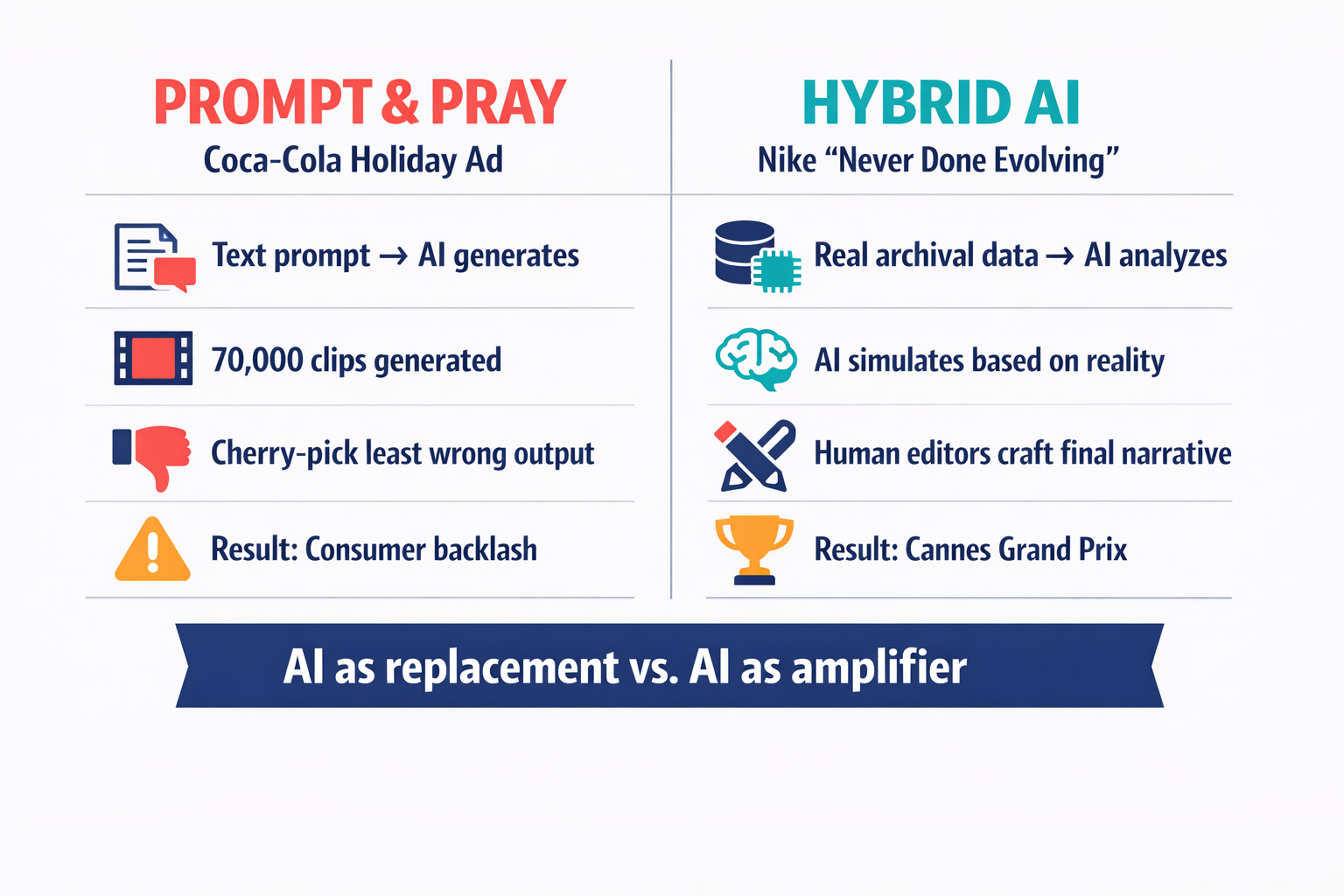
While Coca-Cola was generating 70,000 clips and hoping for the best, Nike took a completely different approach for their 50th anniversary. They used AI to simulate a tennis match between 1999 Serena Williams and 2017 Serena Williams.
The campaign, "Never Done Evolving," won a Grand Prix at Cannes. And the difference in methodology is everything.
Nike didn't ask AI to imagine Serena. They fed a machine learning model real archival footage of her gameplay—her speed, shot selection, reaction time across two decades. The AI calculated possibilities based on reality. It was a time machine built on data, not a hallucination generator fed a text prompt.
The AI generated the movements and gameplay logic. Human compositors and editors handled the visual fidelity and narrative pacing. Stanford's "vid2player" technique created behaviorally accurate simulations using domain knowledge of tennis, not pixel-level guessing.
Nike used AI to visualize something impossible. Coca-Cola used AI to avoid filming something real.
That distinction—AI as storytelling amplifier versus AI as human replacement—is the entire ballgame. I explored this divide in depth in our interactive analysis of hybrid AI architectures and brand equity.
The Trust Numbers Are Brutal
The consumer data on this is unambiguous. Only 13% of consumers trust ads created entirely by AI. That number jumps to 48% when humans co-create with AI. That's not a marginal difference—it's a 3.7x trust multiplier just for keeping humans in the loop.
NielsenIQ research found something even more concerning: AI-generated ads create a "negative halo effect" that damages brand perception beyond the individual campaign. Viewers labeled AI ads as "annoying," "boring," and "confusing"—even when the visual quality was objectively high. The synthetic quality itself becomes the message, drowning out whatever the brand intended to say.
When 44% of consumers say they're actively bothered by AI-generated content, "fully automated" isn't a production strategy. It's a brand risk.
Meanwhile, Dove built massive brand equity by campaigning against AI distortion with "The Code." Heinz ran an AI campaign that went viral—but they used AI to prove that when you ask an image generator to draw "ketchup," it draws Heinz. They turned the AI's limitations into a joke about brand dominance. Transparent, clever, and it didn't ask anyone to mistake a hallucination for reality.
What Actually Works: The Sandwich Method
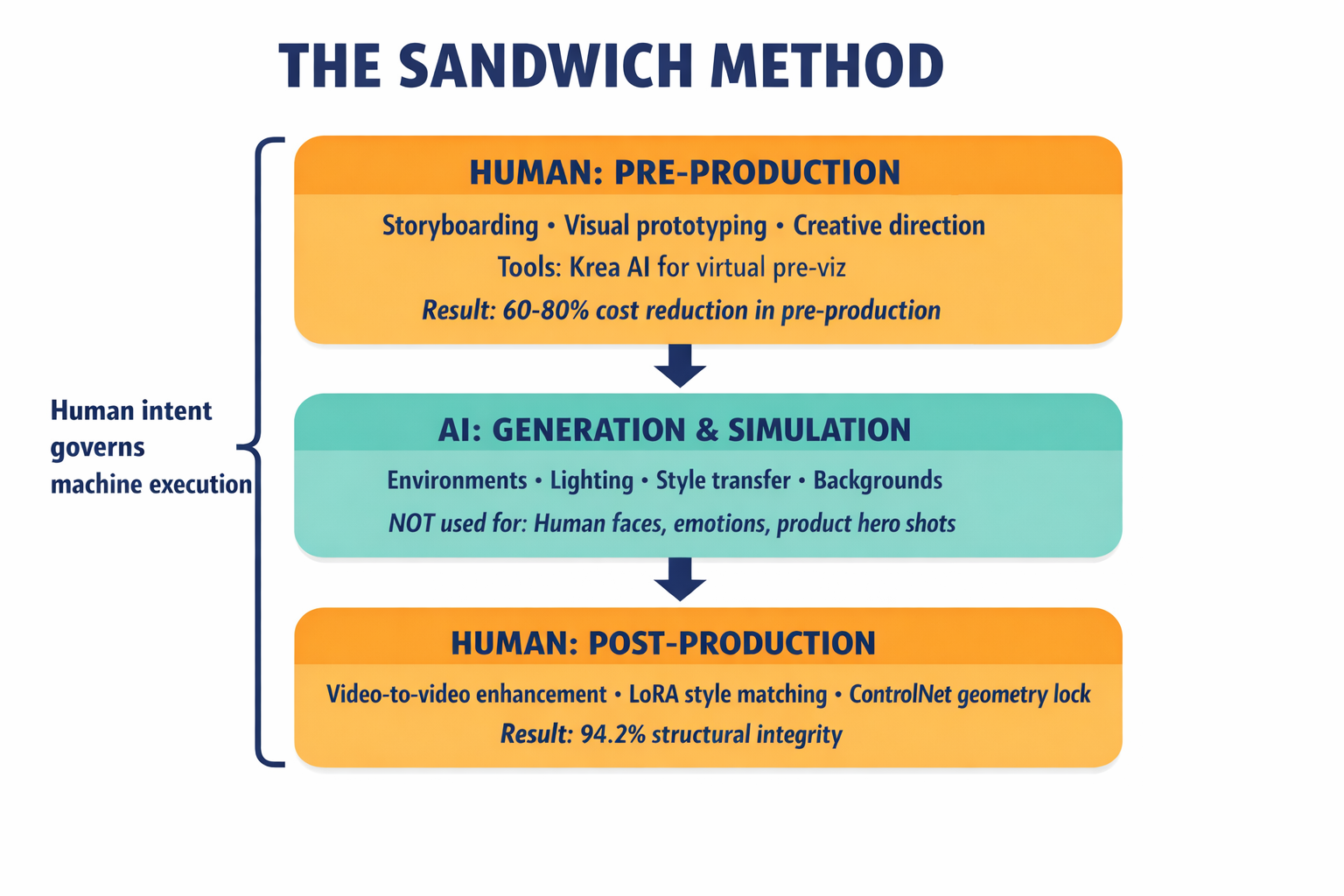
After studying dozens of AI campaigns—the failures and the successes—my team built a workflow framework we use with enterprise clients. We call it the "Sandwich Method" because human work goes on both sides of the AI layer.
Before the AI touches anything, we use generative tools for rapid storyboarding and visual prototyping. Tools like Krea AI let directors "shoot" the commercial virtually—iterating on lighting, composition, and pacing in real time. This cuts pre-visualization costs by 60-80% without committing to a final look. The AI dreams. Humans direct the dream.
For anything requiring emotional resonance—human faces, product interactions, moments of connection—we film real talent. The ByteDance physics study proved that AI cannot reliably simulate micro-expressions or fluid dynamics. So we capture those "hero" elements on set, often using AI-generated environments projected onto LED walls so actors interact with realistic lighting.
After filming, AI becomes a sculptor rather than a creator. We use video-to-video pipelines—not text-to-video—to transform, style, and enhance captured footage. Custom-trained LoRA models (lightweight style adapters) ensure every frame matches the brand's specific visual language. ControlNet locks the exact geometry of products, so a bottle's silhouette stays mathematically consistent while the AI handles lighting and backgrounds. Our testing shows this achieves 94.2% structural integrity compared to the variable output of prompting alone.
The result: AI accelerates the craft without replacing the humanity. Production timelines shrink. Budgets stretch further. And the final product passes the gut check that Coca-Cola's ad failed.
What About the Cost Argument?
The most common pushback I hear: "But full AI generation is so much cheaper." Let me reframe that.
A fully AI-generated campaign that triggers a brand trust crisis isn't cheap. It's the most expensive production decision you can make. The Coca-Cola backlash generated thousands of negative news articles and became a case study in what not to do—that's not a cost saving, it's a write-down on brand equity.
The hybrid approach delivers real efficiency gains without the reputational risk. Our clients typically see 60-80% cost reduction in pre-production, 30-40% fewer shoot days through AI-powered set extensions, and up to 90% reduction in localization costs using AI dubbing for global rollouts. For the full technical methodology behind these numbers, see our detailed research on hybrid AI production pipelines.
The question isn't "How much can AI save us on production?" The question is "What stories can AI help us tell that we couldn't afford to tell before—while keeping the human soul intact?"
Won't AI Video Models Just Get Better?
They will. A new generation of "World Models" that simulate actual physics rather than mimicking pixel patterns is in development, with meaningful capability expected around 2026-2027. But "better" doesn't mean "ready for premium brand storytelling." Even when models stop producing trucks with the wrong number of wheels, the trust gap will persist. Consumers aren't just reacting to visual glitches—they're reacting to the signal that a brand chose automation over craft.
The hybrid workflow isn't a stopgap until AI gets good enough. It's the permanent architecture. The tools inside it will evolve—better models, faster rendering, more precise control—but the principle stays the same: human intent governs machine execution.
I had a conversation with a creative director last month who put it perfectly. She said, "I don't want AI to make my ad. I want AI to make my ad possible." That's the distinction that separates the Coca-Colas from the Nikes.
The Real Question for Your Next Campaign
Stop asking your agency whether they "use AI." Every agency uses AI in 2025. The question that matters is how.
Are they using AI as the creator—generating final pixels from text prompts and hoping the output doesn't trigger an uncanny valley response? Or are they using AI as an accelerator—expanding what's creatively possible while keeping human judgment at every decision point?
The brands that will own the next decade of consumer trust are the ones that use AI to amplify what makes them human, not to automate it away. Coca-Cola's tagline is "Real Magic." The irony is that they forgot the first word.
If you're navigating this tension between AI efficiency and brand authenticity, I'd genuinely like to hear how you're approaching it. The playbook is still being written, and the best thinking I've encountered is coming from practitioners, not pundits.