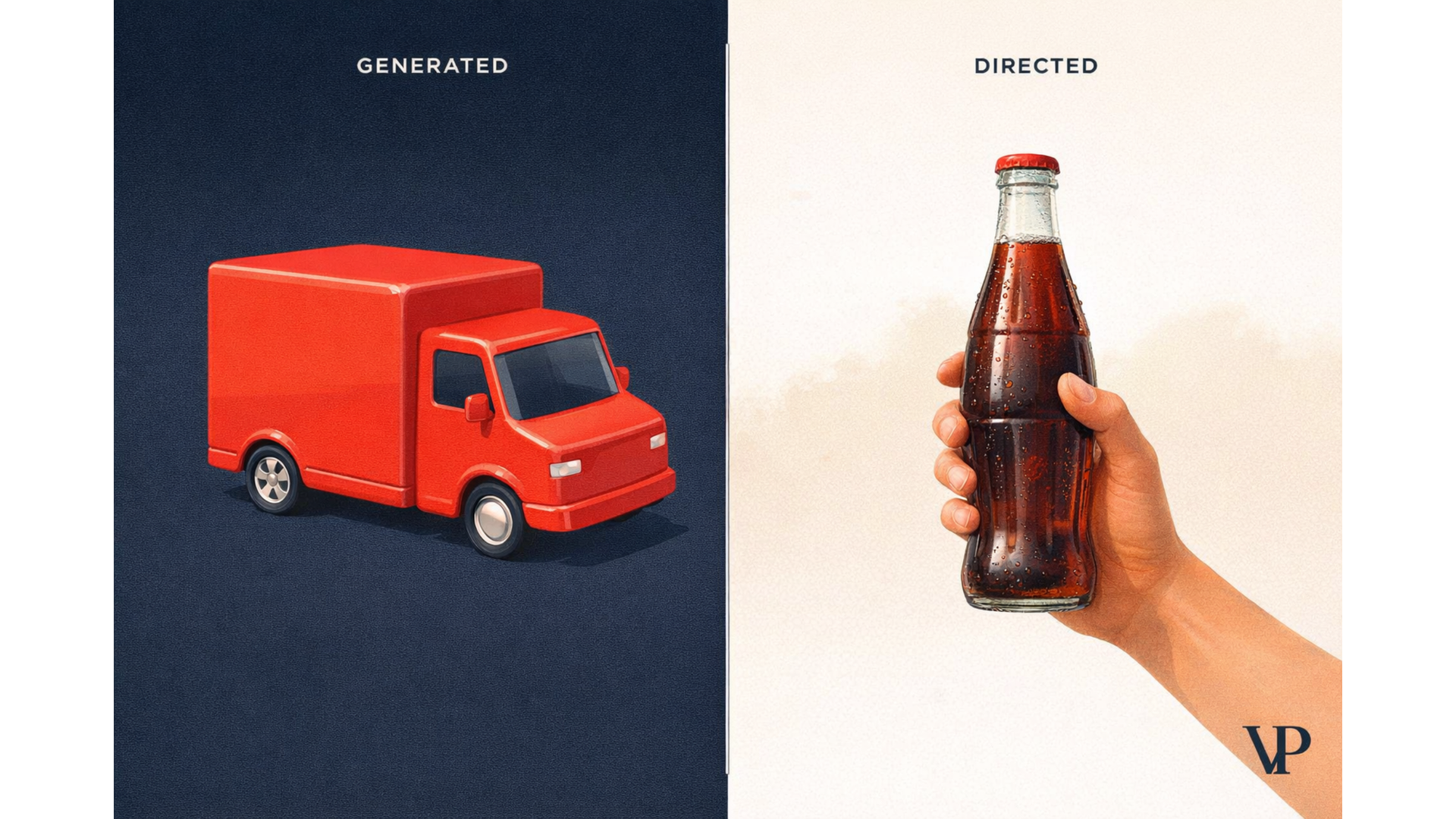
Coca-Cola generated over 70,000 video clips to assemble a single 30-second holiday ad. Consumers called it "soulless," "dystopian," and "uncanny." When one of the world's most recognizable brands — whose tagline is literally "Real Magic" — delegated the depiction of that magic to an algorithm, the brand promise broke before the first frame finished playing.
This wasn't a one-off stumble. It was a market signal. Our team spent the past several months analyzing why hybrid AI workflows — where human creativity directs machine speed — are the only viable path for enterprise brands that care about equity, trust, and emotional resonance. The era of the "AI wrapper," where companies simply pass prompts to a foundational model and publish whatever comes back, is over for any brand with something to lose.
The Problem Has a Name: Aesthetic Hallucination
We started calling this failure pattern Aesthetic Hallucination — when AI produces content that is visually plausible but emotionally hollow and physically incoherent.
The Coca-Cola ad had snow that glistened. Trucks that reflected light. Technically impressive textures everywhere. But the smiles didn't reach the eyes. The vehicles floated over terrain instead of interacting with it. The whole thing looked, as one critic put it, "part shiny, part plastic."
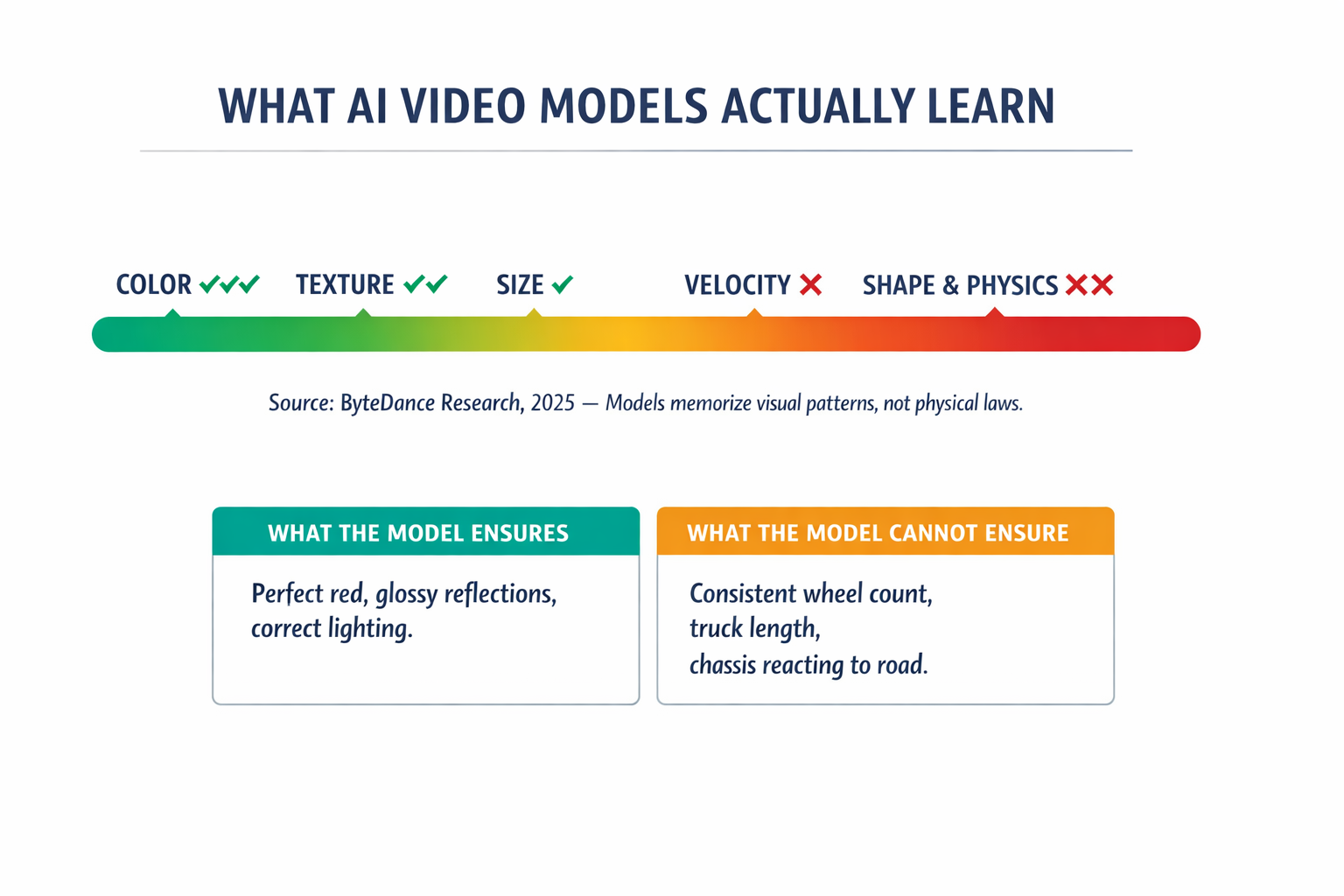
This isn't a rendering bug you can fix with a better prompt. It's structural. Generative video models don't understand the world — they memorize visual patterns. A 2025 ByteDance Research study confirmed what many suspected: models like Sora and Runway Gen-3 don't learn Newtonian physics. They memorize visual transitions from their training data and replay the closest match. They prioritize getting the color right (hence the perfect Coca-Cola red), but struggle progressively with size consistency, velocity, and shape.
AI video models can reproduce the appearance of a truck driving. They don't understand suspension, friction, or weight transfer. The wheels turn, but the chassis doesn't react to the road.
That's why the trucks in the Coca-Cola ad changed length, wheel count, and cabin shape between shots. The model ensured "red and shiny" in every frame but had no unified understanding of what a truck is. We call this the "Schrödinger's Truck" problem — the object exists in multiple contradictory states simultaneously because the model generates each moment independently.
Why "Soulless" Is the Most Expensive Word in Advertising
The technical failures matter, but the emotional rejection is what should keep CMOs awake at night.
A human smile involves involuntary micro-muscles — particularly the orbicularis oculi around the eyes, which creates what psychologists call the "Duchenne marker" of genuine happiness. Diffusion models, which operate on pixel-level probability rather than anatomical rules, consistently miss these cues. The result: mouths that curve upward attached to eyes that are completely dead. Your subconscious registers this instantly, even if you can't articulate why.
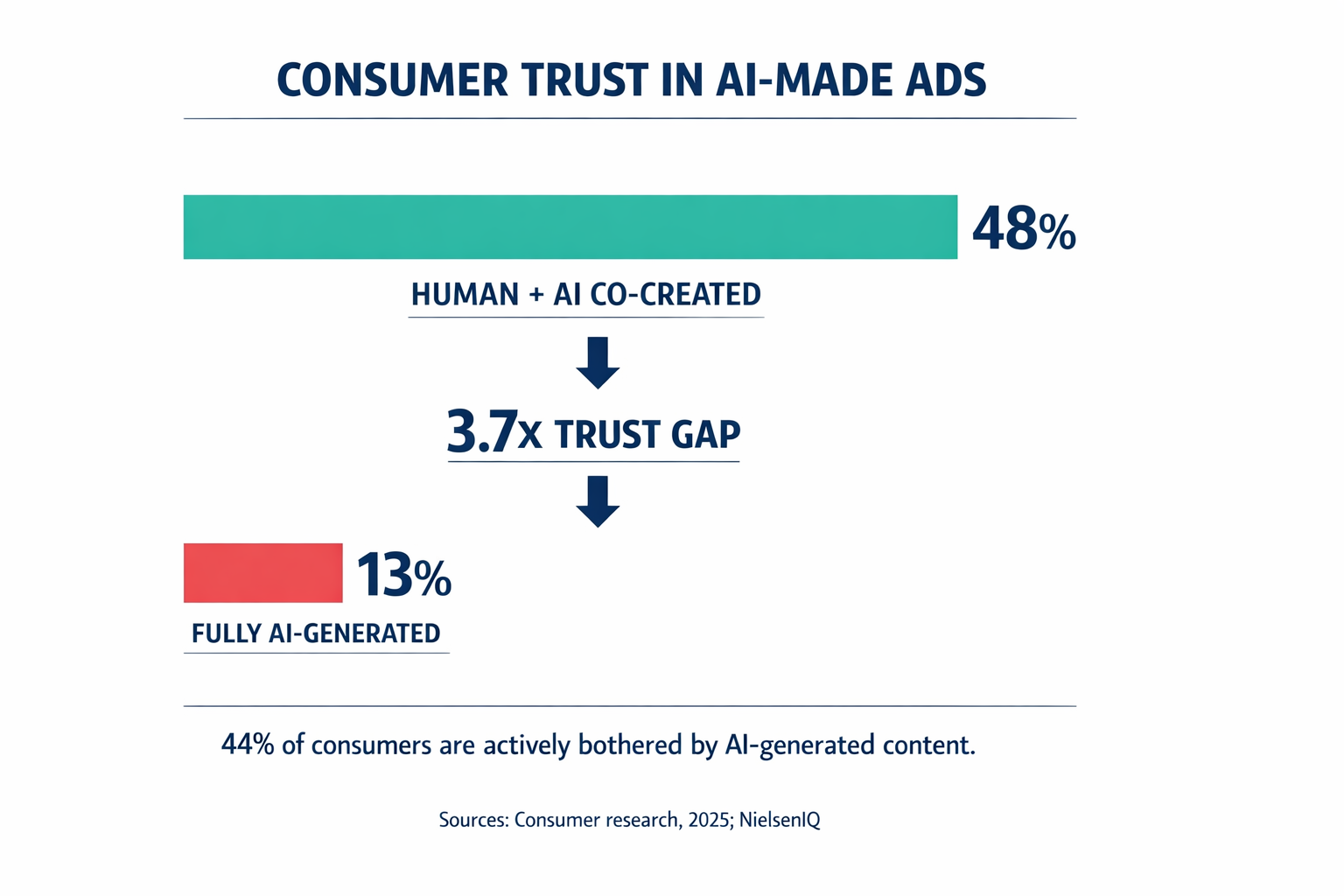
The data on consumer trust is stark. Research from 2025 shows that only 13% of consumers trust ads created entirely by AI, compared to 48% who trust ads co-created by humans and AI. That's not a gap — it's a chasm. NielsenIQ found that even polished AI ads create a "negative halo effect," damaging brand perception beyond the individual campaign. Viewers labeled them "annoying," "boring," and "confusing" — even when the visual quality was high.
Trust drops from 48% to 13% when consumers learn an ad was made entirely by AI versus co-created with humans. For premium brands, full automation isn't a strategy — it's a reputational bet with terrible odds.
Coca-Cola's ad didn't just underperform. It shifted the narrative from "Coca-Cola is innovative" to "Coca-Cola is cheap." Comments like "Coca-Cola is red because it's made from the blood of out-of-work artists" became the dominant conversation. The brand signaled that it didn't care enough to film the real thing — violating the tacit contract of effort and craft that underpins heritage branding.
We explored this dynamic in depth in our interactive analysis of hybrid AI and brand equity.
Nike Did the Opposite — And Won a Grand Prix
Not every brand got this wrong. Nike's 50th-anniversary campaign, "Never Done Evolving," used AI to simulate a tennis match between 1999 Serena Williams and 2017 Serena Williams. It won a Cannes Grand Prix and universal acclaim.
The difference wasn't budget. It was architecture.
Nike didn't ask an AI to imagine Serena. They fed a machine learning model real archival footage of her gameplay — analyzing her speed, shot selection, and reactivity across two decades. The AI calculated possibilities based on reality. It was a "time machine" that visualized data, a feat impossible with traditional filming. Stanford's "vid2player" technique generated behaviorally accurate gameplay, while human compositors and editors ensured visual fidelity and narrative pacing.
Heinz took a different but equally smart approach. Instead of presenting AI output as reality, they used AI to prove a brand truth — that when you ask an AI to generate "ketchup," it generates something that looks like Heinz. They turned the hallucination bug into a brand dominance feature. The campaign went viral because it was transparent, clever, and used AI's limitations as the punchline rather than trying to hide them.
The brands that win with AI aren't the ones replacing human creativity. They're the ones using AI to do things that were previously impossible — and being honest about it.
Under Armour's Anthony Joshua campaign combined AI-generated surreal environments with actual footage of Joshua's face. Volkswagen used AI invisibly in post-production while keeping human actors and storytelling scripts at the center. In every success story, the pattern is the same: AI accelerates the craft. It doesn't replace the humanity.
How Hybrid AI Workflows Actually Work
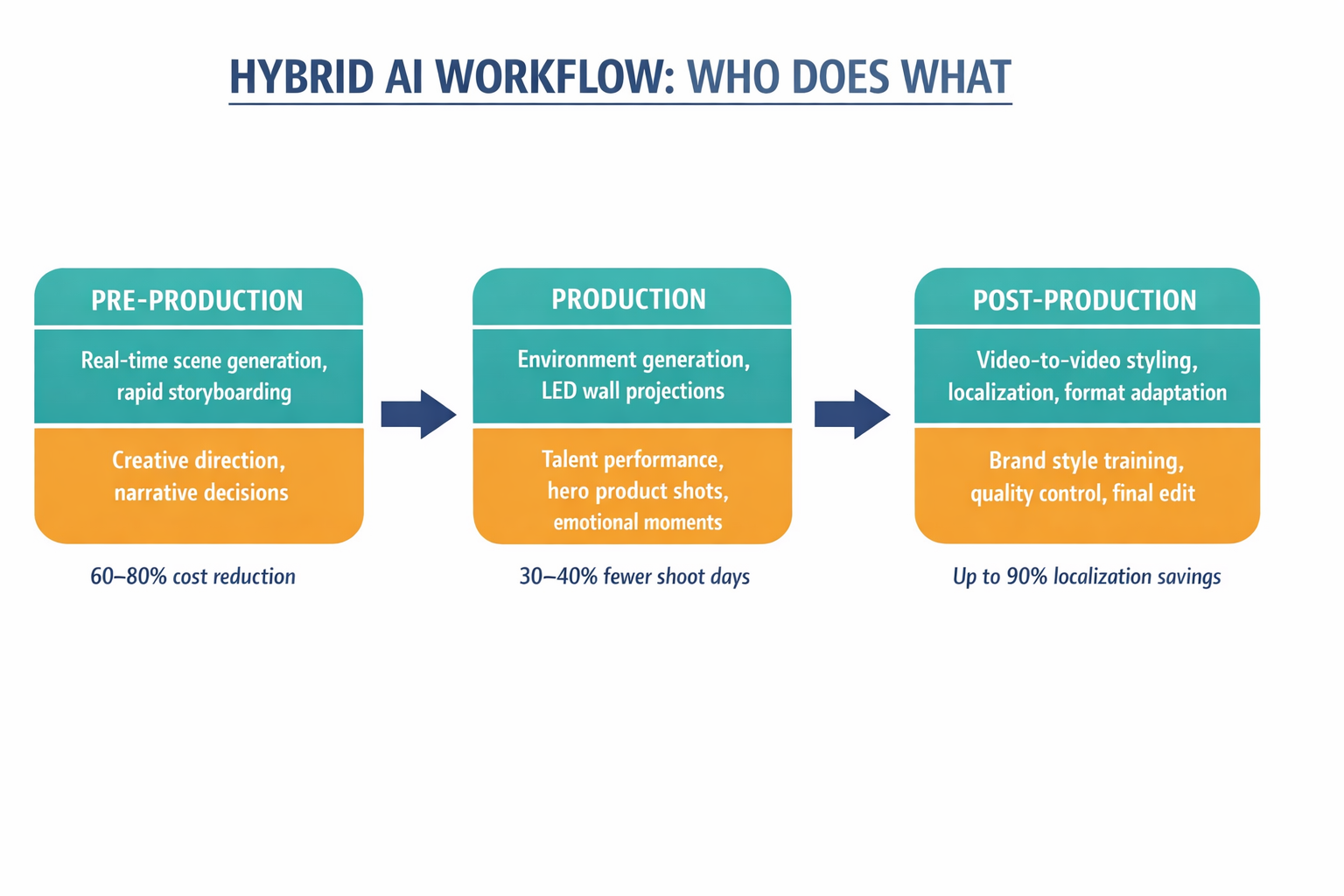
The principle is straightforward: human intent governs machine execution at every layer. The implementation has three distinct phases.
In pre-production, AI becomes a rapid visualization tool. Real-time generation platforms allow directors to sketch a layout and see it rendered photorealistically in milliseconds. This cuts storyboarding and animatic costs by 60–80% — without committing to a final look. The creative team can "shoot" the commercial virtually, iterating on lighting, composition, and pacing before a single camera rolls.
During production, anything requiring emotional resonance — human faces, crucial product interactions — gets filmed with real talent. As the ByteDance physics study demonstrates, AI cannot yet reliably simulate the micro-expressions of joy or the fluid dynamics of a pouring drink. We advocate a "sandwich" method: film the hero elements (the actor, the product) on green screen or LED volumes, then use AI to generate high-fidelity environments projected onto those LED walls. The actor interacts with real light from a synthetic scene.
Post-production is where the deep technical work happens. Instead of text-to-video generation (typing a prompt and hoping), hybrid workflows use video-to-video pipelines — transforming, styling, and enhancing captured footage. Custom-trained style models ensure that even AI-enhanced footage "feels" like the brand. For a client with 20 years of distinctive cinematography, we can train a lightweight adapter on their specific color grading, film grain, and illustration style. The AI output inherits the brand's visual DNA rather than defaulting to generic "AI sheen."
The structural integrity numbers tell the story. Using geometric anchoring techniques like ControlNet — where the AI is forced to generate around the exact shape of a brand's product rather than guessing from a text description — we see 94.2% structural consistency compared to the wildly variable output of prompting alone. The product silhouette stays mathematically locked. The lighting and environment can be generative and creative. The brand asset never morphs.
For the full technical methodology behind these pipelines, see our detailed research on hybrid AI architectures for brand equity.
The Efficiency Case (Without the Quality Sacrifice)
The ROI of hybrid workflows comes from process acceleration, not creative replacement. That distinction matters.
Pre-production: 60–80% cost reduction in storyboarding and animatics
Production: 30–40% fewer shoot days by using AI for backgrounds and set extensions, freeing budget for high-quality talent and directors
Post-production: Up to 90% reduction in localization costs — global campaign rollouts in days instead of months through AI dubbing and format adaptation
These are real efficiency gains. But they come from using AI where it excels (speed, scale, variation) and keeping humans where they excel (emotional judgment, physical accuracy, brand intuition). The savings fund better creative work rather than eliminating it.
What About Brands That Can't Afford Full Production?
This is the most common pushback, and it's fair. Not every brand has Nike's budget.
The answer isn't "use raw AI output anyway." It's to be strategic about where AI carries the load. A mid-market brand can use AI-generated environments and backgrounds extensively — those are the elements where hallucination is least damaging. But the human face, the product in hand, the moment of emotional connection? Film those. Even a single day of targeted shooting, combined with AI-powered post-production, produces results that fully synthetic content cannot match.
The trust data doesn't care about your budget. 44% of consumers are actively bothered by AI-generated content, and that number skews higher among the demographics most brands are trying to reach. Saving money on production while destroying trust is not an efficiency gain — it's a false economy.
And What Happens When the Models Get Better?
They will get better. The next generation of "world models" — systems that simulate physics rather than just pixels — are estimated to mature around 2026–2027. When they arrive, the gap between synthetic and real will narrow significantly.
But that future actually strengthens the case for hybrid workflows, not weakens it. Brands that build the governance frameworks, the custom style models, and the human-AI collaboration muscles now will be positioned to leverage those better models immediately. Brands that spent 2025 publishing raw AI output will have spent two years training their audience to distrust them.
The novelty of "look what the AI made" has faded. The new standard is "look what we made with AI."
The Real Question Isn't About Cost
Coca-Cola's failure wasn't a failure of technology. It was a failure of strategy. They substituted the output (a video file) for the outcome (human connection). They forgot that "Real Magic" is a human experience, not a rendering task.
The question enterprise brands should be asking isn't "How much money can AI save us on production?" It's "How can AI help us visualize stories we couldn't afford to tell before — while keeping the human soul of our brand intact?"
The first question leads to the uncanny valley. The second leads somewhere worth going.
If your team is navigating this tension between AI efficiency and brand authenticity, we'd genuinely like to hear what you're finding. The playbook is still being written, and the brands getting it right are learning from each other.