My first flood detection pipeline treated single satellite acquisitions as verdicts. NDWI fires above a threshold, mark the pixel flooded; MNDWI confirms, note the extent. What I hadn't accounted for is that NDWI and MNDWI flag both inundated terrain and cloud shadows as water-like — because both suppress near-infrared and shortwave infrared reflectance through nearly identical physics. A single Sentinel-2 frame cannot distinguish between them. I was building a system with the same false positive failure mode as every parametric trigger I later learned had misfired.
The false positive and false negative failures in parametric flood insurance share the same root cause: most trigger systems are anchored to a single satellite acquisition, which is the wrong unit of analysis for a classification problem that requires temporal context.
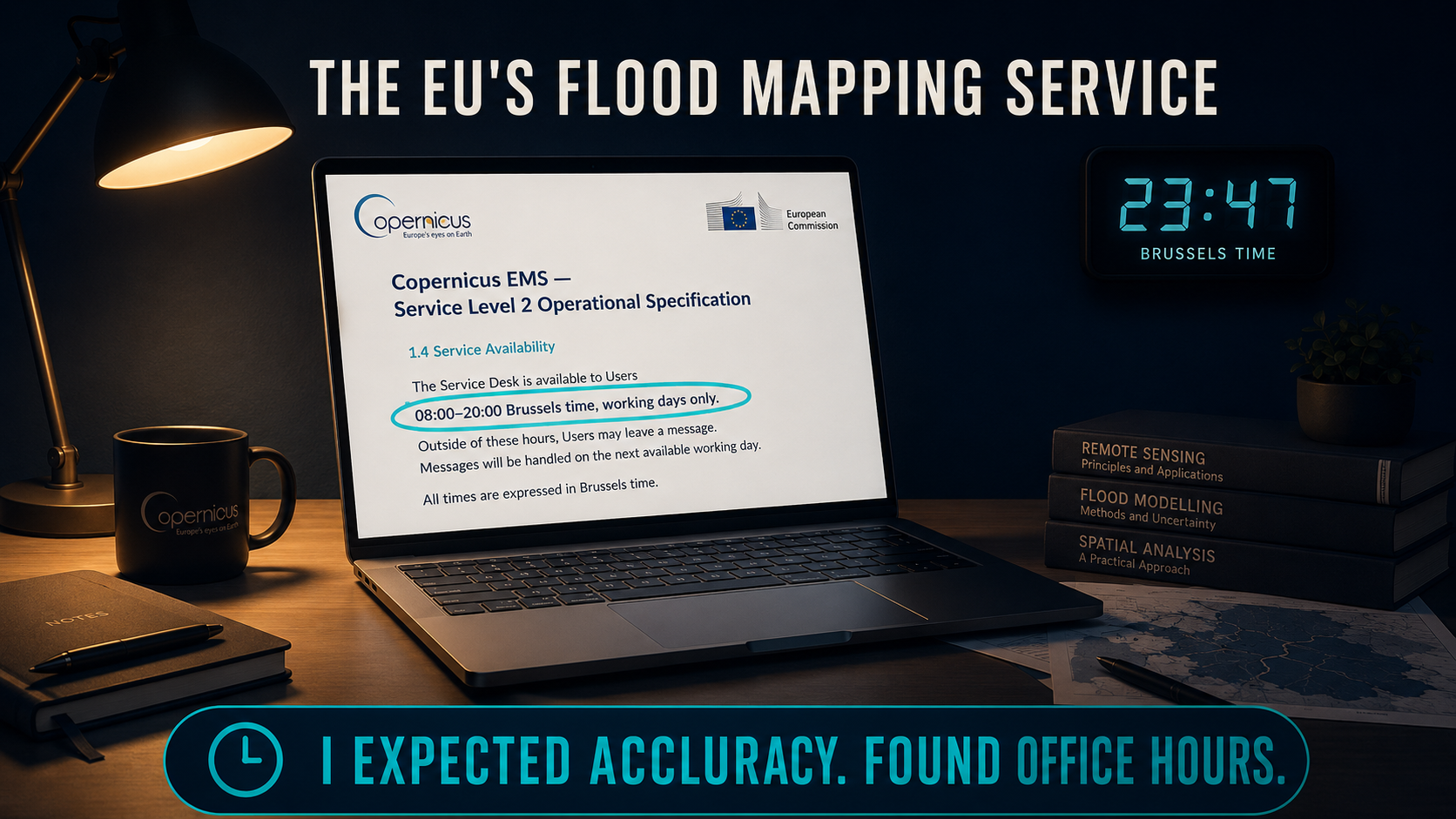
I Found a Business-Hours Constraint Where I Expected Accuracy Benchmarks
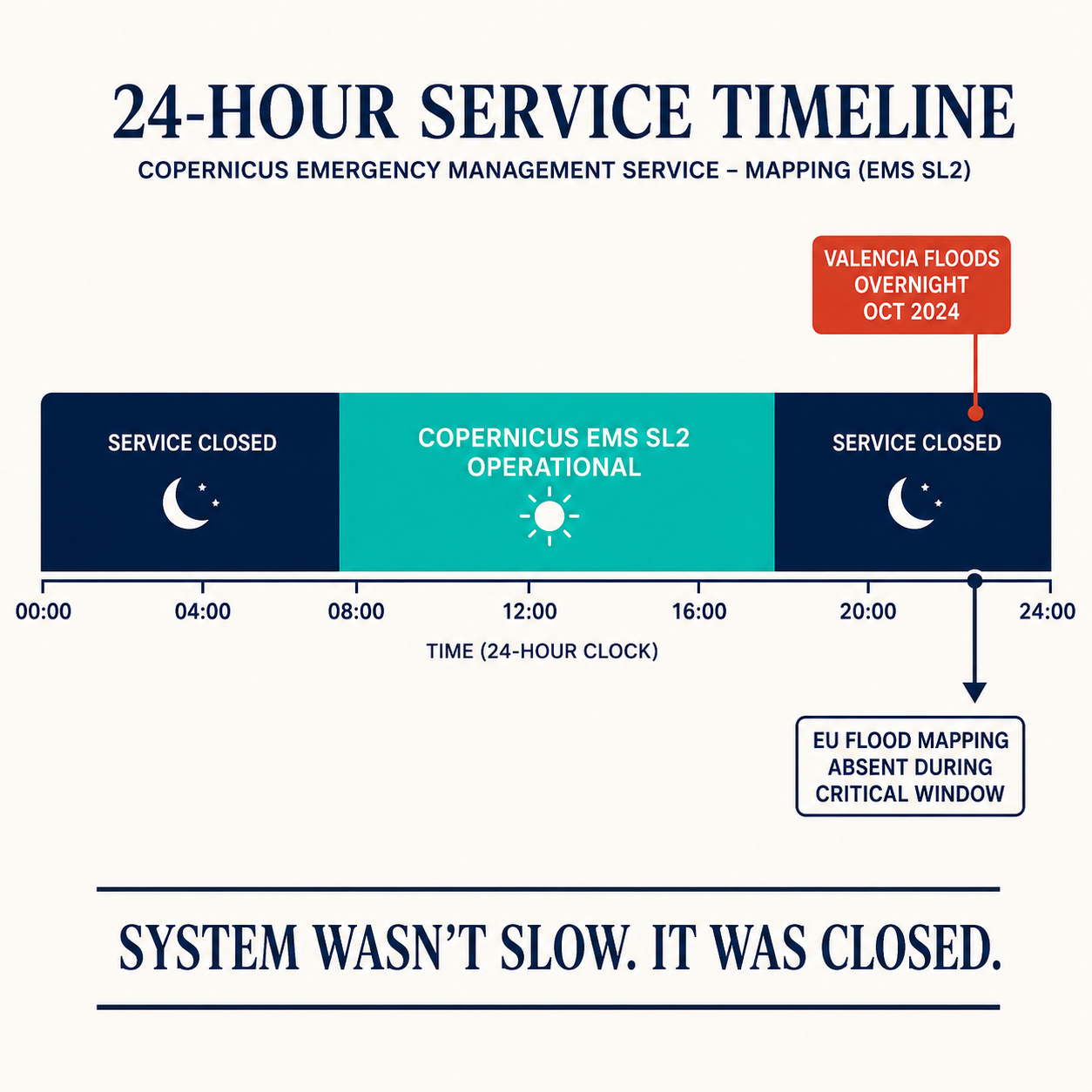
Reading the Copernicus Emergency Management Service operational specification, I was looking for revisit rates and detection accuracy thresholds. What I found was a service-hours clause — Service Level 2 operates 08:00 to 20:00 Brussels time, on working days only.
I traced that against Valencia's October 2024 timeline to understand what it meant. A year's worth of rain fell in eight hours. 227 people died. The Copernicus flood extent analysis — 15,633 hectares confirmed flooded, roughly 190,000 people affected — arrived three to four days after the event. The delay wasn't a sensor problem or a resolution problem. Valencia's critical first twenty-four hours overlapped with evening and overnight. The EU's designated satellite flood-mapping service was structurally closed when the trigger data mattered most.
I keep returning to that constraint because it reveals something about how this field was designed. Emergency mapping conceived as an office-hours service means the systems weren't built for the thing parametric insurance actually requires: trigger verification at event time, not post-event documentation that arrives three days later.
The vendor products in this space have the same design orientation, whatever their technical capability. ICEYE's Flood Rapid Impact delivers post-event analysis in six to twelve hours across a constellation of more than 60 SAR satellites — genuinely impressive — and its partnership with Munich Re's Risk Management Partners (January 2026) and its arrangement with Swiss Re reflect real reinsurer conviction. Floodbase (formerly Cloud to Street) fuses seventeen optical and radar satellites, has Capella Space SAR extending its coverage, and has built end-to-end parametric trigger certification for Munich Re programs in Colombia. These are well-designed products. What neither of them provides is a forensic verification system calibrated to a specific portfolio's trigger zones, cover regions, and evidence-chain requirements. You get their methodology. That's the constraint I keep running into.
What the Actuary's Question Changed
The conversation that reframed how I build this came from an actuary reviewing a parametric program design. She asked what documentation would accompany the trigger certificate if the payout were disputed in court.
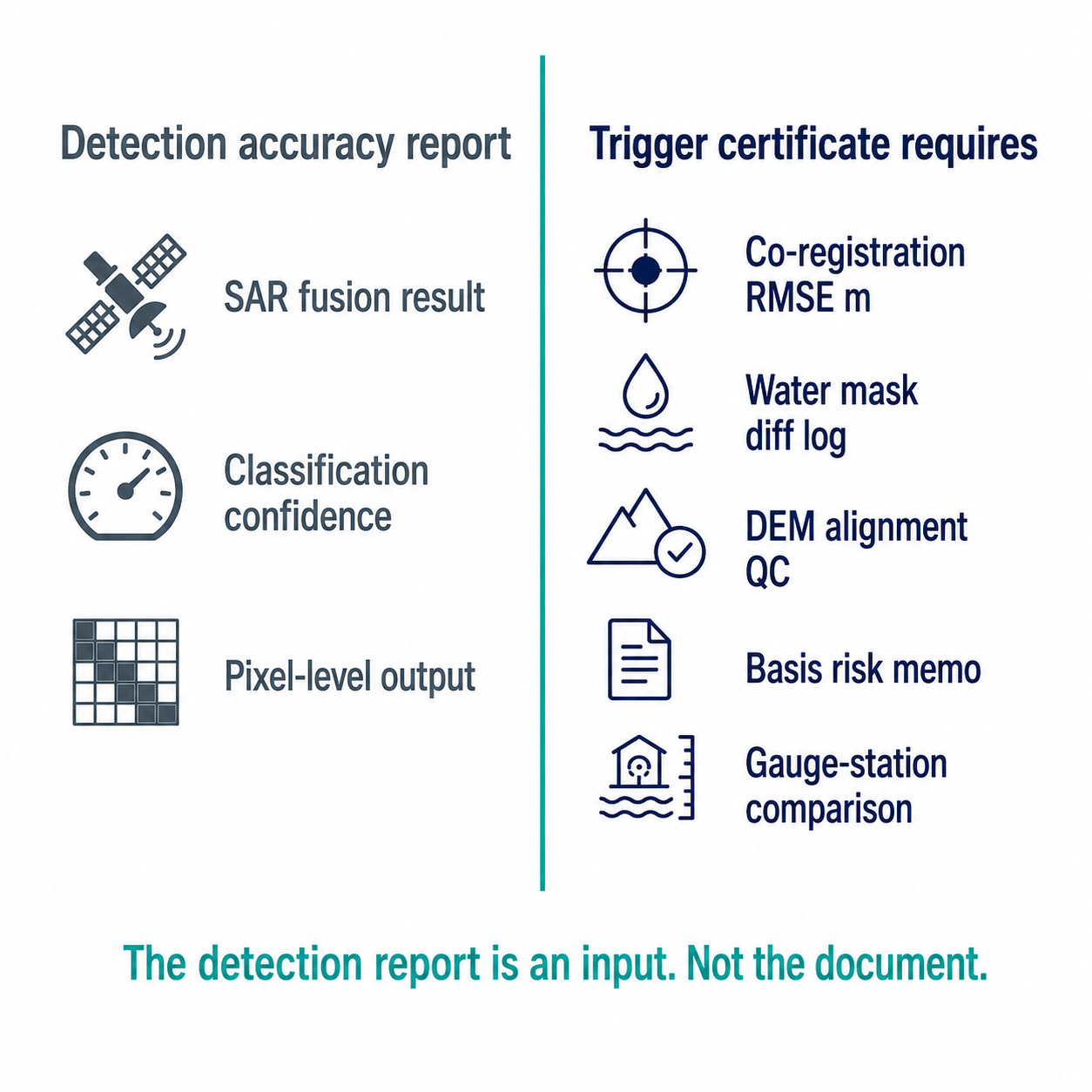
My answers described detection accuracy: temporal fusion, multi-polarization SAR, SAR-optical co-registration results. She listened and then said the detection accuracy report isn't the document — it's an input to the document.
She was right, and I hadn't thought it through clearly enough. The trigger certificate — the signed document authorizing the payout — has to survive reinsurer audit, regulatory review, and potentially a federal judge examining the flood extent polygon attached to the loss adjustment worksheet. The detection algorithm's output is one layer. The SAR-optical co-registration accuracy report (RMSE in meters, not just a confidence label), the permanent water mask diff log showing whether any classified flood zone was a newly formed reservoir not yet in the baseline, the hydrological DEM alignment quality-control overlay, the basis risk analysis memo comparing the satellite trigger zone to gauge-station records — these are the layers between the satellite image and what the actuary signs.
I had been solving for pixel-level detection. She was asking about forensic defensibility.
A detection accuracy report is an input to the trigger certificate. It's not the trigger certificate. The question is what documents the actuary can sign and defend.
The architecture at Veriprajna's satellite flood intelligence page starts from the trigger certificate and works backward to the sensors, rather than starting from the sensors and hoping the output is certifiable.
The Wrong Unit of Analysis — and What Temporal Stacks Actually Prove
When I traced why NASA suppresses the LANCE near-real-time flood product's one-day composite from the Worldview visualization tool entirely — the false positive rate is operationally unacceptable; only two-day and three-day temporal persistence composites are released for end users — the temporal stack concept shifted from a research curiosity to the obvious unit of analysis.
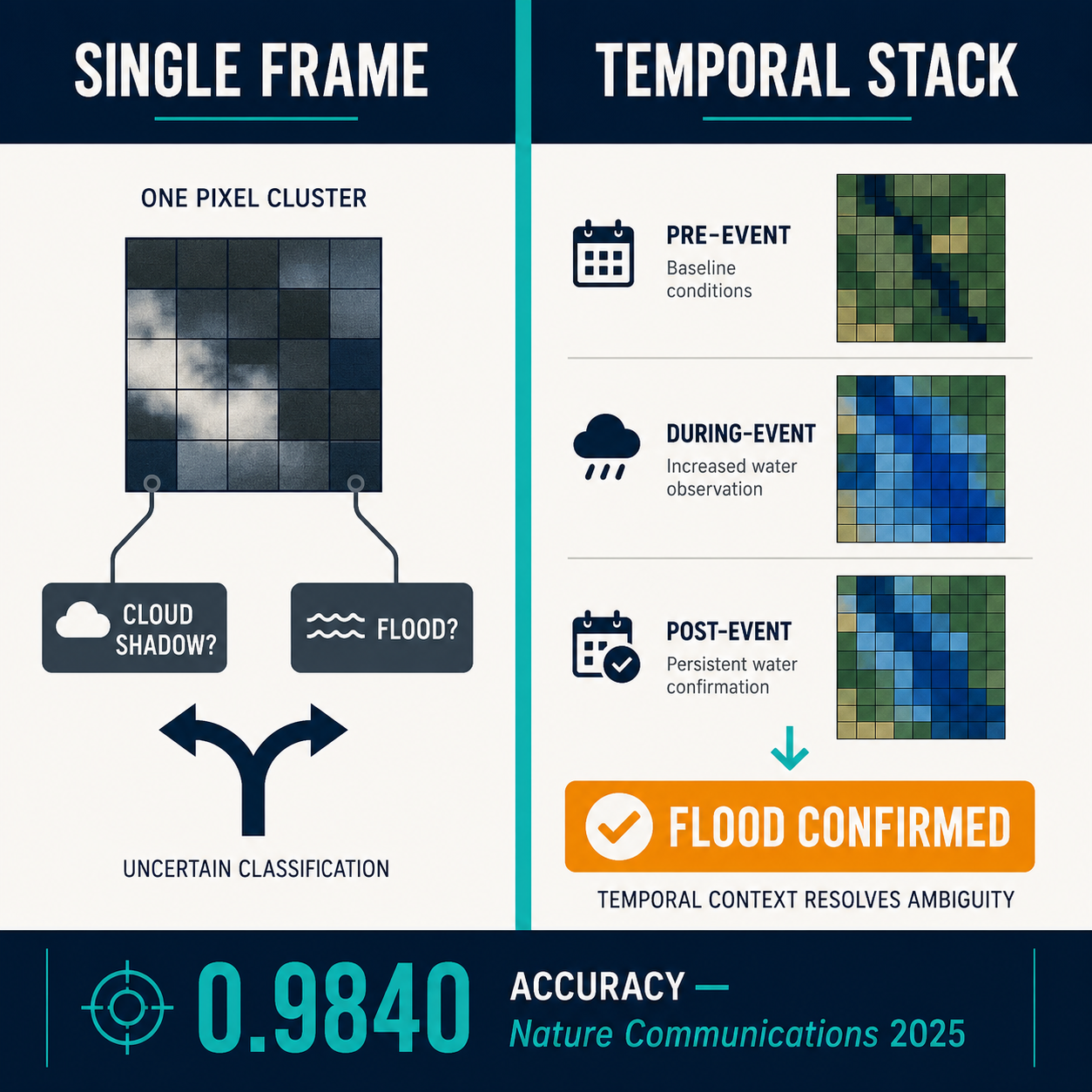
A single SAR acquisition has ambiguity a temporal stack doesn't. Sentinel-1's VV-polarization backscatter drops over smooth water (specular reflection, signal goes away from the sensor) but also drops over terrain shadows in mountainous areas due to radar layover and foreshortening. What becomes unambiguous is how a specific patch of ground behaves across multiple passes — pre-event baseline, during-event acquisitions, post-event confirmation — fused with optical data during any cloud-clear window. Research published in Nature Communications (2025), using ten years of Sentinel-1 data, demonstrates the result: 0.9840 overall accuracy, F1 of 0.9207 using modified DeepLabV3 with multi-polarization SAR and terrain correction. SAR-multispectral fusion improved detection in cloud-shadow areas by more than 23.64 percent over single-sensor approaches.
My working assumption changed: a single acquisition is an input to a temporal stack, not a trigger verdict. The Sentinel-1 constellation restoration helps on the data access side — Sentinel-1C launched December 2024, reaching operational status in May 2025; Sentinel-1D followed in November 2025, restoring six-day revisit on free data. That revisit interval is still too slow for real-time monitoring during a fast-moving flood event, so rapid-trigger programs need commercial SAR supplementing the free baseline. At $1,000 to $5,000 or more per scene depending on resolution and urgency, that's a production cost decision, not a research decision. Worth it when a payout is $2M; not worth it if the trigger methodology doesn't produce a certifiable evidence chain.
What I Think About When the Scale Gets This Large
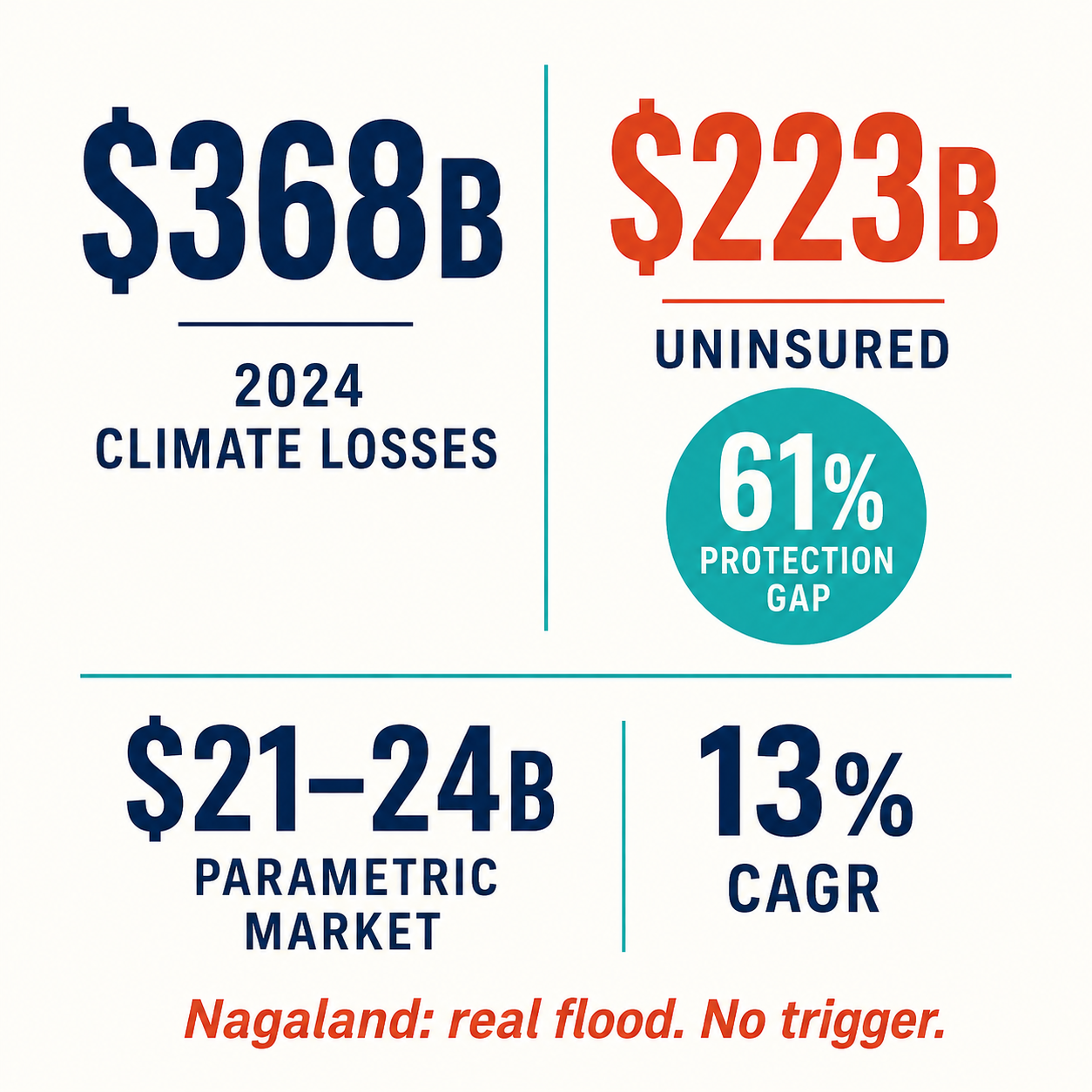
What I keep returning to when I see programs expanding at this scale is the Nagaland failure: the parametric flood scheme that failed to trigger despite confirmed on-the-ground flooding, because the satellite-derived threshold was calibrated too high relative to ground reality. Policyholders paid premiums; the trigger returned null. That's the false negative problem — the opposite direction from Valencia's latency failure, the same underlying cause.
The Lagos parametric flood insurance program, launched March 2026, covers four million people through AXA Climate, Swiss Re, JBA Risk Management, ICEYE, and African Risk Capacity. Floodbase and Yokahu extended parametric flood coverage to New Orleans businesses in April 2025. The market is $21–24 billion and growing at roughly 13 percent annually, because a $368 billion climate loss year in 2024 — $223 billion of it uninsured — makes the protection gap impossible to ignore.
Programs at this scale will encounter both failure modes. The question isn't whether the accuracy is achievable — the research shows it is. The question is whether the programs were designed from the evidence chain outward, or assembled from vendor products and then asked to justify themselves retroactively when a trigger is disputed. The programs that survive that scrutiny will be the ones where the actuary knew what she was signing before the first event arrived.