A review can sound ordinary while the account behind it acts in concert with other accounts. For brand-protection and trust-and-safety teams assessing review fraud, that distinction changes what a detector needs to explain. A writing score describes properties of a piece of text. It cannot, on its own, explain whether several reviews represent independent activity.
We use Campaign Firewall, our synthetic review-fraud demonstration, to make that distinction inspectable. Its most useful example is a modeled campaign of 15 reviews on a competitor listing. Eleven have little writing anomaly, yet their account relationships connect the group. The design question is what that evidence should prompt a reviewer to examine, and what remains unproven.
A quiet text signal can coexist with a connected campaign
The 15 reviews belong to a synthetic example modeled as an all-human paid campaign. That is a fixture label, not evidence that real people wrote the reviews or received payment. All reviews, account histories and platform connections in this demonstration are synthetic.
The local text-only baseline flags four of those 15 reviews. Eleven have a low stylometric component, meaning little anomaly under this implementation's writing checks. Neither result certifies authorship. The baseline is looking at wording; the planted campaign concerns how accounts behave together.
The campaign card below makes the gap visible. Its lower card shows the 15-record group, 11 records marked “Text-Clean,” and shared product-history evidence. “Text-Clean” is a label for low writing anomaly in the demo. It is not a certificate of an independent, authentic review.
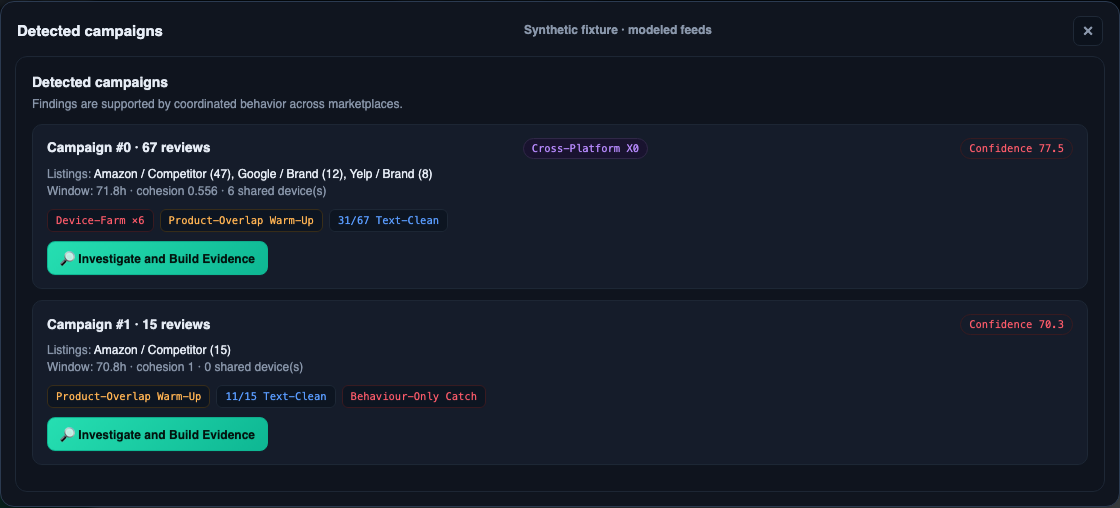 The lower card combines low writing anomaly with a connected account pattern in the synthetic 15-review campaign.
What connects the accounts is a modeled overlap in their product histories within a compressed period. The relationship rule requires qualifying history overlap, the same listing and review timestamps no more than 72 hours apart. Timing alone creates no connection. That matters because a burst of reviews and a set of accounts with overlapping histories are different observations.
We regard this as a reason to inspect the group. Looking at each review in isolation loses the shared pattern that made it consequential. Looking only at the group, however, could hide which records actually support the connection. A useful investigation needs both the campaign context and the signals behind its members.
The evidence should determine the next step
Campaign Firewall combines writing, account behavior, timing and relationship signals into a heuristic score. For this 15-record example, it routes every record to REVIEW. That state represents a human review route in the modeled policy. It does not mean a person has completed the investigation or that a platform has taken action.
The comparison panel below illustrates the routing distinction with eight selected rows. It is not the complete 15-record campaign. The upper rows include campaign-labeled records routed to REVIEW despite the local baseline seeing no text anomaly. The lower rows are genuine-labeled synthetic records that the ensemble clears even though the baseline flags their wording.
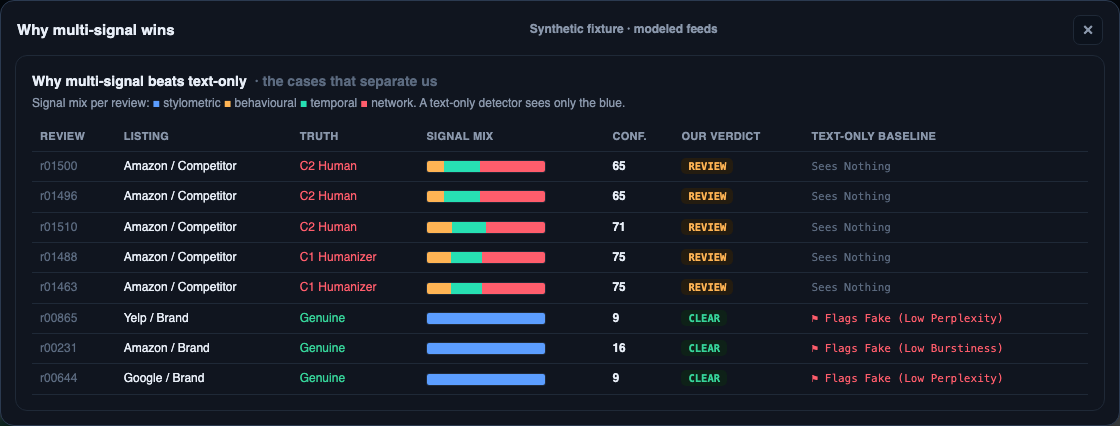 Selected campaign records go to REVIEW, while selected genuine-labeled records go to CLEAR despite text-only flags.
These cleared rows are part of the design argument. A writing anomaly deserves a reasoned interpretation, just as an ordinary-looking sentence does. Treating either as a final verdict would ask a narrow signal to resolve a broader question about review activity.
For a team evaluating a detection system, we would ask whether a reviewer can identify the accounts involved, inspect the relationship rule and distinguish that evidence from the proposed consequence. A cluster label alone offers little basis for challenging the finding. A record of the connections gives the reviewer something specific to accept, reject or investigate further.
Even strong relationship evidence leaves important questions open. Shared histories do not independently establish payment, actual authorship or a legal violation. The demonstration prepares investigation documentation and an unfiled dispute draft. It neither removes reviews nor files disputes. Preserving those boundaries is part of making the evidence usable.
What this comparison can establish
The four-of-15 text-only result and the 15 REVIEW routes are observations on the same synthetic fixture. Both methods derive their text percentiles from that corpus, and the ensemble's review threshold was fitted using its labels. This comparison is an in-sample reproducibility check, not a held-out evaluation or a claim about commercial detectors.
Before operational use, evaluation on new data would need to test whether the relationship rules continue to identify useful groups and what they do to genuine review activity. The synthetic case supplies a concrete failure mode to examine. It does not settle performance outside the fixture.
The Campaign Firewall breakdown explains the example and its evidence. For teams assessing review-fraud tooling, we would make the purchasing criterion explicit: the system should expose why accounts appear related and what further judgment the finding requires. A plausible sentence cannot close that inquiry, and a connected group should open an investigation with an inspectable reason.