A review-fraud finding can be strong enough to warrant an investigation while leaving the case for restricting a review unresolved. Product teams need to preserve that difference in the system's output. Otherwise a useful signal can acquire more authority each time it moves from a score to a narrative to a dispute draft.
My standard is that the evidence should explain the next permitted step. A system that exposes suspicious account relationships has answered a different question from one that establishes who wrote a review, whether someone was paid, or whether a platform's policy was violated. Treating those answers as interchangeable makes an escalation workflow difficult to defend.
Believable wording leaves an account question open
In our Campaign Firewall demonstration, one synthetic campaign contains 15 reviews on a modeled Amazon competitor listing. Eleven have little stylometric anomaly, meaning the writing-pattern checks contribute very little to their scores. The local text-only baseline flags four of the 15. Those results do not certify human authorship; every review and account history in the example is synthetic.
The accounts' shared product histories supply a different reason to examine the group. The detector links overlapping histories within the same listing and a bounded review window. It does not create a relationship merely because two reviews arrive close together. The combined heuristic routes all 15 records to REVIEW, an escalation for human examination rather than completed human review.
This changes the reviewer’s question. Asking only whether the prose looks generated misses why these accounts appear related. Asking why the accounts share those histories makes the underlying records relevant, even when the wording looks ordinary. The relationship pattern still does not establish payment or justify removing a review. Campaign Firewall performs no platform action.
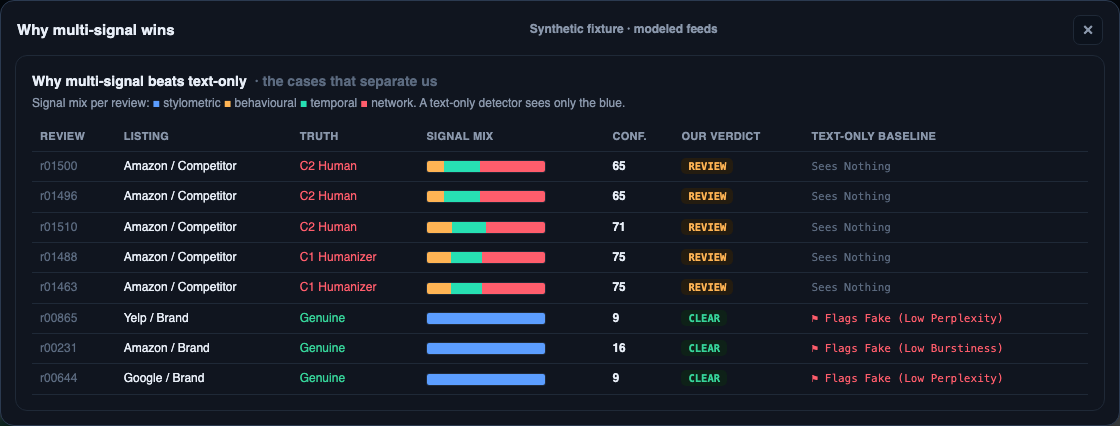 These eight illustrative rows span multiple fixture cases, not the complete 15-review campaign. They expose both escalation and clearance decisions; the displayed scores are heuristic values, not probabilities.
The comparison is a demonstration of reasoning, not independent validation of a detector. Text percentiles and the ensemble's review threshold were fitted on this same synthetic corpus. Performance on new records remains unresolved. That limitation matters to the product decision: an inspectable route can be worth examining before its accuracy is established well enough to support operational use.
Keep the unanswered question in the handoff
For a product team evaluating this kind of tool, I favor an action-dependent evidence standard. Start with a proposed consequence, then ask what claim must be established to support it. Opening an investigation might call for a reproducible account relationship and the underlying histories. Requesting a restriction would also require checking the applicable policy and whether the available records establish its conditions. A coordination score cannot supply missing evidence of payment simply by becoming larger.
That distinction should survive the documentation stage. In Campaign Firewall, deterministic scoring sets the routes before the optional Codex bridge writes the narrative. The paired video replays a cached response generated by that bridge. Generated prose cannot change the tiers. The grounding filter uses heuristic checks, so retained claims still need analyst inspection; a sentence surviving the filter is not a guarantee that it is true.
I want a reviewer to be able to trace a consequential sentence back to the account evidence and see where an inference begins. If the records show overlap but establish no payment, the handoff should preserve that gap. A fluent description of a suspected paid campaign cannot fill it. The demo's dispute draft stays unfiled, preserving the opportunity to examine those claims before any external step.
The Campaign Firewall breakdown shows the relationship evidence and the preparation workflow. For me, the useful product test is whether someone receiving the record can identify both the reason to investigate and the question that must still be answered before acting. That is a more defensible handoff than suspicion expressed with increasing confidence.