Your "adaptive" LMS is not adaptive. It is a recommendation engine with a diploma printer, and a better base model will not make its checkmark mean anything. That is the uncomfortable conclusion we reached while building Attest, our knowledge-tracing layer that certifies proven mastery instead of seat time (https://veriprajna.com/demos/adaptive-learning-ai). Corporate learning has spent years chasing model quality when the thing an auditor actually wants lives somewhere else entirely: outside the model, in the governance that decides what gets certified.
The failure every training platform shares
U.S. corporate training runs about $102.8 billion a year, roughly $874 per learner (Training Magazine, 2025), and most of that spend confirms one thing: that an employee watched the video. Not that they learned it. SCORM reports "Completed." Two people finish the identical four-hour AML recertification module and the LMS shows two identical green checkmarks: a senior BSA analyst who has known the material for eight years, and a six-month branch manager with real gaps. Same course, same checkmark, and no signal about competence.
The platforms that call themselves "adaptive" mostly are not. They run collaborative filtering ("people like you took Course X next"), not concept-level knowledge tracing ("you have not mastered concept Y"). Even Cornerstone's March-2026 "Adaptive Learning Agent" leans on collaborative filtering rather than concept-level tracing. The distinction sounds academic until an auditor asks for mastery evidence and all you can hand over is attendance.
In regulated work that gap has a price. The EU AI Act's Article 4 begins enforcing role-based AI-literacy on August 2, 2026, with penalties reaching €35 million or 7% of global revenue. The same logic runs through AML enforcement, where a training program found inadequate is not excused by a completion log.
Completion is not competence, and in regulated work that gap is a liability an auditor can price.
Why a stronger model does not close the gap
This is the part the field keeps getting wrong. Even a perfect knowledge-tracing model cannot prove to a regulator which interactions backed which mastery claim, or refuse to certify evidence that looks gamed. Those are governance properties, not model properties. They do not improve when the model does, and they do not age out when the next model arrives.
So we split the system deliberately. A concept-mapping agent (built on Pydantic AI, default claude-opus-4-8) decomposes one flat "AML Training" course into an 18-concept taxonomy, automating the content tagging the field calls the number-one reason adaptive projects fail. A real self-attentive knowledge-tracing transformer (SAKT, 119,809 parameters, trained on CPU) then infers per-concept mastery from each learner's full interaction history. It scores a held-out AUC of 0.8315 on our seeded synthetic knowledge-tracing benchmark, in the range of the ~0.80 published on the public ASSISTments dataset (Pandey and Karypis, 2019). That number matters only as proof this is a real knowledge-tracing model and not a gradebook.
Then everything that decides an outcome is plain, deterministic Python. A Flow-Zone sequencer routes each concept (skip when mastery is at or above 0.67, flow between 0.38 and 0.67, scaffold below), and a competence gate decides what gets certified. The model advises. Code decides. The model cannot override the gate.
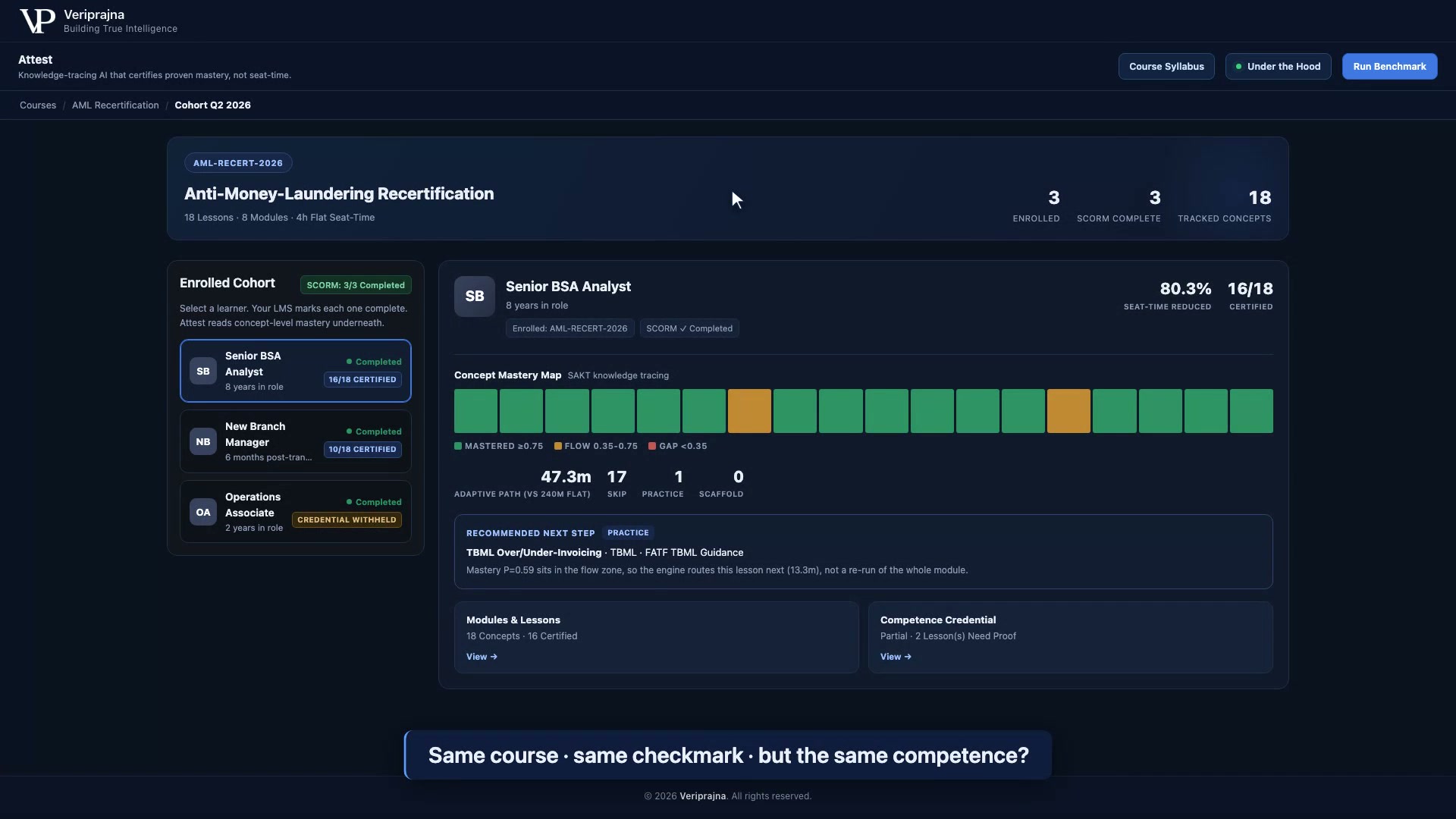 The analyst already knows most of the module: 16 of 18 concepts certified, seat time cut from 240 to 47.3 minutes (80.3% saved). The roster reads concept-level mastery under the same SCORM checkmark every learner earned.
One catch, watched happen
The clearest way to see governance sit outside the model is to watch the gate refuse a certification the model would happily support.
One learner in the cohort, an Operations Associate, used an AI assistant to auto-answer the entire module. On the surface the run looks perfect: the SAKT model reports apparent mastery between 0.93 and 0.99 on nearly every concept. A system that trusted the model would print 18 green checkmarks.
The competence gate does not trust the model. It certifies a concept only when three deterministic conditions all hold: mastery at or above 0.747, at least three supporting interactions, and a response pattern that is not anomalous. On this learner the gate flagged the evidence directly: "near-perfect accuracy at implausibly fast response times across 18 unrelated concepts, inconsistent with genuine recall." It certified 0 of 18. Every concept routed to "needs proof," and the seat-time saving was withheld pending verification.
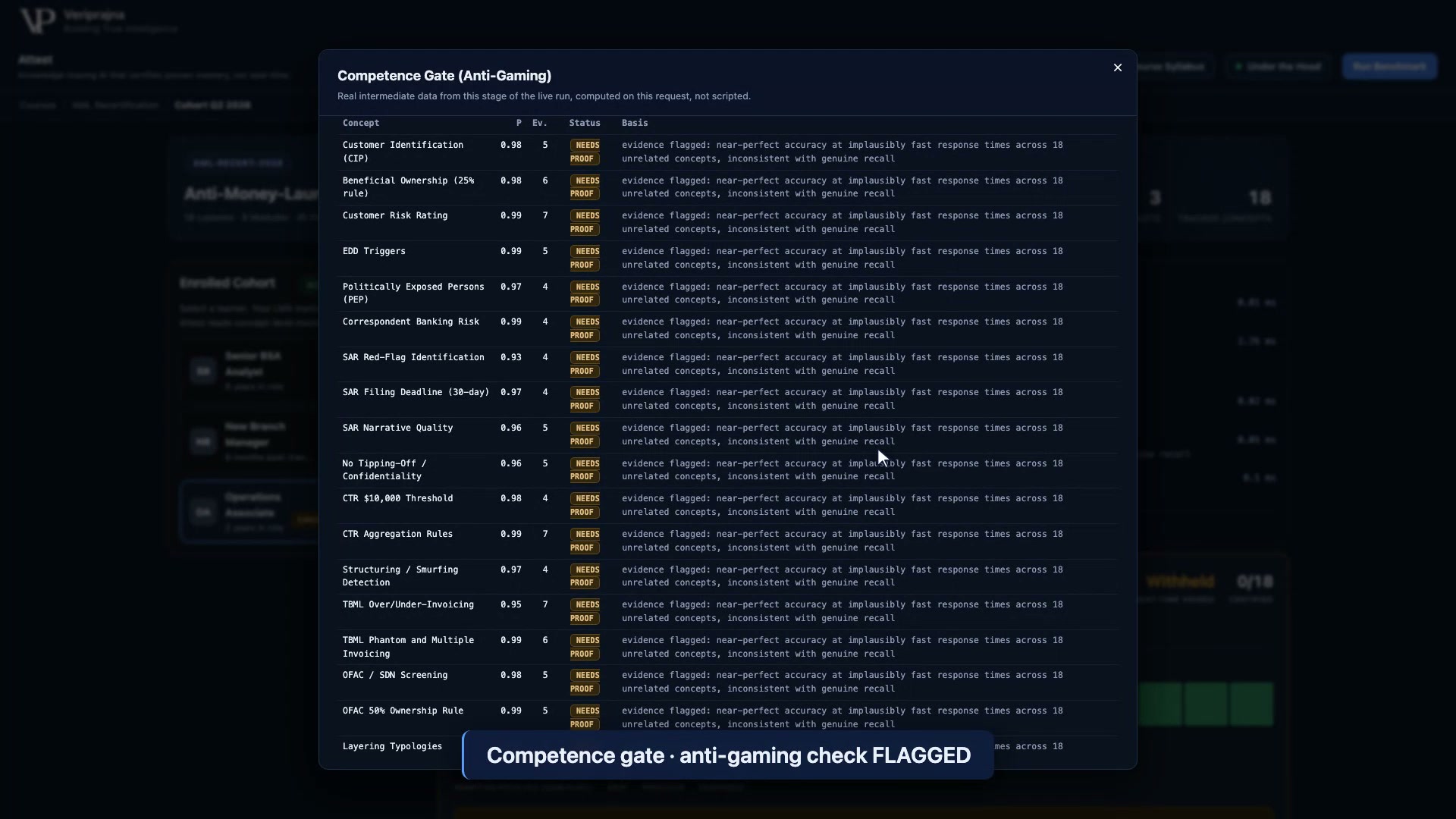 The AI-gaming case: high apparent mastery, zero certifications. The gate withholds all 18 concepts because the response pattern is inconsistent with genuine recall, not because a model scored it low.
This is not a cheater-detection metric, and we do not frame it as one. It is a governance outcome shown on one illustrative learner: we certify what we can prove, and nothing else. The same gate applies the same rule in quieter ways. It routed the analyst's Trade-Based Money Laundering concept to "needs proof" at mastery 0.59, and a SAR red-flag concept at 0.73, both below the 0.747 line, even though the analyst is genuinely strong. And it is not a blanket skeptic: the branch manager, who has real gaps, cleared 10 of 18 with the anti-gaming check reading gaming=false, saving 38.9% of seat time rather than the analyst's 80.3%. The gate discriminates. It is not a rubber stamp, and it is not a bouncer.
We certify what we can prove. We never bluff a green check.
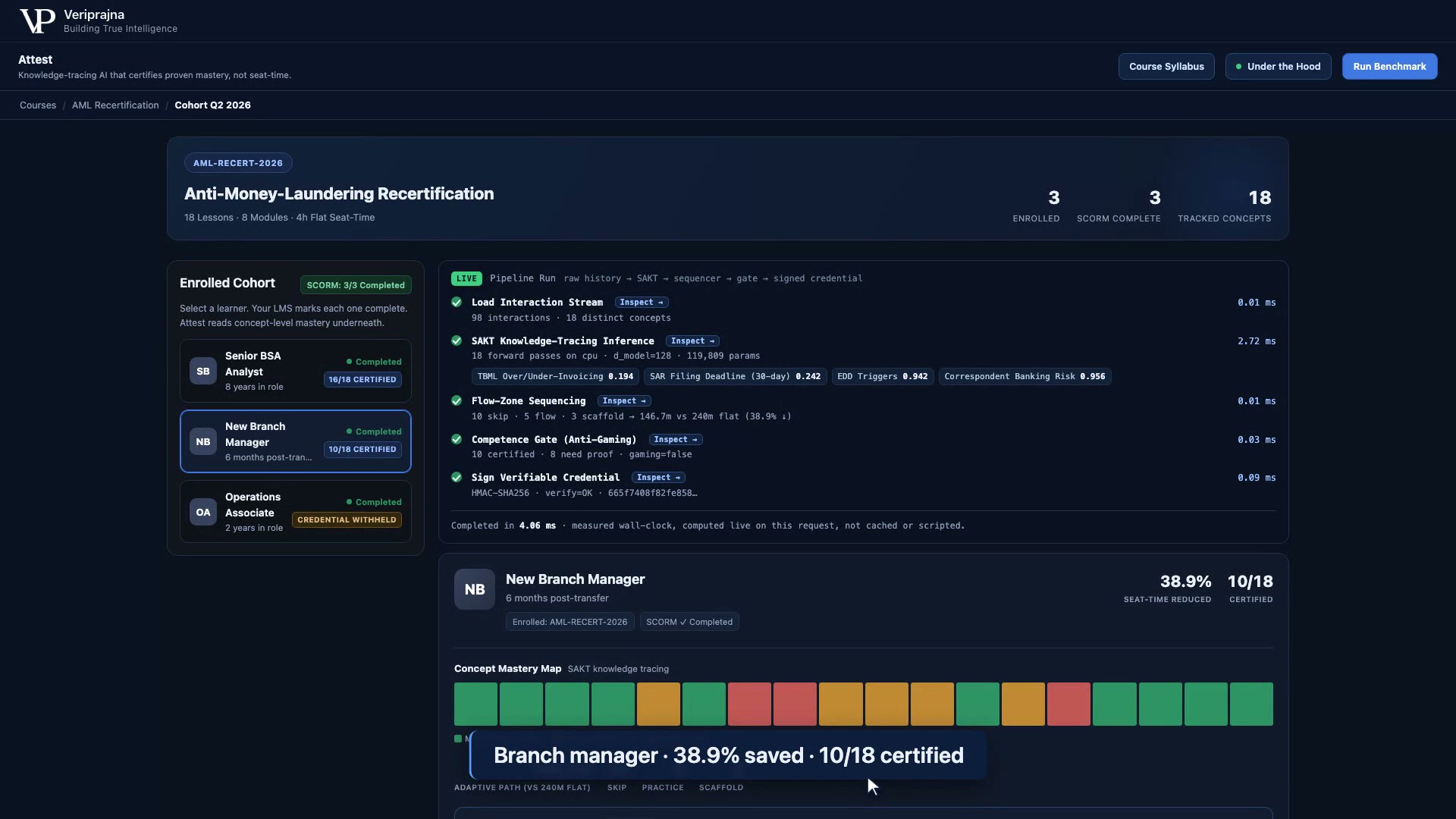 The learner who genuinely needs the training: 10 of 18 certified, only 38.9% of seat time saved, gaming=false. Fewer skips than the analyst, because the model actually found gaps.
What you hand a regulator instead of a checkmark
Every certified run emits a signed Competence Certificate: per-concept mastery probability and certify or needs-proof status, the evidence trail behind each estimate, the model name and version and benchmark AUC, the Flow-Zone thresholds applied, adaptive versus flat seat time, the regulatory mapping for each concept, an honest-limitation footer, and an HMAC-SHA256 signature. It is the artifact you give an auditor in place of a green checkmark.
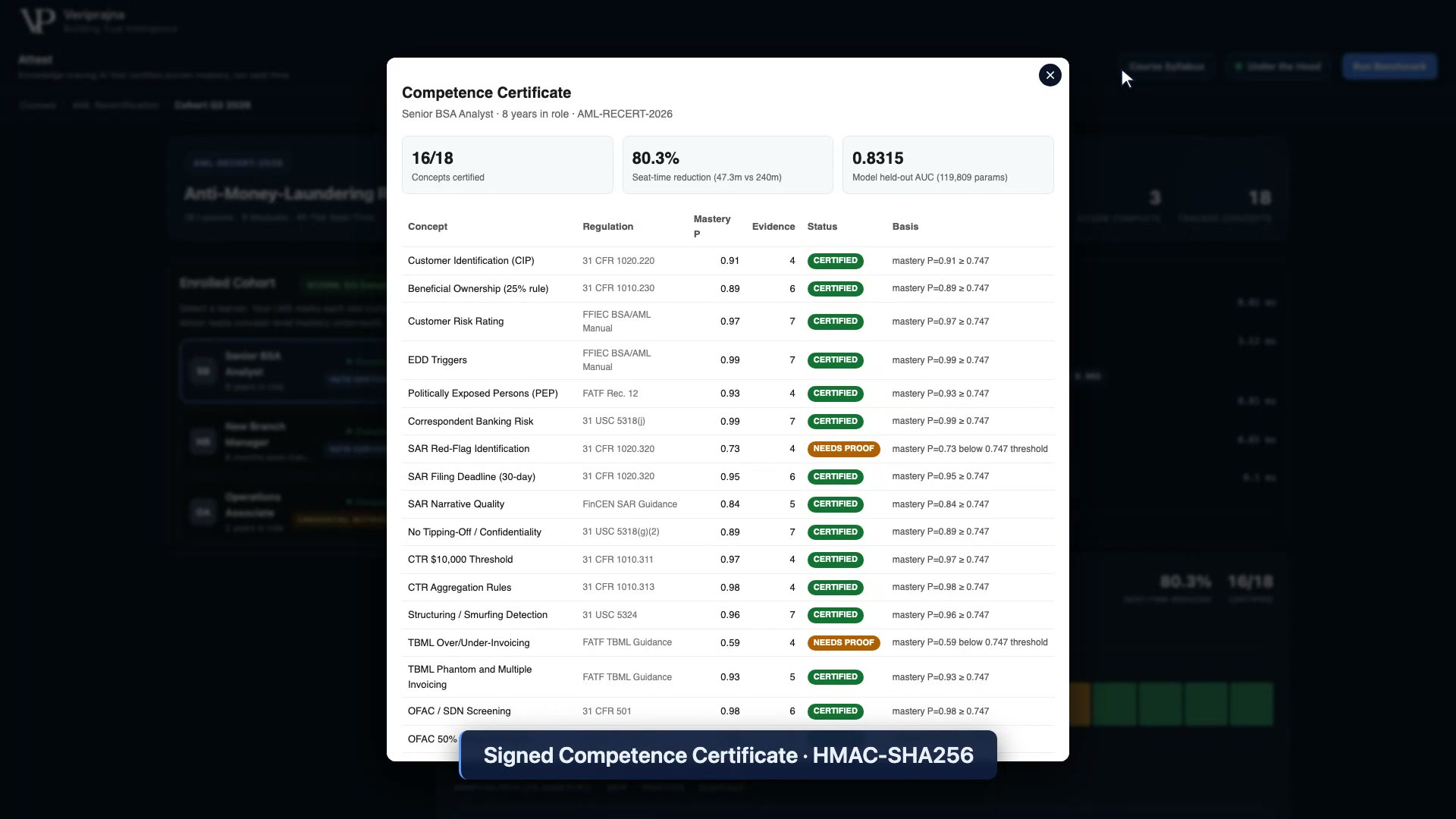 The certificate maps each concept to its actual regulation and shows exactly why each was certified or withheld (TBML at 0.59 and a SAR red-flag concept at 0.73 both fall below the 0.747 threshold), then signs the whole record.
The durable payoff is not the model's AUC. It is the two headline numbers that hold no matter how good the model gets: the percentage of seat time saved by skipping proven concepts (about 51.9% across a simulated 500-person recertification cohort, in the range of the 55% reported in a real compliance-recertification program that cut 51 days to 23, Fulcrum/Allegiant), and the percentage of concepts a governance gate is willing to auto-certify versus route to proof. Both are honest about their limits. The learners and the cohort here are synthetic, the connectors are simulated, and a mastery probability is evidence of next-step performance, not a guarantee of long-term retention. The certificate says so on its own footer.
If your team is working on how to certify training in a way that survives an audit, we would genuinely like to compare notes; the problem is industry-wide and the answers will be too. One question worth sitting with: when your LMS marks a compliance module complete, can you show an auditor which interactions backed that pass, or only that the video played to the end? You can run the full pipeline yourself at https://veriprajna.com/demos/adaptive-learning-ai.