
A 70-year-old media brand publishes hundreds of product reviews under fake names like "Drew Ortiz" — a person who never existed, complete with an AI-generated headshot and a fabricated love of the outdoors. When journalists expose the scheme, the publisher's stock drops 27% in a single day. Within months, the magazine's license is revoked, and nearly the entire newsroom is laid off. This is not a hypothetical. This is what happened to Sports Illustrated in late 2023, and the root cause wasn't artificial intelligence itself — it was the architecture behind how that AI was deployed.
We've spent months dissecting this collapse, not as media critics, but as AI architects. What we found is a cautionary tale that extends far beyond publishing. Any enterprise wrapping a thin software layer around a large language model and calling it a product is sitting on the same fault line.
The "Drew Ortiz" Problem Is an Architecture Problem
The Sports Illustrated scandal centered on a company called AdVon Commerce, which licensed AI-generated content to the magazine. AdVon used an internal tool called "MEL" — essentially a prompt-to-article pipeline built on top of a large language model (LLM). Feed it keywords and product specs, and it spits out a structured review. The "human writers" were often paid minimal rates to paste the output into a content management system, not to actually write anything.
This is what we call an LLM Wrapper: a thin software shell around a generative model with no independent verification layer. It's the AI equivalent of building a skyscraper with no foundation inspection — fast, cheap, and catastrophically fragile.
When an LLM generates a fake author, it isn't lying. It's completing a pattern. That distinction matters enormously for how you fix it.
The model wasn't trying to deceive anyone. It was asked to produce a product review with an author bio, and since no real author existed in its context, it generated one that looked statistically plausible. "Drew Ortiz" was a successful pattern completion, not a deliberate fraud. But the damage was identical.
Why LLMs Hallucinate — and Why You Can't Patch It Away
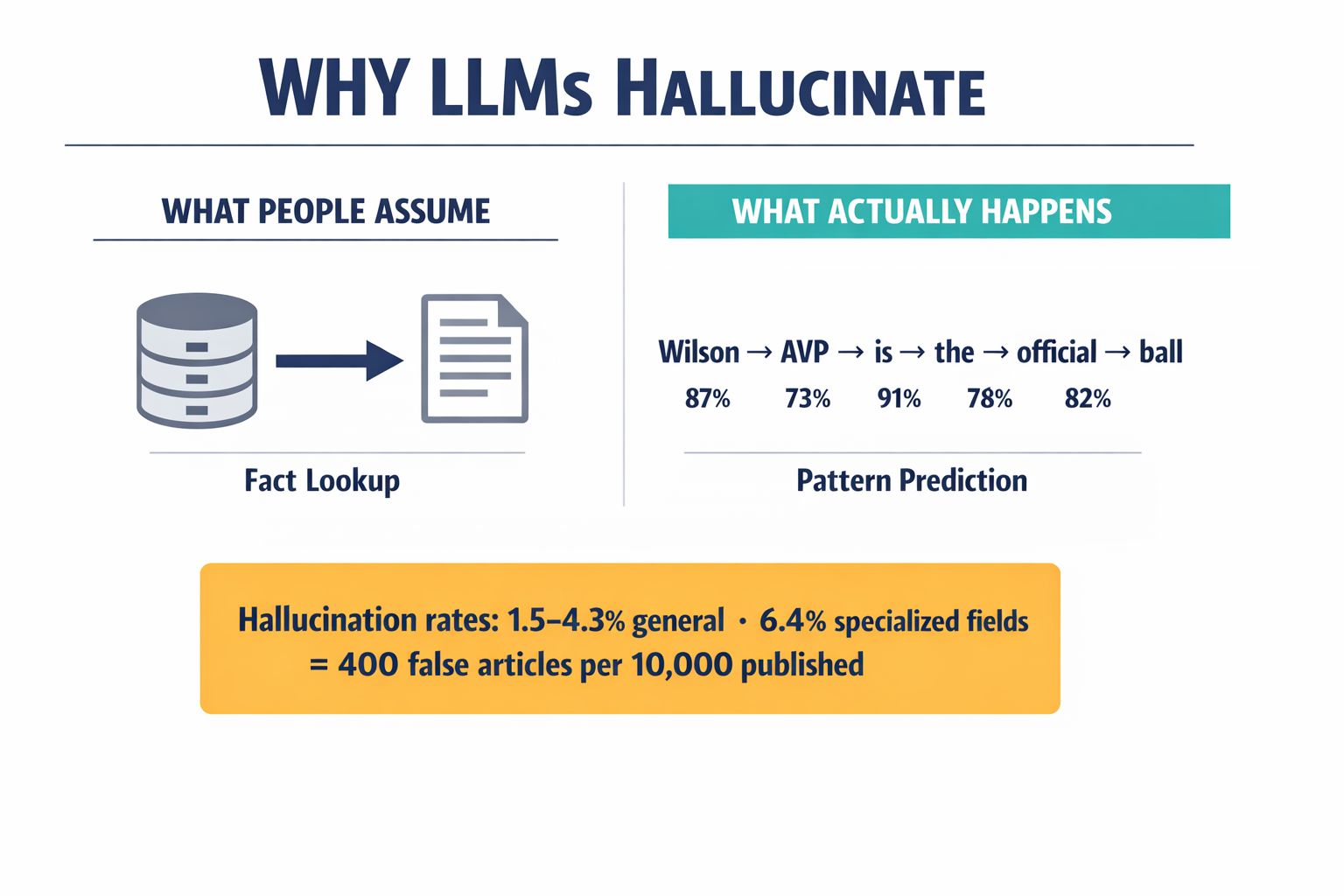
Large language models are, at their core, probability engines. They don't store facts in a database; they store statistical relationships between words learned from training data. When GPT-4 writes "The Wilson AVP is the official ball of the 2024 Olympics," it's not checking a record — it's predicting that this sentence sounds right given the surrounding context.
This is why hallucination isn't a bug you can fix with a software update. It's a fundamental property of how these systems work. Think of it like asking a very well-read person to write a report from memory, without access to any reference materials. They'll get most things right, but they'll confidently fill gaps with plausible-sounding guesses — and they won't flag which parts are guesses.
Even state-of-the-art models hallucinate at rates between 1.5% and 4.3% in general domains, spiking to 6.4% in specialized fields like law. That sounds small until you do the math: a content operation publishing 10,000 articles a year at a 4% error rate produces 400 articles containing material falsehoods. For Sports Illustrated, those weren't just errors. They were fabricated people.
We explored the full technical anatomy of this failure — from context window constraints to knowledge cutoff dates to prompt injection vulnerabilities — in our interactive analysis of the SI collapse.
The Delete-and-Deny Playbook
What made the Sports Illustrated case worse than a technical failure was the institutional response. When Futurism broke the story, The Arena Group (SI's publisher) didn't investigate or disclose. They silently deleted the fake profiles from the website. Journalism ethics professors called it "a form of lying."
The company then blamed AdVon, claiming the vendor had "assured us that all of the articles in question were written and edited by humans." AdVon, meanwhile, had been running the same playbook across USA Today, The Los Angeles Times, and McClatchy newspapers — a pattern investigators described as "reputation laundering." Reputable brands were renting out their domain authority to a content farm, trading decades of earned trust for affiliate revenue.
The real product being sold wasn't content. It was the credibility of the Sports Illustrated name — and once spent, it couldn't be repurchased.
The financial consequences were swift: a 27% stock drop in one day, an 80%+ decline over the year, license revocation by Authentic Brands Group over a missed $3.75 million payment (though the reputational damage made the partnership untenable regardless), and mass layoffs of the actual journalists who had fought to maintain the magazine's standards.
What a Verification Architecture Actually Looks Like
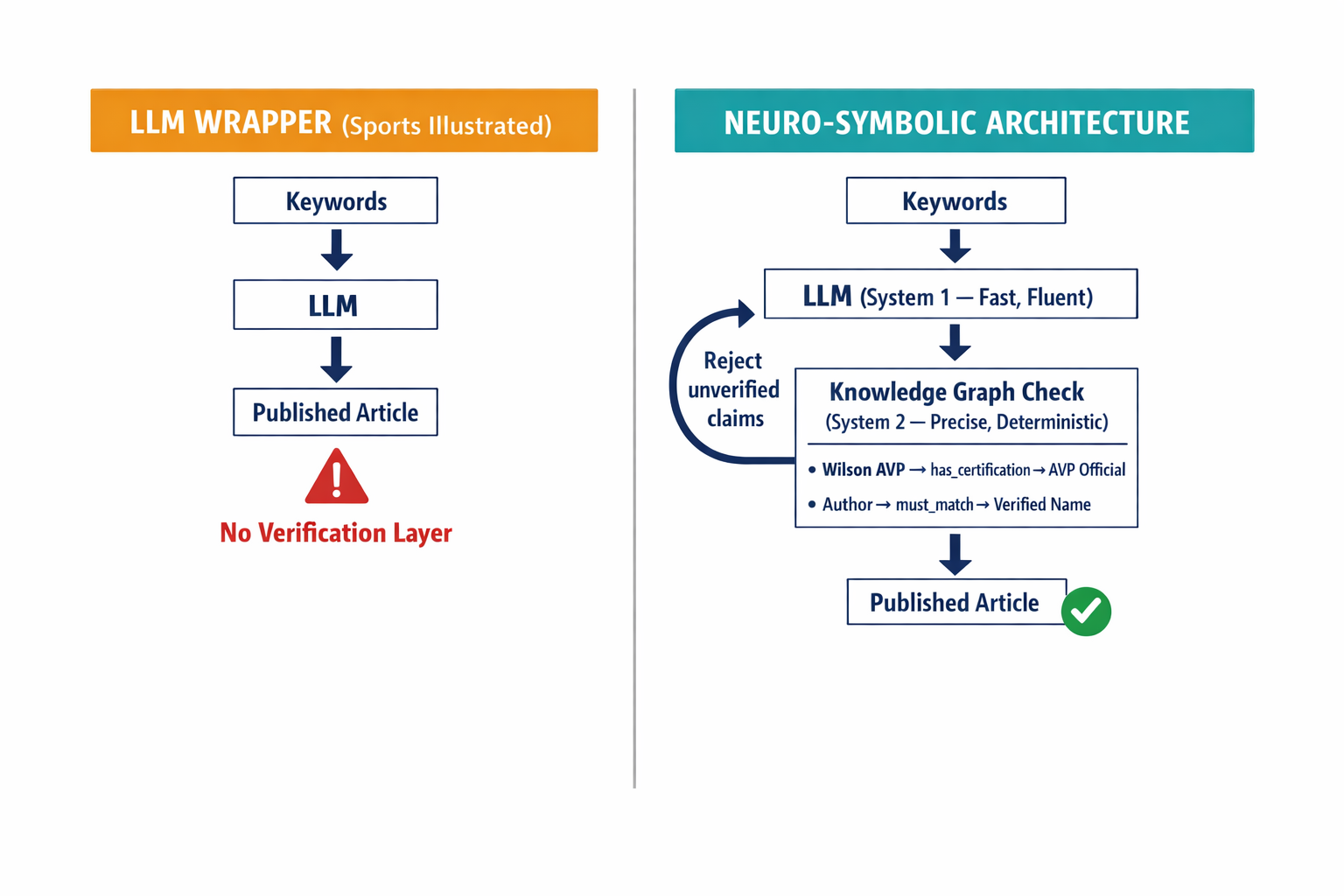
The alternative to an LLM Wrapper isn't "don't use AI." It's neuro-symbolic AI — an architecture that pairs the linguistic fluency of a language model with the logical precision of a structured knowledge system.
The concept borrows from how cognitive scientists describe human thinking. The language model acts like fast, intuitive "System 1" thinking — great at generating fluent prose, terrible at checking facts. The symbolic component acts like slow, deliberate "System 2" thinking — a structured database called a Knowledge Graph that stores verified facts as explicit relationships.
A Knowledge Graph doesn't deal in probabilities. It stores things like:
Wilson AVP → has_certification → AVP Official
Sports Illustrated → employs_writer → [verified name]
If you query it for the author of a specific article and no verified author exists, it returns nothing. It doesn't invent a "Drew Ortiz" to fill the silence. This is what makes it deterministic — it gives you definitive answers, not educated guesses.
In the Sports Illustrated scenario, a neuro-symbolic system would let the LLM draft the review, then check every factual claim against the Knowledge Graph before publication. No verified author in the graph? The article doesn't publish. Period.
Research supports the performance gap. One study found that integrating Knowledge Graphs into AI pipelines reduced hallucinations by 6% and cut token usage (the computational cost of processing text) by 80% compared to standard approaches. In medical applications, neuro-symbolic systems achieved 100% precision in extracting clinical data, compared to 63-95% for standalone GPT-4.
The Artificial Newsroom: Specialized Agents Instead of One Prompt
A single prompt asking an LLM to "write a product review" is like asking one person to be the reporter, fact-checker, editor, and publisher simultaneously. The more roles you pile on, the more likely something slips through.
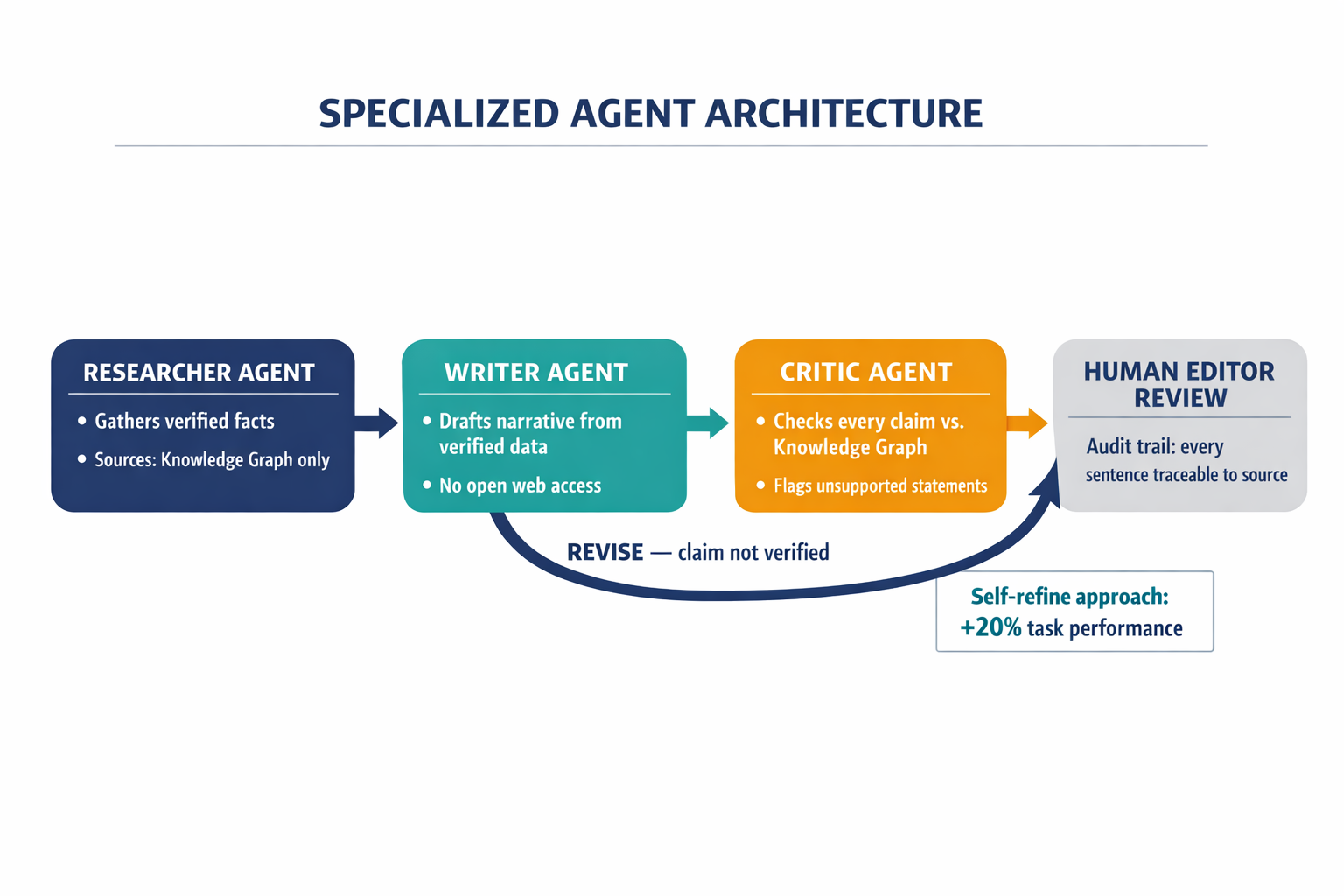
Our architecture decomposes this into specialized AI agents, each with a narrow job and strict permissions — modeled on how an actual newsroom operates.
A Researcher agent gathers raw facts from the Knowledge Graph and trusted sources. It produces data, not prose. A Writer agent takes those verified facts and drafts the narrative — but crucially, it has no access to the open web. It can't wander off and hallucinate new "facts" because its information supply is controlled. A Critic agent then reviews the draft, checking every claim against the Knowledge Graph, flagging unsupported statements, and sending the draft back for revision if anything fails verification.
This creates a feedback loop that mimics editorial oversight. When the Writer generates "The Wilson AVP is the official ball of the 2024 Olympics," the Critic queries the Knowledge Graph, finds no supporting relationship, and rejects the claim before it ever reaches a reader.
The question isn't whether AI will make mistakes. It's whether your architecture catches them before your audience does.
Research on this "self-refine" approach shows it can improve task performance by over 20% and significantly reduce hallucination rates by forcing the system to deliberate rather than publish its first draft.
For high-stakes content, the final step isn't automatic publication — it's a human editor reviewing the draft alongside the Critic's verification report and the source data from the Knowledge Graph. Every sentence can be traced back to its origin. This is the audit trail that Sports Illustrated never had.
What About Cost and Complexity?
A fair objection: this sounds expensive and complicated compared to plugging into an API and generating content at scale. It is more complex upfront. But consider what The Arena Group's "cheap" approach actually cost — hundreds of millions in brand value destroyed, a workforce eliminated, and a 70-year legacy in ruins.
The economics shift when you factor in the cost of failure. For regulated industries — finance, healthcare, legal — a single hallucinated claim can trigger lawsuits, regulatory action, or patient harm. Lawyers have already been sanctioned for citing AI-generated court cases that didn't exist. The verification architecture isn't an overhead cost. It's insurance against catastrophic loss.
Another concern: does this slow things down? It adds milliseconds to each generation cycle, not minutes. The Knowledge Graph query and Critic review happen programmatically. The human review step is reserved for high-stakes content, not every piece of output.
Does This Only Apply to Media Companies?
The Sports Illustrated case is dramatic, but the underlying failure pattern — unverified AI output reaching end users — shows up everywhere. Financial institutions generating client reports. Healthcare companies producing patient-facing content. Legal teams using AI for research. Any enterprise where the accuracy of the output matters faces the same architectural choice.
The NIST AI Risk Management Framework and the new ISO 42001 standard for AI management systems both emphasize the principles that were absent at SI: validity, reliability, transparency, and accountability. Aligning with these frameworks isn't just good practice — it's increasingly becoming a prerequisite for enterprise AI deployment.
For the full technical methodology behind our neuro-symbolic architecture — including Knowledge Graph construction, GraphRAG implementation, and governance frameworks — see our detailed research on enterprise content verification.
The Trust Gap Is the Real Threat
The deepest damage from incidents like the SI scandal isn't to one company. It's to the entire information ecosystem. When a trusted brand is caught fabricating people, it gives every reader permission to distrust all content. Economists call this a "lemons market" — when buyers can't distinguish quality from junk, the value of everything drops.
We believe enterprises have a choice. They can race to produce the most content at the lowest cost, competing in a market that's already flooded with undifferentiated AI output. Or they can compete on verifiability — making the provenance and accuracy of their content a product feature, not an afterthought.
In a world where "Drew Ortiz" can be hallucinated into existence, the only durable competitive advantage is verifiable truth.
The Sports Illustrated story ended with a hollowed-out newsroom and a destroyed brand. It didn't have to. The AI wasn't the problem. The absence of verification was.
If your organization is deploying generative AI in any capacity where accuracy matters, we'd welcome a conversation about what verification architecture looks like for your specific use case.