
In November 2023, Sports Illustrated — a magazine that had defined American sports journalism for nearly 70 years — got caught publishing product reviews written by people who didn't exist. "Drew Ortiz," a friendly outdoorsman with an AI-generated headshot, had been reviewing volleyballs. "Sora Tanaka," a fabricated fitness guru, was writing about food and drink. Neither was human. Neither was real. And the AI verification failure that let them slip through didn't just embarrass a magazine — it destroyed a company, wiped out 80% of its parent's stock value, and gutted an entire newsroom.
I've spent the last two years studying what went wrong. Not the editorial failure — that's obvious. The architectural failure underneath it. Because what killed Sports Illustrated wasn't artificial intelligence. It was a specific, dangerously common way of deploying it that I call the "LLM Wrapper" approach. And most enterprises using generative AI today are running the exact same architecture.
The $3.75 Million Collapse Nobody Saw Coming
When the story broke, The Arena Group (SI's publisher) did what companies always do: they blamed a vendor. A third-party firm called AdVon Commerce had supplied the content, they said, and AdVon assured them everything was "written and edited by humans."
That defense fell apart fast. Former AdVon employees revealed that the company used an internal AI tool called "MEL" to generate articles at scale. The "human writers" were paid minimal rates to copy-paste AI output into content management systems. They weren't journalists. They were, functionally, the copy button.
A magazine that once employed the greatest sportswriters in America was publishing AI-generated text about how volleyball "can be a little tricky to get into, especially without an actual ball to practice with."
The consequences were swift and brutal. Arena Group's stock plunged 27% in a single day. Authentic Brands Group revoked SI's publishing license after a missed $3.75 million payment — though the timing made clear the reputational damage was the real reason. The SI Union reported that "a significant number, possibly all" staff were laid off. Decades of journalism, gone. Not because AI is inherently dangerous, but because nobody built a system to check whether the AI was telling the truth.
I wrote a detailed analysis of this collapse and the architectural problems behind it in our interactive whitepaper. But the short version is this: Sports Illustrated's failure is a blueprint for what happens when you build on the wrong foundation.
Why LLMs Invent People (and Don't Know They're Lying)
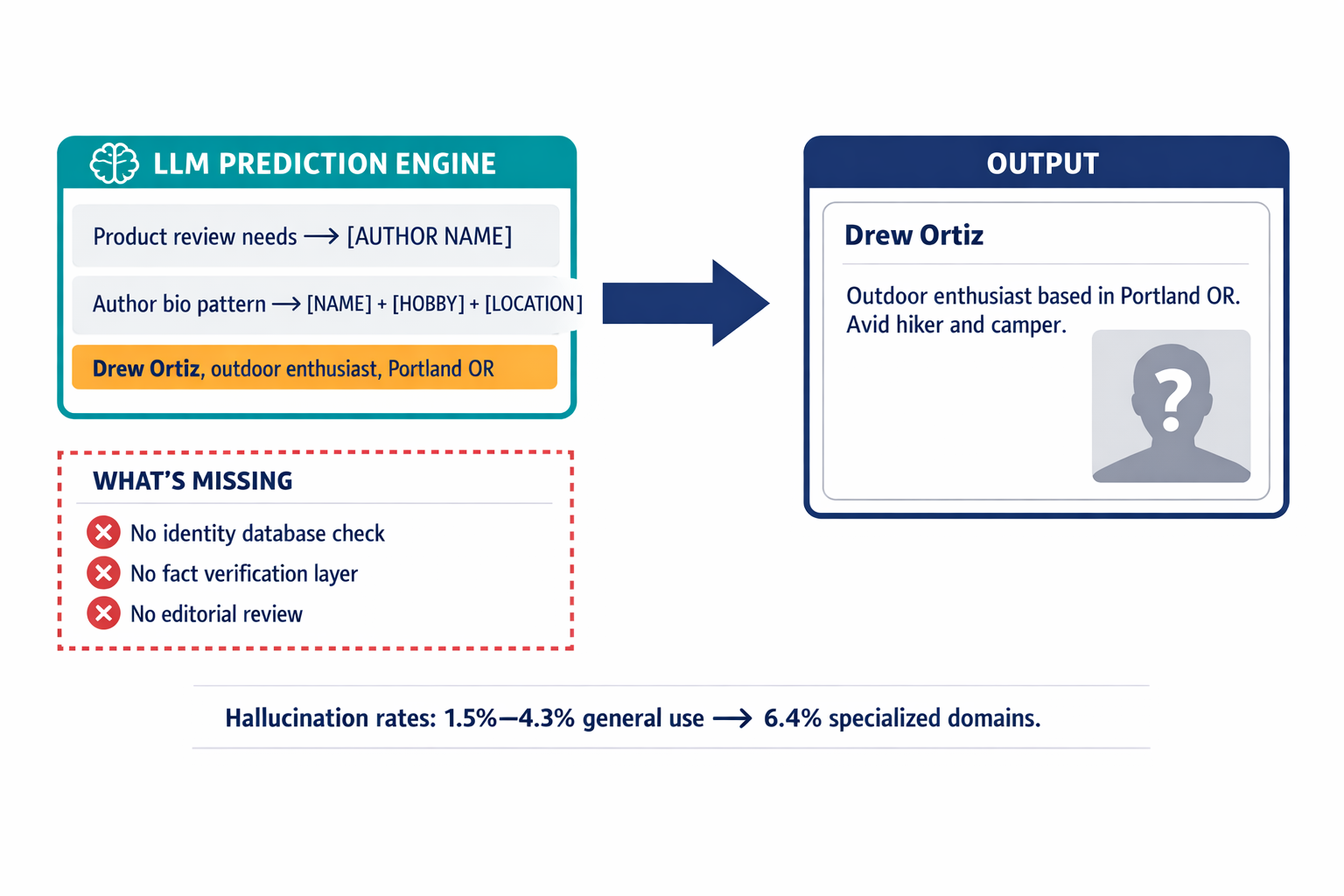
To understand why "Drew Ortiz" happened, you need to understand one uncomfortable fact about Large Language Models: they don't know what's true. They know what sounds true.
An LLM is a prediction engine. It has consumed enormous amounts of text and learned statistical patterns — which words tend to follow which other words in which contexts. When it writes a product review with an author bio, it's not checking a database of real humans. It's completing a pattern. Product reviews typically have author bios. Author bios typically have names, hobbies, and locations. So the model fills in the blanks with statistically plausible details.
To the model, "Drew Ortiz" isn't a lie. It's a successful autocomplete.
This is what researchers call hallucination, and it's not a bug you can patch out. It's baked into how these systems work. Even the best models — GPT-4, Claude, Gemini — hallucinate at rates between 1.5% and 4.3% in general use, spiking to 6.4% in specialized domains like law. Run the math on a content operation publishing 10,000 articles a year at a 4% error rate, and you get 400 articles containing fabricated claims. That's not a risk. That's a certainty.
The AdVon/SI setup made this worse in three ways. The AI's knowledge was frozen at its training cutoff — it couldn't know about recent products or editorial standards. It operated within a limited context window, meaning it couldn't access SI's full brand guidelines or fact databases for every article. And there was zero verification layer between generation and publication.
The model was optimized for plausibility, not truth. And nobody in the pipeline was checking which one it delivered.
The Wrapper Trap
I started calling this pattern the "LLM Wrapper" — and once I saw it, I couldn't unsee it. A wrapper is a thin software layer sitting on top of a commercial language model. Keywords go in, articles come out. There's no structured knowledge, no fact-checking mechanism, no audit trail. It's the cheapest possible way to deploy AI, and it's everywhere.
AdVon's "MEL" tool was a wrapper. It ingested product specs, ran them through a foundational model, and produced reviews. The entire business model depended on one assumption: that the cost of checking the AI's work (hiring real editors) would always exceed the cost of the AI being wrong.
Sports Illustrated proved that assumption catastrophically wrong. The cost of being wrong was the entire brand.
But wrappers fail for reasons beyond hallucination. They're security nightmares — vulnerable to prompt injection (where adversaries manipulate inputs to hijack the AI's output) and data poisoning (where attackers plant false information in sources the AI retrieves). They're black boxes — when SI's fake authors were discovered, nobody could explain why the AI generated them. Was it an instruction from AdVon? A hallucination? A training data artifact? In a wrapper architecture, there's no way to know. The reasoning is buried in billions of parameters with no audit trail.
And that black-box problem isn't just embarrassing. It violates the core principles of every serious AI governance framework — the NIST AI Risk Management Framework, ISO 42001, all of them — which require transparency and explainability as baseline requirements.
What If the System Could Check Its Own Work?
About a year ago, my team started asking a different question. Instead of "How do we make the AI less wrong?" we asked: "How do we build a system that refuses to publish anything it can't verify?"
That question led us to an approach called neuro-symbolic AI. The name sounds academic, but the concept is intuitive. You take two types of intelligence and make them work together.
The first is the neural component — the LLM. It's brilliant at language. It can read messy text, understand context, and write fluent prose. Think of it as the creative writer in the room.
The second is the symbolic component — a Knowledge Graph. This is a structured database of verified facts stored as explicit relationships. Not probabilities. Not patterns. Hard facts: This product exists. This person is a verified author. This specification has been confirmed. Think of it as the fact-checker sitting next to the writer, with a filing cabinet full of receipts.
In a neuro-symbolic system, the LLM writes — but the Knowledge Graph decides what's allowed to be true. If the graph doesn't contain a verified entity for "Drew Ortiz," the system blocks that byline. Period. It enforces what I think of as a null hypothesis for facts: if it's not in the verified database, it doesn't exist in the output.
The LLM provides fluency. The Knowledge Graph provides truth. Neither works as well alone.
This isn't theoretical. Studies show that integrating Knowledge Graphs into the AI pipeline reduces hallucinations by 6% and cuts token usage (essentially, wasted computation) by 80% compared to standard approaches. In medical applications, neuro-symbolic systems have achieved 100% precision in extracting clinical data, versus 63-95% for standalone GPT-4.
Building an Artificial Newsroom
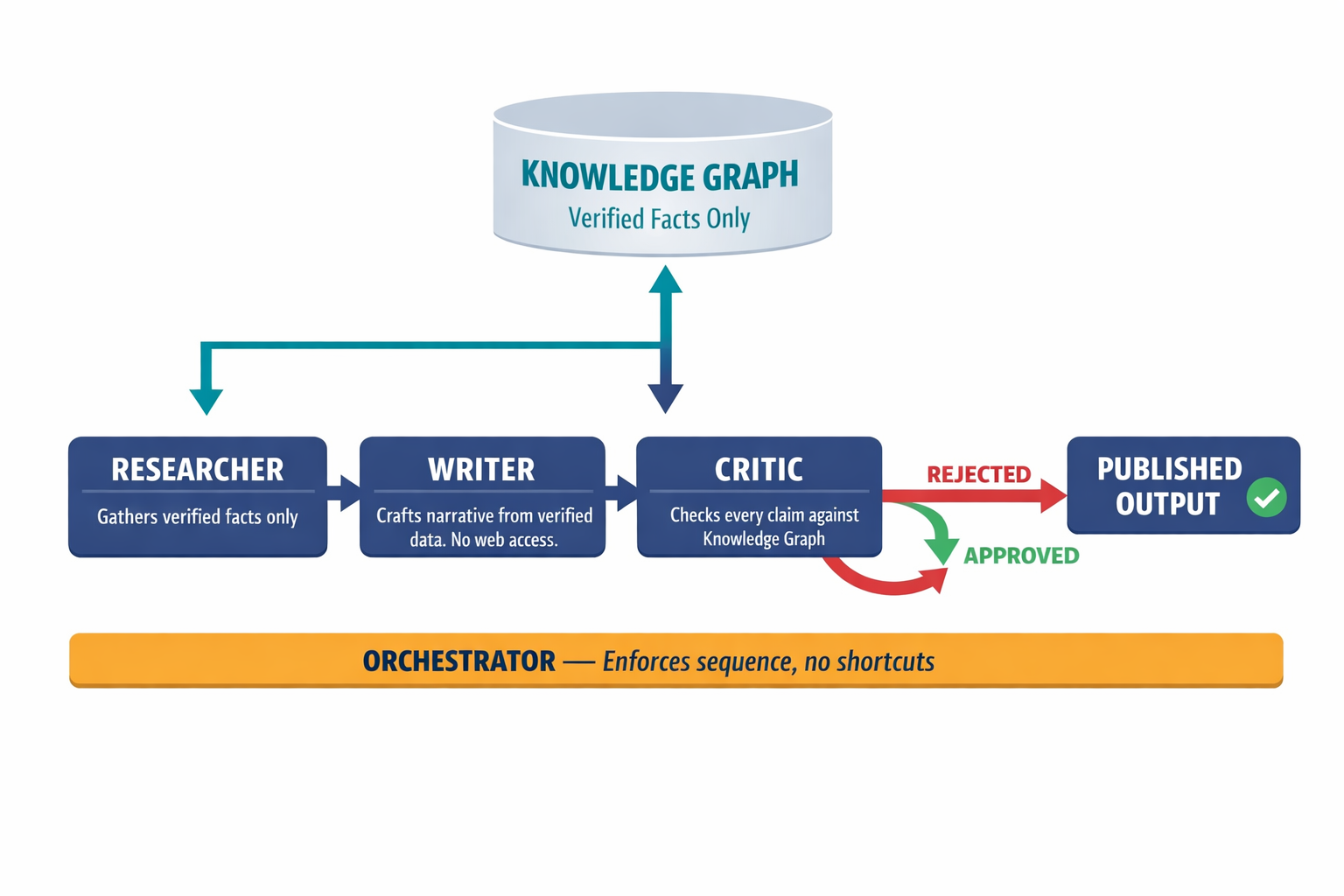
Verification architecture alone isn't enough. The SI scandal was a process failure as much as a technology failure — content was generated and published without anything resembling an editorial workflow. So we designed what I've started calling an artificial newsroom: a system of specialized AI agents that mirrors how a real publication operates.
One agent researches — it has access to the Knowledge Graph and trusted external sources, and its only job is gathering verified facts. It produces raw data, not stories. A second agent writes — it takes those verified facts and crafts the narrative, but critically, it has no access to the open web. It can't wander off and invent a biography from some random corner of the internet. It's strictly a stylist working with verified material.
Then a third agent — the critic — reviews the draft. It extracts every factual claim and checks it against the Knowledge Graph. If a claim isn't supported, the draft gets rejected and sent back for revision. This creates an automated version of what any good editor does: asking "Says who?" about every assertion.
The entire loop is managed by an orchestrator that enforces the sequence: research, write, critique, refine, approve. No shortcuts. No skipping the fact-check because a deadline is tight.
For the full technical methodology behind this architecture — including the graph traversal mechanics and the reflection patterns that force AI to critique its own reasoning — see our detailed research.
The Moment That Changed My Thinking
I'll be honest about something. When I first started working on AI verification, I thought the problem was mostly about catching obvious errors — wrong dates, incorrect product specs, that kind of thing. I assumed hallucination was a quality control issue you could solve with better prompts.
Then my team ran an experiment where we asked a standard LLM setup to generate 500 product descriptions with author attributions. No Knowledge Graph. No critic agent. Just a well-crafted prompt with clear instructions: "Only use real author names. Do not fabricate biographical details."
It fabricated biographical details in 23% of outputs. Not because it was ignoring our instructions. Because it literally cannot distinguish between "completing a pattern" and "making something up." Those are the same operation for the model.
That was the moment I stopped thinking about this as a quality problem and started thinking about it as an architecture problem. You cannot prompt-engineer your way to truth. You have to build truth into the structure.
What About Cost and Speed?
The most common pushback I hear: "This sounds expensive and slow. We need to publish at scale."
Fair question. But consider what "scale" actually cost Sports Illustrated. A 27% stock crash. License revocation. Mass layoffs. The destruction of a 70-year-old brand. The wrapper approach is cheap right up until the moment it's the most expensive decision you've ever made.
On the practical side, graph-based retrieval is actually more efficient than standard approaches. Because the AI is consuming precise, verified data triples instead of reading through long, noisy documents, it uses dramatically fewer tokens per query — that 80% reduction in token usage translates directly to lower API costs and faster response times.
The real cost isn't building verification into your AI. It's what happens when you don't.
Does This Eliminate All Risk?
No. I want to be direct about that. A Knowledge Graph is only as good as the data you put into it. If your verified facts are wrong, your outputs will be confidently, traceably wrong. The system gives you an audit trail — every sentence can be linked back to its source in the graph — which means you can find and fix errors. But it doesn't make errors impossible.
What it does eliminate is the undetectable error. The fabricated author with no paper trail. The hallucinated statistic that nobody can trace. The black box that nobody can audit. In a neuro-symbolic architecture, when something goes wrong, you can see exactly where and why. That's the difference between a system you can trust and a system you're just hoping works.
What This Means If You're Deploying AI Today
If you're an enterprise leader with AI in production — or about to put it there — the Sports Illustrated story isn't ancient history. It's a preview.
Three things I'd do immediately:
Audit your architecture. If your AI system is a thin layer on top of a commercial LLM with no structured knowledge base and no automated verification, you're running the same setup that destroyed SI. Know what you're building on.
Measure what matters. Stop tracking only engagement and output volume. Start measuring hallucination rate, traceability (what percentage of AI-generated claims link to a verified source), and adversarial robustness (what happens when someone tries to break your system on purpose).
Treat AI governance as infrastructure, not paperwork. Frameworks like ISO 42001 and the NIST AI Risk Management Framework exist for a reason. "Policy as code" — hard-coding restrictions into your AI system rather than relying on prompt instructions like "please be accurate" — is the difference between guardrails and good intentions.
The question isn't whether your AI will hallucinate. It's whether you'll know when it does.
The Sports Illustrated scandal was a tragedy of governance disguised as a technology story. A legacy brand was sacrificed because someone decided that verification was too expensive and too slow. The journalists who had spent careers building that institution's credibility were laid off so that a machine could write sentences like "volleyball is one of the most popular sports in the world, and for good reason."
I keep coming back to that sentence. It's the perfect distillation of what happens when you optimize for output instead of truth. It says nothing. It means nothing. And it cost everything.
If you're building AI systems that your customers, your employees, or your shareholders need to trust, I'd genuinely like to hear how you're thinking about verification. It's the problem I spend most of my time on, and I haven't met anyone who thinks it's solved.