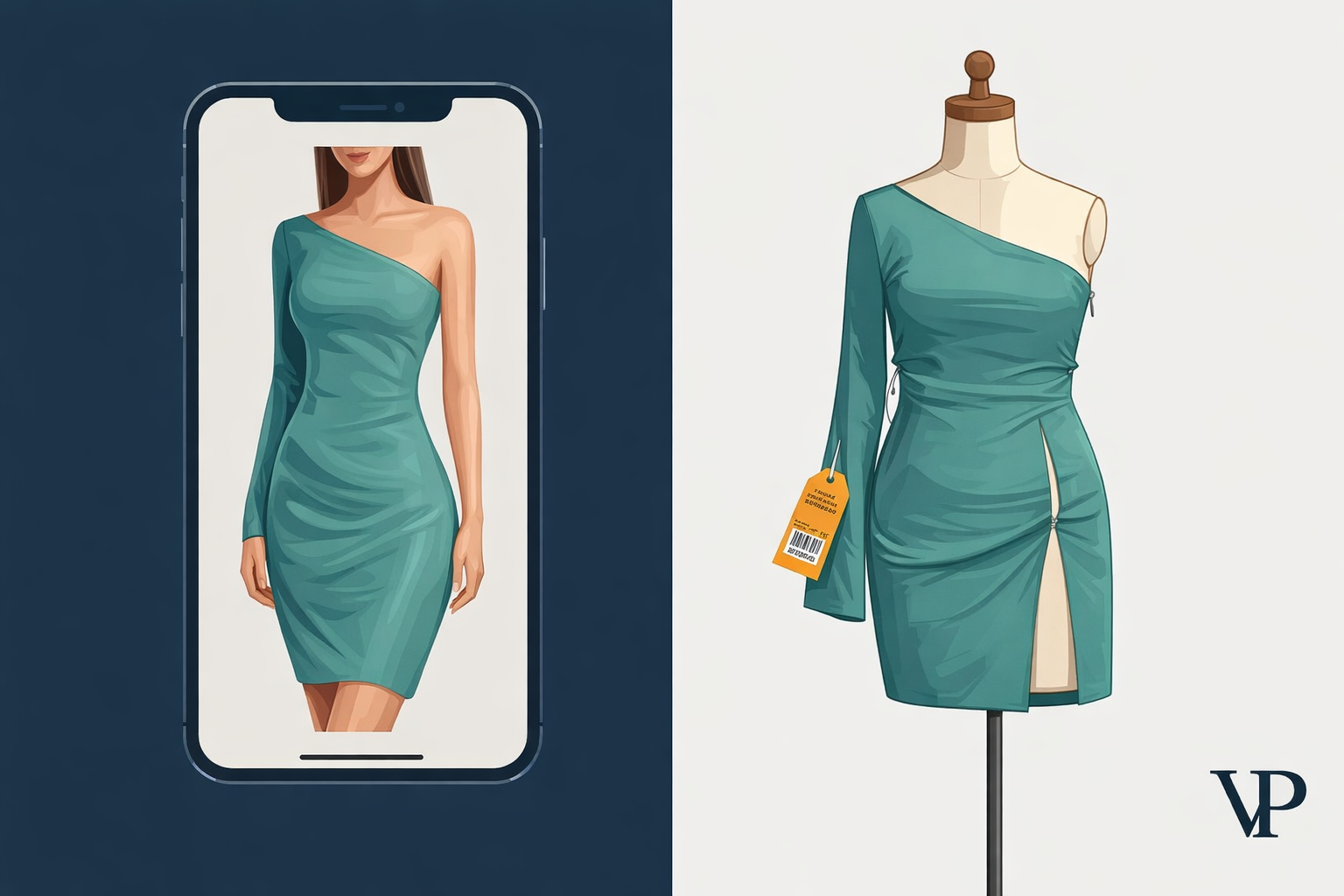
A $100 dress gets returned. The retailer doesn't just lose $100 — they lose up to $66 in processing, shipping, depreciation, and wasted marketing spend. Multiply that by the $890 billion in return-related costs U.S. retailers absorbed in 2024, and you're looking at a crisis that no amount of AI-generated imagery can fix. The fashion industry's most popular technology bet — generative AI virtual try-on — is making the problem worse by showing customers a beautiful lie.
The core issue isn't that shoppers can't see what clothes look like on them. It's that they can't know whether clothes will physically fit their body. That's not a visual problem. It's a physics problem. And the industry is solving the wrong one.
The Returns Crisis Is a Margin Crisis
Fashion e-commerce return rates sit between 24.5% and 40%, with spikes above 50% during promotional periods. Compare that to electronics (8–10%) or beauty (4–10%), and the scale of the problem becomes clear: apparel is a statistical outlier, and it's bleeding retailers dry.
The damage goes far beyond the refund. When a garment comes back, the retailer absorbs:
Reverse shipping at 2–3x the outbound rate (returns are sporadic and can't be consolidated)
Manual inspection and processing — someone opens the package, checks for damage, verifies the SKU
Refurbishment costs — 50–60% of returns need steaming, retagging, and repackaging before resale
Inventory depreciation — a return cycle takes 2–4 weeks, and fashion is perishable. A trendy item that misses its window gets marked down 30–50%
For every three items sold, if one is returned, the profit from the other two is frequently consumed just covering the loss of the third.
This is what "profitless prosperity" looks like: growing revenue, shrinking margins, and a logistics machine running in reverse.
Bracketing: A Rational Response to Bad Information
Consumers aren't returning clothes out of spite. They're responding rationally to uncertainty. Without reliable fit information, 51% of Gen Z shoppers have adopted "bracketing" — ordering multiple sizes with the intent to keep one and send the rest back.
From the customer's perspective, this makes perfect sense. From the retailer's, it's devastating. Two units leave the warehouse. One comes back. The retailer pays outbound shipping on both, inbound on one, and locks up inventory that other customers could have purchased.
The root cause? Fit and sizing issues drive 53% to 67% of all apparel returns. A "Medium" in one brand is an "Extra Small" in another. Size charts offer one-dimensional measurements — bust circumference, waist circumference — to describe a three-dimensional body. A customer might match the bust measurement perfectly but find the armhole too tight or the fabric too rigid across the shoulders.
These are questions about how materials interact with geometry. No size chart answers them.
The Generative AI Trap
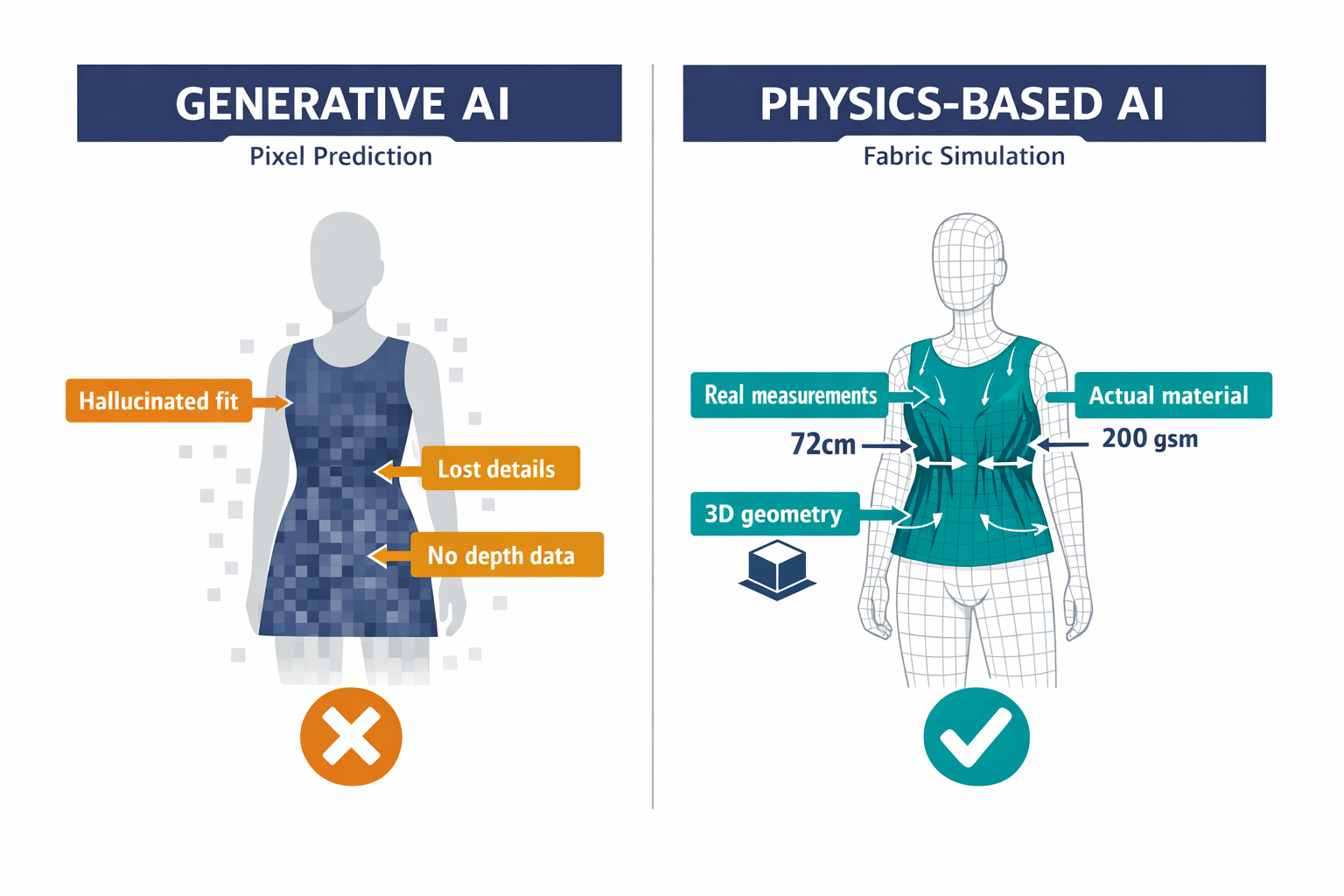
The fashion industry's response has been to throw generative AI at the problem. Virtual try-on tools built on diffusion models — the same technology behind Stable Diffusion and Midjourney — promise to show customers what clothes look like on their body. The images are stunning. They're also misleading.
Diffusion models work by learning statistical patterns from millions of images. When they generate a virtual try-on, they're not calculating whether fabric will stretch across your hips. They're predicting which pixels are most likely to appear next to other pixels, based on patterns in their training data.
This creates three specific failures that directly drive returns:
The model hallucinates fit. If the training data contains mostly images of tall, slender models, the AI subtly "slims" diverse body types to match its statistical average. It might compress a waist or stretch a non-stretch denim as if it were spandex. The customer sees themselves looking great. The physical garment doesn't zip up.
Details drift and disappear. Intricate lace patterns, specific embroidery, or brand logos get "smoothed out" and replaced with generic textures the model has seen before. A customer who buys a dress for its specific pattern receives something that doesn't match what the AI showed them.
Geometry breaks. These models operate entirely in flat, two-dimensional pixel space. They have no concept of depth, volume, or how fabric wraps around curves. Sleeves merge into torsos. Necklines defy gravity. Patterns warp in physically impossible ways.
Generative AI provides a semantic answer — "this is a picture of a person in a dress." But the returns problem is mechanical — "this dress is 2cm too small at the hip."
You cannot ask a diffusion model whether the buttons will pull when the customer sits down. You cannot extract a tightness map. The model doesn't know the waistline is 72 centimeters or that the fabric weighs 200 grams per square meter. It simply knows which pixels usually go where.
We explored these failure modes in depth in our interactive analysis, including how diffusion models assign probability mass to "gap regions" outside real data — the mathematical mechanism behind why they invent details that don't exist.
Physics-Based AI: Simulate the Fabric, Don't Fake It
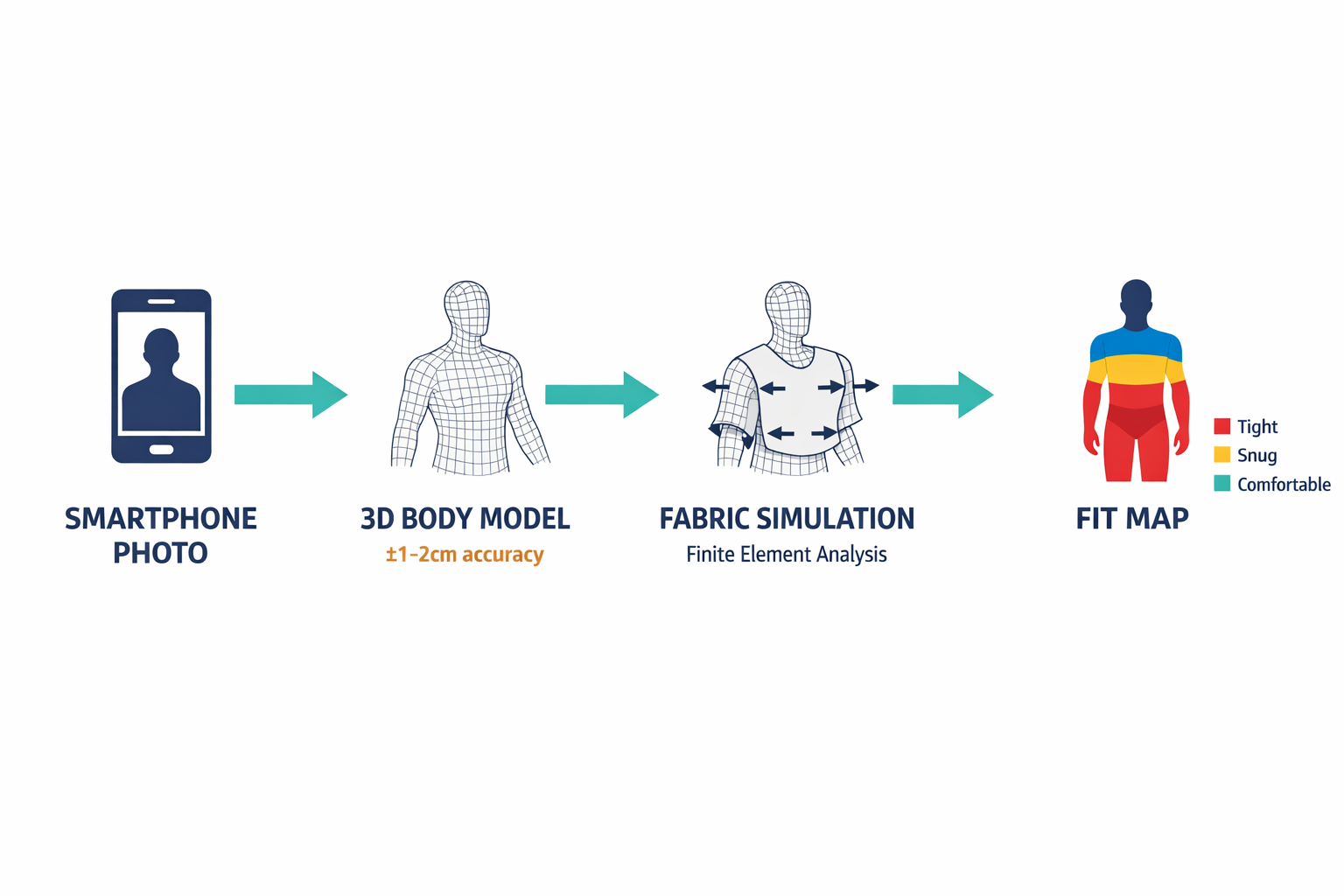
Our team took a fundamentally different approach. Instead of generating images that look right, we built a system that calculates whether clothes will fit — using the same physics that governs how fabric actually behaves.
The pipeline starts with a single smartphone photo. From that image, we reconstruct a metrically accurate 3D model of the customer's body using transformer-based computer vision — the same class of AI architecture behind modern language models, but applied to spatial geometry. The system understands that the angle of a hip is biomechanically related to the position of a foot, even when body parts are partially hidden. It corrects for the distortion that phone cameras introduce (that "fisheye" effect from holding a camera close), recovering the customer's true proportions.
The result: body measurements accurate to within 1–2 centimeters of a physical tape measure.
Then, instead of painting clothes onto that model, we simulate them. The garment's actual digital pattern — the same CAD file used to manufacture it — gets draped onto the 3D body using finite element analysis. Think of it like a wind tunnel test, but for clothing. The system solves equations governing how fabric stretches, bends, and shears based on the material's real physical properties.
We don't show customers what clothes look like. We show them where clothes will be tight, loose, or comfortable — before they buy.
The output is a color-coded fit map: red zones where fabric is compressing the body, yellow zones where it's snug, blue zones where it drapes freely. A customer who sees red at the hips on a Medium but yellow on a Large buys the Large with confidence — no bracketing required.
What This Changes on the P&L
The financial case is straightforward. Consider a mid-sized fashion retailer with $200 million in annual sales and a 30% return rate. That's $60 million in returns, costing roughly $12 million annually in direct processing.
Industry data suggests physics-based fit verification can reduce return rates by 20–30%. A 25% reduction drops the return rate to 22.5%, saving $3 million in direct costs. If half of those prevented returns convert to kept sales, that's another $7.5 million in recovered revenue.
Total annual impact: $10.5 million — from a single intervention point in the customer journey.
Beyond margin recovery, there's a sustainability case that's becoming impossible to ignore. Reverse logistics inflates Scope 3 emissions. The EU's Ecodesign for Sustainable Products Regulation is moving toward banning the destruction of unsold textiles. Every prevented return is a shipment that doesn't happen, a garment that doesn't get liquidated, and a data point for ESG reporting.
For the full technical methodology behind these projections — including our simulation architecture and the comparative analysis between generative and physics-based approaches — see our detailed research.
"But Doesn't Generative AI Drive Conversion?"
It does. And that's precisely the trap. A beautiful but inaccurate virtual try-on image increases the likelihood someone clicks "Buy." It also increases the likelihood they ship it back two weeks later, after the trend window has closed and the garment has depreciated 30–50%.
Optimizing for conversion without optimizing for kept conversion is optimizing for churn. The metric that matters isn't how many people buy — it's how many people buy and keep.
Can't You Just Combine Both Approaches?
This is actually what we do. The physics simulation produces accurate fit data, and we use neural rendering techniques to make that simulation look photorealistic. The customer gets a beautiful image and a reliable fit map. The key difference: the image is constrained by the physics underneath it. It can't hallucinate a fit that doesn't exist, because the rendering is tethered to real calculations about stress, strain, and pressure.
Think of it as the difference between a special effect and an engineering diagram. Generative AI gives you the special effect. We give you the engineering diagram — and then make it look like a special effect.
The Infrastructure Bet
This approach requires something generative AI doesn't: real garment data. Brands need digital twins of their inventory — the actual CAD patterns used in manufacturing, with accurate material properties. We work with clients to build this "digital thread" connecting design, manufacturing, and the online storefront.
It's a heavier lift than plugging in a virtual try-on API. But that's also what makes it defensible. Any brand can buy a generative AI plugin. A physics-based fit infrastructure, integrated with supply chain data and calibrated against real material properties, isn't something a competitor replicates in a quarter.
The ultimate luxury in the age of AI is truth — mathematical, geometric, and physical truth.
The fashion industry can keep investing in prettier lies, or it can start investing in accurate answers. The returns data will eventually force the choice. We'd rather the industry make it deliberately than have it made for them.
If your team is wrestling with return rates and evaluating virtual try-on solutions, we'd welcome the conversation about what physics-based fit analysis could look like for your catalog.