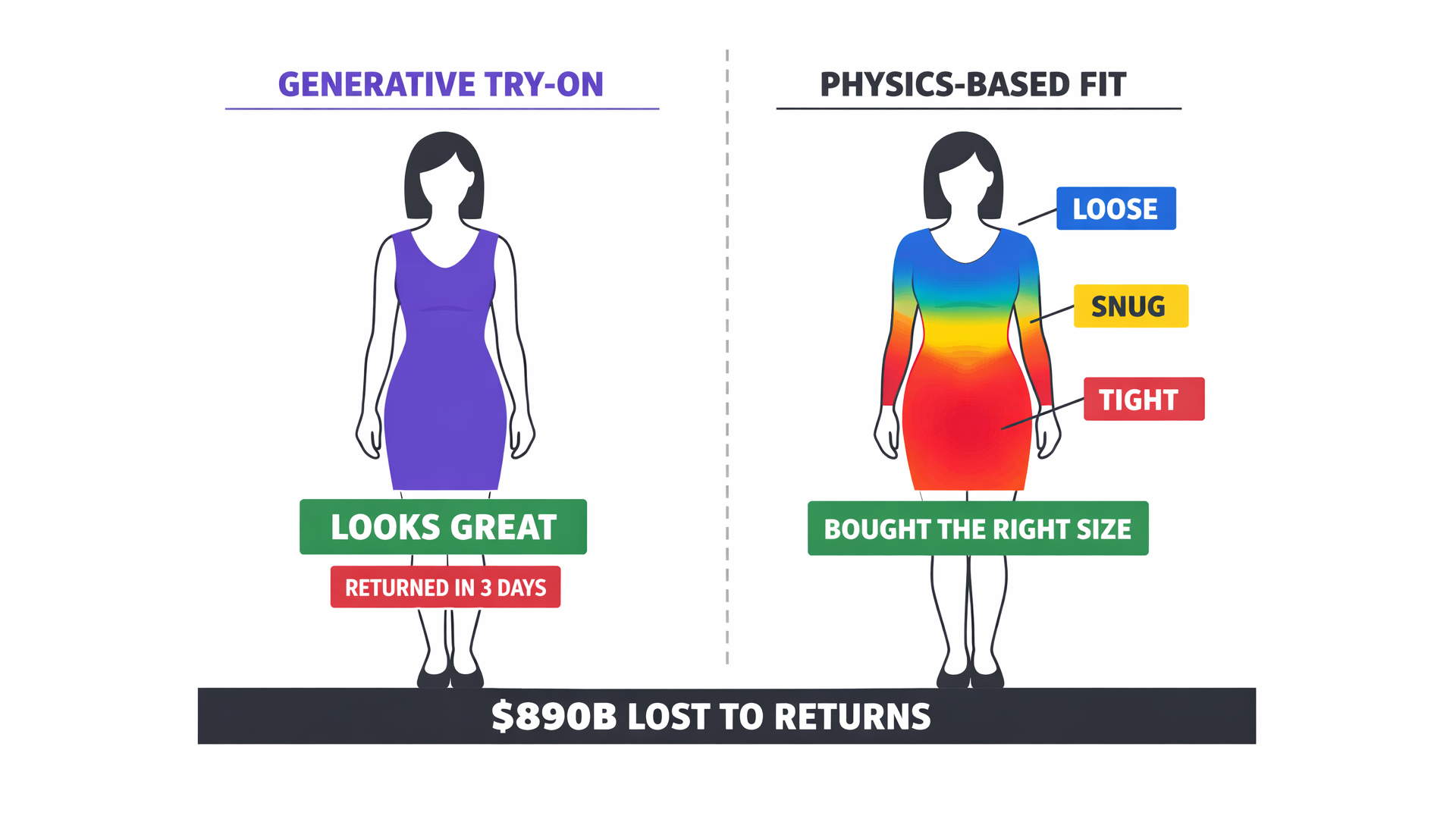
A customer uploads a selfie, taps "try on," and sees herself looking incredible in a fitted dress. She buys it. Three days later, it doesn't zip past her hips. She returns it.
That scenario is playing out millions of times a day across fashion e-commerce, and the technology that was supposed to fix it -- generative AI virtual try-on -- is actually making it worse. I know this because my team at Veriprajna has spent the past year pulling apart the technical architecture behind these tools, and what we found changed how I think about AI in retail entirely.
The fashion industry lost nearly $890 billion to returns in the U.S. alone in 2024. Not misplaced revenue. Real operational cost -- shipping, inspection, repackaging, markdowns, destroyed inventory. For every $100 garment returned, the total damage can reach 66% of the original price when you factor in logistics, depreciation, and wasted customer acquisition spend.
And the root cause? It isn't buyer's remorse. Between 53% and 67% of all apparel returns trace back to one thing: the garment didn't fit.
$890 billion lost, and the majority traces back to a single cause: the garment didn't fit the body it was bought for.
Why Does Generative Virtual Try-On Make Things Worse?
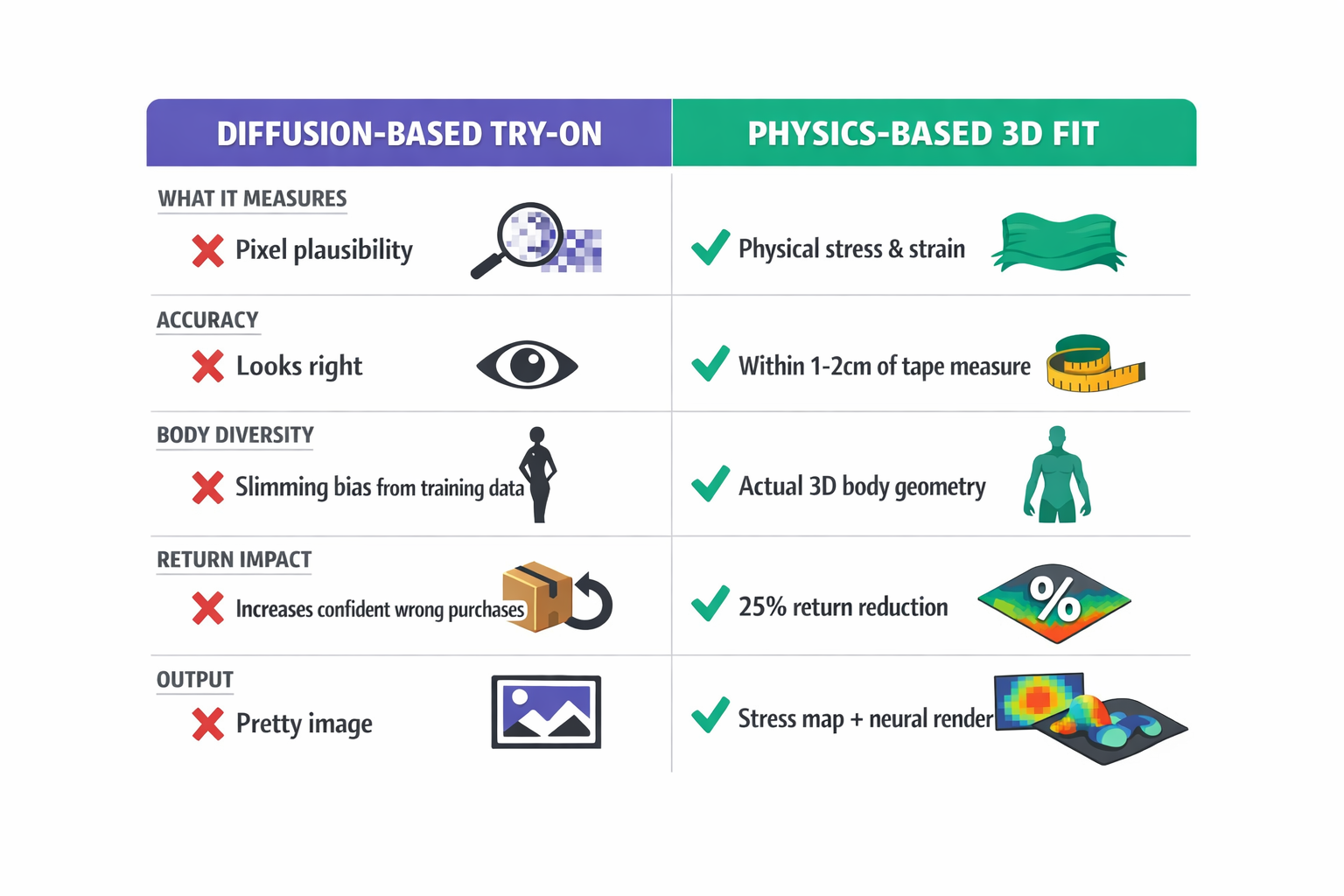
When I first encountered diffusion-based virtual try-on tools -- the kind that generate images by gradually refining visual noise into a photo, built on Stable Diffusion, Midjourney-style architectures, and their derivatives -- I was genuinely impressed by the visuals. The images looked photorealistic. A non-technical person would assume the technology had solved the problem.
But photorealism and physical accuracy are two completely different things.
These models work by predicting what pixels should look like based on statistical patterns from millions of fashion photos. They don't understand fabric weight, stretch, or how a seam interacts with a hip bone. They generate an image that looks plausible, not one that is physically true.
The most dangerous outcome is what I call the "slimming bias." Training datasets are overwhelmingly composed of professional fashion photography -- tall, slender models in idealized lighting. When a real customer uploads a photo with a different body type, the model subtly warps either the body or the garment to match its training distribution. It might stretch a non-stretch denim texture as though it were spandex. It might narrow the waist to fit its statistical average of "person wearing jeans."
The customer sees a flattering image, buys with high confidence, and receives a garment that physically cannot accommodate her body. The return is now worse than if she'd bought without any AI assistance -- because her expectations were actively inflated.
Diffusion models don't calculate fit. They hallucinate it. And hallucinated fit drives returns, not reduces them.
Why Does Bracketing Cost Retailers Millions?
Without reliable fit information, consumers have developed their own workaround: bracketing. Buy a Medium and a Large. Keep whichever fits. Return the other.
Data shows 51% of Gen Z shoppers bracket regularly. From the customer's perspective, this is perfectly rational. From the retailer's perspective, it's devastating. You ship two items, get one back, and the returned unit sits in reverse logistics for two to four weeks -- by which time the trend window may have closed, forcing a 30-50% markdown just to move it.
For a retailer doing $200 million in annual gross sales with a 30% return rate, that's $60 million in returned goods and roughly $12 million in direct processing costs every year. Bracketing is a symptom of the fit gap, and no amount of prettier AI imagery will close it. For those who want the full engineering depth behind the alternative, the detailed research is here.
How Does Physics-Based AI Actually Work?
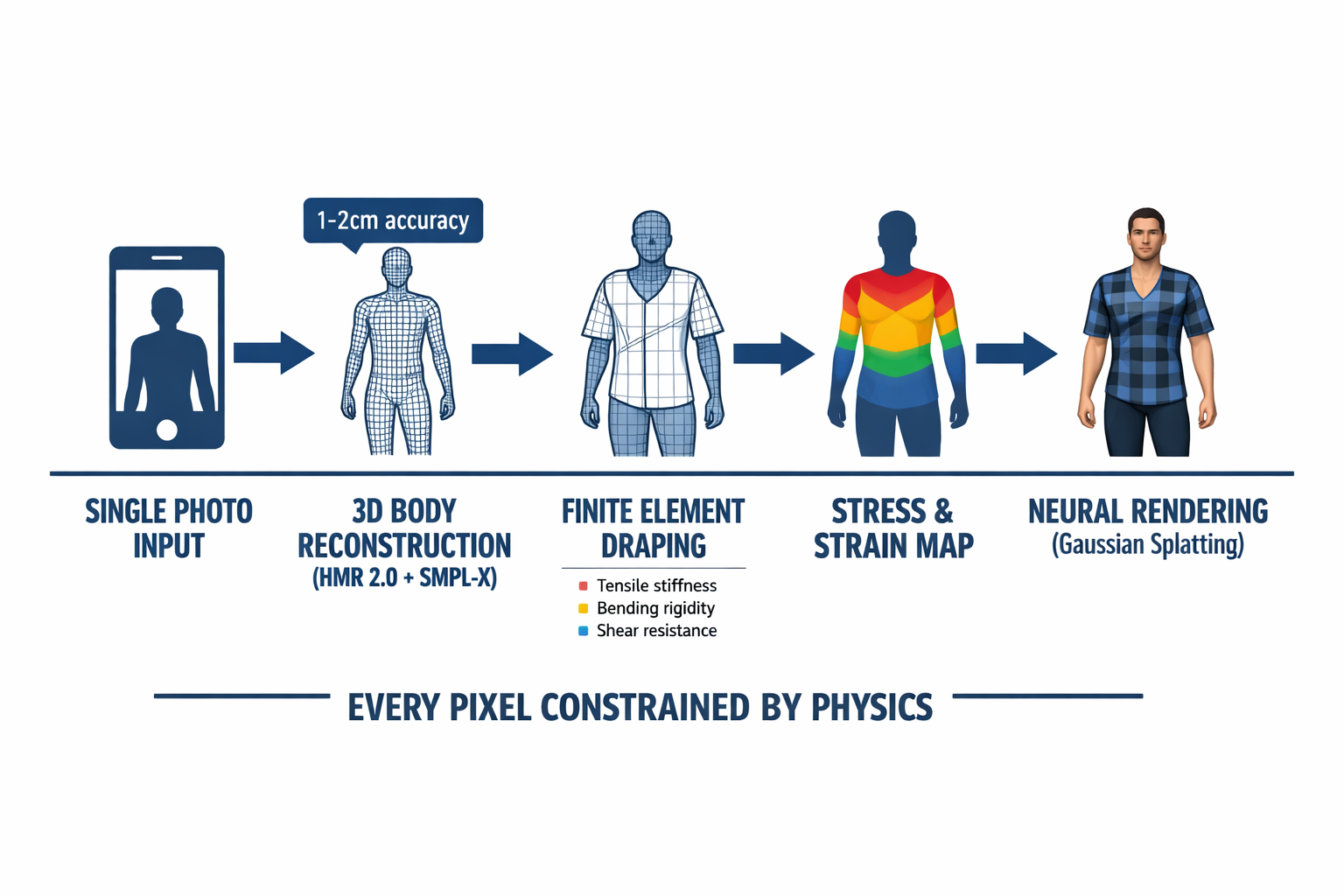
About eighteen months ago, my team made a decision that felt counterintuitive at the time: we walked away from generative approaches entirely and committed to physics-based 3D body reconstruction. The engineering is harder. The compute is heavier. The sales pitch is less flashy. But the math works.
The approach starts with reconstructing the customer's actual 3D body geometry from a single photo. We use transformer-based Human Mesh Recovery -- think of transformers as AI models that understand how different parts of an image relate to each other, so the position of a foot tells the system something about the angle of a hip, even when body parts are partially hidden. Modern architectures like HMR 2.0, combined with advanced parametric models (SMPL-X for full-body articulation, SKEL for biomechanically accurate joint limits) and perspective correction algorithms like BLADE, undo the distortion from phone cameras held at arm's length. The result: body measurements accurate to within 1-2 centimeters of a physical tape measure.
From there, we drape the actual garment -- not a texture, but the digital pattern file used in manufacturing -- onto the 3D body and simulate it using Finite Element Analysis. The fabric behaves according to its real mechanical properties: tensile stiffness (how much it stretches), bending rigidity (how it drapes), and shear resistance (how it conforms around curves). This is the same math used in automotive crash simulation and aerospace engineering, applied to silk and denim. And instead of generating a pretty picture, the system produces a stress and strain map -- a color-coded heat map that shows exactly where the garment is tight (red), snug (yellow), loose (blue), or not touching the body at all (white). A customer who sees red zones across her hips on a Medium but comfortable yellow on a Large doesn't need to bracket. She buys the Large once.
Every pixel in our output is anchored to a physics simulation -- gravity, tension, friction -- so the image can only show what the fabric will actually do on your body.
"But Won't This Feel Less Polished Than Generative Try-On?"
This is the first question I get, and it's fair. Generative images look like magazine photos. A stress map looks like an engineering diagram.
Our answer is neural rendering -- specifically, techniques like Gaussian Splatting that take the physics simulation output and render it photorealistically. The visual quality matches generative approaches, but every pixel is constrained by the underlying physics. The image can't hallucinate a fit that doesn't exist because the simulation won't allow it.
There's also a practical objection: this requires brands to have 3D digital patterns of their garments, not just flat photography. That's true. We work with our clients to build what we call "Smart Assets" using tools like CLO3D and Browzwear -- the same software many brands already use for design. The upfront investment is real, but it creates a digital thread connecting design, manufacturing, and sales. Once that infrastructure exists, the physics engine works across your entire catalog.
I explored the full technical reasoning in our interactive analysis.
What Does This Mean for the P&L?
For that same $200 million retailer, reducing the return rate from 30% to 22.5% -- a 25% reduction, consistent with industry data on advanced virtual try-on -- changes the economics dramatically.
$15 million fewer returns flowing through reverse logistics
$3 million saved in direct processing costs (shipping, labor, repackaging)
$7.5 million in recovered revenue from customers who keep what they buy instead of returning it
Total annual P&L impact: $10.5 million
And that's before accounting for the sustainability gains. A 25% reduction in return volume maps directly to a 25% reduction in reverse logistics emissions -- a number that matters increasingly as EU regulations move to ban destruction of unsold textiles. Physics-based fit verification gives your ESG team something concrete to report.
The Real Divide in Fashion AI
I've come to see the AI landscape in fashion as split between two fundamentally different philosophies. One treats the fit crisis as a visual problem and deploys pixel-prediction models to make shopping feel better. The other treats it as a mechanical problem and deploys physics simulation to make purchasing decisions accurate.
The first approach drives conversion. The second drives profitability. They are not the same thing, and conflating them is costing the industry billions.
What concerns me most is how easy it is to mistake one for the other. A generative try-on demo looks spectacular. A stress map looks technical. But the demo increases returns while the stress map eliminates them. The industry is optimizing for the wrong metric.
In fashion AI, the ultimate luxury is truth -- mathematical, geometric, and physical truth. Everything else is a magic mirror.
If you're a retail leader evaluating AI fit solutions, I'd push you to ask one question: can the system tell you, in centimeters, where the garment will be tight? If the answer is no, you're buying a marketing tool, not a returns solution. I'd genuinely like to hear how others are thinking about this tradeoff.