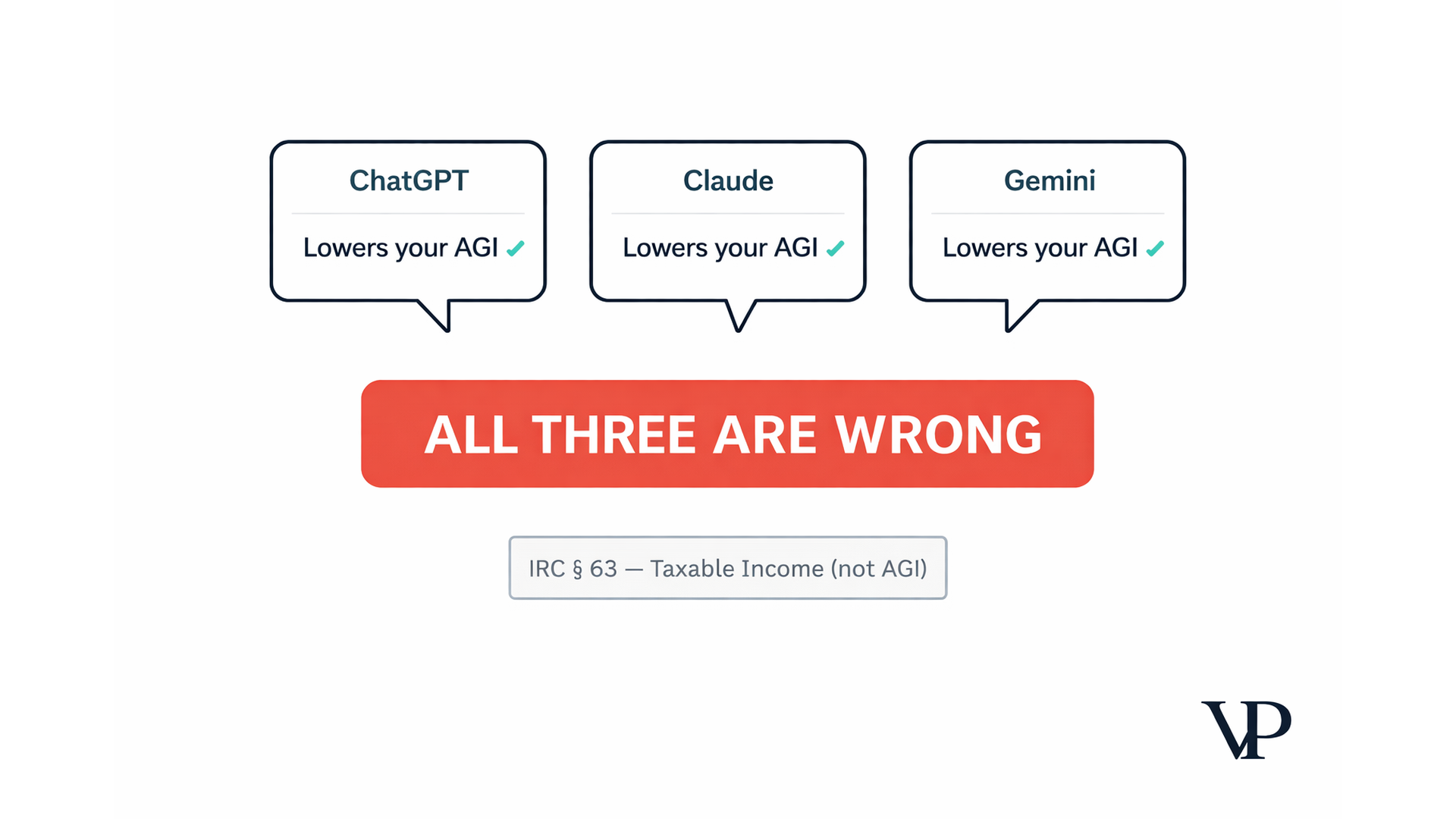
Ask ChatGPT if car loan interest is tax-deductible under the new Omnibus Budget Reconciliation Act, and it'll confidently tell you yes — it lowers your Adjusted Gross Income. Ask Claude the same question. Same answer. Ask Gemini. Same answer. All three are wrong, and the error could cost a taxpayer thousands in penalties.
We call this phenomenon Consensus Error — when every major AI gives you the same incorrect answer because the internet itself got it wrong first. It's not a random hallucination. It's a systematic failure baked into how these models learn, and it represents one of the most dangerous blind spots in AI tax compliance today.
Our team spent months dissecting exactly how this happens, why standard fixes don't work, and what a real solution looks like. What we found has implications far beyond one tax deduction. We published our full interactive analysis here, but the core story deserves a wider audience.
The Car Loan Deduction That Broke Three AIs
The Omnibus Budget Reconciliation Act created a new tax break: interest on loans for new, US-assembled passenger vehicles became deductible for tax years 2025 through 2028. Financial content creators jumped on it. Headlines exploded: "Car Loan Interest Is Now Deductible!" and "New Tax Break for Car Buyers!"
Most of those articles got a critical detail wrong.
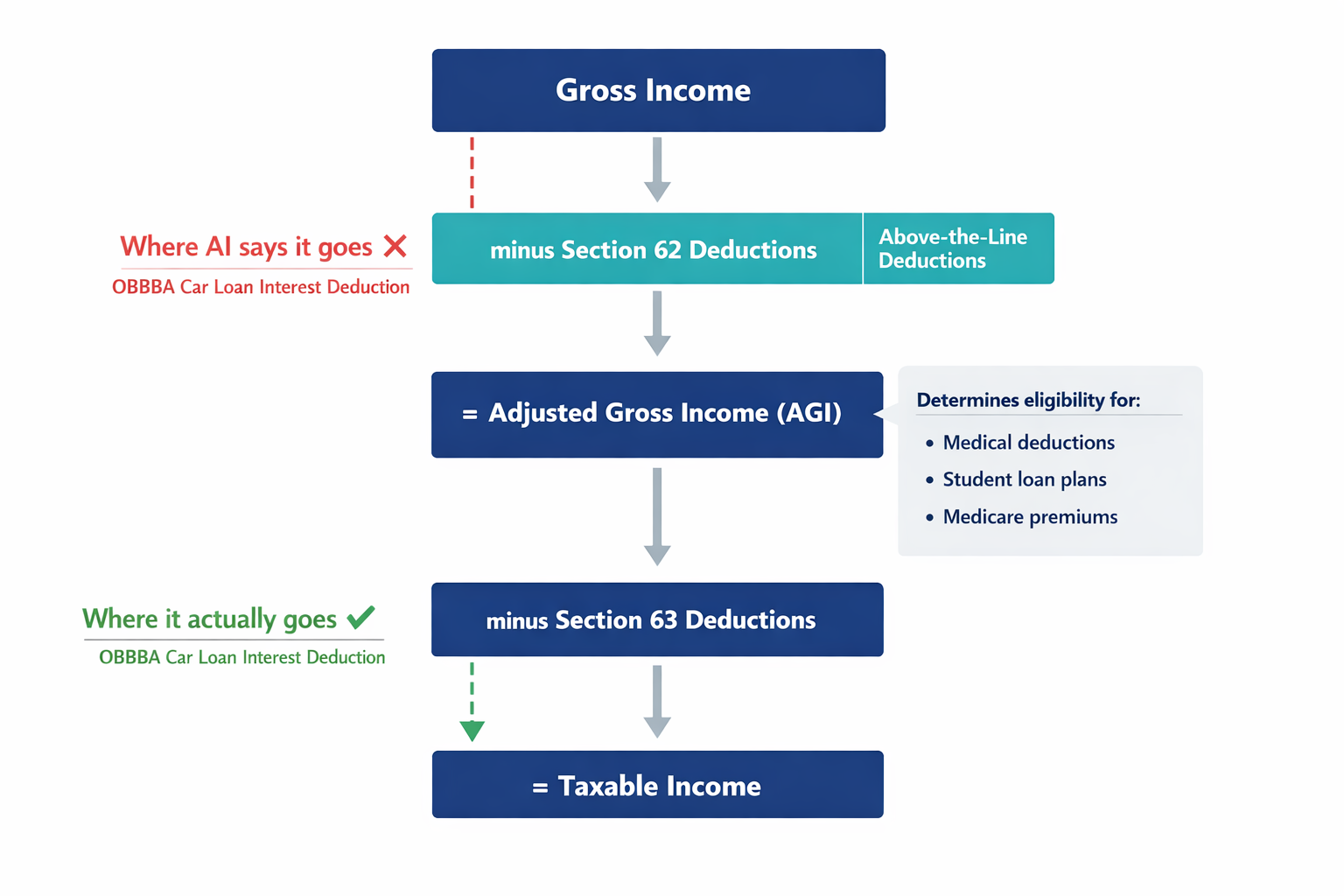
The deduction was added to IRC Section 63, which reduces Taxable Income. It was not added to Section 62, which reduces Adjusted Gross Income (AGI). That distinction sounds technical, but the financial consequences are enormous.
AGI is the number that determines whether you qualify for dozens of other tax benefits — medical expense deductions, student loan repayment plans, Medicare premium calculations, and more. A deduction that lowers your AGI is far more valuable than one that doesn't. Confusing the two isn't a rounding error. It's a fundamentally different tax position that can trigger audits, penalties, and cascading miscalculations across a taxpayer's entire return.
Popularity is not a proxy for truth. In tax law, the most widely repeated answer is often the most dangerously wrong.
When we tested ChatGPT, Claude, and Gemini on this question, all three correctly identified the OBBBA, correctly cited the 2025–2028 timeframe, and then incorrectly told users the deduction would lower their AGI. They got the easy parts right and the part that actually matters wrong.
How the Internet Trains AI to Be Confidently Wrong
To understand why this keeps happening, you need to understand one thing about how large language models work: they predict the most likely next word based on patterns in their training data. They don't reason through statutes. They don't check legal hierarchies. They find the answer that sounds most like what the internet says.
And the internet, on this topic, is overwhelmingly wrong.
The actual statute appears in a handful of official legal repositories, written in dense legislative language — amendments to amendments, cross-references between sections. Meanwhile, thousands of simplified articles, forum posts, and SEO-optimized explainers repeated the same oversimplification. When an AI model weighs these sources, the sheer volume of incorrect-but-accessible content drowns out the correct-but-rare statutory text.
Our research modeled this mathematically. If 90% of the training sources on a specific tax nuance contain the same error — which is common for technical legislative changes — the model is statistically destined to reproduce that error, regardless of how you phrase your question. The math doesn't care about your prompt.
Why "Just Use Better Prompts" Doesn't Fix This
The most common response we hear is that prompt engineering can solve the problem. Tell the AI to "think step by step." Instruct it to "act as a senior tax auditor." Specify that it should "only use official sources."
We tested 47 prompt variations across three leading LLMs. The Consensus Error persisted.
This makes sense once you understand the limitation. Prompt engineering works within the boundaries of a model's existing knowledge weights. It can steer attention, but it cannot override deeply embedded statistical biases. Telling a model to ignore non-official sources doesn't remove those sources from its parameters — they're already woven into billions of numerical weights that shape every response.
You cannot prompt a probability engine into becoming a logic solver. The architecture itself must change.
There's an additional wrinkle. When models are compressed for faster deployment — a process called quantization — their reasoning abilities degrade faster than their language abilities. The model still sounds authoritative and precise. It just makes more logical errors. Confidence and correctness become decoupled, which is perhaps the worst possible outcome for tax advice.
RAG: Right Document, Wrong Answer
Retrieval-Augmented Generation, or RAG, is the industry's current best attempt at grounding AI in trusted sources. The idea is straightforward: instead of relying solely on training data, retrieve the actual statute and feed it to the model alongside the user's question.
It helps. It's not enough.
Even when our tests provided the full OBBBA text directly in the model's context window, the AI still misclassified the deduction as an AGI reduction. Three structural problems explain why.
First, legislative text doesn't read like a narrative. It's a series of surgical amendments — "Section 163(h) is amended by inserting..." The model has to reconstruct the logical state of the law from fragments, and when a fragment says "deduction allowed" without explicitly stating where in the tax calculation it applies, the model fills the gap with its training bias.
Second, the critical evidence is sometimes an absence. Section 62 defines what counts as an above-the-line deduction. The OBBBA car loan provision isn't listed there. That omission is the answer — but vector search systems look for relevant text, not for the meaningful absence of text. They find paragraphs about car loans. They don't find the paragraph in Section 62 that silently excludes them.
Third, and most fundamentally: RAG solves retrieval, not reasoning. It puts the right document in front of the model. But the model still has to interpret it, and a model whose internal weights have been shaped by millions of incorrect examples acts as a biased reader — misinterpreting even correct source material to fit its pre-existing patterns.
Teaching AI to Calculate the Law, Not Guess at It
The solution we've been building doesn't ask an AI to read the tax code and form an opinion. It separates understanding language from applying legal logic — and assigns each task to the technology actually designed for it.
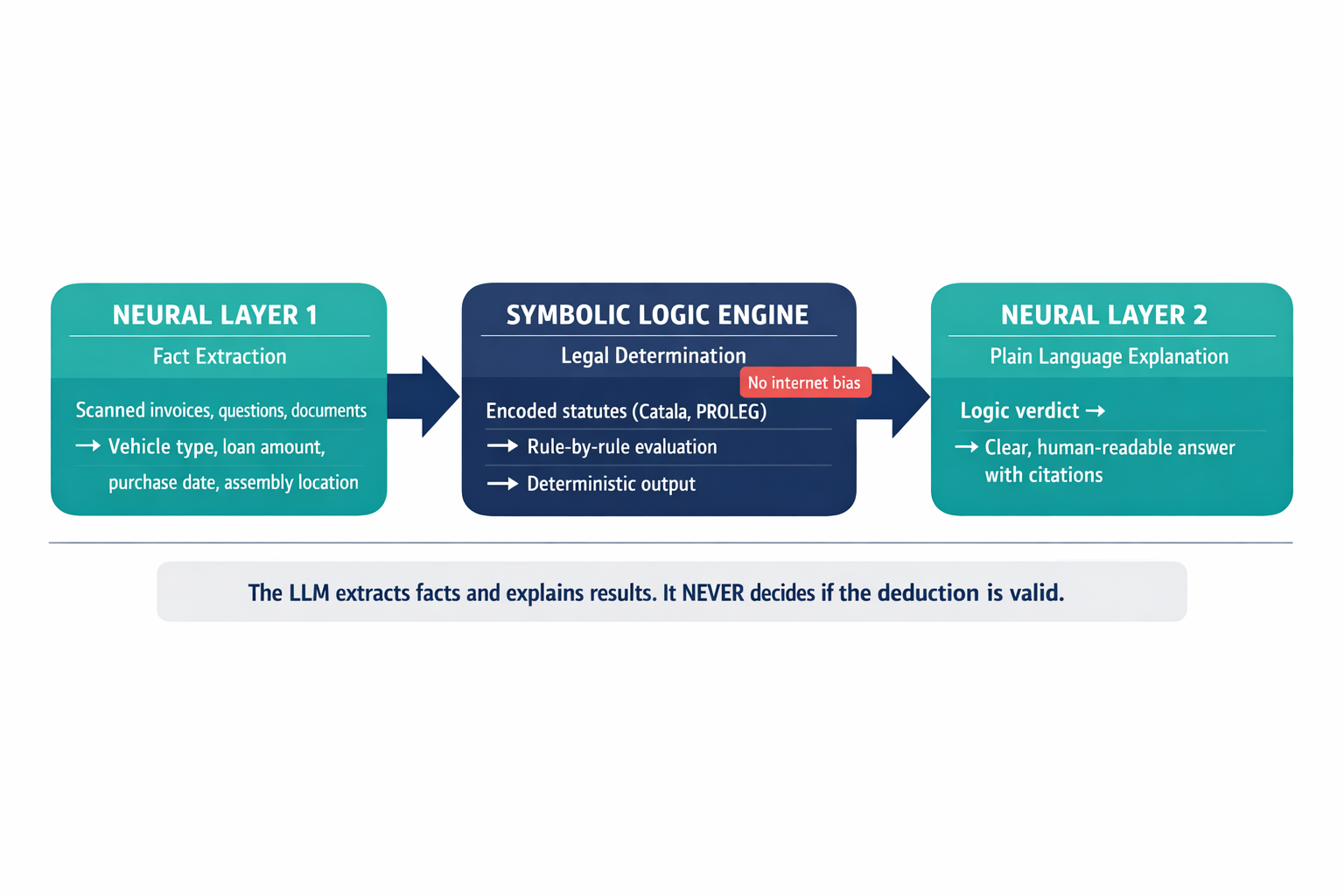
This approach is called Neuro-Symbolic AI: a hybrid that combines the language abilities of neural networks with the rule-following precision of symbolic logic systems. Think of it as pairing a skilled translator with an uncompromising auditor. The translator handles messy real-world inputs — scanned invoices, conversational questions, unstructured documents. The auditor handles the legal determination, following encoded rules that mirror the actual statute.
In practice, this means three layers working in sequence. A neural layer extracts structured information from a user's question or document — vehicle type, purchase date, loan amount, assembly location. A symbolic layer then runs those facts against logic that has been formally encoded from the statute itself, using specialized legal programming languages like Catala (developed by INRIA for the French government's tax authority) and PROLEG (a system that models legal argumentation and burden of proof). Finally, a neural layer converts the logic engine's verdict back into clear, human-readable language.
The critical insight: the language model is never asked whether the deduction is valid. It's asked to extract facts and explain results. The decision is made by the logic engine, which has no access to the internet's conventional wisdom — only to the encoded statute.
For the full technical methodology behind this architecture, our detailed research paper walks through the formal logic, the knowledge graph structure, and the specific failure modes we tested against.
From Black Box to Glass Box
One of the most persistent problems with AI in regulated industries isn't just accuracy — it's explainability. When a standard LLM allows or denies a deduction, the reasoning is locked inside billions of opaque numerical weights. Ask "why did the AI reach this conclusion?" and the honest answer is: because one probability was slightly higher than another.
That's not an answer you can present to the IRS.
A neuro-symbolic system produces something fundamentally different: a traceable logic path. For every determination, it can output exactly which conditions were checked, which were satisfied, which failed, and which section of the code governs the outcome. Loan date verified against the 2025–2028 window. Vehicle assembly location confirmed as US-based. Income checked against the phase-out threshold. Rule reference: IRC § 163(h)(4).
When AI can show its work the way a human auditor would, it stops being a liability and starts being an asset.
This transforms AI from a system you hope is right into a system you can verify is right — before the IRS does.
What About the Phase-Out Rules?
The OBBBA deduction isn't a simple yes-or-no determination. It includes a $10,000 annual cap and a phase-out that reduces the deduction by $200 for every $1,000 of income above $100,000 for single filers. The deduction disappears entirely at $150,000.
This is exactly the kind of multi-step arithmetic embedded in natural language that LLMs handle worst. In our testing, models presented with a taxpayer earning $125,000 frequently either ignored the phase-out entirely or applied a reduction curve borrowed from a different tax credit — the Child Tax Credit phase-out, for instance, which follows completely different rules.
A symbolic logic engine doesn't guess at the math. It executes it. The phase-out calculation is encoded as a deterministic function, and the output is the same every time for the same inputs — which is, after all, what the law requires.
What This Means If You're Running a Finance Team
If your organization is using AI for tax research, regulatory summarization, or compliance workflows, three things should concern you.
The errors look correct. Consensus Error doesn't produce obvious nonsense. It produces well-sourced, confidently stated, precisely wrong answers. Your team may not catch them without deep statutory knowledge of the specific provision in question.
RAG alone isn't sufficient. If your AI vendor's answer to hallucination risk is "we use retrieval-augmented generation," ask them what happens when the model misinterprets the retrieved document. Retrieval is necessary but not sufficient for legal reasoning.
Lenders have exposure too. The OBBBA created new reporting requirements under Section 6050AA. Any institution receiving $600 or more in interest on a qualifying vehicle loan must file information returns with the IRS. In our testing, AI systems asked about the new law's implications for banks consistently focused on the borrower's benefit and omitted the lender's reporting obligation — because that's what the popular articles focused on.
The shift from probabilistic AI to neuro-symbolic AI isn't a theoretical preference. It's a practical necessity for any organization where being wrong carries regulatory consequences.
We're not arguing that language models are useless for finance — far from it. They're extraordinary at understanding messy, unstructured human communication. But understanding a question and correctly applying the law to answer it are two different capabilities, and conflating them is where the risk lives.
If your team is navigating how to deploy AI in compliance-sensitive workflows, we'd genuinely like to hear what challenges you're encountering. The problems are industry-wide, and the solutions will be too.