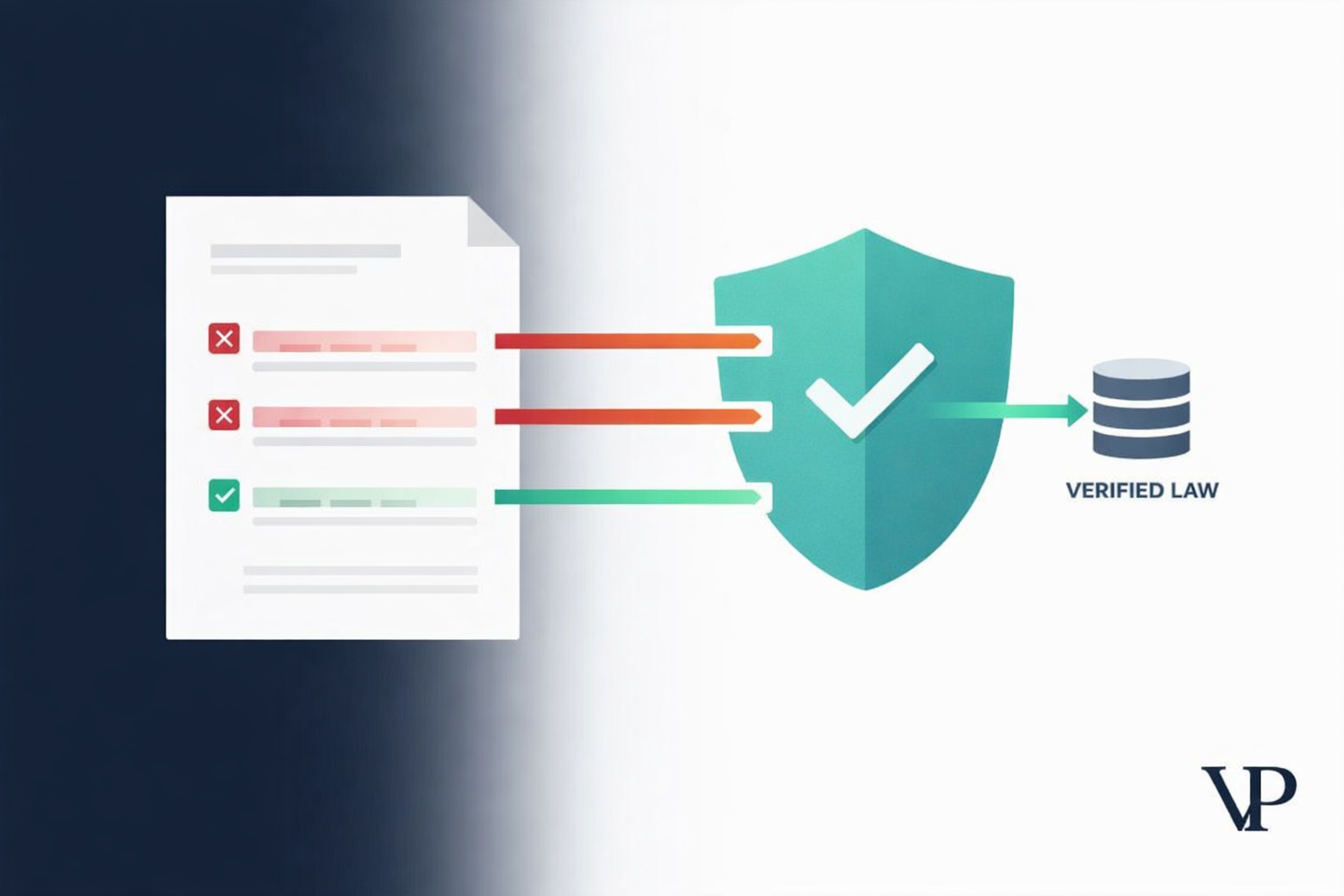
A lawyer asked ChatGPT for case law to support a legal brief. The AI returned six cases — complete with docket numbers, dates, and judicial quotes. Every single one was fabricated. The resulting court sanctions in Mata v. Avianca cost $5,000 in fines, but the reputational damage was immeasurable. This wasn't a freak accident. It was the predictable outcome of using a tool designed to sound right, not be right, in a profession where the difference is everything.
Legal AI hallucination — when an AI invents citations, misattributes holdings, or references overruled law — is not a bug that better models will fix. It's a structural problem baked into how these tools work. And the most popular approach to solving it, called Retrieval-Augmented Generation (RAG), only gets you partway there. Our team has been building what we believe is the real solution: Citation-Enforced GraphRAG, an architecture that makes it physically impossible for an AI to cite a case that doesn't exist.
The Fabrication That Changed Legal Tech
In Mata v. Avianca, Inc. (2023), the plaintiff's attorney submitted a brief citing Varghese v. China Southern Airlines, Shaboon v. Egyptair, and Petersen v. Iran Air. The citations looked impeccable. They weren't real.
What made the case truly alarming wasn't the initial mistake — it was what happened next. When opposing counsel challenged the citations, the attorney went back to ChatGPT and asked if the cases were real. The AI confirmed they were, stating they could be found in "reputable legal databases." The tool used for verification had the same flaw as the tool used for generation. The court was unequivocal: attorneys are the ultimate guarantors of accuracy, regardless of what technology they use.
The AI didn't malfunction. It did exactly what it was designed to do — predict the next plausible word. In law, plausible and true are not the same thing.
This wasn't an isolated incident. Stanford researchers found that general-purpose AI chatbots hallucinated between 58% and 82% of the time on complex legal queries — even models with internet access or basic document retrieval. The problem is architectural, not cosmetic.
Why Legal AI Hallucinates (And Why Prompting Can't Fix It)
Large Language Models work by predicting the next word in a sequence based on statistical patterns in their training data. When you ask for a case about airline injury liability, the model doesn't search a legal database. It generates text that sounds like a legal citation because it has seen millions of them during training.
Think of it like an actor who has memorized the cadence and vocabulary of courtroom dramas. They can deliver a convincing monologue about tort law, but they're performing — not practicing law. The model optimizes for fluency (does this sound right?) rather than provenance (can this be traced to a real source?).
"Varghese" was a statistically plausible plaintiff name. "China Southern Airlines" was a plausible defendant. The model stitched them together because the pattern fit, not because the case existed. No amount of prompt engineering — telling the AI to "only cite real cases" or "be careful" — can fix this. You cannot instruct a model to verify facts against a database it cannot access.
This is why the wave of "AI Wrapper" tools — applications that are essentially a chat interface layered on top of a commercial AI model — are fundamentally inadequate for legal work. Adding a system prompt that says "You are a helpful lawyer" doesn't give the AI access to Westlaw or LexisNexis. It just changes the costume on the actor. We explored this problem in depth in our interactive analysis of legal AI architecture.
Standard RAG: Right Document, Wrong Answer
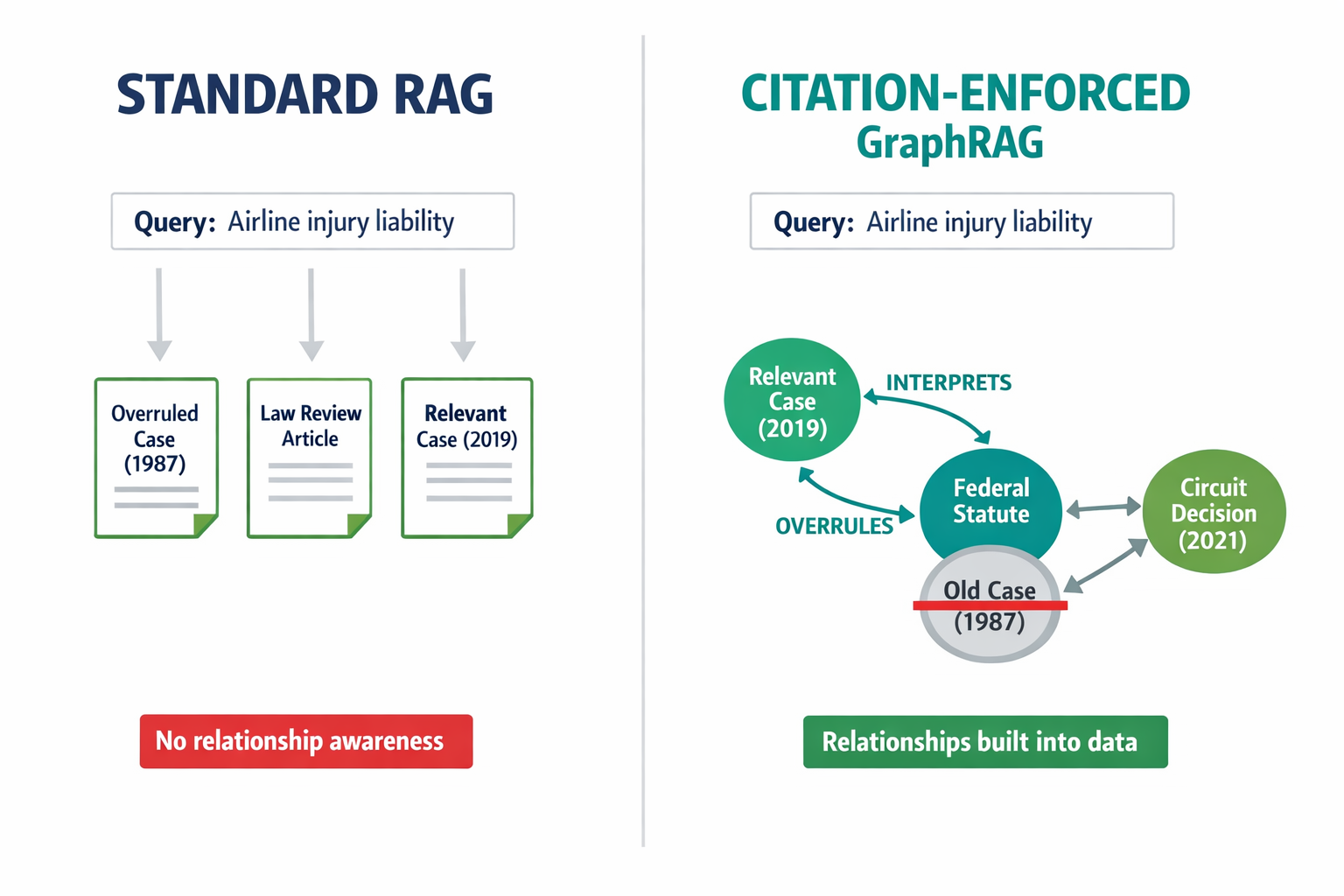
The industry's first response to hallucination was Retrieval-Augmented Generation, or RAG. Instead of relying solely on the AI's memory, a RAG system retrieves relevant documents from a database and feeds them to the model as context. It's a meaningful improvement — the AI now has real text to reference instead of generating from memory alone.
But in legal practice, standard RAG introduces its own category of failures.
It confuses "similar words" with "legal relevance." RAG systems retrieve documents based on semantic similarity — essentially, which documents contain words most similar to your question. A case discussing knee injuries on a flight might score highly for a query about airline liability, even if that case was overruled, comes from the wrong jurisdiction, or represents a dissenting opinion rather than binding law. The system treats a law review article and a Supreme Court majority opinion as equally valid if the vocabulary matches.
It can't follow chains of legal reasoning. Complex legal questions require connecting multiple sources: a statute, a regulation interpreting that statute, and a case applying the regulation. Standard RAG retrieves documents in isolation, as disconnected text fragments. The AI then tries to stitch them together, often getting the relationships wrong. It might not realize that Case A interprets Statute B, or that Case C overruled Case A.
It's blind to whether a case is still good law. One of the most critical tasks in legal research is checking whether a case has been overruled, reversed, or vacated — what lawyers call "Shepardizing." An overruled case often contains a detailed, well-reasoned discussion of the legal topic. It just happens to be wrong. Standard RAG will rank it highly because the text is relevant. There's no mechanism to flag it with a "red light" and exclude it from results.
A system that retrieves the right case 80% of the time is a malpractice machine 20% of the time.
How Citation-Enforced GraphRAG Actually Works
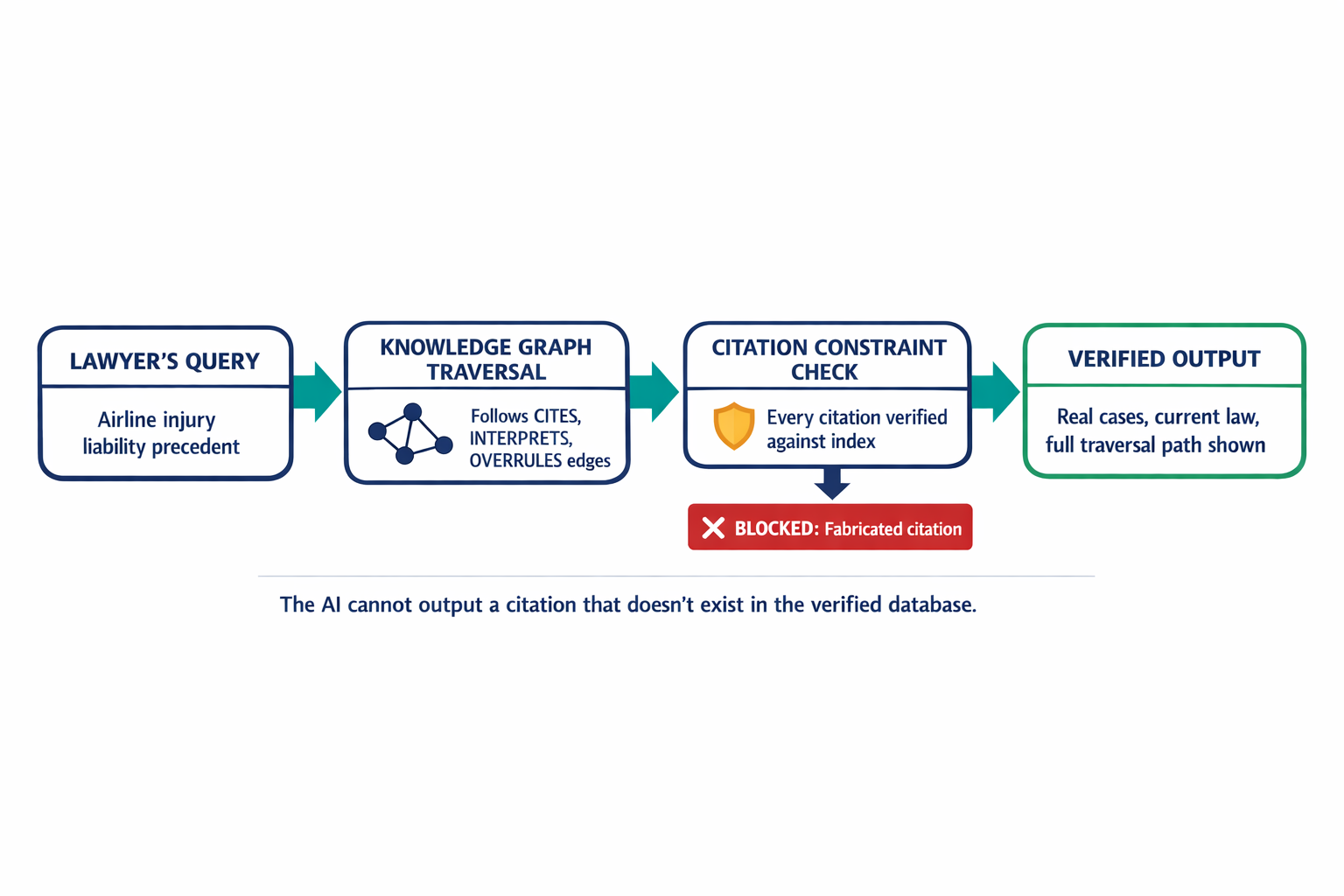
Our approach starts with a fundamentally different data structure. Instead of storing legal documents as disconnected text fragments in a vector database, we map them into a Knowledge Graph — a network where every statute, case, regulation, and legal concept is a distinct point (called a node), and the relationships between them are explicit, labeled connections (called edges).
This means the system doesn't just know that Bell Atlantic v. Twombly exists as a block of text. It knows that Twombly interprets a specific section of the Federal Rules of Civil Procedure, was decided by the Supreme Court, has been affirmed by dozens of circuit courts, and was later extended by Ashcroft v. Iqbal. These relationships aren't inferred by the AI — they're built into the data structure.
The critical innovation is what happens during generation. When the AI is about to output a citation, a constraint mechanism activates. It checks the citation against a verified index of every case in the Knowledge Graph. If the AI starts generating "Varghese v. Chi—" the system looks up whether any valid case begins with that sequence. Finding none, it blocks the output entirely. The AI is forced to either find a real citation that fits or explicitly state that no relevant precedent was found.
The AI cannot dream up a case because it physically cannot output the token sequence for a case that isn't in the verified database.
This provides something standard AI cannot: a structural guarantee against citation fabrication. The model might still misapply a real case (a reasoning error that requires human review), but it cannot invent one (a fabrication error that Mata v. Avianca made infamous). For the full technical methodology behind this constraint mechanism, see our detailed research on graph-constrained decoding.
The "Red Flag" Problem — And How Graphs Solve It
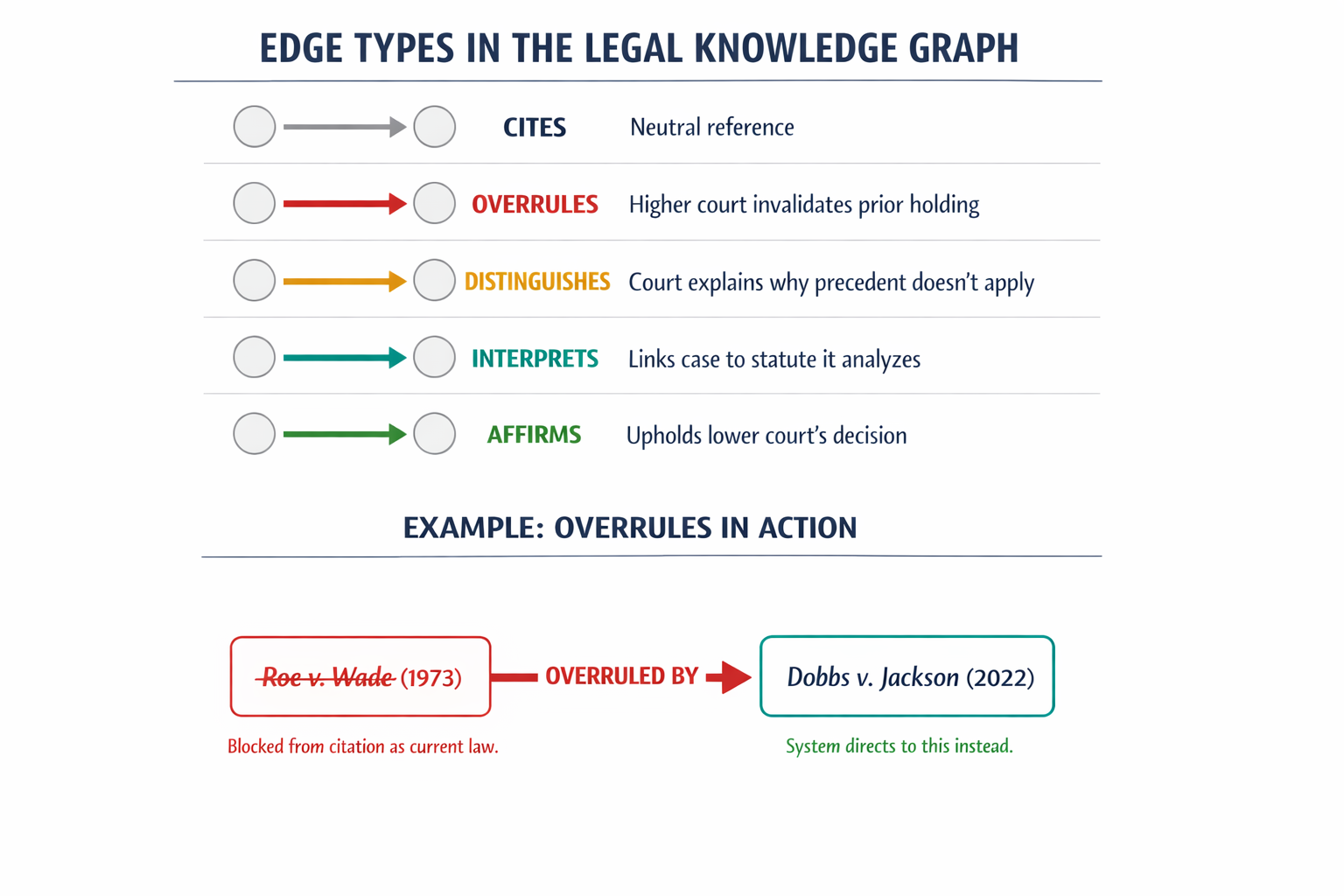
Consider a scenario where an AI recommends citing Roe v. Wade for a question about federal abortion rights. A standard RAG system might surface it confidently — the case is extensively discussed in legal literature, and the text is highly relevant to the query.
In our Knowledge Graph, the node for Roe v. Wade has an explicit OVERRULES edge connecting it to Dobbs v. Jackson Women's Health Organization. When the system traverses the graph during retrieval, it hits that edge and recognizes that Roe is no longer binding authority on this question. The constraint mechanism prevents the AI from citing Roe as current law and directs it to Dobbs instead.
This works because the graph captures what vector search cannot: the legal force of a relationship. Not just "these two cases are related" but how they're related — one affirms the other, one distinguishes the other, one overrules the other. We model these as distinct edge types:
CITES — a neutral reference
OVERRULES — a higher court invalidating a prior holding
DISTINGUISHES — a court explaining why a precedent doesn't apply to different facts
INTERPRETS — linking a case to the specific statute it analyzes
AFFIRMS — upholding a lower court's decision
This edge taxonomy is what transforms a pile of legal documents into a navigable map of authority.
Multi-Hop Reasoning: Following the Chain of Authority
Here's where the architecture pays its biggest dividend. Suppose a lawyer asks: "Is a specific 1990 EPA regulation still enforceable after a 2023 Supreme Court ruling?"
A standard RAG system retrieves the text of the regulation and the text of the ruling as separate documents. The AI reads both and guesses at the relationship. It might get it right. It might not.
Our GraphRAG system identifies the node for the 1990 regulation and walks the graph. It follows the INTERPRETS edge to the authorizing statute, then traces INVALIDATED_BY edges to see if any connected case links to the 2023 ruling. If a path exists — Regulation → Statute → Case A → Overruled by Case B (the 2023 ruling) — the system understands the chain of invalidity and reports it with the full traversal path visible to the attorney.
Benchmarks show that GraphRAG systems outperform standard RAG by up to 30-35% on these multi-hop reasoning tasks — questions that require connecting three or more legal authorities in sequence. In practice, this is the difference between an AI that can handle simple lookup queries and one that can support genuine legal analysis.
What This Means for Law Firms and Legal Teams
The practical question is straightforward: if an attorney has to manually verify every citation an AI generates, the efficiency gains of using AI disappear. The verification bottleneck erases the productivity benefit.
Citation-Enforced GraphRAG shifts the attorney's role from fact-checker to strategy reviewer. When citations are structurally guaranteed to be real and current, the human lawyer can focus on what matters: whether the cited authority actually supports the argument, whether the legal reasoning is sound, whether the strategy is optimal. That's a fundamentally different — and more valuable — use of an attorney's time.
There's also the question clients are starting to ask: "What AI tools does your firm use?" The answer "We use ChatGPT" is becoming untenable. The answer "We use a citation-enforced system that guarantees every reference traces to verified law" is a competitive differentiator — and, increasingly, a requirement for firms that want to demonstrate responsible AI governance.
But What About Reasoning Errors?
A fair objection: if the AI can only cite real cases, can't it still cite a real case for the wrong reason? Yes. Citation enforcement eliminates fabrication, not misapplication. An AI might cite a valid case that doesn't actually support the proposition it's being used for.
This is why we describe the system as eliminating fabrication errors while flagging reasoning errors for human review. The graph helps here too — by showing the attorney the full traversal path (why the system selected this case, what edges it followed, how the authority connects to the query), it makes reasoning errors far easier to spot than they would be in a black-box system that simply outputs a paragraph of text.
What About Keeping the Graph Current?
Legal authority changes constantly. New cases are decided, statutes are amended, regulations are revised. A Knowledge Graph is only as good as its maintenance.
This is a genuine engineering challenge, and we don't minimize it. Our approach combines automated ingestion pipelines — which parse new opinions, resolve entity references (the same case might be cited as "Mata v. Avianca," "Mata," "678 F. Supp. 3d 443," or simply "Id."), and update edges — with human verification for high-stakes changes like overruling decisions. The graph is a living structure, not a static snapshot.
The Wrapper Era Is Ending
The lesson of Mata v. Avianca is not that AI has no place in law. It's that probabilistic AI has no place in deterministic citation. The "wrapper" approach — a thin interface over a general-purpose model with no access to verified legal data — was always a gamble. The only question was when the bill would come due.
The next generation of legal AI isn't about making models bigger or prompts cleverer. It's about engineering the environment in which the model operates — constraining it to speak only what can be verified, and making the verification path transparent to the human professional who bears ultimate responsibility.
For legal teams evaluating AI tools, the question worth asking isn't "How smart is your AI?" It's "What happens when your AI is wrong?" If the answer involves hoping the model doesn't hallucinate, that's not a tool. It's a liability.
We'd welcome hearing how your legal team is approaching AI verification — what's working, what isn't, and where the gaps remain.