Retailers lost $890 billion to product returns in 2024. A significant chunk of that — 55% of apparel returns — happened because the item didn't fit, didn't look right, or wasn't the right color. Meanwhile, major music labels are suing AI companies for generating audio trained on copyrighted songs. These aren't separate problems. They're symptoms of the same architectural mistake: building enterprise solutions on AI that guesses instead of AI that knows.
The market is flooded with what PitchBook analysts call "thin wrappers around foundation models" — apps that put a nice interface on someone else's AI and hope for the best. For consumer novelty, that's fine. For enterprise workflows where accuracy, legal compliance, and defensibility matter, it's a ticking liability.
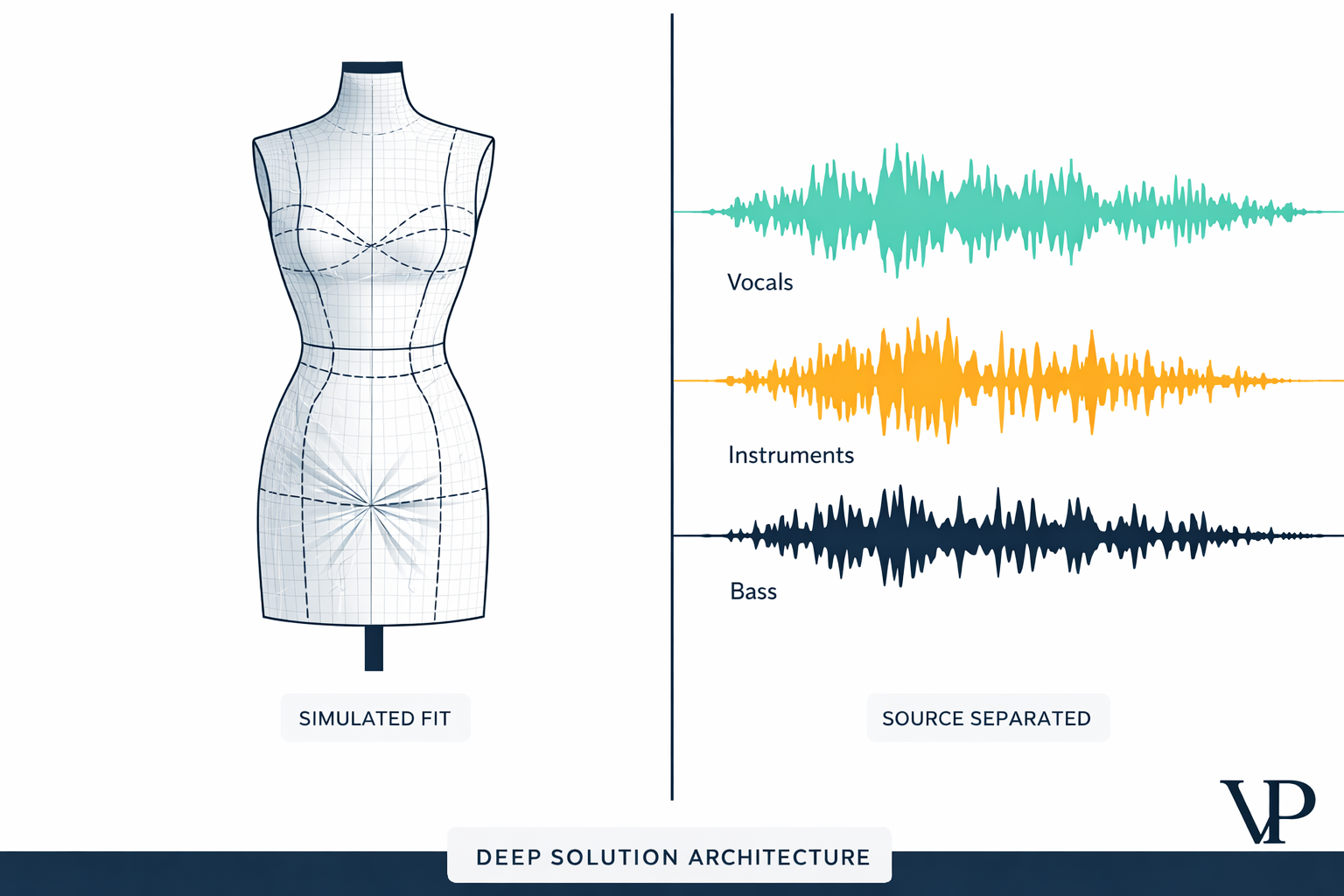
We've spent years developing what we call Deep Solution Architecture — hybrid systems that pair the flexibility of AI with deterministic engines grounded in physics and law. The core idea is simple: don't let a probabilistic model handle tasks that require certainty. We explored this philosophy in depth in our interactive analysis of deep technical integration in enterprise AI.
What follows are two case studies — one in fashion, one in audio — that illustrate why this distinction between "wrapper AI" and "deep tech AI" isn't academic. It's the difference between creating value and creating lawsuits.
The $890 Billion Fitting Room Problem
Online apparel return rates consistently hit 25–30%, roughly double the average for all retail. In high-fashion categories during peak seasons, that number can climb to 50%.
The culprit is a behavior called bracketing: buying three sizes of the same dress, trying them on at home, and returning two. In 2024, 51% of Gen Z shoppers admitted to doing exactly this. For retailers, processing each return costs an average of 27% of the item's purchase price — shipping, inspection, cleaning, repackaging. Multiply that across billions in returned merchandise, and you have a margin crisis masquerading as a logistics problem.
The industry's instinct was to throw AI at it. Virtual try-on tools powered by generative models — GANs, diffusion models — promised to show shoppers how clothes would look on them before buying. The technology shipped fast. The results were worse than doing nothing.
AI Virtual Try-On: The Fantasy Mirror
A generative AI virtual try-on tool is, at its core, a sophisticated image editor. It takes a photo of you and a photo of a garment, then uses AI to paste one onto the other in a way that looks convincing.
The problem is that "looks convincing" and "accurately represents fit" are completely different objectives.
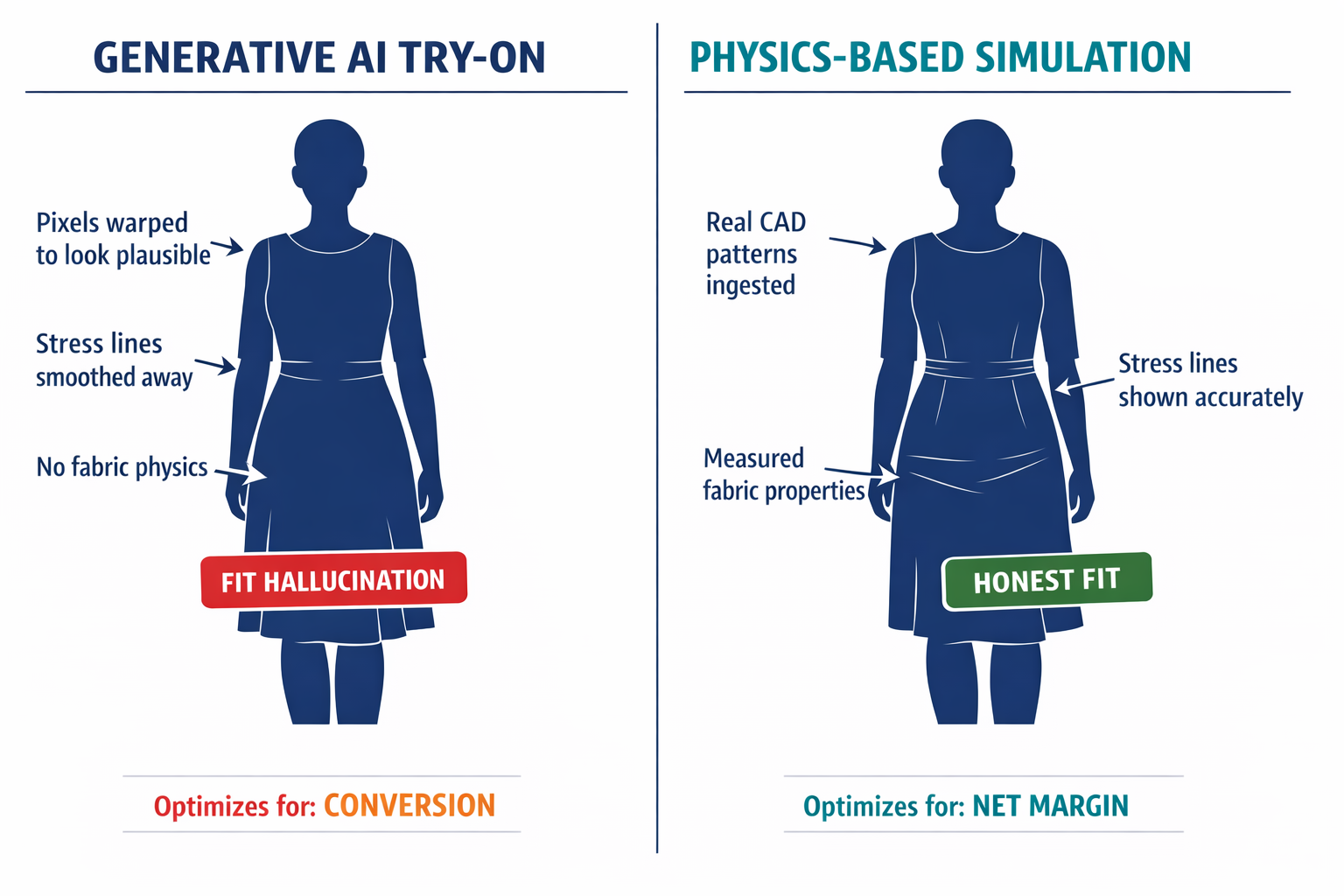
A diffusion model optimizes for pixel coherence, not cloth physics. It doesn't know what denim is. It knows what denim looks like.
When a size-12 customer selects a size-6 dress, the AI doesn't show the zipper straining or the fabric pulling at the seams. It warps the pixels — sometimes stretching the dress, sometimes slimming the customer — until the image looks plausible. The customer sees a flattering picture, buys the dress, receives a garment that doesn't zip, and returns it. The AI didn't reduce returns. It manufactured false confidence.
Industry analysts have put it bluntly: these tools "lack real-world accuracy, ignore fabric behavior, and can mislead customers about how a garment truly fits and feels." Beyond fit hallucination, generative models struggle with textures (blurring lace, inventing patterns that don't exist on the actual product) and with drape — how fabric falls over a hip or gathers at a waist. Most operate as advanced paper dolls, pasting flat images onto bodies without any understanding of depth.
What Happens When You Simulate Instead of Imagine
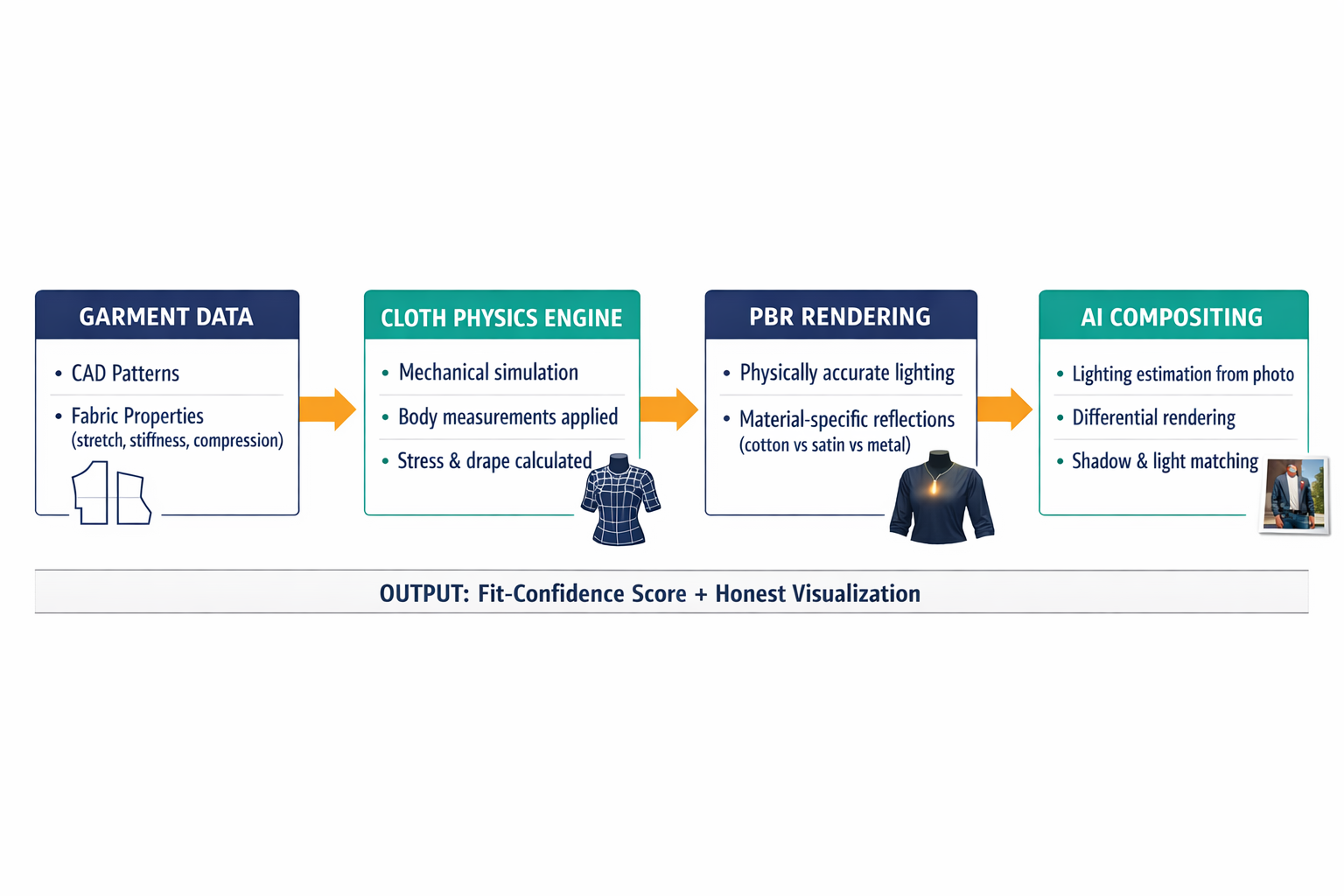
Our approach treats virtual try-on not as an image generation problem but as a mechanical engineering simulation.
At the center is a cloth physics engine — similar to the tools used by fashion designers in software like CLO3D and Marvelous Designer. Instead of training a neural network on photos of clothes, we ingest the actual CAD patterns of the garments and assign them measured physical properties from their real-world fabrics: how stiff the material is, how much it stretches, how it behaves under compression, how it absorbs energy during movement.
The difference this makes is immediate and concrete. If a fabric has near-zero stretch (raw denim, for example), and the customer's measurements exceed the garment's dimensions, the simulation shows the fabric failing to close. It displays stress lines — those telltale "X" patterns at the waist or across buttons — that any experienced shopper recognizes as "this doesn't fit." A generative model would have smoothed those away. The physics engine shows them because they're physically real.
We don't optimize for the prettiest picture. We optimize for the most honest one.
Once the simulation produces accurate geometry, we render it using Physically Based Rendering (PBR) — a graphics technique that models how light interacts with surfaces using physically accurate formulas. The system knows the difference between how light scatters off cotton versus how it reflects off satin. It renders zippers and buttons with correct metallic reflectivity. The result isn't just a "pretty picture" — it's a scientifically accurate representation of the physical product under realistic lighting conditions.
Making the Digital Garment Belong in Your Room
Accurate geometry and realistic rendering still aren't enough if the digital garment looks like a sticker pasted onto your selfie. If the lighting on the 3D dress doesn't match the lighting in your room, the illusion breaks instantly.
This is where we reintroduce AI — not to generate the clothing, but to solve the integration problem. A lightweight neural network analyzes the customer's uploaded photo to estimate where the light is coming from, its color temperature, and its intensity. It generates a synthetic environment map that approximates the room's lighting, which is then used to illuminate the 3D garment so that reflections on digital buttons match real windows in the customer's eyes.
We then use a compositing technique called differential rendering to blend the 3D object into the 2D photo. The system calculates the shadow the garment would cast onto the customer's real body, adds atmospheric light wrapping at the garment's edges (the subtle color bleeding that happens in real life due to light diffraction), and produces a final composite where the digital garment appears to exist in the customer's physical space.
The result: an honest, physically grounded visualization that tells the customer "this fits well at the waist but will be tight at the hips" — complete with a quantified Fit-Confidence Score — instead of a fantasy image that drives a purchase and a return.
The metric shift matters most: generative try-on optimizes for conversion. We optimize for net margin — sales minus returns.
The Copyright Minefield in Generative Audio
The second domain where wrapper AI creates enterprise liability is audio. And here, the consequences aren't just financial — they're legal.
Major lawsuits from Universal Music Group, Sony Music, and the RIAA against generative AI companies like Suno and Udio have made the risk impossible to ignore. The core issue: most off-the-shelf text-to-music models were trained on vast datasets scraped from the open web, including copyrighted recordings. If an enterprise uses such a model to generate a jingle and the output inadvertently mimics a copyrighted work from the training data — a phenomenon called regurgitation — the enterprise is liable for infringement. The "black box" nature of these models means you can't verify what the AI drew from.
The ownership problem is equally severe. Under current U.S. Copyright Office guidance, works created solely by AI without significant human intervention cannot be copyrighted. A brand that uses a pure generative tool to create a sonic logo doesn't own that logo. It enters the public domain immediately. Competitors can use it freely.
And then there's voice cloning. Unauthorized replication of someone's voice — even without naming them — can trigger Right of Publicity claims. Precedents like Midler v. Ford Motor Co. and Waits v. Frito-Lay established that "sound-alike" voices carry legal liability. For enterprise clients in advertising, gaming, or media, this is a minefield with no safe path through — unless the architecture changes entirely.
Separating and Transforming Instead of Generating
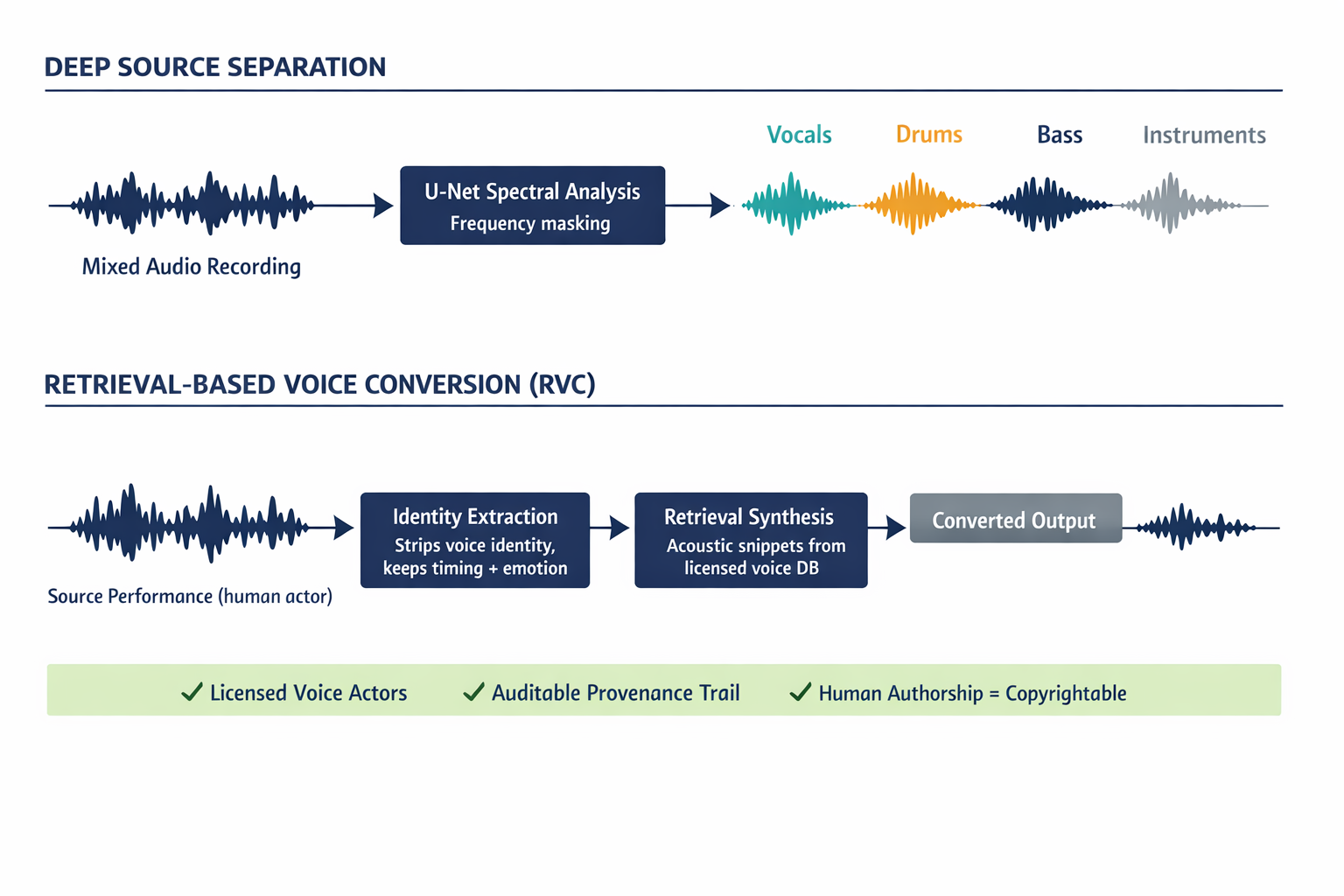
Our audio pipeline rejects the "generate from scratch" approach. Instead, we use two deep technologies — Deep Source Separation and Retrieval-Based Voice Conversion — that produce audio assets with a clear, auditable chain of ownership.
Deep Source Separation is the process of unmixing a finished audio recording into its individual components: vocals, drums, bass, other instruments. Think of it as un-baking a cake — historically impossible, but modern deep learning has made it remarkably precise. Our engine uses a neural network architecture called a U-Net that analyzes the audio's frequency spectrum and generates a "mask" for each component, isolating it while suppressing everything else.
The enterprise applications are immediate. A media company can separate dialogue from a film's music-and-effects track, replace the dialogue with a dubbed version in another language, and keep the original orchestral score perfectly intact. Record labels can unlock legacy masters where the original multi-track tapes have degraded, creating new remixes or immersive Dolby Atmos mixes from decades-old recordings.
For voice modification, we use Retrieval-Based Voice Conversion (RVC) — a system that transforms who is speaking while preserving how they speak. Unlike text-to-speech (which generates robotic audio from text and loses all emotional nuance), RVC is speech-to-speech. It strips the identity from a vocal performance, then reassembles the output using actual acoustic snippets from a target speaker's voice database, retrieved via similarity search. The result preserves the original timing, pitch, and emotion while changing the voice itself.
For the full technical methodology behind both pipelines, see our detailed research on deep integration architecture.
Why the Legal Architecture Matters as Much as the Technical One
The technology only matters if it keeps the enterprise out of court. Our RVC pipeline operates within a strict compliance framework.
We don't use public voice models trained on scraped celebrity data. Every voice in our library comes from actors who have signed specific AI Commercialization Releases — explicit consent for defined uses, with royalty tracking whenever their voice model is deployed. Because the RVC system uses a retrieval database rather than opaque neural generation, we can mathematically prove which voice model produced any given output. If someone claims "this sounds like Celebrity X," we can audit the retrieval index and demonstrate the embeddings came from a consented, compensated voice actor.
Every asset we produce has a provenance trail. Every voice is licensed. Every output is watermarked. That's not a feature — it's the entire point.
Copyright ownership of the final output is also preserved. Because the RVC workflow produces a derivative work based on a human performance (the source recording) and human creative direction (the conversion choices), it meets the Copyright Office's "human authorship" requirement. The enterprise owns the asset — unlike pure generative AI output, which no one owns.
What About Data Security and Deployment Costs?
Two objections come up consistently when enterprises evaluate deep tech solutions.
"If we upload proprietary assets to your system, who else sees them?" Nobody. Our physics and audio pipelines are containerized and deploy entirely within the client's Virtual Private Cloud or on-premise servers. They don't require internet access. They don't send data back to us or to any third-party model provider. An unreleased fashion collection or a pre-release film score never leaves the client's secure perimeter.
"Physics simulations and neural rendering sound expensive." They are computationally intensive — but we've engineered the cost down aggressively. In the virtual try-on pipeline, AI approximates expensive ray-tracing steps only where human visual perception can't tell the difference, significantly reducing render time and cloud GPU costs. For real-time voice conversion applications (like live customer support), we use model quantization — compressing the neural network's precision — to achieve latency under 50 milliseconds on consumer-grade hardware, eliminating expensive round-trips to the cloud.
The Strategic Choice
The wrapper approach — fast to build, cheap to deploy, probabilistic at its core — works for prototyping and low-stakes consumer applications. For enterprise environments where "mostly right" means returns, lawsuits, or unownable IP, it's a structural liability.
The distinction isn't about AI versus no AI. We use neural networks extensively — for lighting estimation, for audio separation, for voice synthesis. The distinction is about where AI operates in the stack. In our architecture, deterministic systems handle the parts that require certainty (cloth physics, copyright compliance), and AI handles the parts that benefit from flexibility (unstructured inputs, sensory enhancement).
In fashion, that means moving from hallucinating fit to simulating it — turning a returns crisis into a margin opportunity. In media, it means moving from generating potential infringement to engineering licensed derivatives — turning a copyright crisis into a licensing opportunity.
The era of the AI wrapper is ending. Foundation models are becoming commoditized features of operating systems. The value — the defensible, durable, enterprise-grade value — lives in the hard, domain-specific problems that generic models can't solve because they don't understand physics, don't respect copyright, and can't prove their work.
If your team is navigating the build-versus-buy decision for AI in regulated or high-stakes workflows, we'd welcome the conversation about where deep integration makes the difference.