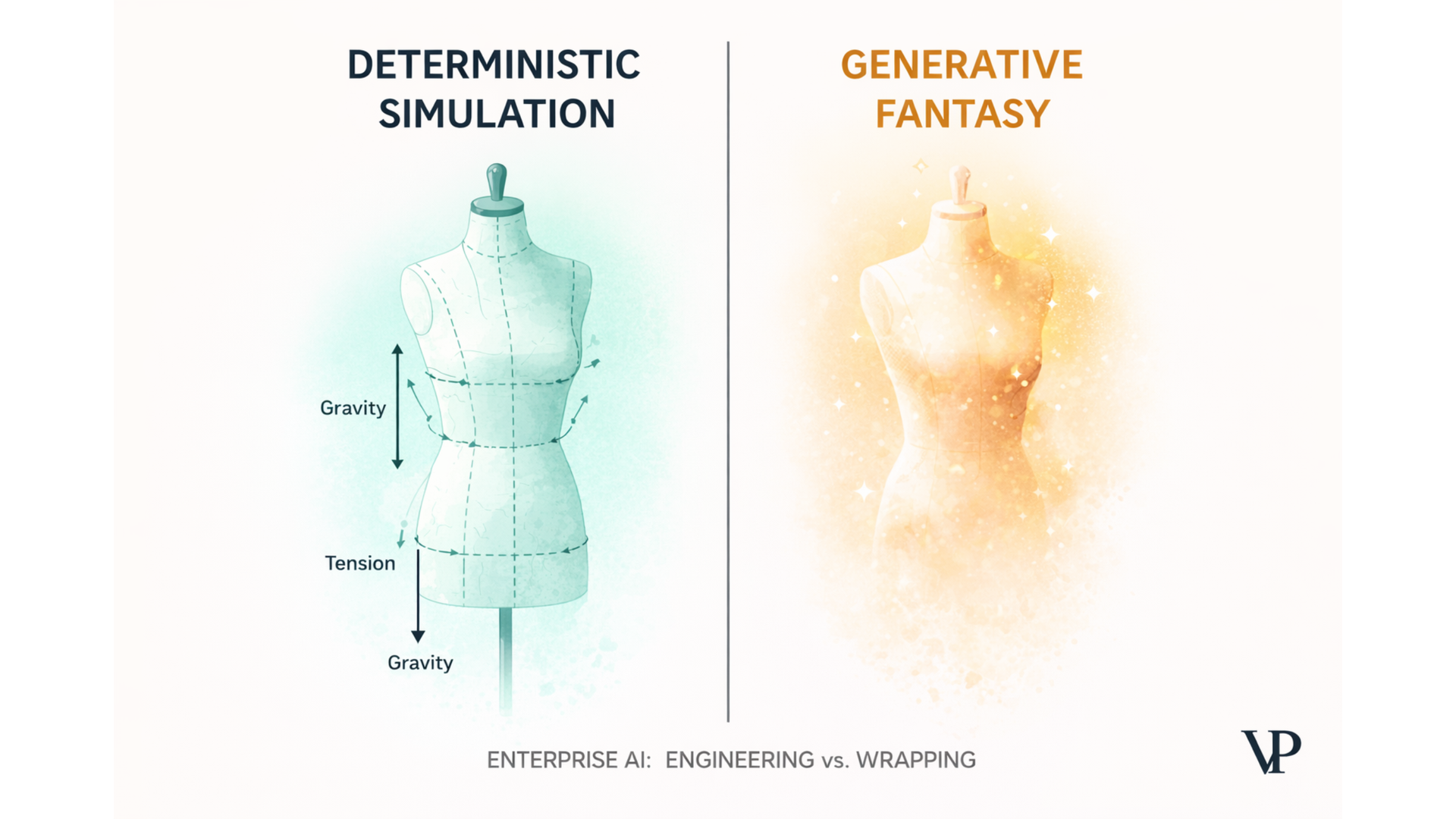
The fashion industry lost $890 billion to product returns in 2024. More than half of those returns happened because the clothes didn't fit the way the screen promised they would. And the AI tools that were supposed to fix this? They made it worse — by showing customers a fantasy and calling it a try-on.
I've spent the last two years watching the enterprise AI market split into two camps. On one side, thousands of startups wrapping a user interface around OpenAI's API and calling it a product. On the other, a handful of teams doing the unglamorous work of making AI actually reliable in domains where "mostly right" gets you sued, returned, or both. We built Veriprajna to be in that second camp — and the difference between the two approaches isn't incremental. It's architectural.
The Wrapper Problem Nobody Wants to Admit
PitchBook analysts have been blunt about it: the market is oversaturated with startups that are "thin wrappers around foundation models" with no structural defensibility. I don't think that's harsh enough. The real issue isn't that wrappers lack moats — it's that they inherit every weakness of the model underneath them and can fix none of it.
When your entire product is a prompt to someone else's neural network, you're at the mercy of that network's hallucinations, its training biases, and its next pricing change. If the model generates a copyright-infringing image or a hallucinated medical claim, the wrapper developer can't reach into the model weights and fix it. They don't own the weights. They just rent access.
Enterprise AI that can't be audited is enterprise AI that can't be trusted.
For consumer toys, this is fine. For enterprise workflows in regulated industries — fashion retail, media production, legal compliance — it's a liability waiting to detonate.
The $890 Billion Fit Gap
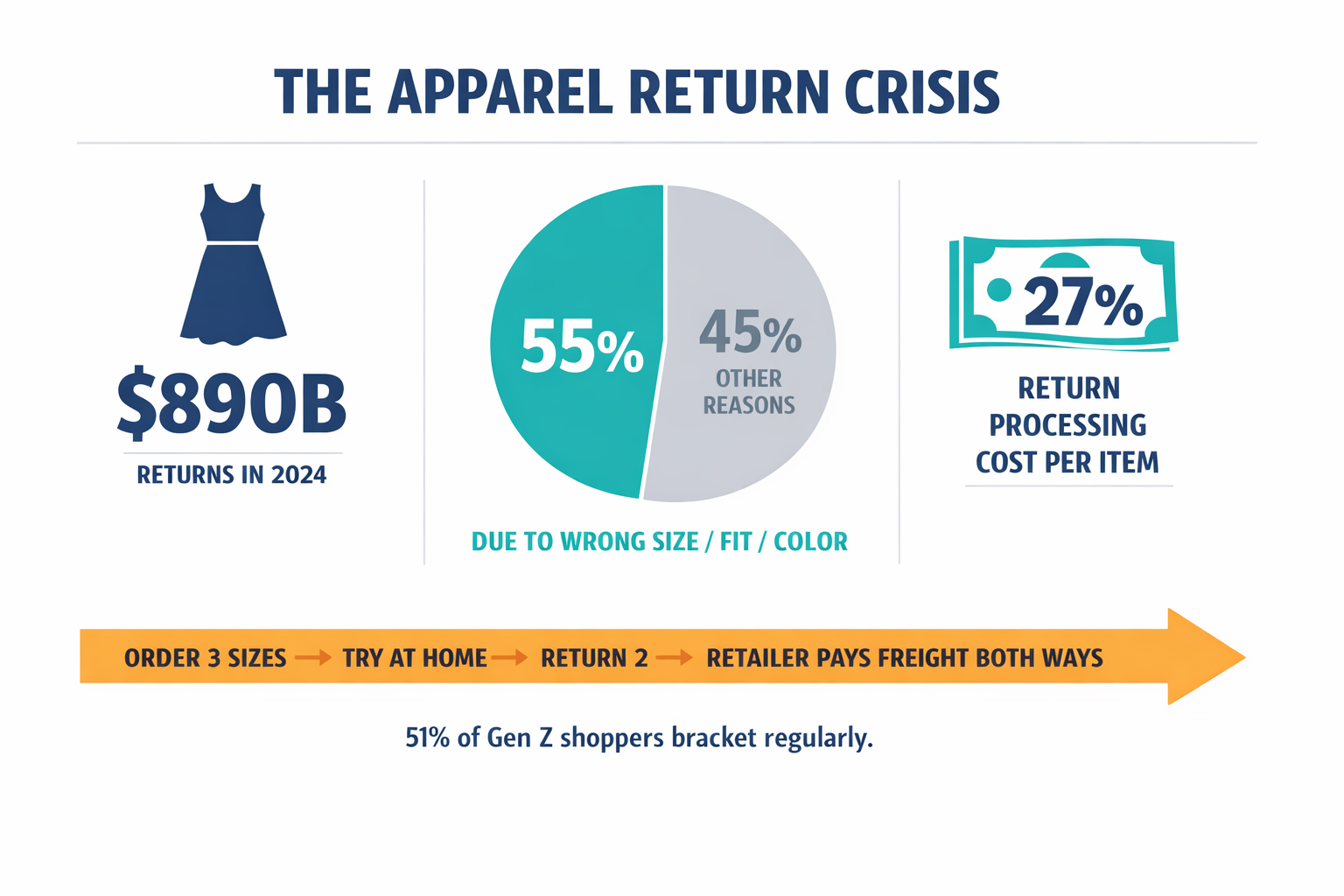
The moment that changed my thinking about this space came from a deceptively simple statistic: 55% of all apparel returns happen because of incorrect size, bad fit, or wrong color. Not buyer's remorse. Not damaged goods. The product just didn't match what the customer saw on screen.
This has spawned a consumer behavior called "bracketing" — ordering three sizes of the same dress with the intent to return two. In 2024, 51% of Gen Z shoppers admitted to doing this. For retailers, processing each return costs roughly 27% of the item's purchase price. The bedroom has become the fitting room, and the retailer pays the freight both ways.
The industry's response was predictable: throw AI at it. Build virtual try-on tools using generative models — GANs, diffusion models, the usual suspects. Upload a photo, select a dress, let the AI paint it onto your body.
The problem? These tools optimize for making the image look good, not for making the fit accurate.
Why Generative AI Creates a Fantasy Mirror
I remember the first time my team tested a leading AI virtual try-on tool. We fed it a size 6 dress and a size 12 body. The AI produced a gorgeous image — the dress draped perfectly, no strain, no pulling. It looked like a magazine ad.
It was also a complete lie.
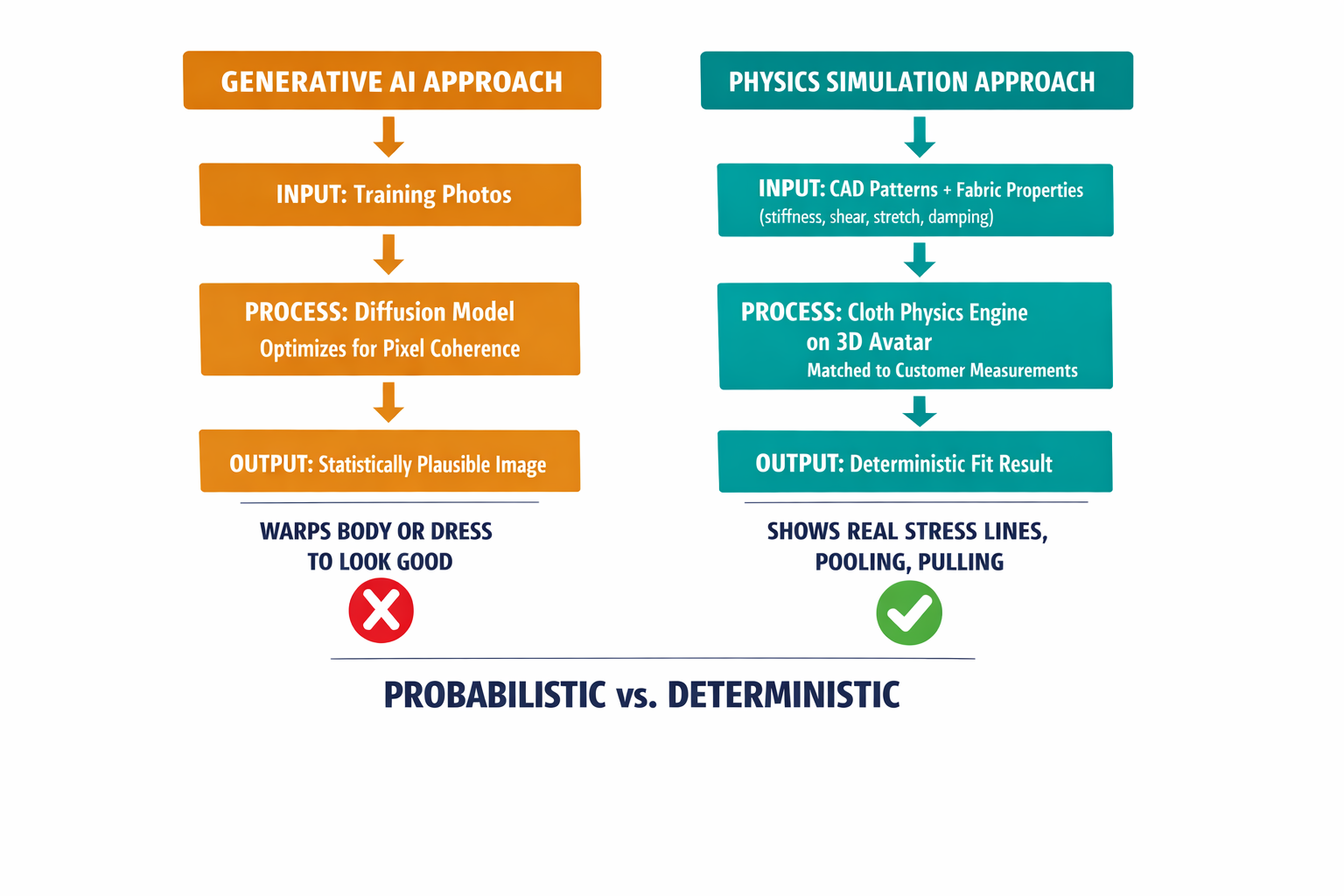
A diffusion model doesn't know what fabric tension is. It doesn't understand that raw denim has near-zero stretch, or that a bias-cut silk will hang differently than a structured cotton. Its only goal is pixel coherence — making the output image look statistically plausible based on its training data. So when the garment doesn't fit, the AI does one of two things: it warps the dress to cover the body, or it warps the body to fit the dress.
A virtual try-on that always shows a perfect fit isn't a tool — it's a flattering liar that drives returns.
Industry analysts have put it plainly: "Virtual try-ons lack real-world accuracy, ignore fabric behavior, and can mislead customers about how a garment truly fits and feels." The customer sees the fantasy, buys the garment, and returns it when reality arrives in a cardboard box.
We explored this problem — and the deep technical architecture we built to solve it — in our interactive analysis.
We Stopped Generating Images and Started Simulating Physics
The breakthrough for us was reframing the problem. Virtual try-on isn't an image generation task. It's a mechanical engineering simulation.
Instead of training a neural network on photos of clothes, we ingest the actual CAD patterns from the garment manufacturer and assign each fabric its real physical properties — bending stiffness, shear resistance, tensile stretch, internal damping. These are the same parameters used in professional fashion design tools like CLO3D and Marvelous Designer.
Then we simulate. On a 3D avatar matched to the customer's measurements, we run a cloth physics engine that models how the fabric actually behaves under tension, compression, and gravity. If the garment is too tight, the simulation shows stress lines — those telltale "X" patterns at the waist or pulling at the buttons. If it's too loose, the fabric pools and bunches realistically.
The difference is fundamental: a generative model guesses what a dressed body should look like. A physics engine calculates what happens when this specific fabric meets this specific body. One is probabilistic. The other is deterministic. And in a world where every wrong guess costs 27% of the sale price, determinism pays for itself.
Making Physics Look Real in a Selfie
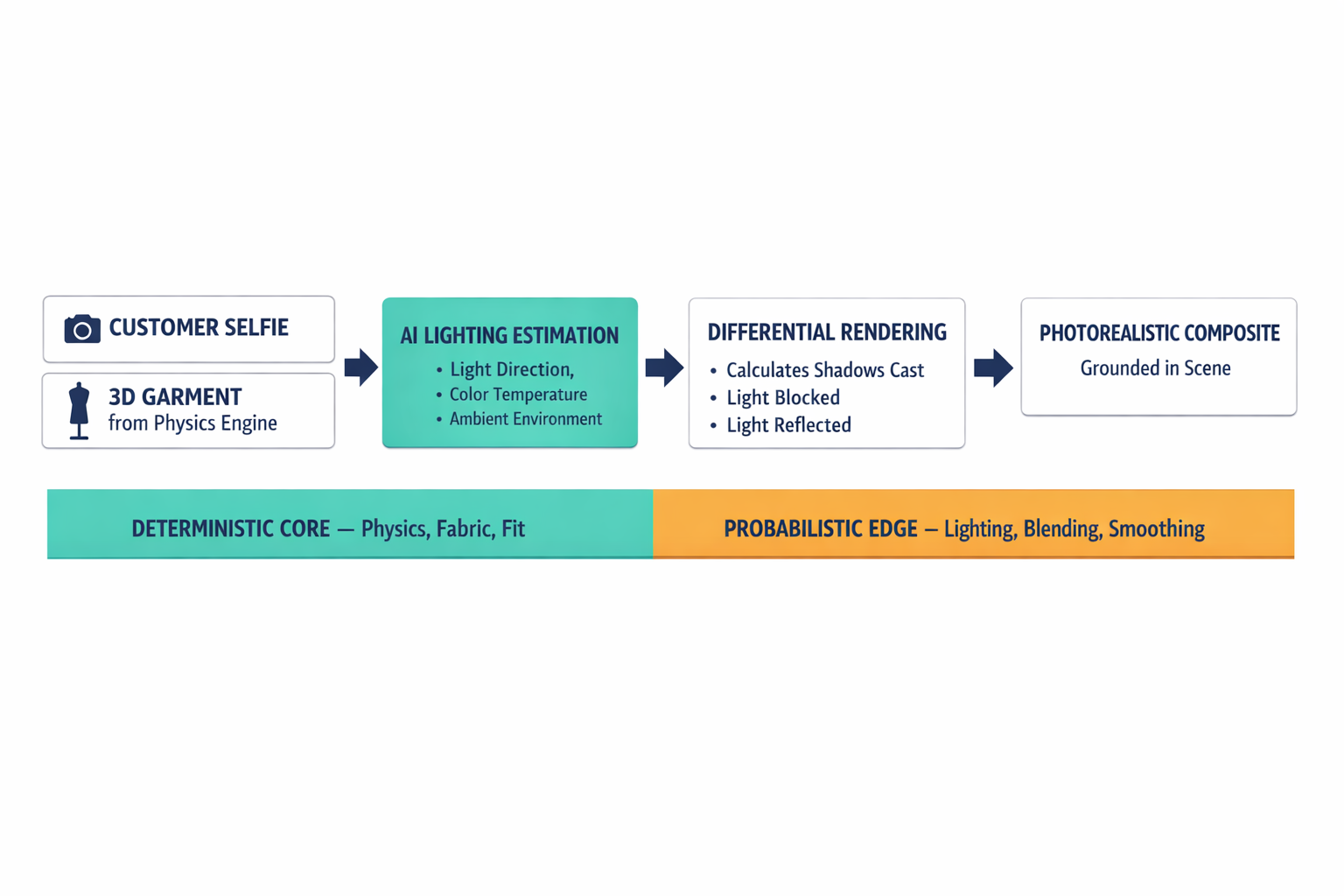
Accurate simulation is only half the challenge. The other half is making the result look photorealistic when composited into a customer's phone photo. If the lighting on the 3D garment doesn't match the lighting in the customer's bathroom, the whole thing looks like a sticker slapped onto a selfie.
This is where we reintroduce AI — not to generate the garment, but to solve the lighting problem. A lightweight neural network analyzes the customer's photo to estimate light direction, color temperature, and ambient environment. We use that estimate to light the 3D garment so its reflections and shadows are consistent with the real scene.
Then a technique called differential rendering blends the 3D object into the 2D photo. The system calculates the shadow the garment would cast onto the customer's body, subtracts the light the garment blocks, and adds the light it reflects. The result is a digital dress that casts a realistic shadow onto real legs — grounded in the scene rather than floating on top of it.
We call our architectural philosophy "Deterministic Core, Probabilistic Edge." The physics engine handles the hard constraints — fabric behavior, fit accuracy, material properties. AI handles the soft problems at the boundaries — interpreting unstructured inputs like selfies, estimating lighting, smoothing edges. Each technology does what it's best at. Neither is asked to do what it can't.
The Copyright Minefield in Generative Audio
Fashion isn't the only domain where wrappers create liability. In audio, the legal exposure is arguably worse.
Major rights holders — Universal Music Group, Sony, the RIAA — are suing generative audio companies like Suno and Udio for training on copyrighted music. If an enterprise uses one of these tools to generate a jingle or soundtrack, and the output inadvertently mimics something from the training data (a phenomenon called "regurgitation"), the enterprise is liable for infringement. And because these models are black boxes, you can't verify what's in the training data.
It gets worse. Under current U.S. Copyright Office guidance, works created solely by AI without significant human involvement can't be copyrighted. A brand that uses a pure generative tool to create a sonic logo doesn't own that logo. It enters the public domain immediately. Competitors can use it freely.
If your AI-generated audio can't be copyrighted, you've just created a public asset with a private budget.
We took a completely different approach. Instead of generating audio from scratch — with all the legal risk that entails — we built a pipeline around two deep technologies: source separation and voice conversion.
Decomposing and Recomposing Instead of Generating
Source separation is the art of unmixing a finished audio recording into its individual components — vocals, drums, bass, other instruments. Think of it as un-baking a cake back into eggs, flour, and sugar. Until recently, this was considered nearly impossible. Modern deep learning has changed that.
Our separation engine uses a neural network architecture called a U-Net that analyzes the audio's frequency spectrum and generates a "mask" for each component. The mask acts like a filter: it keeps the frequencies belonging to, say, the vocal track and suppresses everything else. The result is clean, isolated stems extracted from a single mixed recording.
For enterprise clients, this unlocks enormous value from existing content libraries. A media company can separate dialogue from a film's music-and-effects track, replace the dialogue with a dubbed version in another language, and keep the original orchestral score intact. Record labels can "unlock" legacy masters where the original multi-track tapes have degraded, creating new remixes or immersive Dolby Atmos mixes from a stereo file.
Voice conversion takes this further. Retrieval-Based Voice Conversion (RVC) transforms the identity of a voice — changing who it sounds like — while preserving the original performance's rhythm, emotion, and timing. Unlike text-to-speech, which generates robotic audio from text, RVC is speech-to-speech. It keeps the human performance intact and swaps only the vocal identity.
The technical core is a retrieval system: for every tiny slice of the source audio, the system searches a database of the target speaker's actual voice recordings to find the closest acoustic match, then reassembles the output from those real snippets. The result sounds natural because it's built from real human voice data — not hallucinated from model weights.
For the full technical methodology behind both our fashion and audio architectures, we've published a detailed deep-dive.
The Compliance Architecture That Makes This Enterprise-Ready
Every voice in our system comes from actors who have signed explicit AI commercialization releases — consent, compensation via royalties, and full traceability. Because the RVC system uses a searchable retrieval database, we can mathematically prove which voice model produced any given output. If someone claims "this sounds like Celebrity X," we can audit the database and demonstrate the embeddings came from Consented Voice Actor A.
And because the output is a derivative of a human performance — not a purely AI-generated artifact — it qualifies for copyright protection. The enterprise actually owns the asset.
This same philosophy of auditability extends across everything we build. Every image from our virtual try-on system and every audio clip from our voice conversion engine carries an invisible watermark encoding the licensing ID, user ID, and timestamp. Our pipelines run inside the client's own infrastructure — containerized, air-gapped, with no data leaving their secure perimeter. Unreleased fashion collections and pre-release film assets never touch our servers or any third-party model provider.
"But Won't Foundation Models Just Get Better?"
This is the objection I hear most often, and it's a fair one. Foundation models improve rapidly. Won't they eventually simulate physics accurately? Won't they learn copyright law?
Maybe. But "eventually" doesn't help the retailer hemorrhaging margin on returns today, or the media company facing an injunction tomorrow. And there's a deeper issue: even a perfect generative model is still a black box. You can't audit why it made a specific decision. You can't prove to a court that the output doesn't contain copyrighted training data. You can't guarantee it will produce the same result twice.
Physics engines are deterministic — same input, same output, every time. Licensed voice databases have a clear chain of title. These aren't limitations of our approach. They're the entire point.
What Does This Mean for Enterprise AI Strategy?
The wrapper era rewarded speed. Ship fast, prompt cleverly, capture users before the next model update makes your product obsolete. That logic works for consumer experiments. It fails catastrophically for enterprise deployments where accuracy has legal and financial consequences.
The shift I'd encourage any enterprise technology leader to consider:
Measure net margin, not conversion rate. A virtual try-on that increases sales by 20% but also increases returns by 30% is destroying value. Measure what happens after the purchase.
Demand auditability. If your AI vendor can't explain why a specific output was generated, you can't defend it in court or in a compliance review.
Own the hard layer. The AI model is a commodity. The domain-specific engine underneath it — the physics simulation, the licensed voice database, the compliance framework — is the moat.
The businesses that thrive in the next phase of enterprise AI won't be the ones that prompted most cleverly. They'll be the ones that engineered the deepest — building systems that respect the laws of physics and the laws of the land, and that can prove it.
I'd be curious to hear from others navigating this tension between AI speed and enterprise reliability. Where are you drawing the line between probabilistic and deterministic in your own stack?