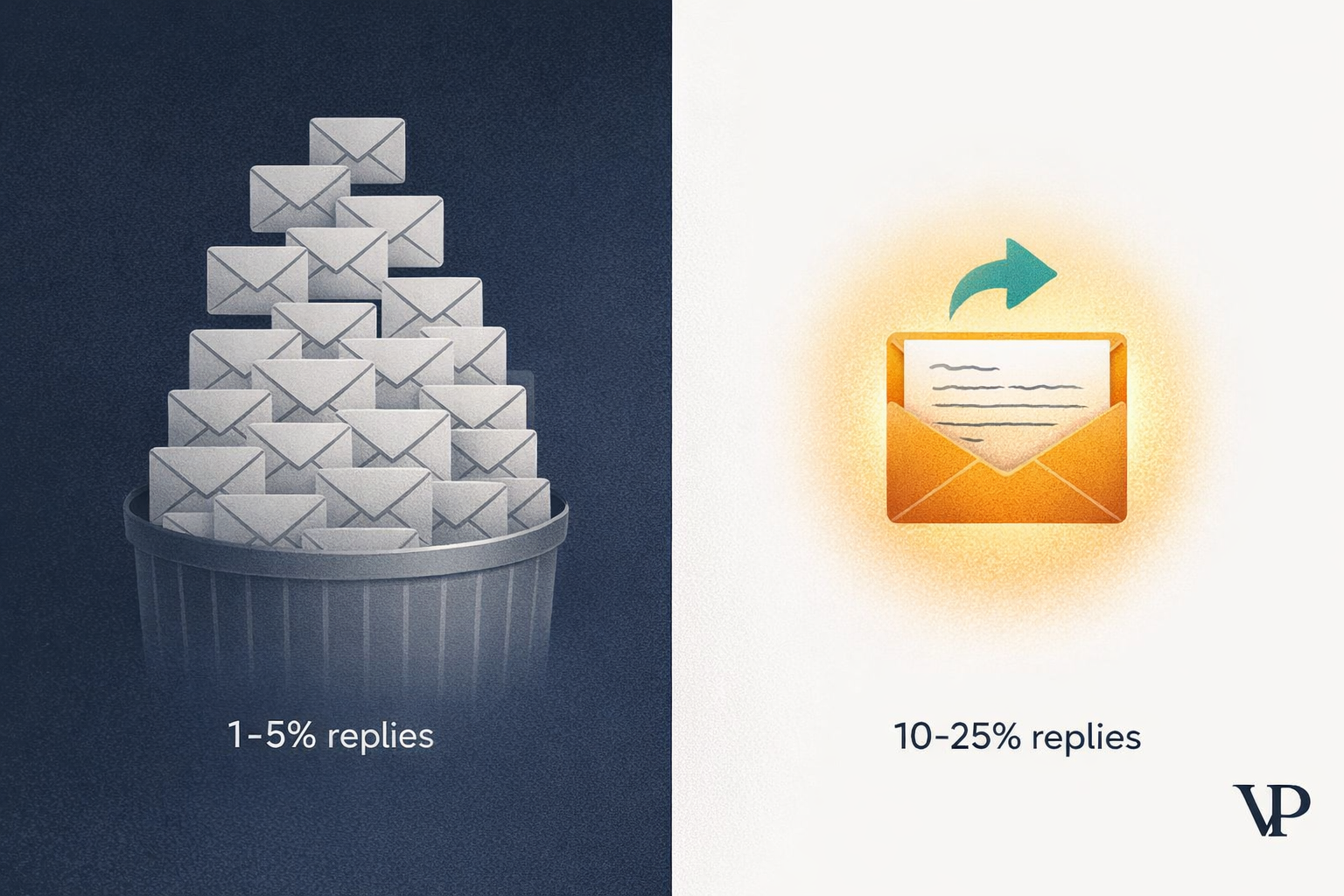
Cold email reply rates have collapsed to between 1% and 5%. Not because email is dead — because every AI-powered outreach tool is producing the same email. The same "I hope this finds you well," the same three-paragraph structure, the same words ("delve," "landscape," "transformative") that now function as neon signs reading: a robot wrote this. We've been studying this problem for months, and what we found surprised us: the issue isn't that companies are using AI for sales outreach. It's that they're scaling the wrong thing. They're scaling the robot. The companies seeing reply rates of 10-25% are doing something fundamentally different — they're scaling the human.
The difference comes down to a technique called few-shot style injection, which uses vector databases to capture the specific writing voice of top-performing sales reps and inject that voice into AI-generated messages at scale. It's the difference between cloning your average email and cloning your best closer's instinct for exactly how to say something.
The "Scaling the Robot" Trap
Most AI sales tools work the same way. They wrap a large language model (an LLM — think ChatGPT or Claude) in a thin application layer, plug in some prospect data, and blast out thousands of emails. The pitch is irresistible: infinite outreach at near-zero cost.
But LLMs have a default voice. They're probability machines — they predict the most likely next word based on their training data. That means their output converges on an average. It's grammatically clean, structurally predictable, and emotionally flat. Every email sounds like it was written by the same competent-but-forgettable intern.
When everyone's AI writes the same way, personalization becomes invisible.
The numbers tell the story. Average cold email open rates have dropped to roughly 27.7%, down from 36% just a year earlier. Reply rates sit between 1% and 5% for generic campaigns. Meanwhile, spam filters from Google and Outlook are getting better at detecting AI-generated text by looking for exactly the patterns these tools produce: low variation in sentence length, predictable word choices, and that uncanny smoothness that human writing never has.
High-volume generic AI blasts don't just get ignored — they actively damage your sender domain reputation, making it harder for any of your emails to reach an inbox.
What Your Best Sales Rep Knows That AI Doesn't
Think about the best salesperson on your team. They don't write emails the same way to a startup CTO and a bank's VP of Operations. They adjust — shorter sentences for the busy executive, a touch of irreverence for the founder, careful formality for regulated industries. They mirror the prospect's own communication style without thinking about it.
This isn't a soft skill. It's backed by hard science. Researchers call it Linguistic Style Matching (LSM) — the phenomenon where people are significantly more likely to trust and engage with someone who communicates the way they do. A study by Ludwig et al. found that conversion rates in online environments are directly influenced by the degree of linguistic match between a message and its recipient's style. Negotiation studies show that mirroring techniques can increase agreement rates from 12% to 67%.
Your best rep does this naturally. Standard AI tools can't do it at all. They have no mechanism to perceive a prospect's communication style, let alone adapt to it.
We explored this dynamic in depth in our interactive analysis of style injection in enterprise sales, where we map out exactly how the gap between generic and style-matched outreach is widening.
Cloning Voice, Not Just Content
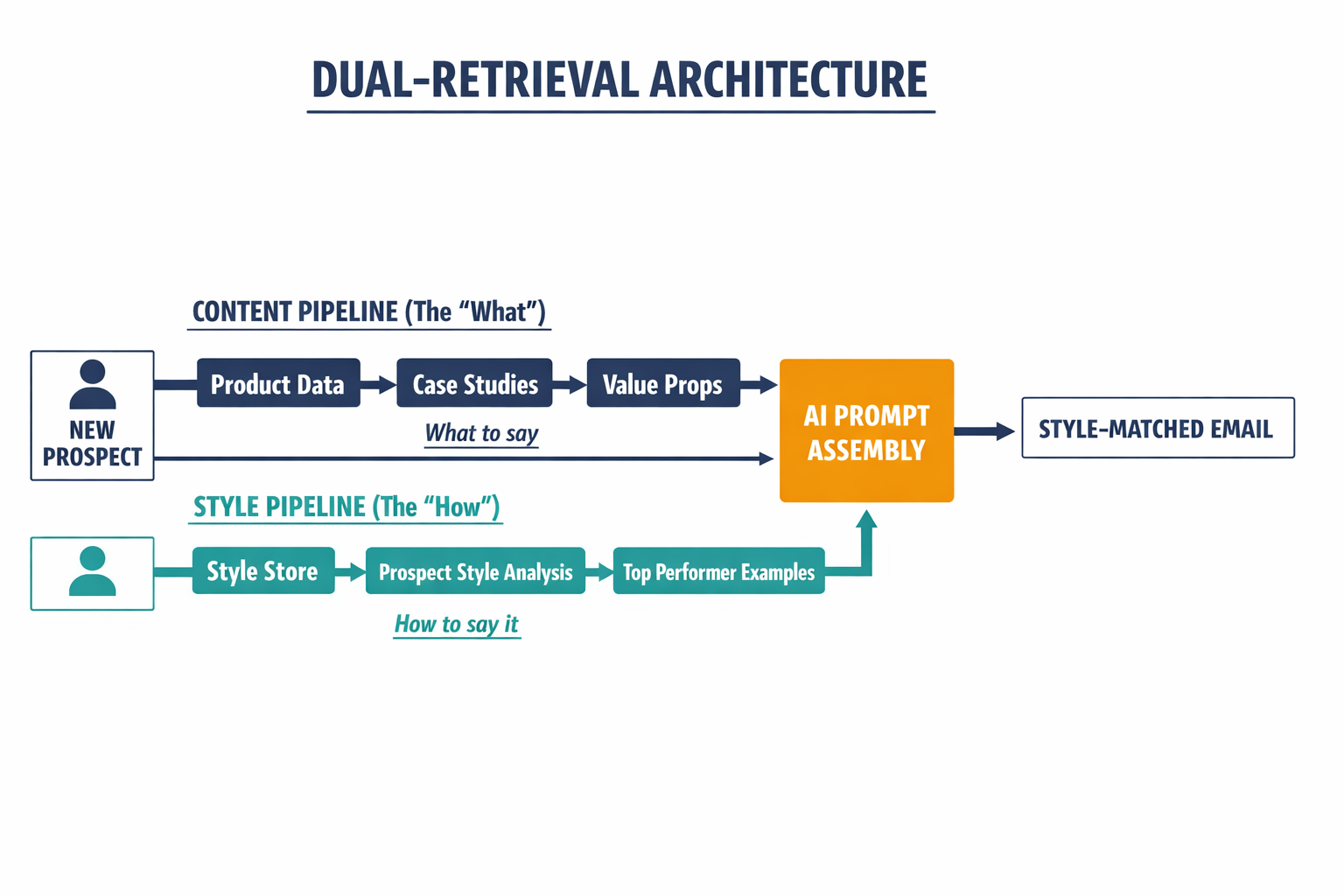
Few-shot style injection works by solving a problem most AI sales tools don't even acknowledge: the "what" and the "how" of a sales email are completely separate problems.
The "what" is straightforward — product features, value propositions, relevant case studies. Any RAG system (Retrieval-Augmented Generation, where AI pulls in relevant documents before writing) handles this reasonably well.
The "how" is where deals are won or lost. It's sentence length, word choice, whether you open with a question or a bold claim, whether you sign off with "Best" or "Talk soon" or nothing at all. It's the texture of human personality in text.
Our architecture treats these as two independent retrieval paths. One pipeline fetches the right facts. A completely separate pipeline fetches the right voice — pulling real examples of high-performing emails that match the current prospect's profile. Both get assembled into the prompt that guides the AI's output.
The AI learns what to sell from your product data. It learns how to sell from your best people.
This is what "few-shot" means in practice. Instead of giving the AI a vague instruction like "write a persuasive email," you show it three to five real emails that actually worked — emails written by your top performers to similar prospects. The model picks up on patterns it could never learn from instructions alone: the rhythm, the specific turns of phrase, the instinct for when to be direct and when to be soft.
Building a "Style Store" — Your Most Undervalued Asset
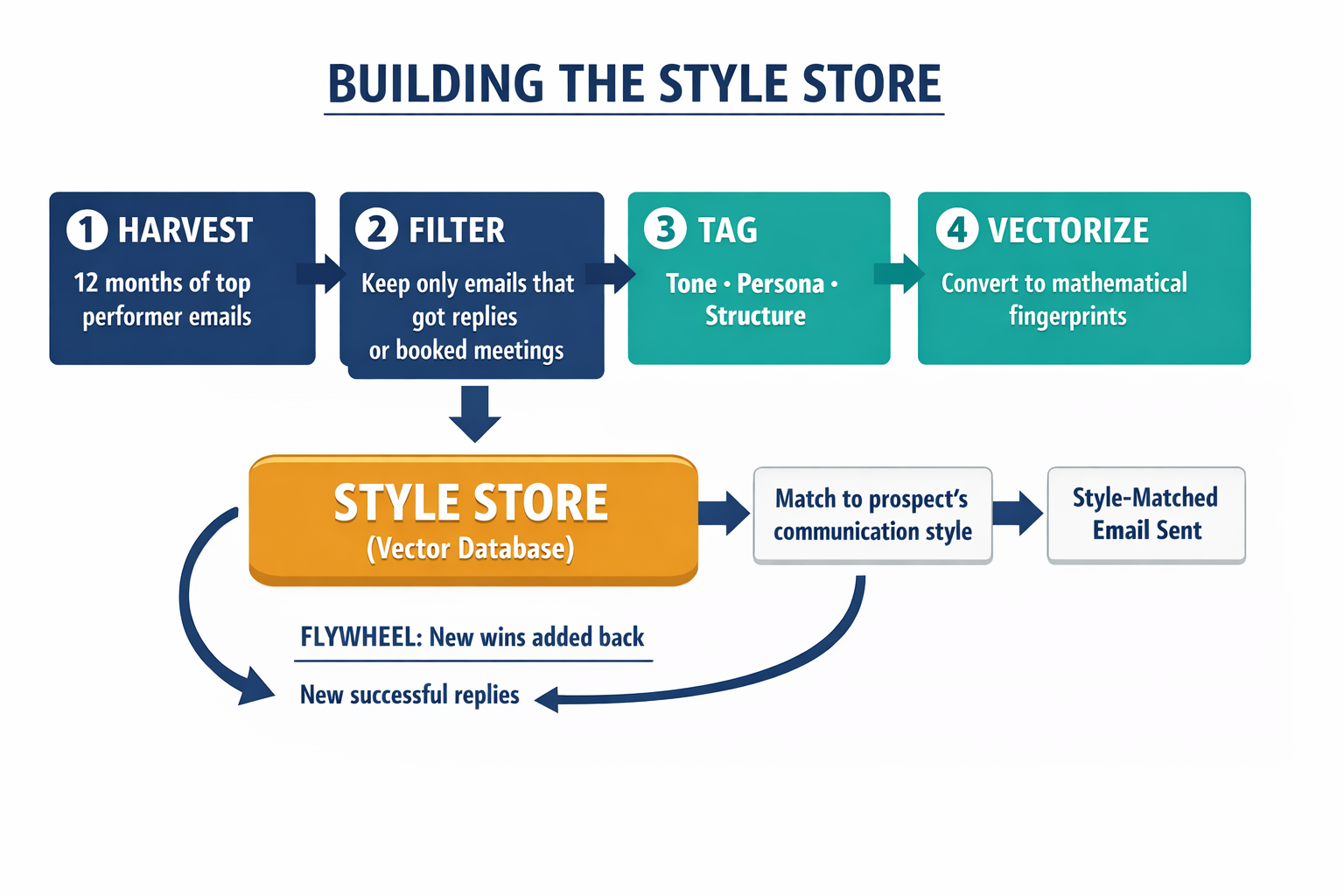
The foundation of this approach is something we call a Style Store — a curated library of your organization's best human-written emails, stored not as text files but as mathematical representations (vectors) in a specialized database.
Building one requires four steps, none of which involve writing a single new email:
Harvest the last 12 months of outbound email data from your top performers
Filter for outcomes — keep only emails that led to replies, meetings booked, or deals advanced
Tag each email with metadata: tone (formal, casual, urgent), recipient persona (technical, financial, executive), structure (direct ask, problem-solution, soft touch)
Convert each email into a vector — a numerical fingerprint that captures not just what the email says, but how it says it
When a new prospect enters the pipeline, the system analyzes their public communication (LinkedIn posts, company bio) to infer their style preferences, then searches the Style Store for the closest matches. A CTO who writes in short, punchy LinkedIn posts gets emails modeled on your short, punchy successes. A VP who writes long, analytical updates gets something that mirrors that cadence.
The critical innovation is that this store improves itself. Every new successful email gets vectorized and added back, creating a flywheel where the system gets better at matching style to outcome over time.
The Deliverability Advantage Nobody Talks About
There's a practical benefit to style injection that goes beyond reply rates: your emails actually reach the inbox.
Human writing has a quality that researchers call "burstiness" — natural variation in sentence length, unexpected word choices, the occasional fragment or abrupt transition. AI-generated text, by contrast, is smooth. Predictably smooth. And modern spam filters are trained to detect exactly that smoothness.
When you inject real human style into AI output — complete with the jagged edges, the personality quirks, the varied rhythm — the resulting email reads as human to both the recipient and the algorithm deciding whether it reaches them. Our research found that this "human camouflage" effect protects sender domain reputation, which compounds over time. Every generic AI blast slightly degrades your domain score. Every human-textured email preserves it.
Generic AI outreach doesn't just fail to convert. It makes your next email less likely to arrive.
What This Actually Looks Like in Practice
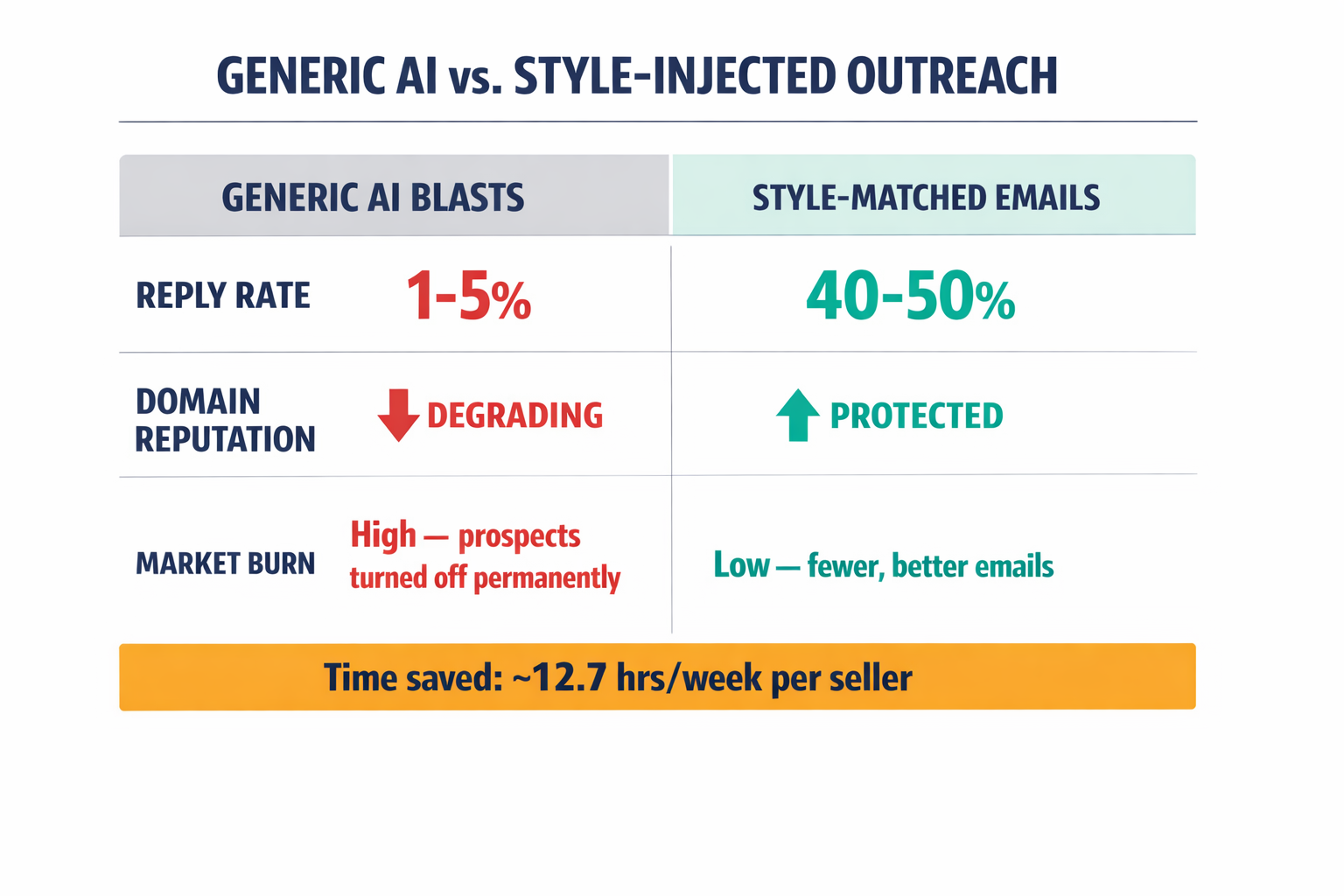
Campaigns using advanced personalization and style matching report reply rates of 40-50%, compared to 1-8.5% for generic approaches. The ROI of email marketing overall remains strong at roughly $36-$40 per dollar spent — but that return is overwhelmingly concentrated among teams that have solved for relevance and tone.
The economics flip when you factor in what we call "market burn." Your addressable market is finite. Every bad email sent to a prospect doesn't just fail — it makes that prospect harder to reach next time. Sending 1,000 generic emails is more expensive than sending 100 style-matched ones when you account for the prospects you've permanently turned off and the domain reputation you've degraded.
For teams already using this approach, we're seeing three consistent outcomes:
Time savings of roughly 12.7 hours per week per seller on drafting, without quality loss
Faster onboarding — new reps immediately send emails in the voice of the company's top performers
Consistency across the team — no more "Monday morning" quality dips or rogue messaging
For the full technical methodology behind the dual-retrieval architecture, including vector schema design and implementation logic, see our detailed research on few-shot style injection.
"Won't the AI Exaggerate to Sound More Persuasive?"
This is the most common objection we hear, and it's a legitimate concern. When you push an AI to adopt a highly persuasive style, it can start embellishing — claiming capabilities your product doesn't have, overpromising results. Researchers call this "stylization-induced truthfulness collapse."
Our architecture addresses this by keeping facts and style in completely separate lanes. The content pipeline (what the AI can say) acts as a hard constraint. The style pipeline (how it says it) only modifies expression — sentence structure, tone, word choice — without touching the factual claims. A secondary verification step checks the output against the source material before anything gets sent.
It's the difference between teaching someone to be charismatic and teaching them to lie. Style injection does the former.
"Does This Work Outside English-Speaking Markets?"
It does, but it requires separate Style Stores for each market. A "direct" tone in American English can read as abrasive in Japanese business culture. Machine-translating style-injected English emails into other languages strips the nuance that makes the approach work in the first place.
The more effective path is maintaining native Style Stores — a library of successful German-language emails for the German market, Japanese for Japan, and so on. Multilingual embedding models can help map style patterns across languages, but cultural context still requires human curation.
The Shift Ahead
The era of "Hi {{First_Name}}, I noticed your company recently {{trigger_event}}" is ending. Not because personalization is wrong, but because that version of it was always shallow. Knowing a fact about someone isn't the same as speaking their language.
What we're building toward is something we think of as cognitive personalization — AI that doesn't just know who you're writing to, but understands how that person prefers to be spoken to, and adapts in real time. The organizations that capture their best sellers' voices now — building that Style Store, training that retrieval system — will have a compounding advantage that generic tools can never match.
The most valuable asset in your sales organization isn't your product data. It's the way your best people talk about it. The question is whether you're scaling that, or scaling the average.
We'd be curious to hear: has your team experimented with style-aware AI outreach, or are you still seeing the "uncanny valley" effect in your AI-generated emails?