
Cold email open rates dropped from 36% to 27.7% in a single year. Reply rates are stuck between 1% and 5%. And the culprit isn't email as a channel — it's that every AI-generated sales email now sounds like the same robot wrote it. Because, effectively, the same robot did.
I've spent the past year obsessed with a question that most AI sales tools are ignoring: why do your top reps close deals that your average reps can't, even when they're selling the same product to the same buyer profile? The answer isn't better product knowledge. It's voice. It's rhythm. It's the way your best closer writes a three-word sentence after a long one, drops in a self-deprecating joke, or signs off with something that feels like a real human being wrote it at 9 PM because they actually cared.
We've been building a system at Veriprajna that captures that voice — not as a vague "tone setting" in a prompt, but as a retrievable, scalable technical asset. We call the approach "Scaling the Human," and it's built on something called few-shot style injection using vector databases. The core idea: instead of telling an AI how to write, you show it — by feeding it your top performers' actual winning emails at the moment of generation.
The "Scaling the Robot" Trap
Most AI sales tools work the same way. They wrap a large language model (an LLM — think ChatGPT or Claude) in a thin layer that plugs in your prospect's name, company, and maybe a recent news mention. Then the model generates an email using its default voice.
That default voice is the problem. LLMs are probability machines. They predict the most likely next word, which means they gravitate toward the linguistic average of their training data. The result is text full of words like "delve," "landscape," "transformative," and "unlock" — words that have become audible fingerprints of AI-generated content. Spam filters are catching them. And the humans who survive the spam filter? They've developed antibodies too.
Sending 1,000 bad emails is more expensive than sending 100 good ones — once you factor in the burned market and the wrecked domain reputation.
I watched a prospect's VP of Sales demo three different AI outreach tools at a conference. Every tool produced emails that were, structurally and tonally, interchangeable. Grammatically perfect. Factually fine. Emotionally dead. He turned to me and said, "These all sound like the same intern." That moment crystallized something for my team.
The problem isn't that AI can't write. It's that AI writes like average AI. And average, at scale, is spam.
Why Your Top Rep's Voice Is a Conversion Variable
There's a body of research in cognitive science around something called Linguistic Style Matching — the idea that people trust, engage with, and buy from communicators whose language patterns mirror their own. Not the content of what's said, but the structure: sentence length, formality, use of pronouns, even punctuation habits.
One study found that negotiation success rates jumped from 12% to 67% when salespeople mirrored the communication style of their counterpart. Another, by Ludwig et al. at City University London, showed that online conversion rates are directly influenced by the degree of linguistic congruence between a message and its recipient.
Your best reps do this instinctively. They read a CTO's terse LinkedIn posts and write a terse email. They notice a VP of Marketing's playful tone and match it. They adjust — not just what they say, but how they say it.
Standard AI tools can't do this. They have no mechanism to perceive a prospect's style, and no mechanism to adjust their own. They output one voice, every time, for every prospect.
The most valuable asset in sales isn't product data. It's the human connection — and connection is a function of voice.
What Few-Shot Style Injection Actually Does
Few-shot prompting is a technique where you give an AI a handful of examples before asking it to generate something new. Instead of saying "write a persuasive email" (which is vague and produces generic output), you say "here are three emails that booked meetings — write a new one that follows this pattern."
The AI uses those examples to infer the unwritten rules: sentence length, vocabulary, level of directness, use of humor, how the email opens and closes. It picks up on patterns you'd struggle to articulate in a prompt — what researchers call "tacit knowledge."
The breakthrough is making this dynamic. A static set of three examples can't serve a diverse prospect base. A message to a CTO at a bank needs a fundamentally different voice than one to a developer advocate at a seed-stage startup. So the system needs to swap examples in real time based on who you're writing to.
That's where vector databases come in. We explored this architecture in depth in our interactive analysis, but the short version: a vector database stores text not as rows and columns, but as mathematical representations of meaning. You can search it by similarity rather than by keyword.
We use this to build what we call a Style Store — a curated library of your organization's highest-performing emails, tagged and searchable not by topic, but by how they sound.
The Dual-Retrieval Trick That Makes It Work
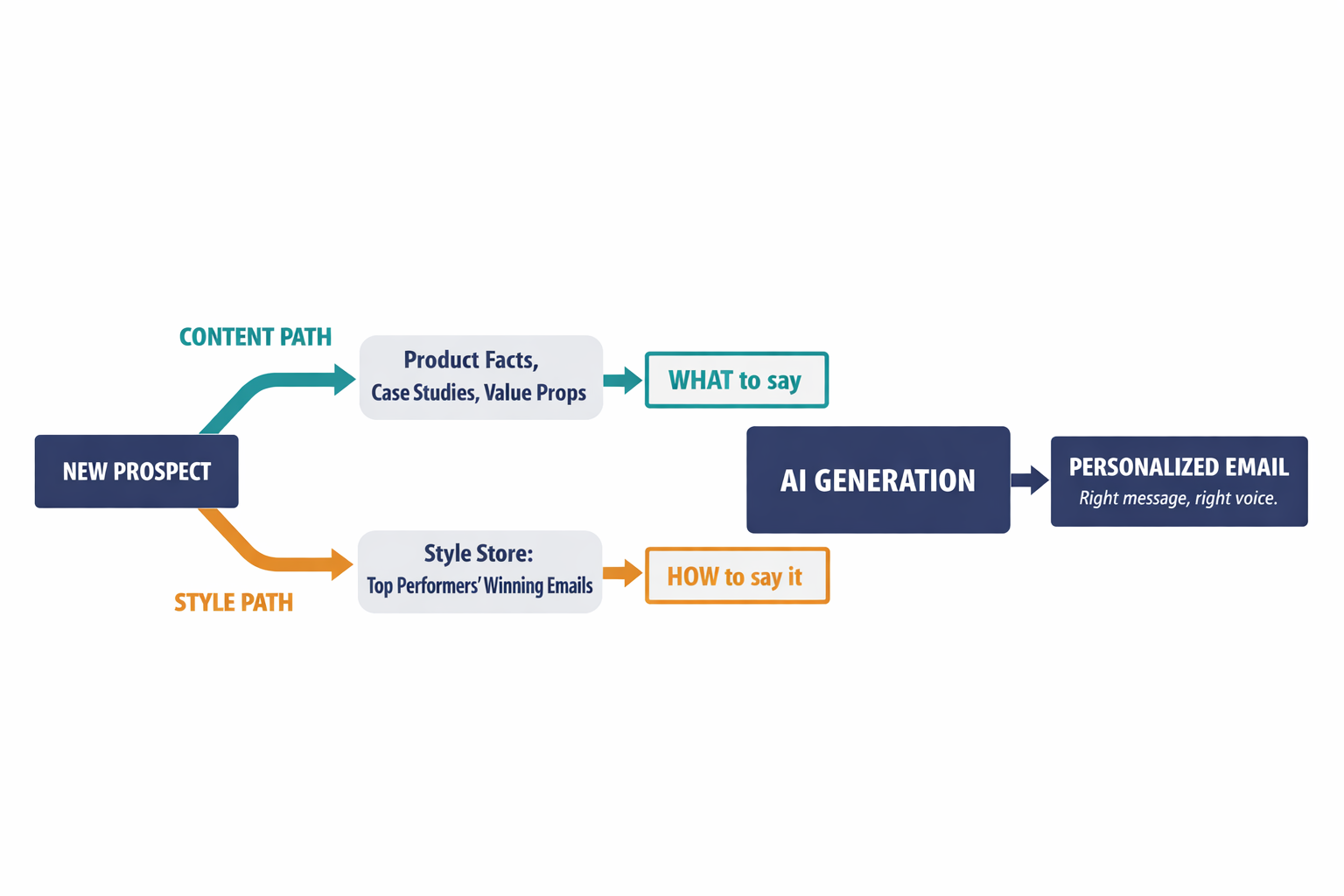
Standard AI retrieval systems have a blind spot. When you search for "sales email to a CTO," a typical system returns emails about CTOs — not emails written in the voice that works on CTOs. It conflates topic with tone.
Our architecture splits the retrieval into two separate paths. One path fetches the content — product facts, case studies, value propositions. The other path fetches the style — real examples of emails that worked, matched to the prospect's persona, industry, and communication preferences.
The AI gets both at generation time. It knows what to say from the content path. It knows how to say it from the style path. These two concerns — substance and voice — are treated as independent variables that can be mixed and matched.
Want to pitch enterprise security using a casual, founder-to-founder tone? Swap the style path. Same product, different voice. Want to pitch the same product to a compliance officer at a bank? Swap it again.
There is no single "perfect" sales email. The optimal style depends on the recipient, the product, and the stage of the relationship. Only a system that retrieves style dynamically can navigate that complexity.
The "Human Camouflage" Effect
One benefit I didn't anticipate: deliverability.
Human writing has a quality that researchers call "burstiness" — natural variation in sentence length and structure. A short punch. Then a longer, more complex thought that unfolds across a clause or two. Then another short one. AI text, by contrast, is smooth. Uniform. Predictable. And increasingly, that uniformity is what spam filters are trained to detect.
When we inject real human style examples into the generation process, the output inherits that burstiness. The AI breaks its own probability curves to match the retrieved examples. The result reads less like machine-generated content and more like correspondence — because it's patterned on actual correspondence.
Campaigns using this approach report reply rates of 10-25%, compared to sub-2% for generic AI outreach. Open rates climb to the 40-60% range. For the full technical methodology behind how we build and maintain the Style Store, see our detailed research.
Building a Style Store Without Losing Your Mind
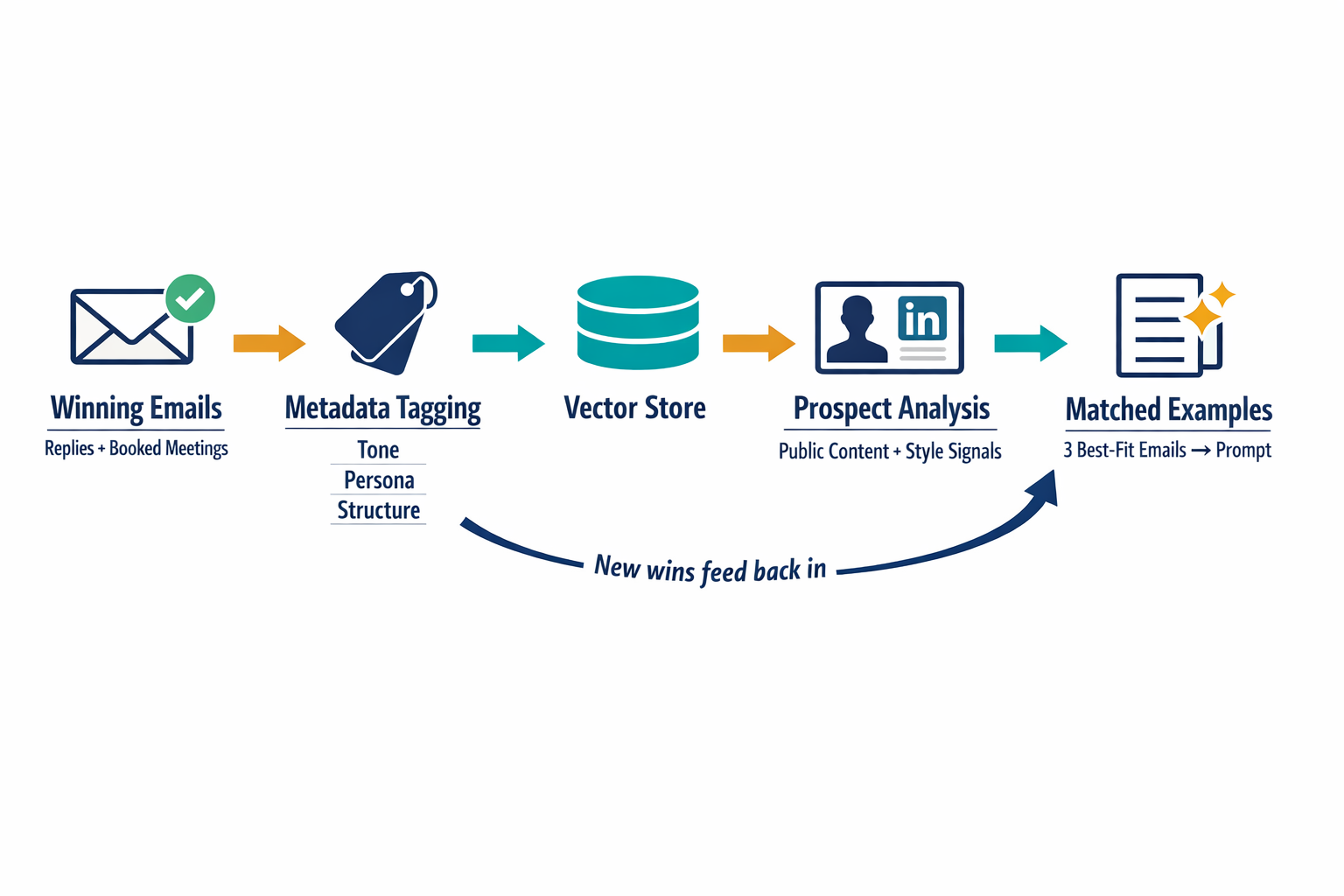
The practical implementation starts with your own data. You need your top performers' historical emails — specifically the ones that got replies and booked meetings. We cross-reference email data with CRM outcomes to identify which messages actually converted.
Each email gets tagged with metadata: tone (direct, empathetic, challenger), recipient persona (technical, financial, operational), structure (problem-agitate-solve, direct ask, soft touch), and outcome. Then it gets converted into a vector and stored.
When a new prospect enters the system, we analyze their public content — LinkedIn posts, bio, company announcements — to infer their communication style. The system then queries the Style Store: "Find three successful emails sent to CTOs in fintech that use a brief, direct, slightly technical tone." The top matches become the few-shot examples in the prompt.
Data quality is non-negotiable. We use automated curation to ensure only high-confidence examples make it into the pool. Research on few-shot selection shows that cleaning up your example set can boost task accuracy from roughly 59% to 72% — and we see a similar uplift in generation quality.
What About Accuracy? Can Style Injection Make the AI Lie?
This is the objection I hear most often, and it's a legitimate one. When you push an AI hard toward a particular voice — especially a "persuasive" or "casual" one — there's a risk it starts embellishing. Researchers call this "stylization-induced truthfulness collapse." Tell an AI to be extremely compelling, and it might exaggerate your product's capabilities to fit the tone.
We handle this architecturally. The content context (facts) and the style context (examples) occupy separate sections of the prompt. The model is explicitly instructed that style examples govern form while content context governs substance. And we run a secondary verification step post-generation to catch factual inconsistencies before anything gets sent.
It's not foolproof. But it's dramatically more reliable than a single prompt that tries to handle tone, facts, personalization, and constraints all at once.
This Doesn't Replace Your Best Rep — It Clones Them
I want to be clear about what this system does and doesn't do. It doesn't replace salespeople. It lets a single top-performing rep effectively "write" hundreds of emails a day that sound exactly like them. Our data suggests it saves roughly 12.7 hours per week per seller on drafting alone — without sacrificing quality.
It also solves the onboarding problem. New reps can start sending emails in the voice of your best performers on day one, because the Style Store is shared infrastructure. No more "Monday morning quality dip." No more waiting six months for a new hire to find their voice.
The flywheel matters too. Every new email that books a meeting gets vectorized and added back to the Style Store. The system gets better with use, not worse.
Where This Goes Next
The architecture we've built is a foundation for something larger. Today, it injects style at the point of email generation. Tomorrow, it maintains a consistent human-like persona across entire multi-turn conversations — adapting in real time as it learns an individual prospect's preferences over the course of a thread.
We're moving from what the industry calls "co-pilot" mode (human reviews every email) toward "autopilot" mode (human sets the strategy, AI handles execution). The ability to sustain a believable, persuasive, specific voice across dozens of interactions will be the dividing line between AI sales tools that work and AI sales tools that get ignored.
The era of "Hi {{First_Name}}, I noticed your company is doing great things in {{Industry}}" is ending. Not because personalization failed, but because we confused customization — swapping variables in a template — with connection — speaking someone's language.
The best sales reps have always known the difference. Now we can scale it.
I'd be curious to hear from anyone who's tried to capture and replicate top-performer behavior in their sales org — whether with AI or without. What worked? What broke?