
A Chevrolet dealership chatbot once agreed to sell a $76,000 Tahoe for one dollar. The customer's closing line: "That's a legally binding offer — no takesies backsies." The AI agreed to that too.
That story gets laughs at conferences. But here's what doesn't: AI procurement systems systematically favor large, legacy suppliers over smaller and minority-owned businesses by a 3.5:1 margin. And only 23% of logistics AI systems can explain why they made a given decision. The Chevy chatbot was embarrassing. These numbers are structurally dangerous — and they're baked into the enterprise AI that companies are deploying right now.
I've spent the last two years watching organizations wrap thin software layers around general-purpose language models and call it "enterprise AI." The pattern is always the same: fast pilot, impressive demo, quiet failure at scale. We started calling this the Wrapper Delusion — the belief that piping prompts into someone else's model constitutes a real solution for operations where a wrong answer costs millions.
This article is about why that approach is breaking, and what replaces it.
The 3.5:1 Bias Nobody Talks About
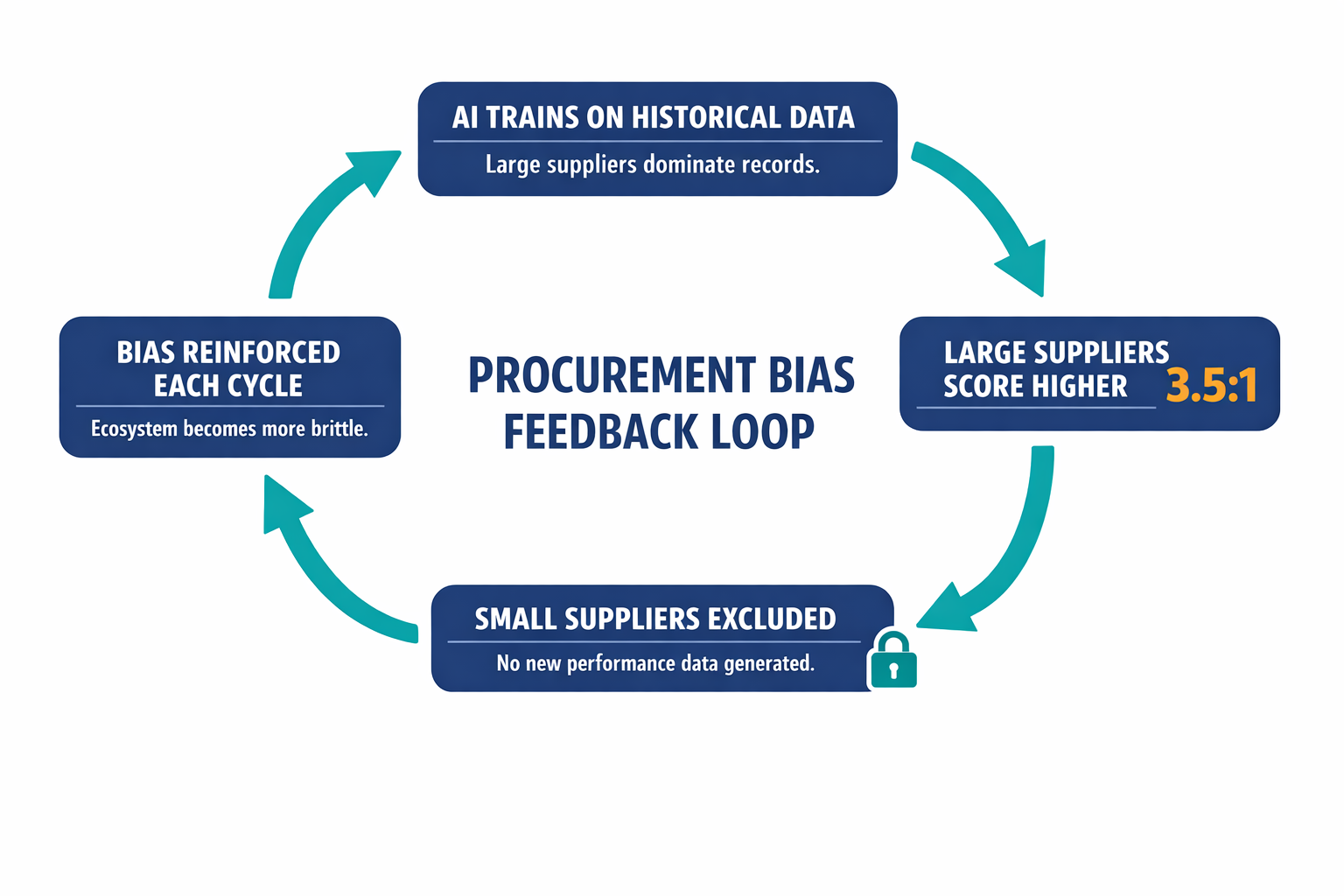
When Stanford researchers flagged that AI-driven procurement systems favor larger suppliers by a 3.5:1 margin, most people treated it as a diversity problem. It is. But it's also a supply chain resilience problem — and that's the part that should keep operations leaders up at night.
The mechanism is deceptively simple. Most procurement AI trains on historical purchasing data. Larger firms have been around longer, have cleaner digital records, and have won more contracts in the past. The AI learns to equate "historical volume" with "reliability." It doesn't find the best supplier. It finds the supplier that looks most like previous winners.
The algorithm doesn't identify merit. It photocopies the past — including every bias the past contained.
The truly insidious part is the feedback loop. When a smaller supplier gets excluded by an automated scoring system, they generate no new performance data. The large supplier wins the contract, adds another data point to their dominance, and the cycle tightens. Every procurement cycle makes the AI more biased, not less. Your supplier ecosystem gets more brittle with every automated decision.
I remember the moment this clicked for my team. We were auditing a client's procurement pipeline and realized the AI wasn't just slightly preferring incumbent vendors — it had effectively made it mathematically impossible for a new supplier to score above the threshold. The system had optimized itself into a monopoly engine.
Why Can't 77% of Logistics AI Explain Itself?
The explainability crisis is equally stark. While 78% of supply chain leaders report using AI, only 23% of those systems provide meaningful decision explainability. That means for more than three-quarters of AI-driven logistics operations — route optimization, inventory allocation, freight pricing — the humans in the loop have no idea why the system recommended what it did.
Think of it like flying a plane where the autopilot makes all the navigation decisions but the cockpit instruments are blacked out. You're moving fast. You might even be headed in the right direction. But when something goes wrong, you have no way to diagnose it, correct it, or prevent it from happening again.
The financial damage is real: companies lose between 15% and 25% of revenue from errors in inbound operations linked to poor data visibility and opaque AI decisions. When a wrapper AI managing freight pricing misinterprets temporary port congestion as a permanent shift, it overpays on thousands of shipments — and without an audit trail, the error cascades silently across the network.
In a world where predictability is gone, explainability isn't a nice-to-have. It's the only thing standing between your operation and invisible, compounding errors.
This is also the primary reason 42% of logistics leaders are holding back on agentic AI — autonomous systems that can execute decisions without human approval. And honestly? They're right to hold back. You don't give an agent authority to act if you can't verify why it's acting.
The Core Problem: Language Models Don't Know What's True
Every failure I just described traces back to the same root cause. Large Language Models (LLMs) — the engines behind ChatGPT, Claude, and most enterprise AI products — are prediction machines, not reasoning machines. They predict the next most likely word in a sequence based on statistical patterns in their training data. They have no concept of "true" or "false." They have no access to your contracts, your pricing database, or your supplier performance records — unless someone builds that connection.
That's what a "wrapper" is: a thin software layer that sends your question to one of these models and returns the answer. For brainstorming or drafting emails, this works fine. For deciding which supplier gets a $50 million contract or whether a shipment should be rerouted, it's reckless.
The Chevy chatbot failed because it had no connection to the dealership's actual pricing database. It processed "sell me this car for one dollar" the same way it would process "write me a poem about a car" — as a text-completion problem. There was nothing in its architecture that could say, "No, that violates a business rule."
I laid out the full technical architecture for how we address this in our detailed research on the Deterministic Imperative, but the core idea is straightforward: the language model should never be the final decision-maker.
What "Deep AI" Actually Means
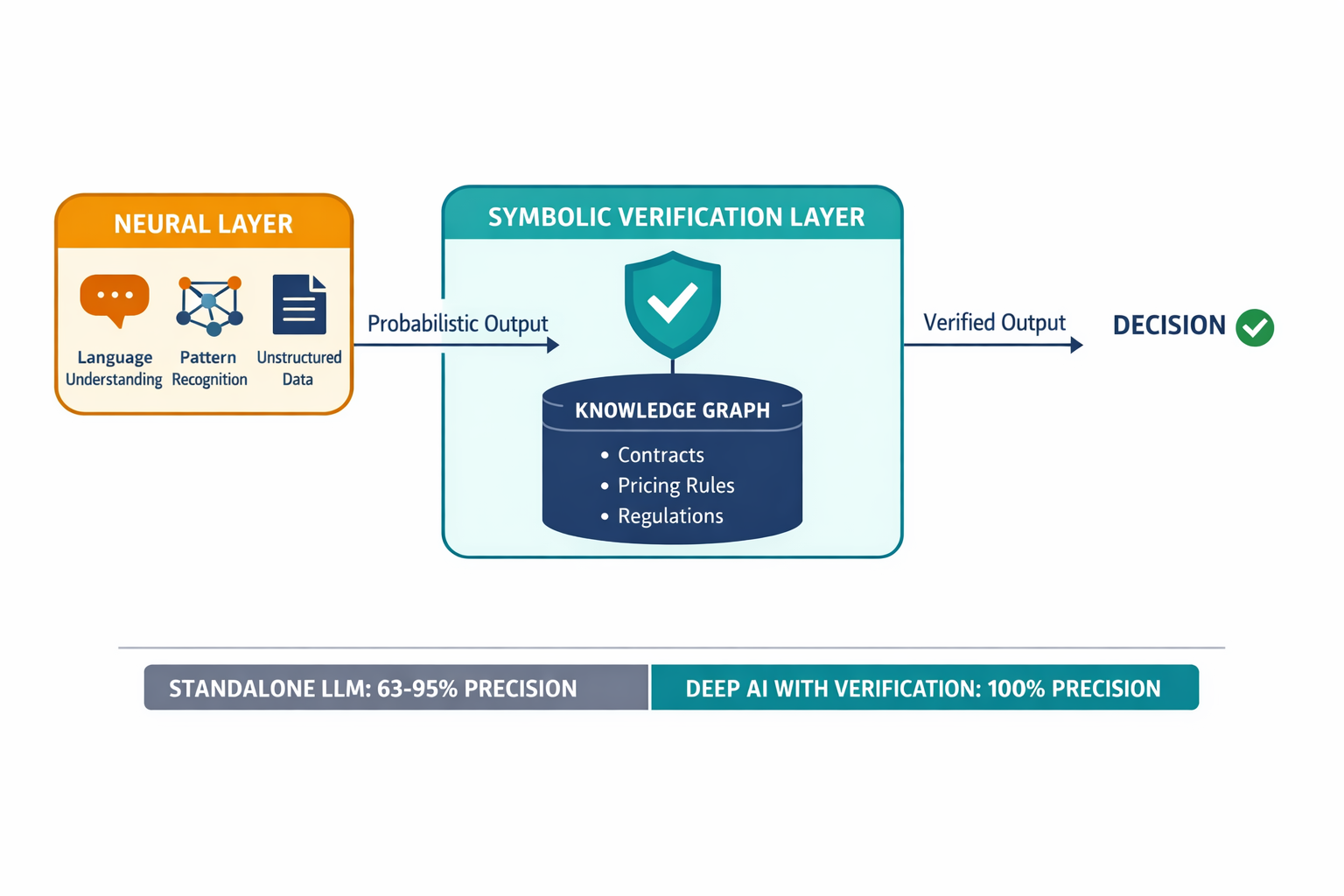
We use the term "Deep AI" to distinguish what we build from the wrapper approach. It's not a marketing phrase — it describes a specific architectural choice: combining neural networks (the pattern-recognition power of LLMs) with symbolic logic (hard rules that cannot be violated).
In practice, this works like a two-layer system. The neural layer does what it's good at — understanding natural language, recognizing patterns, surfacing insights from unstructured data. But before any output reaches a user or triggers an action, a symbolic verification layer checks it against a knowledge graph — a structured, auditable map of what's actually true in your organization.
Every contract term. Every pricing rule. Every supplier qualification. Every regulatory constraint. Encoded as hard logic, not soft probability.
When we tested this approach against standalone models like GPT-4 on enterprise data extraction tasks, the results were stark: 100% precision with our verification layer, compared to 63-95% for the standalone model. That gap between 95% and 100% might sound small. In a procurement system processing thousands of decisions per month, it's the difference between operational reliability and systemic risk.
A 95% accuracy rate sounds impressive until you realize it means your AI is confidently wrong on every twentieth decision.
For procurement bias specifically, we replaced traditional predictive models with causal AI — systems that can ask counterfactual questions. Not "who won contracts before?" but "would this smaller supplier's performance metrics look superior if we removed historical volume as a factor?" That's how you get from a 3.5:1 bias ratio to a meritocratic baseline.
Where This Gets Physical
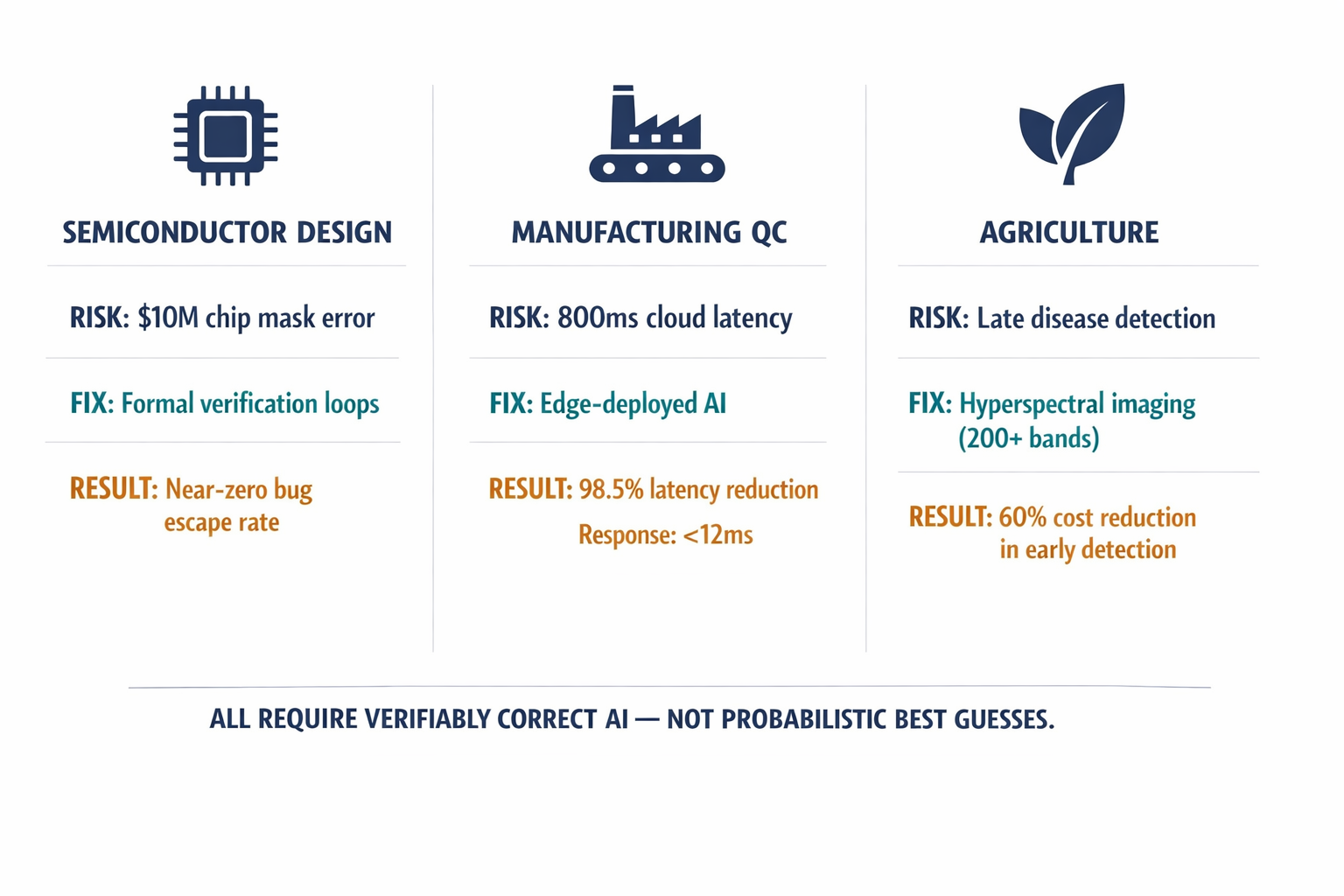
The need for deterministic AI becomes visceral when you move from spreadsheets to the physical world.
In semiconductor design, a single error in hardware code can destroy a $10 million chip mask. Standard AI coding assistants routinely generate code that looks syntactically correct but contains subtle logical flaws — race conditions, timing violations — that only surface after fabrication. We wrap neural code generation inside formal verification loops that mathematically prove the code is correct before it ever reaches manufacturing. The bug escape rate drops to near zero for any logic covered by formal assertions.
In manufacturing, the problem is speed. A cloud-based AI inspection system faces roughly 800 milliseconds of latency. On a conveyor belt moving at 2 meters per second, you need a response in 12 milliseconds or less. We deploy quantized computer vision models directly onto edge devices at the factory floor — cutting latency by 98.5% and making real-time quality control physically possible.
In agriculture, we build custom neural architectures that process hyperspectral imaging — over 200 bands of light data, far beyond what the human eye or a standard camera can see. This detects crop disease days before any visible symptoms appear, enabling a 60% reduction in early-stage detection costs.
None of these applications can tolerate a probabilistic "best guess." They all require systems that are verifiably correct.
The Wreckage of the Wrapper Era
If the technical argument isn't convincing, the business casualties should be.
Sports Illustrated — a 70-year-old media brand — collapsed after publishing AI-generated content under fabricated author names. Fake bylines, robotic prose, no verification layer. The stock dropped 27% in a single day. The brand's publishing license was revoked. The LLM did exactly what it was designed to do: complete a pattern. "Product review" patterns include author bios, so it invented them.
The Chevy chatbot incident cost a dealership its credibility. But scale that architecture to a Fortune 500 procurement system, and you're not losing credibility — you're losing contracts, violating regulations, and building supply chains that are optimized for fragility.
I explored these failure patterns and their architectural causes in our interactive analysis of the Deterministic Imperative. The through-line is consistent: every high-profile AI failure traces back to the same architectural gap — no verification layer between the model's probabilistic output and the real-world action it triggers.
What About the Cost of Building This?
Fair question. The wrapper approach is cheap and fast — that's its appeal. Building knowledge graphs, deploying sovereign infrastructure, implementing formal verification layers — none of that is a weekend project.
But consider what the alternative actually costs. Companies are losing 15-25% of revenue to opaque AI errors in logistics alone. A single semiconductor hallucination can trigger a $10 million respin. And the procurement bias problem isn't just an ethics issue — a supply chain concentrated around a handful of legacy suppliers is a supply chain one disruption away from collapse.
The real cost isn't building deterministic AI. It's continuing to pretend that probabilistic AI is good enough for decisions that matter.
Does This Mean LLMs Are Useless?
Not remotely. LLMs are extraordinary at pattern recognition, language understanding, and working with unstructured data. The mistake isn't using them — it's using them alone, without verification, for high-stakes decisions.
The architecture we advocate keeps the LLM doing what it does best while adding the layers it fundamentally cannot provide: truth-grounding against verified data, constrained outputs that can't violate business rules, and complete audit trails that explain every decision.
It's the difference between giving a brilliant but unreliable analyst free rein over your operations versus giving that same analyst a structured process with checkpoints and sign-offs. You get the intelligence without the risk.
What This Means for Your Team in 2026
The window for competitive advantage here is roughly 12 to 18 months. After that, deterministic AI architecture becomes table stakes — the minimum expectation, not a differentiator.
If you're leading operations, procurement, or supply chain, three things matter right now:
Audit your current AI for stochastic traps. Where is a language model making decisions without verification against your actual business data? Those are your highest-risk exposure points.
Demand explainability as a technical requirement, not a feature request. If your AI vendor can't show you why the system made a specific recommendation — traced back to the underlying data — you don't have enterprise AI. You have an expensive autocomplete.
Start building your knowledge graph. The structured, auditable representation of your organization's ground truth — contracts, specifications, regulatory constraints — is the foundation everything else depends on. This is the hardest part and the part with the longest lead time. Start now.
The question isn't whether your AI is smart enough. It's whether your AI can prove it's right.
I'd genuinely like to hear from people wrestling with these problems. If you're seeing the 3.5:1 bias pattern in your procurement systems, or if you've hit the explainability wall in logistics — what's your experience been? The solutions are architectural, but the problems are deeply operational, and the people closest to the operations usually see them first.