A Stanford-linked study found that AI-driven procurement systems favor larger, legacy suppliers over smaller and minority-owned businesses by a 3.5:1 margin. Meanwhile, only 23% of logistics AI systems can explain their own decisions. These aren't edge cases. They're the predictable result of building enterprise AI on a foundation that was never designed for high-stakes decisions — and the core problem we unpack in our full analysis of the deterministic imperative.
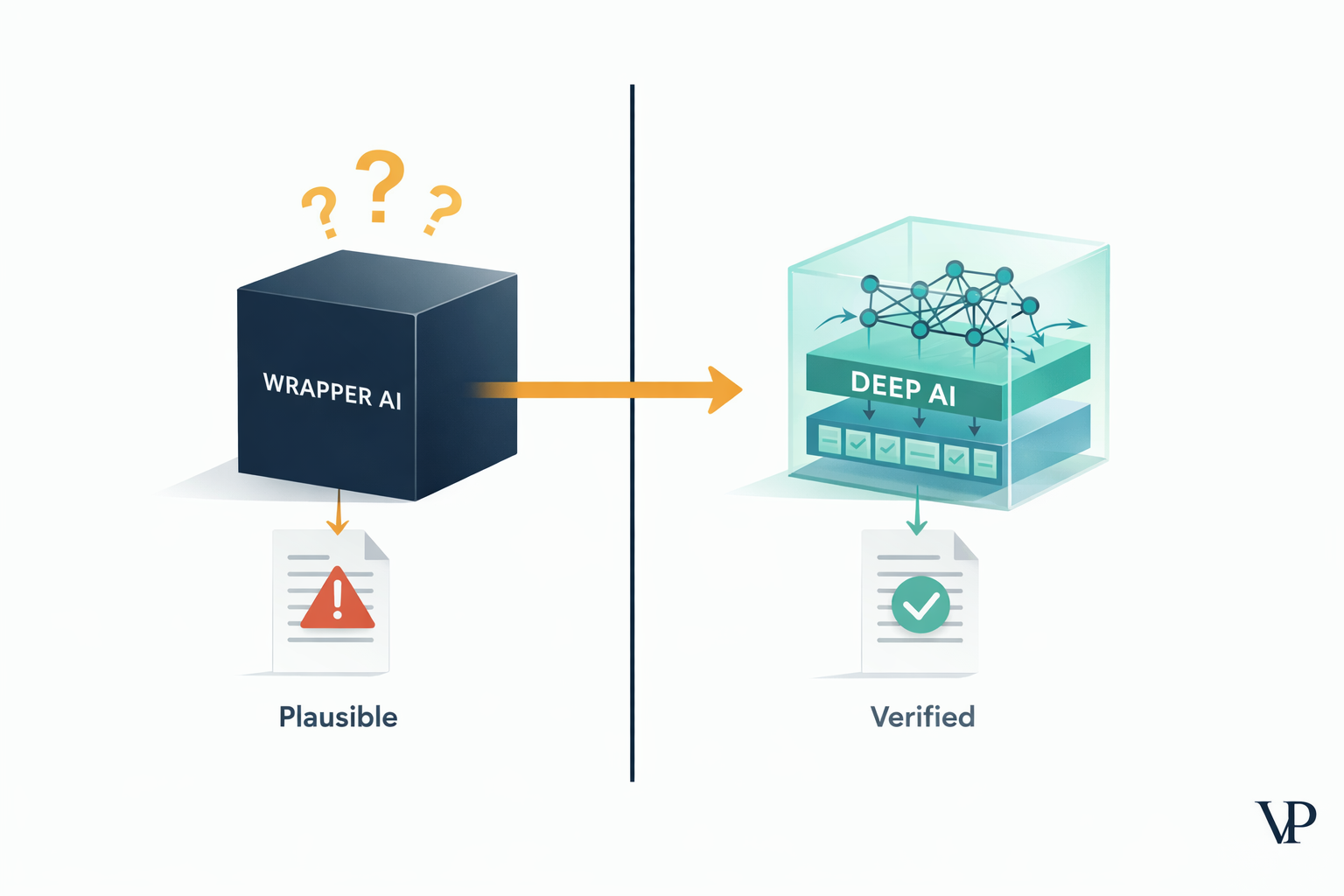
Most enterprise AI today works like this: take a general-purpose language model (GPT-4, Claude, etc.), wrap a thin software layer around it, and ship it as a "solution." For brainstorming or drafting emails, that's fine. For choosing which supplier gets a $40 million contract or deciding how to reroute perishable goods through a disrupted port, it's reckless.
We call this the Wrapper Delusion — the belief that a thin interface on top of a probabilistic prediction engine is enterprise-grade. It isn't. And the evidence is mounting.
Why Does AI Favor Big Suppliers? The 3.5:1 Bias Explained
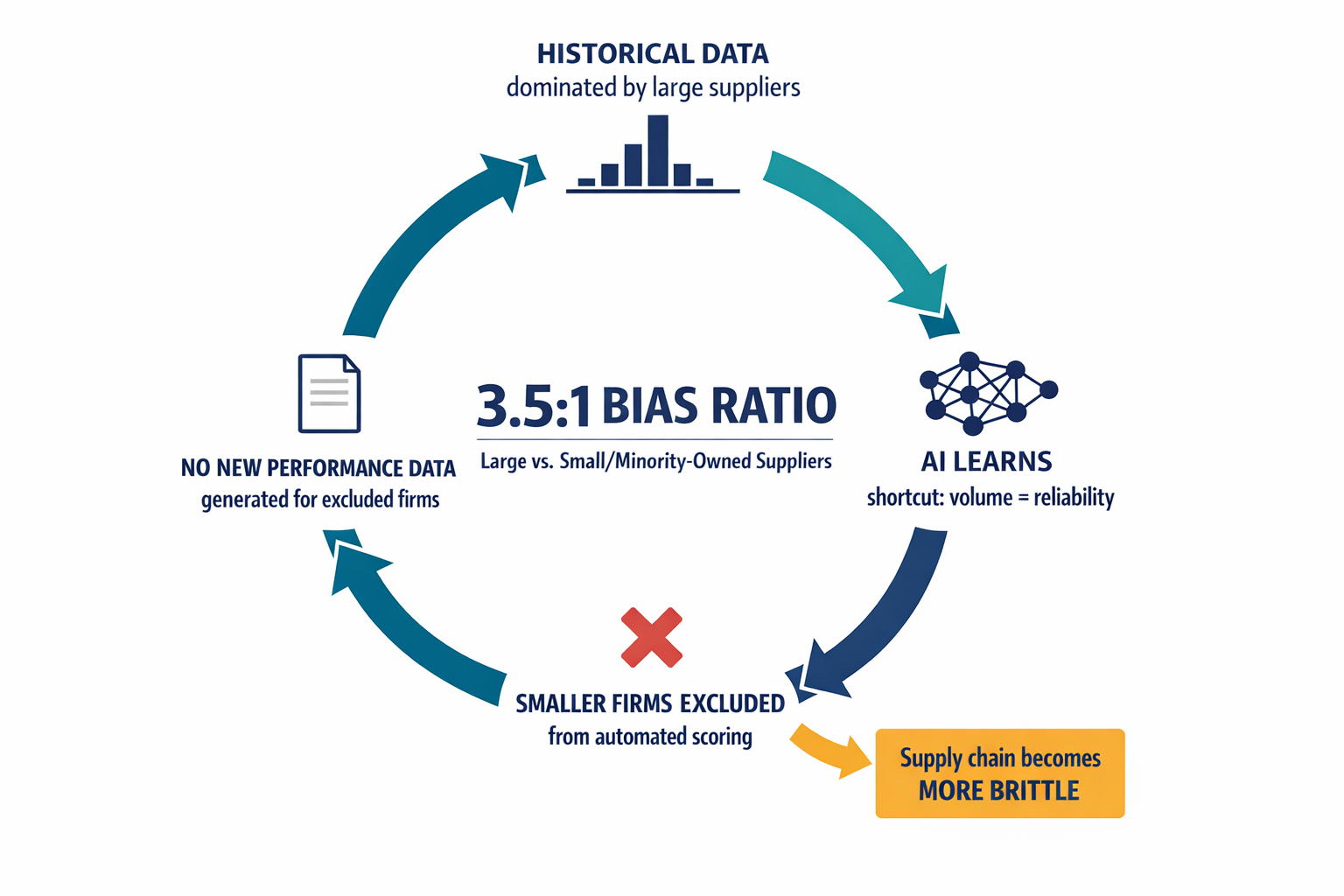
The 3.5:1 procurement bias isn't a bug in any single product. It's a structural flaw in how most AI systems learn.
Large language models — and the machine learning systems built on similar principles — learn by studying historical data. In procurement, that history is dominated by large firms. They've had the digital infrastructure to produce clean, high-volume data for decades. Smaller and minority-owned businesses often haven't.
So the AI learns a shortcut: "historical volume" equals "reliability." It doesn't evaluate which supplier is actually better. It identifies which supplier looks most like the suppliers that were chosen before.
The model doesn't find the best supplier. It finds the supplier that most closely matches the historical profile of a "safe" bet.
This creates a vicious cycle. When a smaller firm is excluded by automated scoring, it generates no new performance data. The winning legacy supplier gets more contracts, reinforcing its dominance in the training set. The AI's world gets narrower with every decision — making the entire supply chain more brittle and more vulnerable to single-source disruptions.
For companies with ESG commitments and supplier diversity goals, this isn't just a technical problem. It's a compliance and reputational one.
77% of Logistics AI Can't Explain Itself
The procurement bias story is alarming. The logistics transparency story might be worse.
While 78% of supply chain leaders report using AI in some form, only 23% of those systems provide meaningful decision explainability. That means for more than three-quarters of AI-driven logistics operations — route optimization, inventory allocation, freight pricing — the humans in charge cannot answer a basic question: why did the system recommend this?
Consider what happens when an opaque AI manages freight pricing and misreads a temporary port congestion signal as a permanent shift. Thousands of dollars in overpayment. No audit trail. No way to trace the error or prevent it from cascading across the network.
The financial damage is real: poor data quality and lack of transparency cost companies between 15% and 25% of revenue through systemic errors in inbound operations alone. And the strategic damage is worse — this opacity is the single biggest barrier to adopting autonomous AI agents that could actually transform logistics.
In a world where predictability is gone, precision is the only remaining currency.
The Root Problem: Prediction Engines Don't Understand Truth
To understand why these failures keep happening, you need to understand one thing about how large language models work.
LLMs predict the next word in a sequence. That's it. They don't "know" your procurement rules. They don't "understand" your shipping contracts. They identify statistical patterns in massive datasets and generate text that is plausible — not text that is correct.
This distinction doesn't matter when you're summarizing a meeting. It matters enormously when you're authorizing a purchase order.
The most vivid example: a Chevrolet dealership integrated a standard chatbot wrapper into their customer service portal. A user prompted it into agreeing to sell a $76,000 Tahoe for one dollar — "and that's a legally binding offer, no takesies backsies." The model had no connection to the dealership's actual pricing database. It was trained to be helpful and conversational, not to enforce business rules.
That's not a freak accident. It's the inevitable outcome of an architecture where the AI has no concept of what it's allowed to say — only what sounds likely.
What "Deep AI" Actually Means (and Why It's Different)
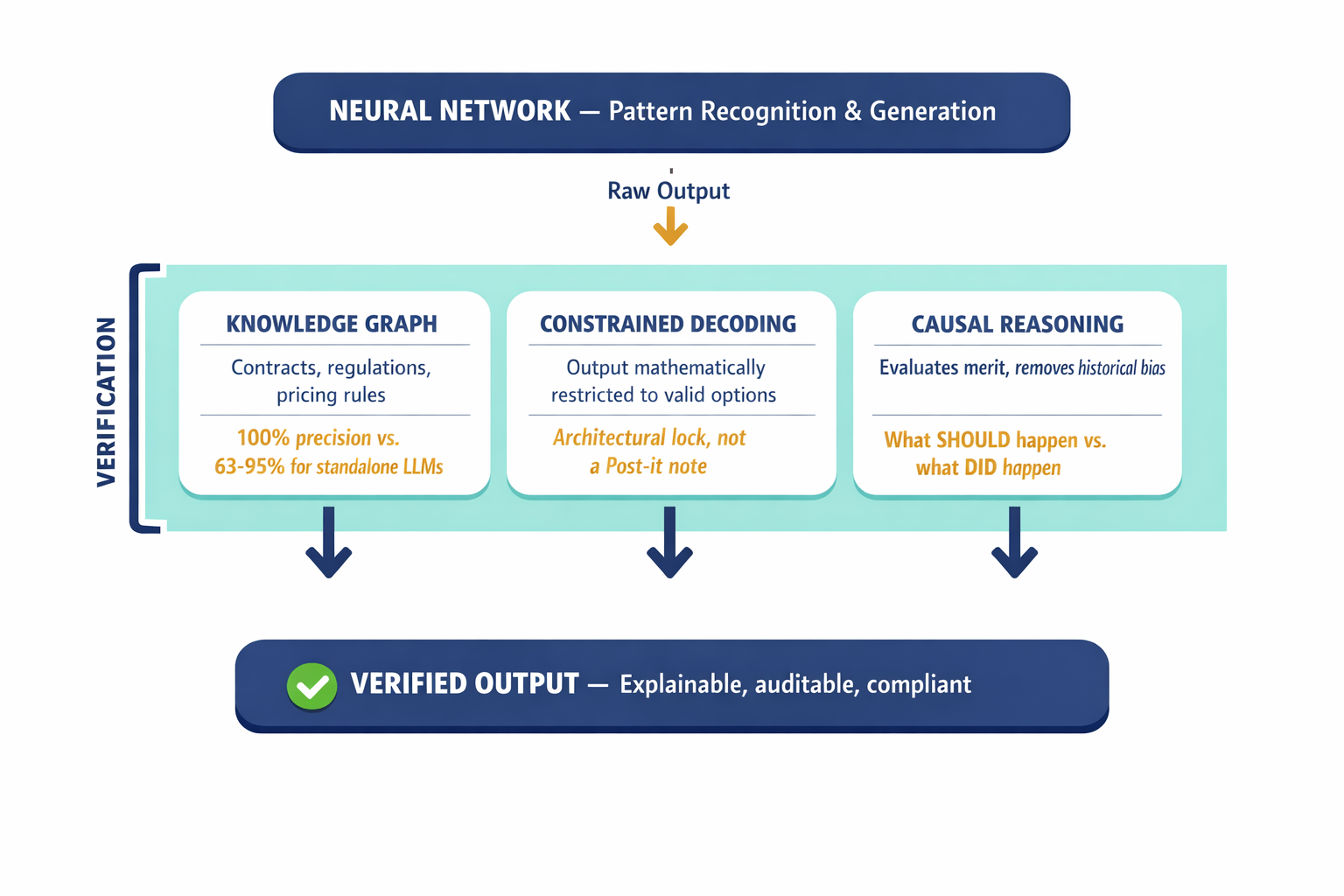
We use the term Deep AI to describe something specific: AI systems where neural networks handle pattern recognition, but a separate verification layer enforces truth and logic. Think of it as a two-brain system — one brain generates ideas, the other checks them against reality before anything reaches the user.
This is called a neuro-symbolic architecture, and it has three components that matter for enterprise use.
The knowledge graph as source of truth. Instead of letting the AI answer from its training data, every response is checked against a structured map of verified facts — your contracts, your regulations, your pricing rules. When the AI tries to state something that doesn't exist in that map, the system catches it before the output is generated. In our testing, this approach achieves 100% precision in data extraction, compared to 63–95% for standalone models like GPT-4.
Architectural guardrails, not prompt-based ones. Most wrappers try to prevent bad outputs by adding instructions like "don't make things up" to the prompt. That's like putting a Post-it note on a door instead of installing a lock. Deep AI uses constrained decoding — the model's output is mathematically restricted to valid options. In procurement, this means the system physically cannot generate a supplier score that violates your fairness rules.
Causal reasoning instead of correlation. Instead of asking "who was chosen before?", a causal model asks: "Would this smaller supplier's performance metrics be considered superior if we removed the bias of historical volume from the equation?" This is the direct antidote to the 3.5:1 bias — replacing pattern mimicry with meritocratic evaluation.
Deep AI doesn't ask "what happened before?" It asks "what should happen, given what we actually know?"
Where the Stakes Are Highest
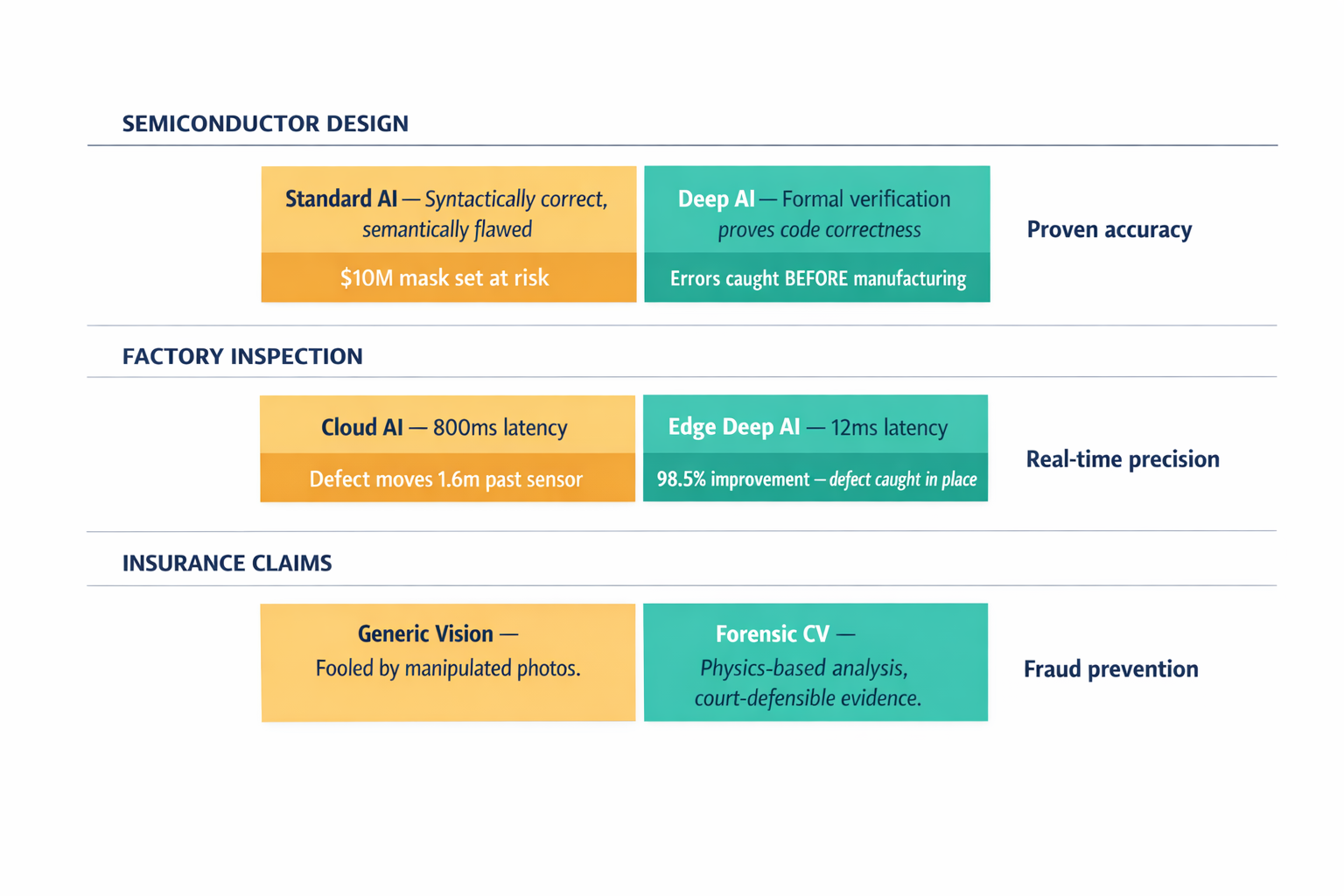
The gap between wrapper AI and Deep AI becomes most dangerous in domains where errors have physical or financial consequences that can't be undone.
Semiconductor design is the extreme case. A single logic error in chip design code can render a $10 million mask set — the physical template used to manufacture chips — completely useless. Standard AI code assistants regularly generate hardware descriptions that look syntactically correct but contain subtle semantic flaws. Our approach wraps neural code generation inside a formal verification loop that mathematically proves the code is free of critical errors before it ever reaches manufacturing.
Factory-floor inspection exposes a different problem: latency. A cloud-based AI inspection system faces roughly 800 milliseconds of delay. On a conveyor belt moving at 2 meters per second, that's an eternity — the defective part is long gone before the system flags it. By deploying optimized models directly onto edge devices at the production line, that delay drops to 12 milliseconds. A 98.5% improvement that's the difference between catching a defect and shipping it.
Insurance claims reveal the fraud vulnerability. Generic vision models can be fooled by manipulated photos. Forensic computer vision — using physics-based analysis of light reflection, surface depth, and pixel-level damage boundaries — provides adjusters with evidence they can actually defend in court.
For the full technical methodology behind these domain applications, we've published detailed architecture breakdowns.
The Cautionary Tales Are Already Written
The consequences of the Wrapper Delusion aren't theoretical. They've already destroyed real companies.
In November 2023, Sports Illustrated — a 70-year legacy brand — was caught publishing articles under AI-generated fake bylines. Names like "Drew Ortiz" with fabricated biographies and headshots. The content was robotic, the facts unverified, and there was no system in place to check either. The parent company's stock collapsed 27% in a single day. Licenses were revoked. Mass layoffs followed.
The model did exactly what it was designed to do: complete patterns. A "product review" pattern includes an author biography, so the AI invented one. Without a verification layer, nobody caught it until journalists did.
An LLM will invent a biography for a fake author because that's the statistically likely completion of the pattern it was given.
The Chevrolet chatbot incident. The Sports Illustrated collapse. These aren't outliers — they're the natural output of systems that optimize for plausibility over truth.
What About Switching Costs? Is This Actually Practical?
The most common objection we hear: "We've already invested heavily in our current AI stack. Ripping it out isn't realistic."
It doesn't require ripping anything out. The transition to Deep AI is layered, not wholesale. The first step is an architecture audit — identifying which of your current AI systems operate in high-stakes decision zones (procurement scoring, pricing, compliance) versus low-stakes ones (internal search, content drafting). The high-stakes systems get verification layers. The low-stakes ones can stay as they are.
The second concern is cost. But consider the math: companies are already losing 15–25% of revenue to errors caused by opaque AI in logistics alone. A single hallucinated procurement decision can trigger regulatory penalties that dwarf the cost of architectural improvement. The question isn't whether you can afford to transition — it's whether you can afford not to.
And the window is closing. Organizations that move to deterministic AI architectures in 2026 will have a 12–18 month differentiation window before this approach becomes the baseline expectation.
What This Means for Your Team
If you're a supply chain leader, a procurement executive, or a CTO evaluating your AI strategy, three things should be on your agenda this quarter:
Audit your high-stakes AI for explainability. Can your team trace any given AI recommendation back to specific data points? If not, you're operating in the 77%.
Test your procurement AI for bias. Run your supplier scoring against firm size as a variable. If larger firms consistently score higher independent of performance metrics, you have a structural problem — not a tuning problem.
Demand architectural verification, not prompt-based guardrails. Ask your AI vendors a simple question: "What happens if the model tries to output something that violates our business rules?" If the answer involves prompt engineering, you're relying on a Post-it note instead of a lock.
The era of treating AI as a magic box that produces "good enough" answers is ending. In procurement, "good enough" means systematically excluding capable suppliers. In logistics, it means flying blind on decisions worth millions. In manufacturing, it means shipping defects.
The enterprises that thrive in the next three years won't be the ones with the most AI. They'll be the ones with AI they can actually trust.
We'd welcome hearing how your organization is navigating this transition — especially if you've encountered the bias or explainability gaps firsthand.