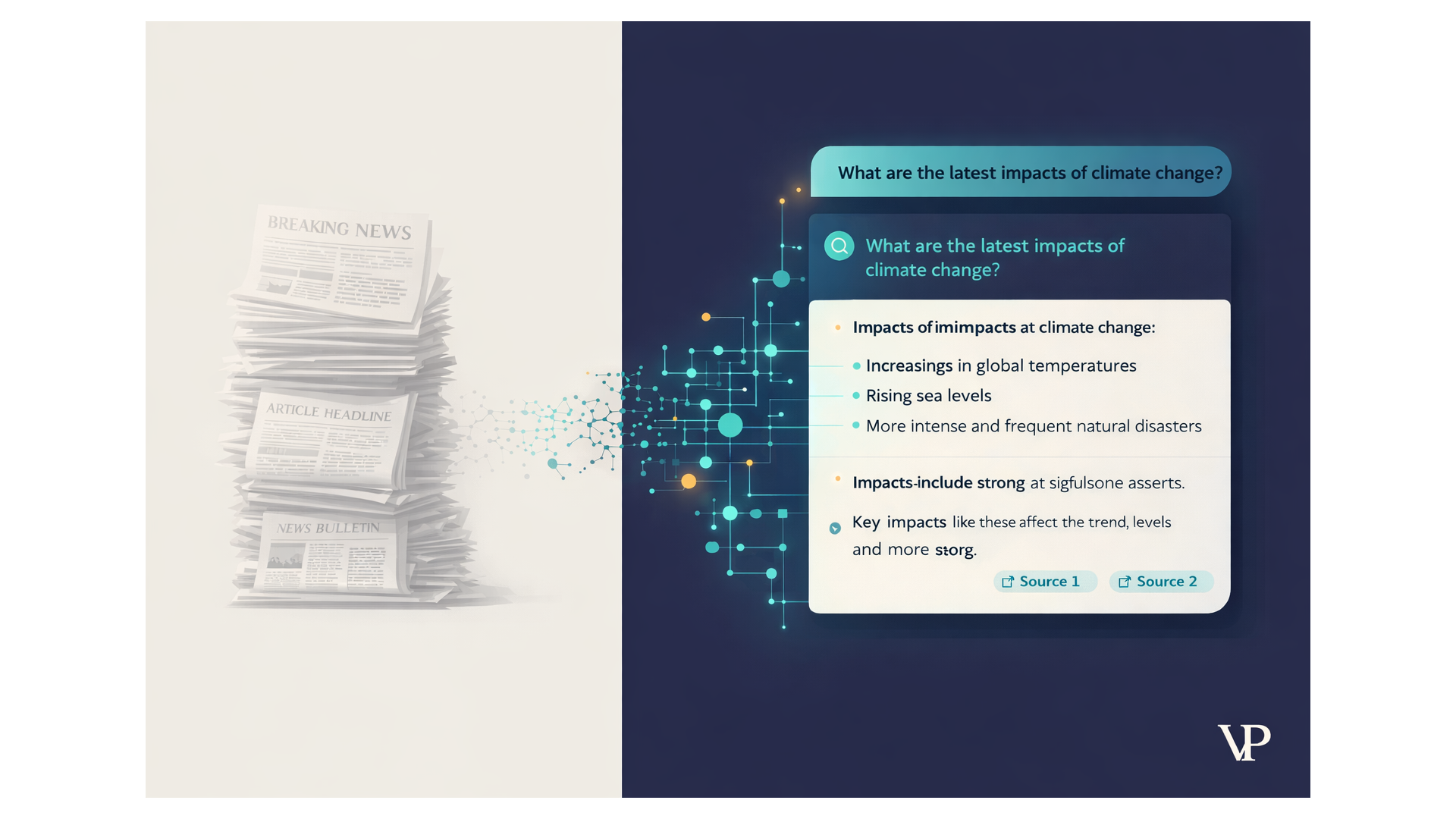
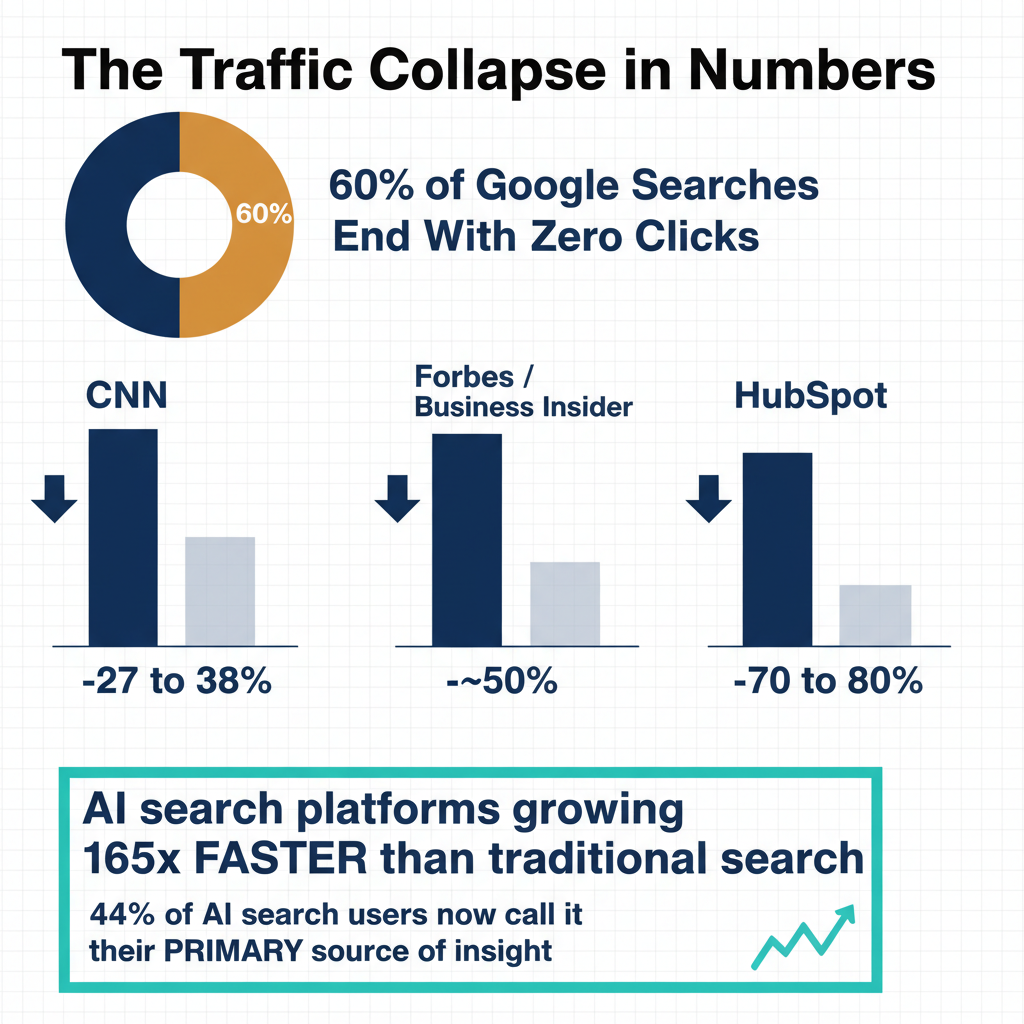
Sixty percent of Google searches now end without anyone clicking a link. For news publishers, this isn't a bad quarter — it's the end of the business model they've spent twenty years building.
I've spent the last year studying what happens when AI answers the question before the reader ever reaches your website. The numbers are brutal: CNN's traffic is down 27–38%. Forbes and Business Insider have seen drops approaching 50%. HubSpot — a company that essentially invented content marketing — lost 70–80% of its organic traffic. Meanwhile, daily Google searches have actually increased to between 9 and 14 billion. People are searching more than ever. They're just not clicking through anymore.
We published our full analysis of this shift, and the conclusion surprised even me: the media companies best positioned to thrive in the AI era aren't the ones producing the most content. They're the ones sitting on the deepest archives.
The Feed Is a Broadcast. The Future Is a Conversation.
The news article is a relic of print economics. You wrote 800 words because you couldn't print 800 individual answers — paper was expensive, distribution was slow, and you had to bundle information together. That logic made zero sense online, but we kept doing it anyway. We just made the paper digital and called it a "feed."
Now a user searching "What is the mayor's stance on housing?" doesn't want to read a 1,000-word feature on the history of city zoning. They want the mayor's stance. Period. The traditional model forces them to search, click, scroll, scan, read, and then extract the answer themselves. AI just gives them the answer.
The article was a container designed for scarcity. We live in abundance now, and the container is cracking.
Traffic to AI platforms like ChatGPT and Perplexity is growing 165 times faster than traditional search. Forty-four percent of people using AI-powered search now call it their primary source of insight — ahead of Google. Users are typing longer, more complex prompts. They don't want ten blue links. They want synthesis.
The Archive Isn't a Graveyard. It's an Untapped Gold Mine.
When I talk to media executives, most treat their archives as a cost center — old servers to maintain, legacy content nobody reads. That framing is exactly backwards.
A 50-year newspaper archive is a dataset that OpenAI cannot replicate without a license. It contains decades of local power dynamics, corporate histories, policy shifts, and verified reporting that no general-purpose AI can match. The problem isn't the data. The problem is that it's locked inside disconnected articles that neither humans nor machines can efficiently query.
Think of it this way: a publisher's archive is like a warehouse full of gold ore. Right now, they're selling tours of the warehouse. What they should be selling is refined gold.
The pivot is from publishing (selling access to articles) to servicing (selling the intelligence buried inside those articles). It's a shift from monetizing attention to monetizing utility. And the organizations that figure this out first will have a moat that no AI company can easily cross.
The Financial Times Already Proved This Works
The FT built "Ask FT" — a tool that lets professional subscribers converse with the archive instead of searching through it. The answers come exclusively from FT journalism, with citations linking back to source articles. No hallucinated facts from random corners of the internet. No guessing which article might contain the answer.
What struck me about their approach is the business logic: they aren't chasing mass traffic anymore. They're tracking "Actual Core Readers" — users who engage deeply — and the conversational tool is driving retention by surfacing older evergreen content that would otherwise stay buried forever.
Bloomberg took this even further. BloombergGPT doesn't just retrieve text — it translates natural language into Bloomberg's proprietary query language, pulling structured financial data and formatting it on the fly. An analyst can ask "Show me revenue growth for tech companies in Q3 2024" and get a formatted table, not a list of articles to read. They turned their news feed into a queryable intelligence engine.
The product isn't the article anymore. It's the ability to interrogate decades of articles with a single question.
Why a Basic Chatbot Won't Cut It
When most people hear "AI on your archive," they picture a chatbot wrapper — dump your PDFs into a vector database, connect an LLM, done. My team tried exactly this early on, and the results were embarrassing.
Standard search-and-retrieve AI (what the industry calls "naive RAG") chops documents into small chunks, converts them to mathematical representations, and finds the chunks most similar to your question. For a simple factual lookup, this works fine. For anything involving time, connections between people, or reasoning across multiple articles, it fails in three specific ways.
It loses the thread. Chunking breaks narratives apart. A chunk about a verdict gets separated from the chunk about the original crime. Ask "What was the outcome of the trial?" when the trial spanned five years of coverage, and the system retrieves fragments but can't stitch the story together.
It's blind to time. An article from 2010 saying "the housing market is crashing" looks semantically identical to one from 2024 saying the same thing. The AI can't tell current truth from historical truth. I watched our early prototype confidently attribute a politician's 2012 policy position to 2024 — technically accurate text, completely wrong in context.
It can't connect dots across articles. If Article A links a person to a company, and Article B links that company to a scandal, a basic system can't answer "Is this person connected to the scandal?" No single chunk contains the direct link. The system lacks what researchers call multi-hop reasoning — the ability to follow a chain of connections.
Building an Intelligence Engine, Not a Search Bar
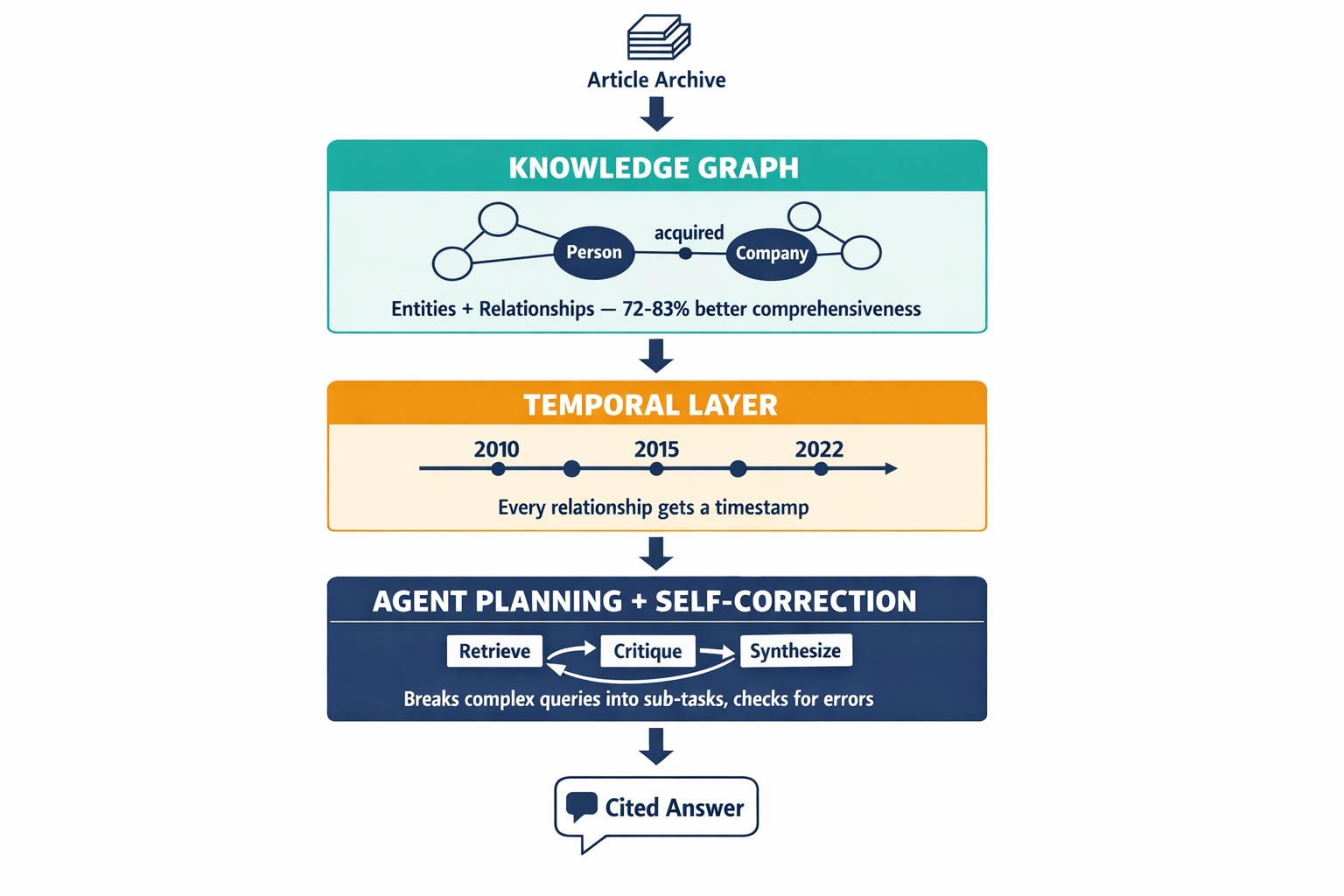
After those early failures, we rebuilt from scratch using three layers that work together.
The first layer maps relationships. Instead of treating the archive as a bag of disconnected text, we extract every person, organization, location, and event mentioned in the articles, along with the relationships between them — who acquired what, who voted for which bill, who was appointed by whom. All of this goes into a knowledge graph: a structured web where every article is interconnected through the entities it mentions. When tested on complex reasoning questions, this approach (called GraphRAG) showed 72–83% improvement in comprehensiveness compared to basic text search.
The second layer adds time. Every relationship in the graph gets a timestamp. The connection between a CEO and their company exists for a specific date range. When a user asks "How has the mayor's stance changed since 2010?", the system doesn't retrieve a jumbled pile of quotes from different decades. It decomposes the question into time windows, retrieves the relevant facts for each period, and assembles a chronological narrative with dated citations.
The third layer plans and self-corrects. Instead of a single retrieve-and-answer step, an AI agent breaks complex requests into sub-tasks, executes them independently, reviews its own work for gaps or contradictions, and then synthesizes the final response. One part of the system retrieves financial history. Another finds legal disputes. A separate "critic" checks whether the assembled answer actually holds together before the user ever sees it. This dramatically reduces the hallucination problem — the AI inventing facts — which would be fatal in a journalistic context.
We detail the full technical architecture in our deep-dive research paper for anyone building these systems.
What This Actually Looks Like in Practice
Imagine a user asks: "How has the mayor's stance on housing changed since 2010?"
In the old model, they'd search the site, open maybe a dozen articles spanning different years, read each one, and mentally piece together a timeline. Forty-five minutes, minimum.
In the new model, the system identifies the mayor as an entity, filters for housing-related coverage, traverses the knowledge graph to find stance changes over time, and generates a narrative: "In 2010, the mayor ran on a preservationist platform, opposing high-rises. By 2015, following the affordability crisis, he shifted to a neutral stance. In 2022, he championed the 'Build Now' bill." Each claim has a clickable citation. A visual timeline renders alongside the text. Ten seconds.
That's the difference between content and intelligence. The publisher had the answer all along — it was just scattered across a decade of disconnected articles.
The Business Model That Follows
The economics shift fundamentally. Instead of fighting for fractions of a penny per ad impression, media companies can build three new revenue streams.
A premium intelligence tier. Not $10/month to "read the news," but $1,000+/year for professionals who need to query the archive — financial analysts running due diligence, lawyers tracking regulatory history, corporate teams monitoring competitors. The FT is already moving in this direction.
Licensed API access. Hedge funds, law firms, and enterprise search platforms don't want to scrape news sites. They want a clean, licensed connection that delivers sentiment analysis, entity timelines, and synthesized briefings directly into their workflows. Charge per query. Align revenue with the value the client actually extracts.
A defensible data moat. In a world where anyone can access GPT-4, the model isn't the competitive advantage. The data is. A curated knowledge graph built from 50 years of verified local reporting is a non-fungible asset. It becomes more valuable as it grows, and it cannot be replicated by an AI company without a licensing deal.
When LLMs are commodities, the only moat is proprietary data structured for retrieval.
What About the Journalism Itself?
A question I get often: does this mean articles are dead? No. The article remains essential for storytelling, investigation, and opinion. What's dying is the article as the default container for every piece of information. A 200-word factual update doesn't need to be an article. A timeline of policy changes doesn't need to be an article. A comparison of quarterly earnings doesn't need to be an article.
The intelligence engine handles retrieval and synthesis. Journalists focus on what machines genuinely cannot do: source development, accountability reporting, narrative craft. The technology elevates the craft by removing the busywork.
Won't AI Companies Just Scrape Everything Anyway?
Some will try. But licensing deals are already becoming the norm — Axel Springer with OpenAI, the FT with OpenAI. The critical insight is that selling raw data for model training is a low-margin, one-time transaction. Selling a live intelligence interface — a continuously updated RAG engine with proprietary structure — creates recurring revenue that scales with usage. You're not selling the ore. You're selling the refinery.
The Window Is Open, But It Won't Stay Open
The media industry is in the early innings of a transformation more profound than the shift from print to digital. The organizations that move now — vectorizing their archives, building knowledge graphs, creating conversational interfaces — will define the next era of news. The ones that keep optimizing for clicks on a feed that fewer people visit each month will watch their most valuable asset — decades of verified, structured knowledge — get scraped, summarized, and served by someone else's AI.
The feed was a broadcast mechanism. The chat is a consultation mechanism. The revenue follows the value, and the value has moved.
If you're leading a media organization and thinking about what your archive could become, I'd genuinely like to hear how you're approaching this. The playbook is still being written.