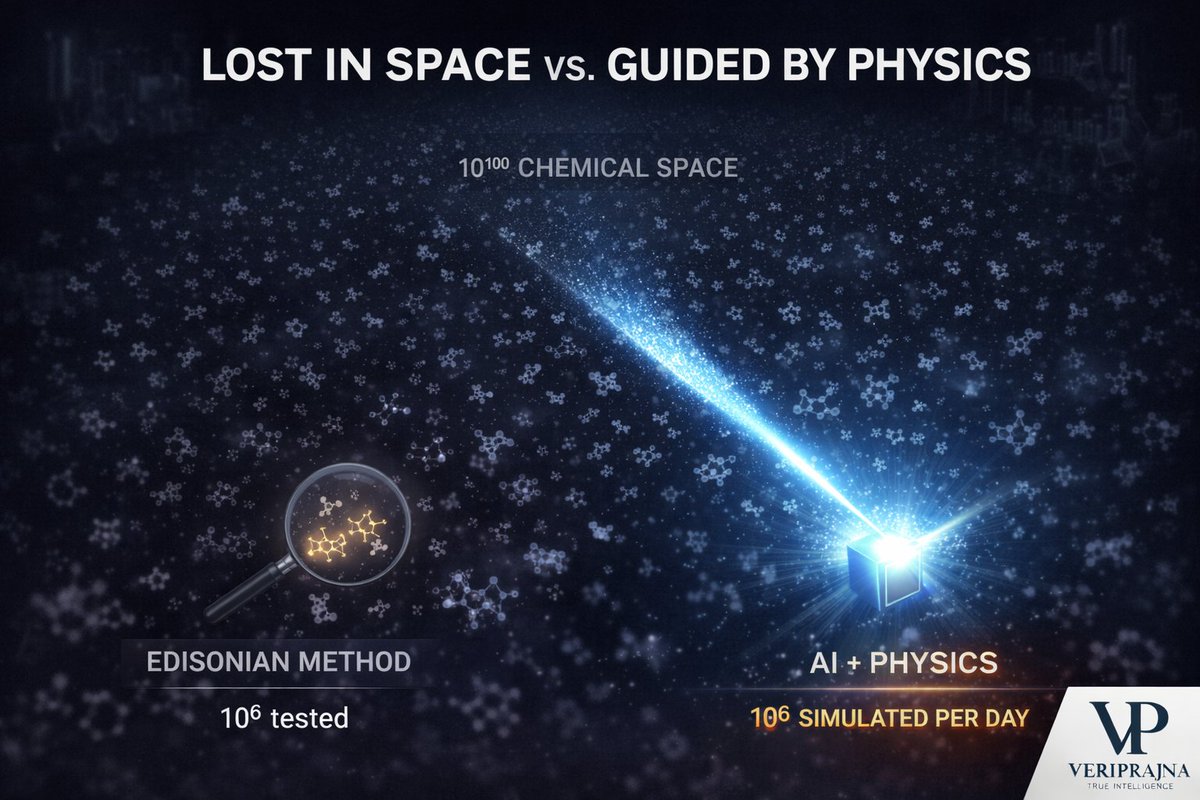
- Chemical space spans 10^60 to 10^100 molecules.
Standard HTS campaigns screen 10^6 compounds—coverage: 0.000...001%.
Edison's trial-and-error is statistically doomed. 🧵
#DeepTech #DrugDiscovery - Pharma R&D economics:
- Cost per drug: $2.23 BILLION (2024)
- Internal returns: 1.2% (2022 low)
- Average development time: 10+ years
- Eroom's Law: declining productivity for decades
Physical screening at scale doesn't work.
#Pharma #RnD - Lipinski-compliant drug-like molecules: 10^60
Full organic chemistry space: 10^100
Atoms in observable universe: 10^80
You cannot physically explore chemical space. Random sampling = economic suicide. - Tesla's critique of Edison (1890s): "A little theory and calculation would have saved 90% of the labor."
140 years later, R&D still uses Edisonian trial-and-error.
Random screening where intelligent simulation should guide.
#Innovation - Solution: Physics-Informed Machine Learning (PIML)
NOT black box AI. Embed physical laws (PDEs, thermodynamics, conservation laws) into neural architecture.
Advantages:
✓ Data efficiency (requires less training data)
✓ Extrapolation (predicts beyond training set) - ✓ Physical consistency (no hallucinations)
Why Graph Neural Networks > LLMs for molecules:
LLMs treat molecules as text strings (SMILES). Lose 3D geometry, chirality, bond angles. - GNNs model molecules as graphs: atoms = nodes, bonds = edges. Permutation invariant. Geometry-aware.
Benchmarks: GNNs dominate molecular property prediction.
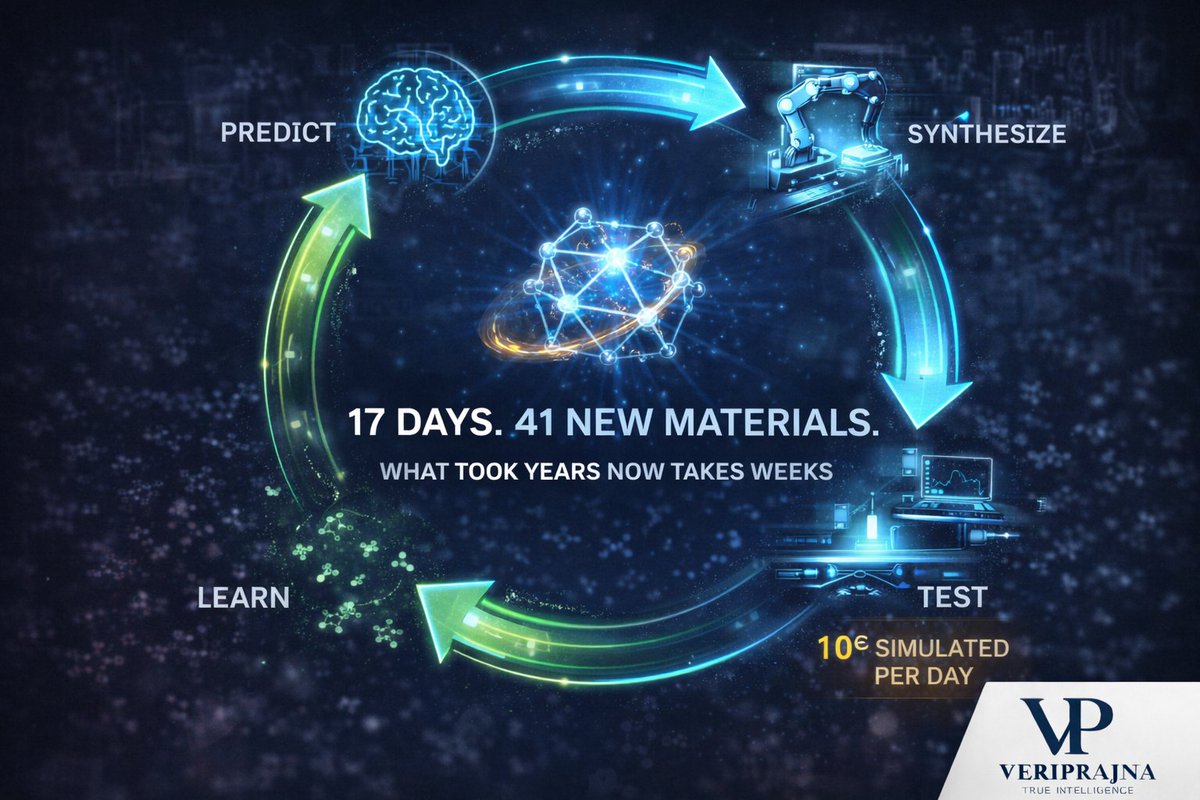
Closed-Loop Discovery = Active Learning via Bayesian Optimization - 1. AI predicts property + uncertainty (Gaussian Process)
2. Acquisition function selects highest-value experiment (UCB/EI/Thompson)
3. Robot executes synthesis/test
4. Result feeds back, model improves
5. Repeat
Acquisition functions balance Exploration vs Exploitation: - UCB (Upper Confidence Bound): Optimistic, high-risk/high-reward
EI (Expected Improvement): Conservative, incremental gains
Thompson Sampling: Probabilistic, good for batch experiments
Cost-Informed BO reduces reagent costs 90%. - Berkeley A-Lab (Autonomous Lab):
- 41 novel inorganic materials synthesized
- 17 days total time
- 71% success rate
- AI autonomously corrected failed recipes
Traditional human-led discovery: months to years for same output.
24/7 robotic labs = 4x acceleration. - The Edisonian Era is over.
From random to rational. From trial-error to predict-test-learn.
Veriprajna specializes in closed-loop discovery labs. - 📖 Read the full technical whitepaper here: https://veriprajna.com/whitepapers/end-of-edisonian-era-closed-loop-ai-materials-discovery
📧 [email protected]
🌐 https://veriprajna.com
💬 WhatsApp: +919217059957
Don't guess. Simulate.
#DeepTech #ActiveLearning