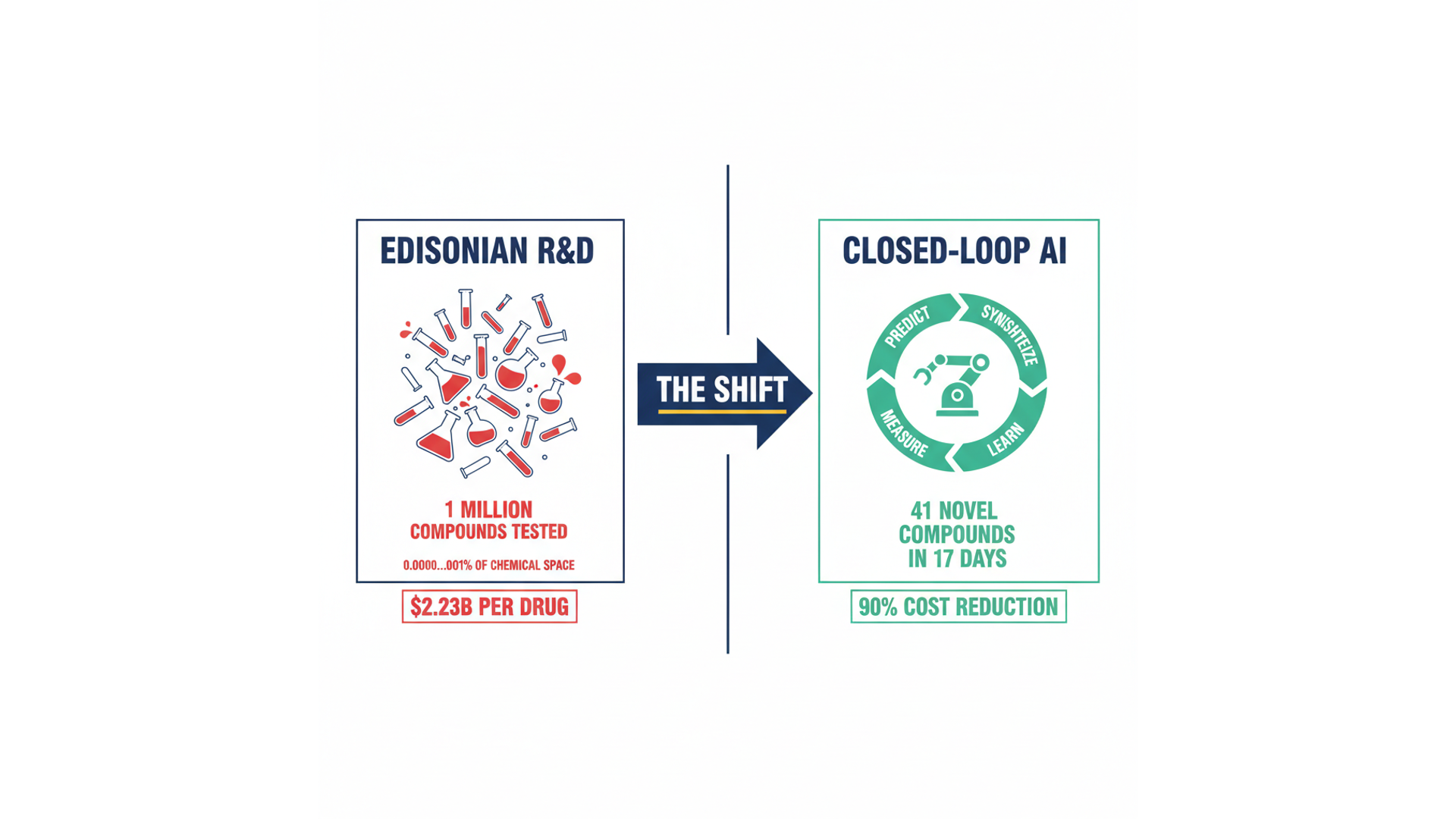
The number of drug-like molecules that could theoretically exist is estimated at 10^60. The number of atoms in the observable universe is roughly 10^80. When I first put those two numbers side by side, I stopped what I was doing and walked out of the room. Because it meant something uncomfortable: the entire pharmaceutical and materials science industry has been searching a space so vast that even screening a billion compounds covers essentially 0% of it. And yet, the dominant method for finding new drugs and materials is still, fundamentally, the one Thomas Edison used to find his lightbulb filament -- try thousands of things and hope one works.
I have spent the last several years building systems at Veriprajna that replace this guesswork with something deterministic -- letting math, not intuition, decide what to test next. Closed-loop AI discovery is not a buzzword. It is a structural shift in how R&D operates, and the economics are not subtle. Cost-Informed Bayesian Optimization -- a technique where an AI model intelligently picks the most promising experiment to run next, instead of testing at random -- has shown the ability to reduce reagent costs by up to 90% while achieving the same results. The question is no longer whether this transition will happen. It is whether your organization will make it in time.
Why Did the Edison Method Hit a Wall?
Thomas Edison tested thousands of carbon filaments to find one that worked. Even Nikola Tesla criticized him for it, noting that "a little theory and calculation" could have saved 90% of the labor. Fair enough in the 1890s. But we are still doing this.
High-Throughput Screening (HTS) -- the modern descendant of Edison's approach -- industrialized trial and error. A standard HTS campaign might test one million compounds. That sounds impressive until you realize it covers 0.000000000000000000000000000000000000000000000000001% of the available chemical space. It is the equivalent of mapping the Pacific Ocean by dipping a teaspoon into the water at random intervals.
The financial consequences are staggering. The cost of developing a new drug has risen to approximately $2.23 billion per asset as of 2024. The internal rate of return for pharma R&D hit a 12-year low of 1.2% in 2022 before recovering to 5.9% in 2024 -- largely driven by outlier successes like GLP-1 agonists (a class of weight-loss and diabetes drugs), not systemic improvement.
If you are testing new materials physically in a wet lab without simulating them first, you are lighting money on fire.
I remember a conversation with my team where someone put it bluntly: "We keep paying for answers to questions we could have eliminated before asking." That framing changed how I thought about the entire problem. The issue is not that experiments fail. The issue is that we run experiments that were destined to fail, and a model could have told us so in milliseconds.
Why Most "AI for Science" Solutions Miss the Point
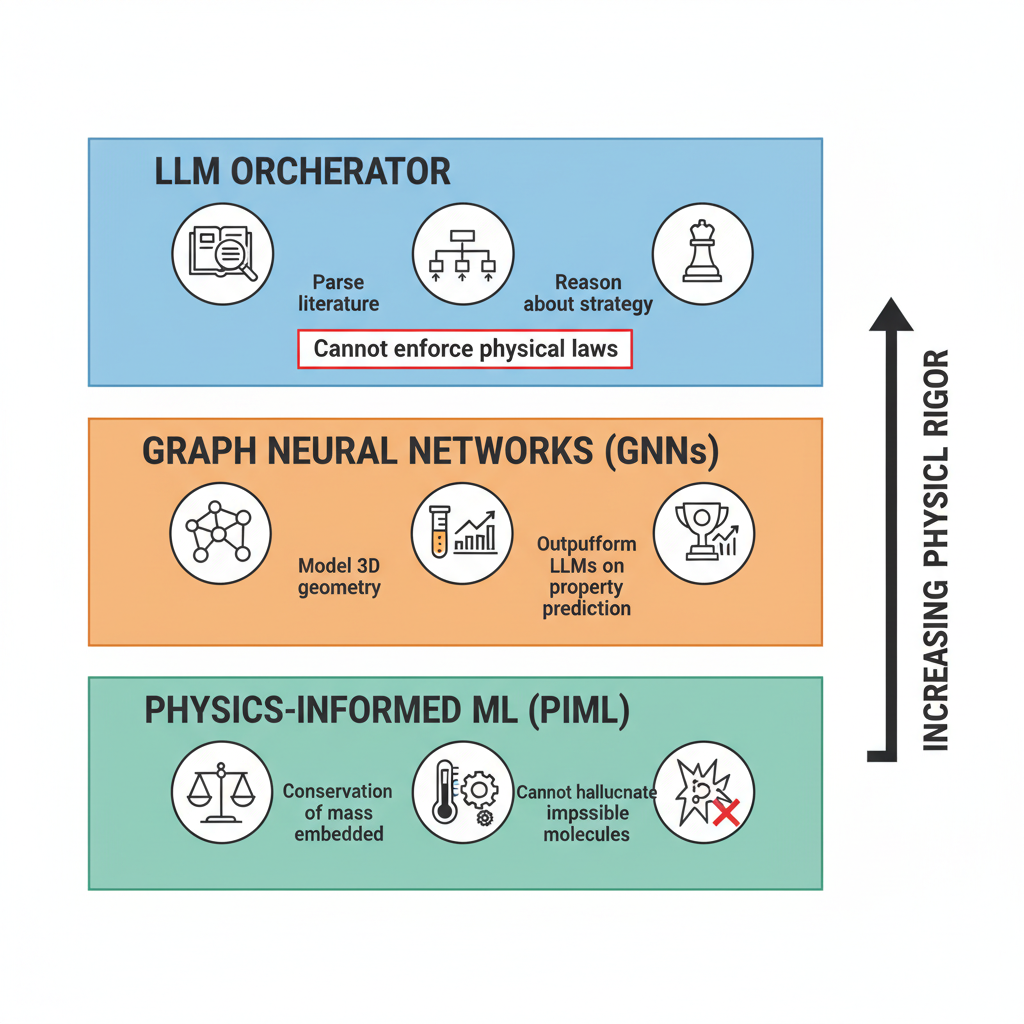
The market is flooded with AI tools that wrap public LLM APIs and call themselves scientific discovery platforms. I understand the appeal -- large language models are powerful reasoning engines. But molecules are not sentences. They are three-dimensional graphs defined by atoms, bonds, chirality (the handedness or mirror-image orientation of a molecule), and electronic properties that do not map linearly to text strings.
When LLMs process molecules, they typically use SMILES notation -- a text-based representation. The problem is that LLMs can generate valid-looking SMILES strings that correspond to chemically impossible structures. They hallucinate molecules the same way they hallucinate facts. Benchmarks consistently show that Graph Neural Networks (GNNs), which explicitly model molecular geometry by passing information between neighboring atoms, outperform LLMs in property prediction tasks.
The architecture my team advocates is hybrid. LLMs serve as the orchestrator -- parsing literature, designing protocols, reasoning about strategy. Specialized GNNs and Physics-Informed Machine Learning (PIML) models do the heavy lifting of molecular design. PIML embeds physical laws like conservation of mass and thermodynamic constraints directly into the neural network. This means the model cannot hallucinate a molecule that violates basic physics. Systems like MIT's FlowER explicitly track electron redistribution during reaction predictions to ensure mass and charge conservation -- something no general-purpose LLM can do.
A wrapper around GPT cannot enforce conservation of mass in a chemical reaction. It cannot navigate a 10^60 search space with Bayesian rigor.
We explored the full technical architecture -- GNNs versus LLMs versus PIML, and where each belongs -- in our interactive analysis.
How Does a Self-Driving Lab Actually Work?
The real breakthrough is not just moving computation upstream. It is closing the loop between prediction and physical verification so the system teaches itself.
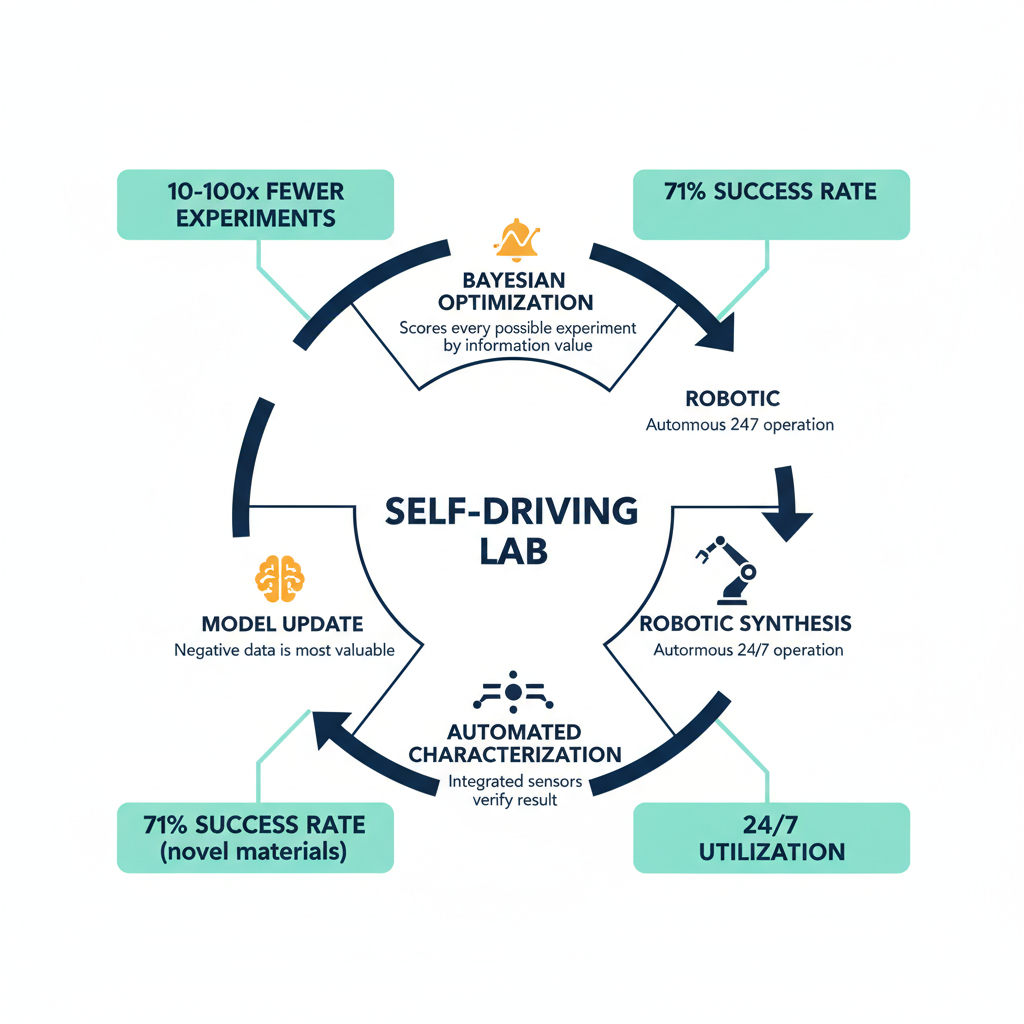
A closed-loop discovery lab -- sometimes called a Self-Driving Lab -- runs a continuous cycle. The AI predicts a candidate material by optimizing an acquisition function -- essentially a scoring formula that ranks every possible experiment by how much useful information it would produce. A robotic platform synthesizes it without human intervention. Integrated sensors characterize the result. That result feeds back into the AI model, which updates its beliefs and selects the next experiment. The cycle repeats, and each iteration makes the model smarter.
The A-Lab at Lawrence Berkeley National Laboratory demonstrated this at scale: 41 novel inorganic compounds synthesized in 17 days, with the AI autonomously correcting its own synthesis recipes when reactions failed. That 71% success rate for novel materials is far beyond what human intuition-driven synthesis achieves.
What powers the decision-making is Bayesian Optimization -- a mathematical framework that uses a probabilistic model (typically a Gaussian Process, which you can think of as a smart interpolation that also estimates its own uncertainty) to balance exploration of unknown regions with exploitation of promising ones. Instead of randomly testing compounds, the system calculates which single experiment will yield the most information, then runs only that one. This is why active learning can find optimal candidates with 10x to 100x fewer experiments than random screening.
The Gold Mine Everyone Throws Away
One realization hit me harder than I expected. In every traditional lab I have visited, failed experiments get buried in notebooks. Nobody indexes them. Nobody learns from them systematically.
In a closed-loop system, negative data is the most valuable data you generate. Failed experiments sharpen the AI's decision boundaries -- to distinguish a viable drug from a non-viable one, the model must know what failure looks like. Negative data also grounds generative models, preventing them from predicting reactions that are thermodynamically impossible. And systematically recorded failures become permanent intellectual property: a map of dead ends that prevents your organization from ever wasting resources on those paths again.
Every failed experiment, properly recorded, is a permanent map that prevents your organization from ever burning money on that dead end again.
When I started treating failure data as an asset rather than a cost, it changed how my team designs experiments. We now optimize for information gain, not just for success.
"This Sounds Expensive to Build"
Fair question. Building a robotic lab requires upfront capital. But the economics flip fast.
Traditional HTS is operationally expensive -- consumables, reagents, and personnel time dominate costs. Active learning slashes the number of physical experiments needed, often by an order of magnitude. Cost-Informed Bayesian Optimization explicitly factors the price of each experiment into its decision-making: if two experiments offer similar information, it picks the cheaper one, reducing optimization costs by up to 90%.
On the capital side, autonomous equipment runs 24/7 at near-100% utilization, compared to 30-40% in human-staffed labs. The return on assets is structurally higher.
The time savings are equally dramatic. AI-first biotechs like Exscientia have moved small molecules from concept to Phase I clinical trials in roughly 12 months -- versus the industry average of 4-5 years. Insilico Medicine took an AI-discovered fibrosis candidate from target discovery to preclinical status in under 18 months. These are not projections. These are results.
For the full technical methodology behind multi-fidelity optimization and cost-informed strategies, see our detailed research.
"Can't We Just Hire More Chemists?"
You can. But you are solving a math problem with labor, and the math does not care how many people you throw at it. A thousand chemists screening compounds randomly will still cover a negligible fraction of chemical space. The bottleneck is not headcount. It is strategy.
What surprised me most in building these systems is how the role of scientists changes. They do not become obsolete -- they become more effective. Instead of spending 80% of their time on routine synthesis and characterization, they focus on designing the search strategy, interpreting unexpected results, and asking better questions. The lab becomes an instrument of their intelligence rather than a test of their patience.
What This Means If You Run an R&D Organization
The transition from Edisonian to closed-loop is not a technology upgrade. It is a structural change in how discovery economics work.
The most immediate thing you can do is dig up your negative data. If failed experiments are sitting unindexed in lab notebooks, you are discarding your most valuable training data -- digitize it, structure it, and feed it into your models. Beyond that, stop physically testing any compound that has not first passed through a computational filter. Physics-informed surrogate models can screen candidates in milliseconds, and every experiment you skip saves real money.
You also do not need a fully autonomous lab to start seeing returns. Even applying Bayesian optimization to your existing experimental workflow -- letting the model pick the next experiment instead of a human hunch -- can cut your experimental budget dramatically.
The Edisonian era served us well. It gave us the lightbulb, penicillin, and lithium-ion batteries. But the search spaces we face now are too vast for intuition. The organizations that figure this out first will not just save money. They will discover things that brute force never could.
I would genuinely like to hear from anyone wrestling with this transition -- what is working, what is not, and where the real friction lives.