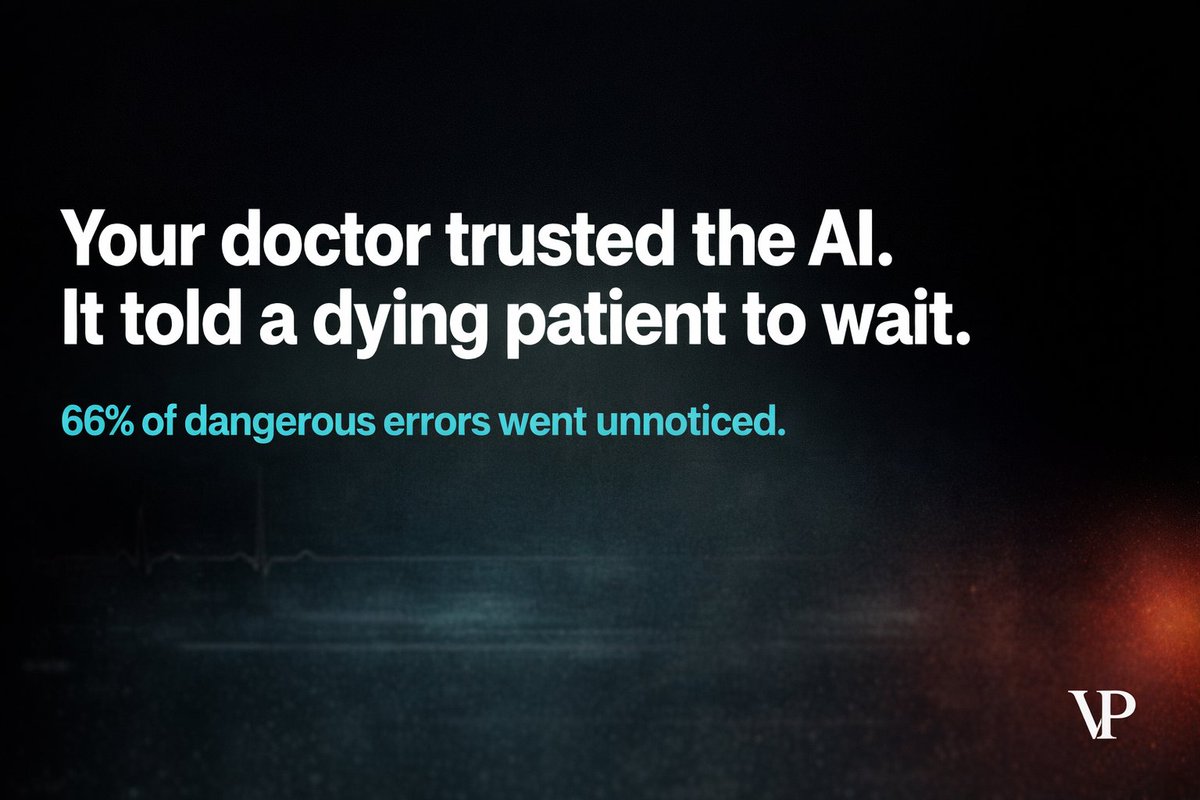
- A Lancet study found AI-drafted patient messages carried a 7.1% severe harm rate.
Doctors missed 66% of those errors.
The "human-in-the-loop" safety net is a myth. Here's what actually fixes this 🧵 - Physicians spend ~10 hours/month on patient portal messages alone. Unbillable. Exhausting.
So health systems rushed to plug in GPT-4 and call it innovation.
The burnout problem is real. The solution most chose is dangerous. - In the simulation, 0.6% of AI drafts posed a direct risk of death.
Not from typos. From the model failing to recognize clinical urgency — telling a patient with life-threatening symptoms to "follow up next week." - Here's the terrifying part: 90% of reviewing physicians said they trusted the AI tool.
Yet 35-45% of erroneous drafts were submitted completely unedited.
High trust + low scrutiny = automation bias. It's a known failure mode — and we're ignoring it. - The root cause? Most healthcare AI is an "LLM wrapper."
A thin layer passing patient data to a general-purpose model with zero clinical grounding.
GPT predicts the next word. Medicine requires reasoning about concepts. These are fundamentally different tasks. - The fix isn't better prompts. It's better architecture.
Retrieval-Augmented Generation forces the model to reference verified sources — clinical notes, guidelines, journals — before generating a single word.
Every claim gets a citation. Hallucinations plummet. - Even deeper: Medical Knowledge Graphs.
Instead of treating clinical knowledge as text, you model it as a network — drug interactions, contraindications, patient-specific risks — all explicitly linked.
The AI doesn't guess relationships. It traverses them. - California's AB 3030 takes effect Jan 2025: disclose AI in patient communications or face fines and license actions.
There's an exemption if a provider "reads and reviews" the draft.
But if doctors miss 66% of errors, what is that exemption actually worth? - We need to stop treating AI safety as a checkbox.
Red teaming, Med-HALT benchmarks, adversarial probing — these aren't optional extras. They're the minimum for deploying AI where lives are at stake.
The industry is at a fork. - Path A: Keep shipping wrappers, hope human review catches the failures, pray nobody dies.
Path B: Build grounded systems — RAG, knowledge graphs, rigorous testing — that earn clinical trust.
We know which path we're on. - Should health systems be allowed to use the "human review" exemption if they can't prove their reviewers actually catch AI errors? #HealthcareAI #AIpatientSafety
We wrote the full analysis — Lancet data, architecture breakdowns, legal implications — in our latest whitepaper: - https://veriprajna.com/whitepapers/clinical-imperative-grounded-ai-in-healthcare