The Chip That Looked Wrong Was the Best One We Ever Saw

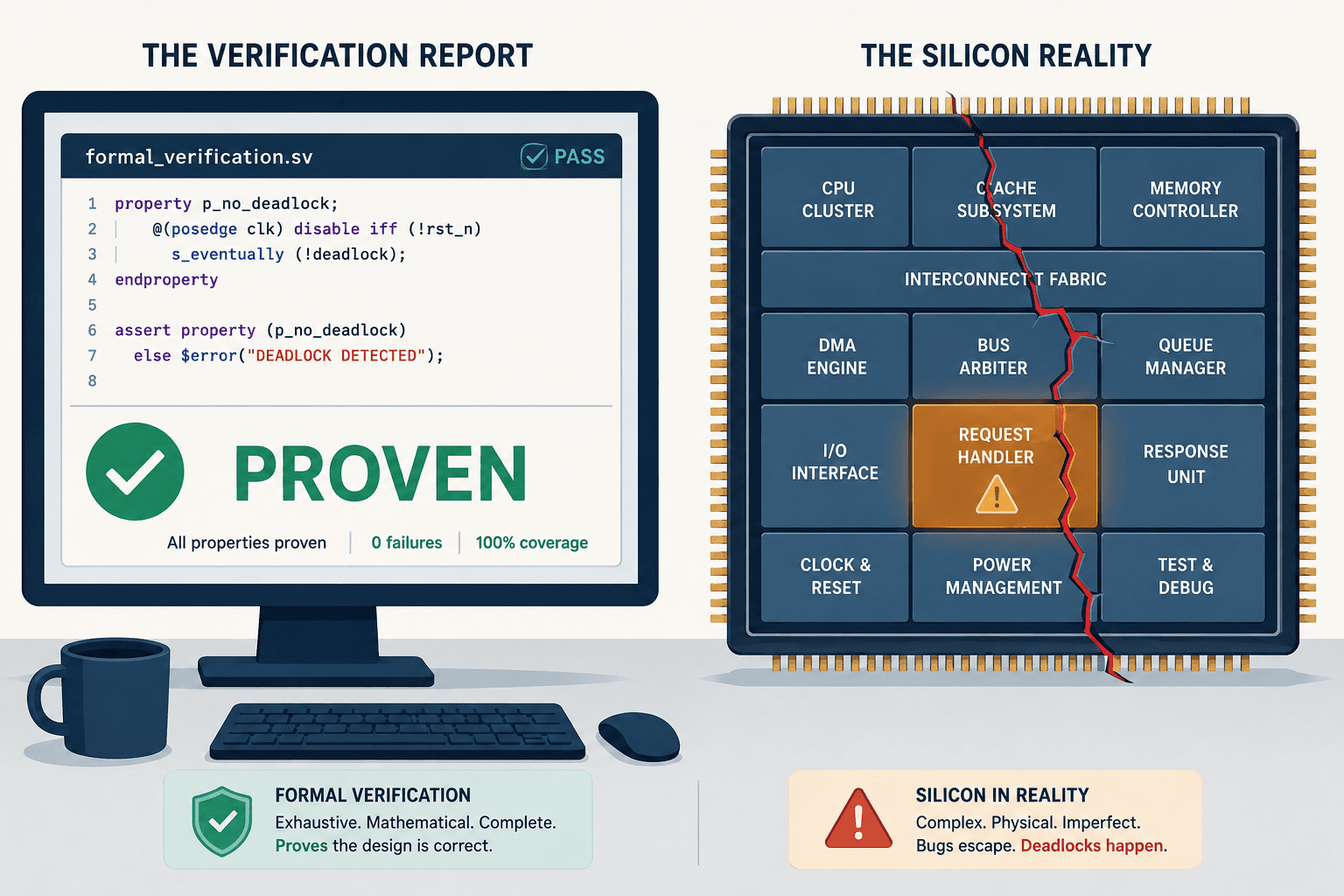
I was staring at a chip floorplan on my monitor at 2 AM, and my first instinct was that something had gone horribly wrong.
The memory macros were scattered like someone had sneezed on the canvas. The logic clusters formed amorphous blobs that violated every design principle I'd internalized over years of studying silicon architectures. There were no neat columns, no symmetrical rows, no recognizable "Manhattan" grid — just what looked like organized chaos.
Then I ran the simulation. Wire length: down significantly. Congestion: almost nonexistent. Timing closure: cleaner than anything our team had produced with conventional tools. The layout that looked broken was, by every physical metric that actually matters, better.
That was the moment I understood — viscerally, not just intellectually — that the era of human-intuitive chip design is ending. And that the company I was building, Veriprajna, was pointed at exactly the right problem. Because Moore's Law isn't dying from a lack of physics breakthroughs. It's dying from a lack of imagination. And reinforcement learning has imagination that we don't.
Why Did Moore's Law Actually Stop Working?
The popular narrative is simple: transistors can't get smaller. And that's partially true — at 3nm and 2nm process nodes, you're fighting quantum tunneling, leakage currents, and thermal physics that make every additional shrink exponentially harder and more expensive.
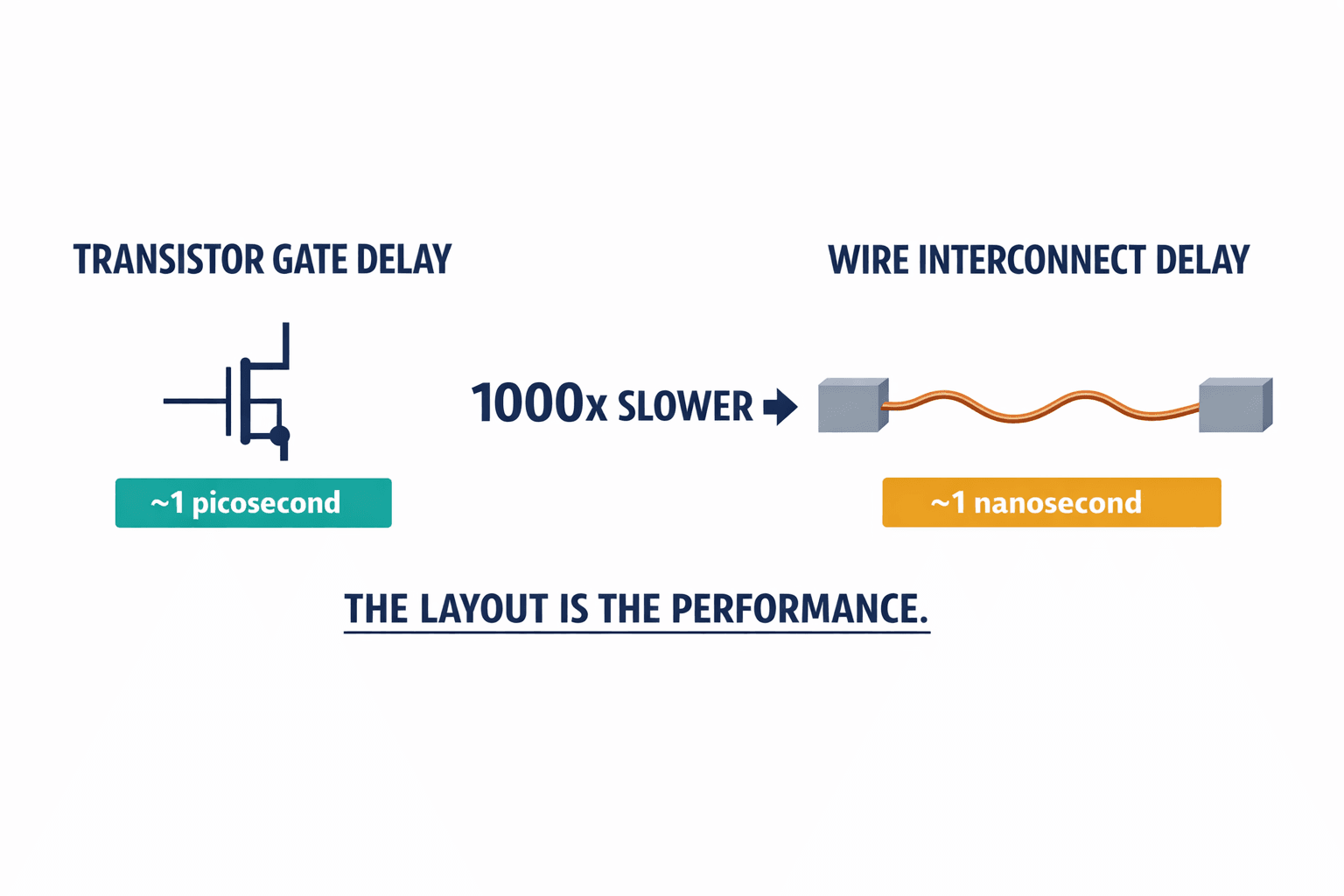
But here's what most people miss: the transistor isn't the bottleneck anymore. The wire is.
In modern chips, a signal can cross a logic gate in picoseconds. But traveling through the tiny copper interconnects that link components together? That takes nanoseconds — orders of magnitude longer. The resistance and capacitance of those microscopic wires now dominate both delay and power consumption. Which means the geometric arrangement of components on the chip — the floorplan — has become the single most important factor in how fast and efficient that chip will be.
A poor floorplan cannot be rescued by faster transistors. The layout is the performance.
This is the part that hit me hardest when we started digging into the research. For decades, the industry treated floorplanning as a downstream task — important, but secondary to the heroics of lithographic shrinking. Now that shrinking has stalled, floorplanning is the whole game. And the tools we've been using to play it are from the 1980s.
The 40-Year-Old Algorithm Running Your Phone
I need to tell you about Simulated Annealing, because understanding its limitations is understanding why AI matters here.
Simulated Annealing — SA for short — is the workhorse algorithm behind chip placement in most commercial Electronic Design Automation (EDA) tools. It was developed in the 1980s, inspired by the metallurgical process of heating and slowly cooling metal to remove defects. The algorithm randomly shuffles components around, gradually "cooling" to settle on a solution.
It sounds elegant. In practice, it has two fatal problems.
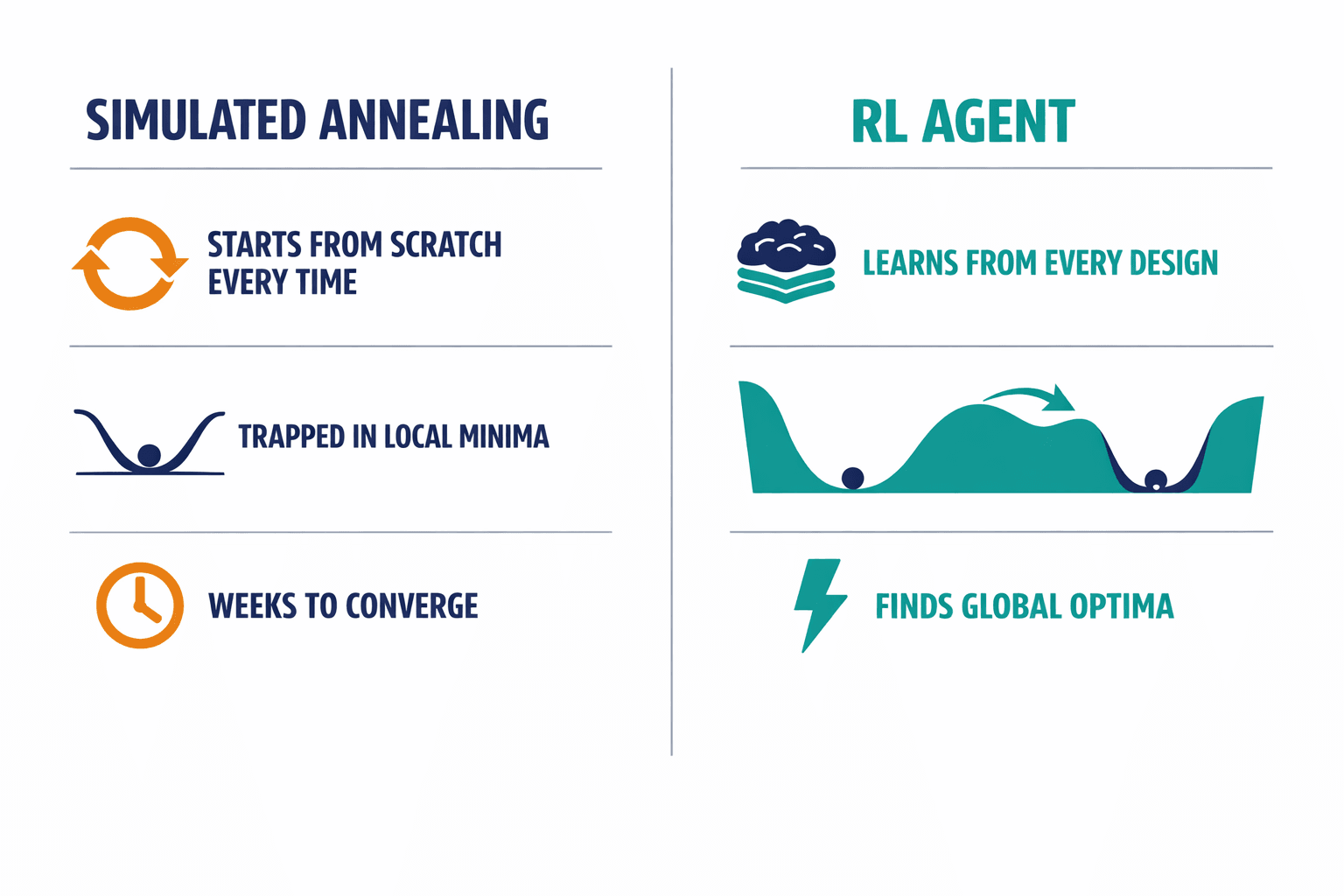
First, it's memoryless. Every time you run SA on a new chip, it starts from scratch. It learned nothing from the last chip it designed, or the one before that. Imagine if every time a chess player sat down at the board, they forgot every game they'd ever played. That's SA.
Second, it gets trapped. The optimization landscape for a modern chip — billions of transistors, thousands of constraints, conflicting objectives for power, performance, and area — is a rugged terrain full of valleys and ridges. SA finds a valley and sits in it, unable to perceive that a far deeper valley exists just over the ridge. It settles for "good enough" because it literally cannot see "great."
I remember a conversation with a veteran physical design engineer — twenty-plus years in the industry — who told me, with visible frustration: "I spend three weeks after every SA run manually moving macros to fix what the tool got wrong. I'm the cleanup crew for an algorithm that hasn't fundamentally changed since I was in college."
That's the cognitive ceiling. Not just the tool's limitations, but the human cost of compensating for them. Teams of expert engineers spending weeks hand-tuning layouts, burning months of calendar time and millions in salaries, because the optimization engine at the core of their workflow is architecturally incapable of finding the best answer.
What If Chip Design Were a Game?
This is the reframe that changed everything for me.
In 2021, Google published a paper in Nature describing AlphaChip — a deep reinforcement learning agent that treats chip floorplanning not as an optimization problem, but as a game. The board is the silicon die. The pieces are the netlist components — memory blocks, logic clusters, I/O interfaces. Each move is placing a component at a specific coordinate. The score is a composite of the physical qualities of the final layout: wire length, congestion, timing, thermal density.
The agent plays this game millions of times. And it learns.
Not rules of thumb. Not heuristics. It learns a policy — a deep, pattern-matched intuition for where things should go, developed through raw experience with the physics of the cost function. It learns that placing memory controllers near I/O reduces latency. It learns that certain clustering patterns for arithmetic units minimize congestion. No human programmed these insights. The agent discovered them because it was rewarded for doing so.
I wrote about the technical architecture behind this — the Edge-based Graph Neural Networks, the Markov Decision Process formulation, the reward functions — in our interactive whitepaper. But the detail that stopped me cold wasn't the math. It was the transfer learning.
When Google pre-trained the agent on a diverse set of chip blocks — TPU cores, memory controllers, PCIe interfaces, open-source RISC-V designs — the agent didn't just get good at those specific chips. It developed general principles of floorplanning. When presented with a completely new, unseen TPU block, it didn't start from zero. It started with intuition. And it converged to a superhuman layout in hours, not weeks.
Simulated Annealing forgets everything after every run. The RL agent gets smarter with every chip it designs.
That's not an incremental improvement. That's a different species of tool.
The Alien Layouts That Actually Work
Here's where the story gets genuinely strange.
Human chip designers favor what the industry calls "Manhattan" layouts — neat rectilinear grids, memory blocks in orderly columns, logic in rectangular regions. We design this way because our brains need visual order to manage complexity. The grid isn't optimal for electron flow; it's optimal for human comprehension.
RL agents don't have that constraint. Their fidelity is to the physics, not to aesthetics. And the layouts they produce look, frankly, alien. Macros scattered in irregular clusters. Logic clouds with no discernible geometric pattern. The kind of arrangement that would get a junior engineer called into their manager's office.
But when you simulate these alien layouts, they consistently outperform the human designs. The "chaos" is actually a higher form of order — a hyper-optimization that minimizes the actual Euclidean distance of critical signal nets in ways that rigid human geometry cannot achieve.
I had an argument with a member of my team about this early on. He looked at one of these layouts and said, "This is a hallucination. The agent is confused." I said, "Run the timing analysis." He did. Zero negative slack paths. The agent had found a solution that was physically superior in every measurable dimension but aesthetically incomprehensible to a trained engineer.
That's the moment we started calling this the "defibrillator" effect. Moore's Law didn't die because we ran out of physics. It stalled because we ran out of human design imagination. The RL agent injects non-intuitive, physics-optimal vitality into a process that had been trapped in human cognitive patterns for decades.
Who's Already Using This — and What Are the Results?
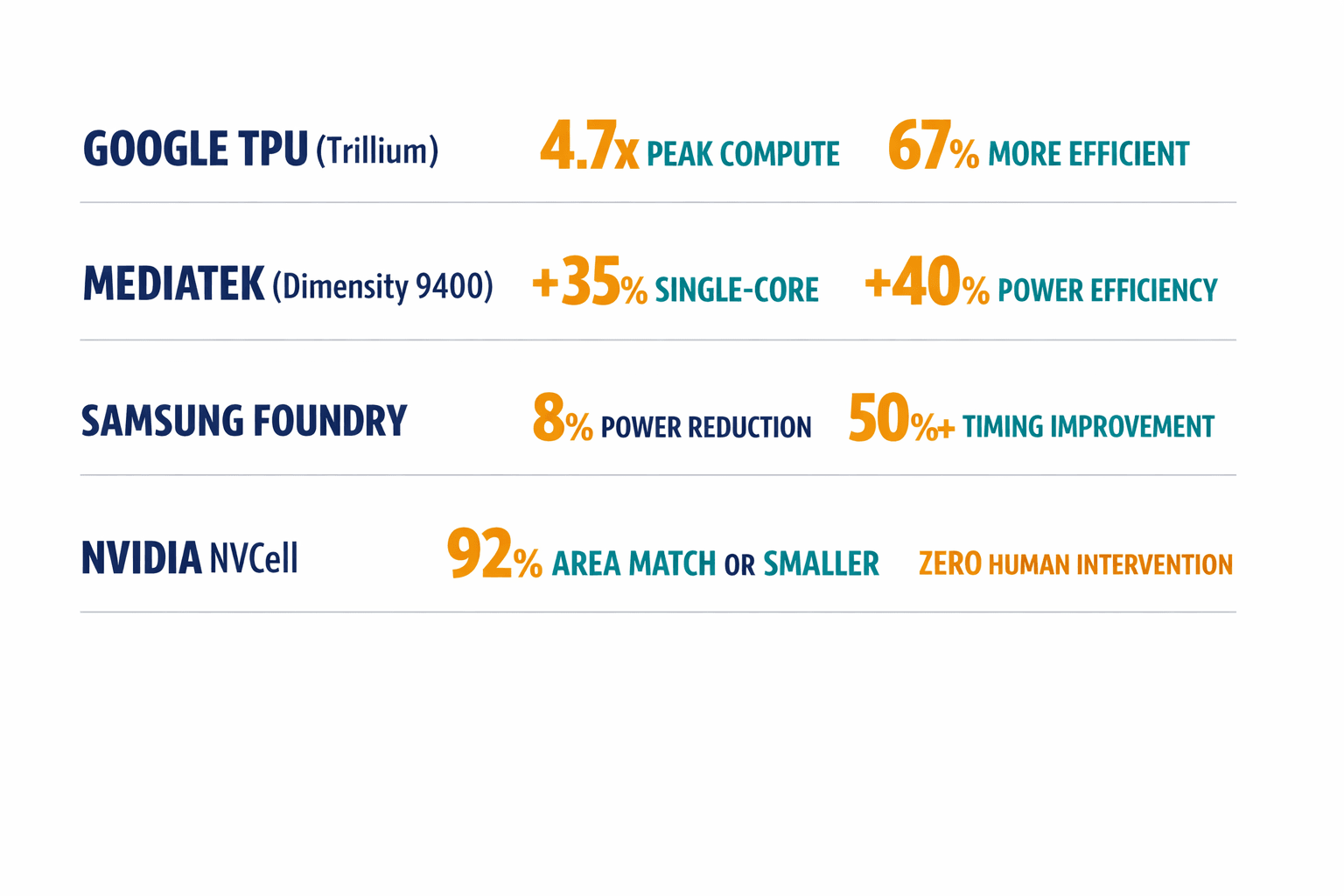
Google's internal results with AlphaChip are striking. Across multiple generations of TPU design — v5e, v5p, and the latest Trillium generation — the agent was used on an increasing proportion of design blocks. Google reports that AlphaChip contributed to a 4.7x increase in peak compute performance and a 67% improvement in energy efficiency in the Trillium TPUs compared to the previous generation.
But the validation that matters most for the broader industry came from MediaTek.
MediaTek is a merchant fabless semiconductor company — they don't have Google's infinite compute budget or captive chip program. They sell into the brutally competitive Android smartphone market, where a 5% battery life improvement or a 2% die size reduction determines whether you win or lose a design socket. When MediaTek adopted RL-based floorplanning for their Dimensity 9400 SoC and reported +35% single-core performance, +40% power efficiency, and 2x AI compute at 33% less power, the industry took notice. MediaTek executives explicitly credited their "smart EDA" and RL algorithms for enabling the floorplans that delivered these numbers — specifically the optimized placement of L3 cache and memory controller hierarchies.
Samsung Foundry has reported using similar AI-driven flows to reduce power by 8% on critical blocks and improve timing by over 50% — in weeks rather than months. Professors from Harvard, NYU, and Georgia Tech have cited the AlphaChip approach as a "cornerstone" of modern chip design research.
This isn't a lab curiosity. It's production silicon shipping in millions of devices.
What Happens at the Microscopic Level?
The RL revolution doesn't stop at macro placement. It goes fractal — all the way down to the atomic units of digital design.
NVIDIA's NVCell framework applies reinforcement learning to standard cell layout — the internal arrangement of transistors and wiring inside the basic building blocks like NAND gates and flip-flops. At 3nm and 2nm nodes, the design rules for these cells are excruciatingly complex. NVCell generates layouts that are 92% smaller or equal in area to hand-crafted expert designs, with zero human intervention.
The compounding effect here is enormous. If you shrink the standard cell library itself, every chip built with that library gets smaller and more efficient. It's a multiplicative advantage that propagates through the entire design ecosystem.
For the full technical breakdown of the architecture — including the Edge-GNN formulations, the MDP state spaces, and the routing frontier — see our research paper.
Why Can't You Just Buy This From Synopsys?
People ask me this constantly. Synopsys has DSO.ai. Cadence has Cerebrus. Aren't the incumbents already solving this?
Here's the distinction that matters: those tools optimize the knobs on existing engines. They don't replace the engine.
Synopsys DSO.ai is a design space exploration tool — it runs the standard placer many times with different parameter settings and picks the best result. Cadence Cerebrus uses ML to optimize the RTL-to-GDSII flow steps. Both are valuable. Neither generates fundamentally novel layouts. They're tuning an internal combustion engine. We're building an electric motor.
Deep RL for chip design means the agent is the placer. It doesn't configure a legacy algorithm; it makes the placement decisions directly, millions of them, guided by a learned policy trained on the physics of the design. That's how you get alien layouts. That's how you escape the local minima that have trapped the industry for decades.
The difference between AI-assisted EDA and AI-native EDA is the difference between a GPS that suggests routes and a self-driving car.
The incumbents will get there eventually — they have to. But right now, there's a window where the companies that build deep RL capability into their design flows gain a structural advantage that compounds with every chip generation.
The Trust Problem No One Talks About
I'd be dishonest if I didn't address the hardest part of this transition, and it's not technical. It's cultural.
A veteran engineer with two decades of experience looks at an alien layout and asks: "Why did the agent put the clock divider there? Is this a hallucination?" That question is legitimate. In an industry where a single flawed tape-out can cost tens of millions of dollars, "trust the black box" is not an acceptable answer.
We spent months building what I think of as the explainability layer — dashboards that don't just show the final layout but visualize the agent's reward trajectory. Sensitivity maps that reveal which constraints — congestion, timing, thermal — drove specific placement decisions. When an engineer can see that the "weird" clock divider placement was a calculated response to a congestion hotspot three routing layers up that they hadn't noticed, the conversation shifts from "I don't trust this" to "show me what else it found."
This is the real work of bringing AI into chip design. Not the algorithms — those are published. Not the compute — that's a credit card problem. The real work is earning the trust of the people who've been doing this brilliantly, by hand, for their entire careers. You don't do that by telling them they're obsolete. You do it by showing them what they couldn't see.
The Dirty Data Problem
The other barrier nobody talks about is data. RL agents are hungry. Google had the luxury of a unified repository of every TPU ever designed. Most semiconductor companies have legacy designs scattered across servers, in different file formats — LEF/DEF, GDSII — with inconsistent naming conventions and incomplete documentation.
At Veriprajna, a significant part of what we build is the data infrastructure: ingesting legacy design files, cleaning and normalizing them, converting them into training datasets. A company's history of tape-outs — every design decision, every timing fix, every congestion workaround from the last decade — becomes a competitive asset when it's structured properly. We call it the Corporate Brain, and it's the moat that makes transfer learning work for enterprises that aren't Google.
What the Post-Moore Era Actually Looks Like
Here's my conviction, stated plainly: if we can't make transistors much smaller, we have to arrange them much smarter. That's the new scaling law. Not lithographic scaling. Complexity scaling. And the only tool capable of navigating the combinatorial explosion of modern chip design is an intelligence that learns, remembers, and transfers knowledge across designs.
The elite design team of the future isn't fifty engineers doing manual layout. It's five engineers guiding a fleet of RL agents on a GPU cluster, reviewing alien layouts that outperform anything a human could draw, and building the institutional knowledge base that makes each successive chip better than the last.
Moore's Law didn't die from a failure of physics. It stalled from a failure of design imagination. Reinforcement learning is the imagination we were missing.
I've watched this transition from close enough to feel the resistance and the excitement in equal measure. The engineers who embrace it aren't the ones who were bad at their jobs — they're the best ones, the ones who always knew the tools were holding them back. They look at an alien layout and don't see chaos. They see the answer they were always searching for, rendered in a geometry their hands could never have drawn.
The board is set. The pieces are moving. It's time to let the agent play.