Most Flood Damage Happens Outside the Flood Zone — and It's Quietly Wrecking Your Loss Ratio

The first time I understood how badly flood underwriting was broken, I was looking at a single house on an aerial map.
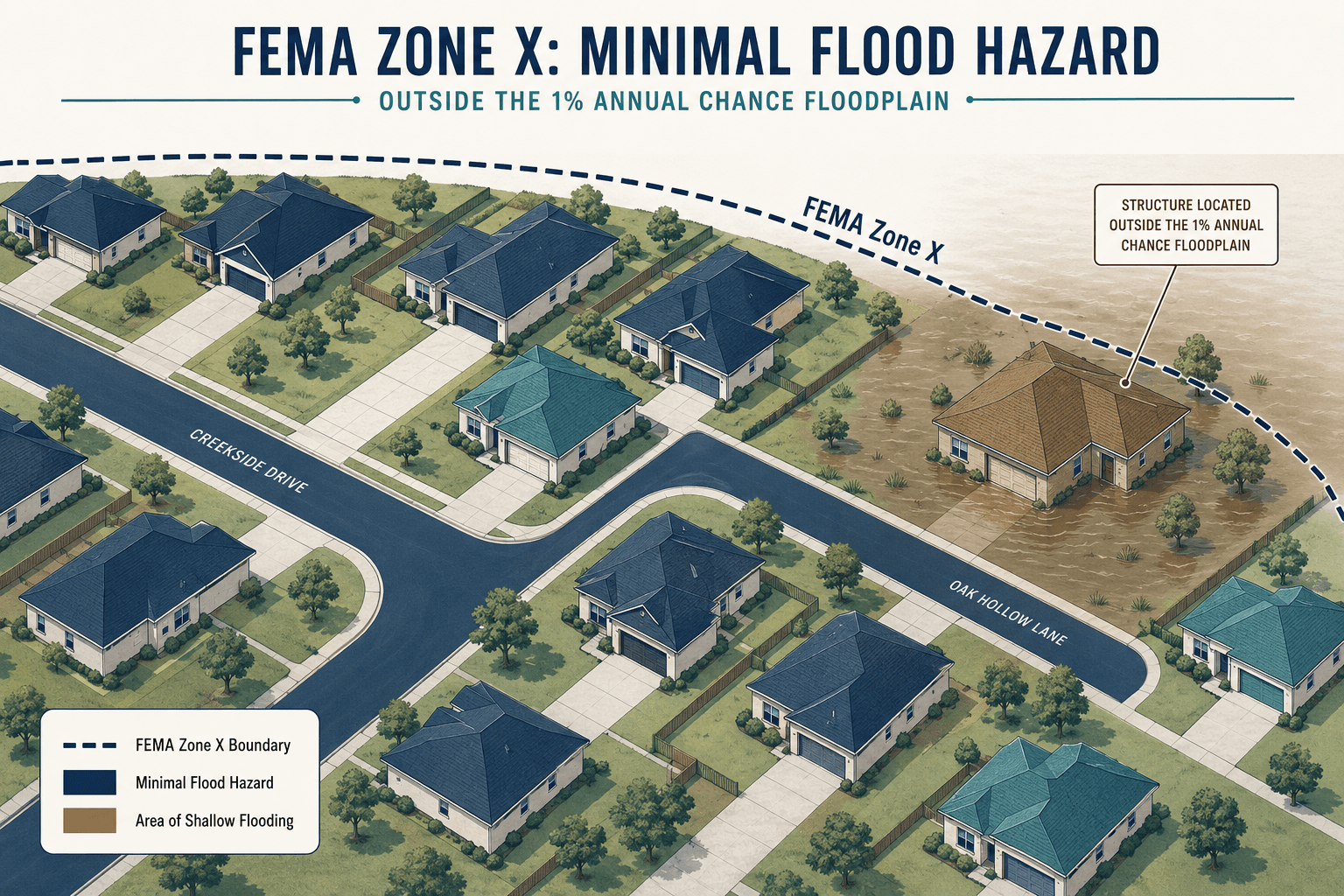
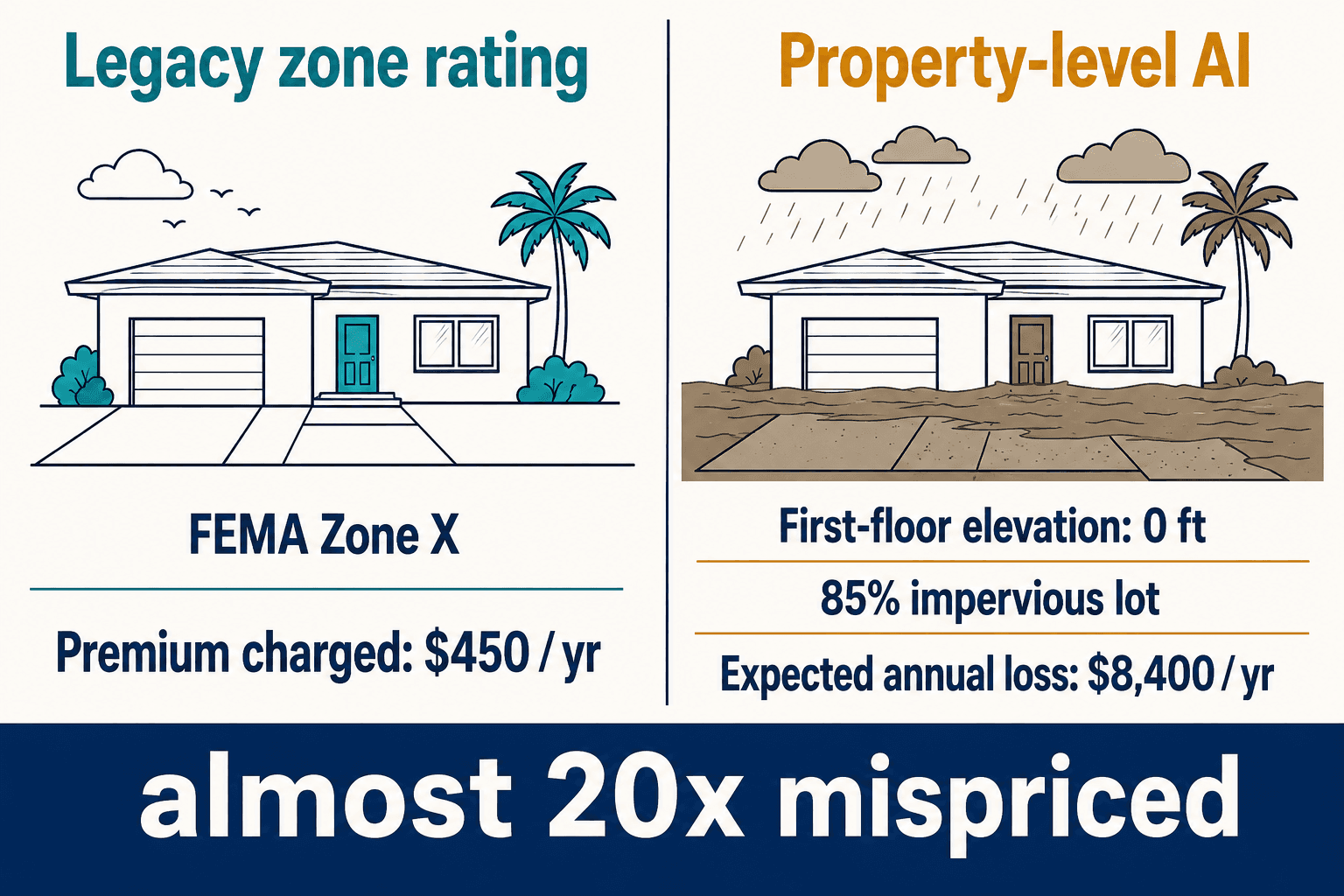
A single-family home in Harris County, Texas. Built 2004, on a slab, no elevation above grade. The lot was 85% impervious surface — concrete driveway, patio, a detached garage — and the nearest storm drain was 400 feet away, part of a municipal system designed thirty years ago for a 10-year rainfall event. FEMA called it Zone X. Minimal flood hazard. No mandate to insure it.
The rating engine quoted that house a flood premium of $450 a year. Property-level analysis put its expected annual loss at $8,400.
That gap — almost twenty to one, on a property the map insists is safe — is the whole problem with flood risk underwriting in one parcel. And it is not a rare parcel. More than two-thirds of US flood damage, 68.3% by the NC State and First Street research, occurs outside FEMA's high-risk zones. If your rating plan still anchors to Zone AE versus Zone X, you are mispriced on both sides of the line: overcharging the elevated house inside the zone, and quietly giving away the slab-on-grade house just outside it.
The flood zone map is not a risk model. It's a regulatory boundary that the rest of the industry has mistaken for one.
I want to walk through what we found when we tried to fix this, including the part where our first fix failed in front of a regulator — because that failure is the reason the thing we eventually built looks the way it does.
Why Is Most Flood Damage Outside the Flood Zone?
Start with why the maps are wrong, because it's worse than "maps go stale."
Roughly 75% of FEMA's flood maps are more than five years old, and a meaningful slice date to the 1970s and 80s. They were drawn primarily for fluvial and coastal flooding — rivers jumping their banks, storm surge coming off the coast. They were never built to capture pluvial flooding: rainfall that falls faster than the ground and the storm drains can move it. Pluvial is the fastest-growing loss driver in the country, and it is almost invisible on a FEMA panel.
That Harris County house floods pluvially. Four inches of rain an hour onto an 85%-impervious lot generates more than twice the runoff of its neighbors, into a system built for an inch and a half. None of that is on the map, because the map isn't asking the question.
The consequences aren't theoretical. After Hurricane Harvey, 70% of flood claims came from outside the FEMA high-risk zones — from the Zone X homes everyone's rating engine had quoted as an afterthought. Harris County alone holds 1.2 million properties in Zone X. The carriers who had flagged the wet ones before the storm carried materially lighter catastrophe loss ratios that year — high single to low double digits, by my own reckoning of the books I saw. Everyone else found out at first notice of loss.
And the structural pressure is only building. The homeowners line is running a projected 106.1% combined ratio for 2025 — paying out more than a dollar of loss and expense for every dollar of premium — and AM Best expects the broader P&C combined ratio to climb toward 96.9 in 2026. Globally, insured natural-catastrophe losses hit $107 billion in 2025. Flood is the peril where the gap between what's happening and what's priced is widest: of roughly $325 billion in global flood economic losses over five years, only about $70 billion was insured.
You cannot close a 106% combined ratio with a map drawn before the neighborhood was poured.
What I got wrong first
Here is the part I'm not proud of.
When my team first dug into this, the answer looked obvious. The market was full of property-intelligence vendors with genuinely good models. ZestyAI builds computer-vision scores — Z-FLOOD, Z-FIRE, Z-WIND — off aerial imagery and building permits, and they were signing carriers fast: in the first quarter of 2026 alone they added Logic Underwriters in Texas, Southern Oak in Florida, Harford Mutual, Horace Mann, and more. The scores work. The carrier network is real.
So our first version was simple: license a vendor flood score, pipe it into the rating engine as a new factor, ship it. A weekend's integration work dressed up as a product.
We took that to a state filing. The examiner's response came back with a single margin note next to our shiny new flood factor: "explain this factor."
We couldn't. Not to their standard. A vendor model card — the one-page "here's roughly what the model considers" document — satisfies a vendor's marketing team. It does not satisfy a Colorado or New York examiner, who wants an actuarial memorandum, a disparate-impact study, and an explainability trail before an AI-derived rating factor goes effective. The NAIC's AI Model Bulletin has been adopted in 24-plus states, and New York's DFS Circular 2024-7 explicitly requires testing for disparate impact. Property condition correlates with income; a computer-vision score that reads "deferred maintenance" as risk can quietly encode something a regulator will call bluelining. The opacity that makes a vendor score easy to buy is exactly what makes it hard to file.
We hadn't built an underwriting capability. We'd bought a number we couldn't defend.
That filing bouncing was the most useful thing that happened to us, because it reframed the whole problem. The hard part of flood risk underwriting in 2026 isn't getting a score. There are excellent scores for sale. The hard part is turning a score into a rating factor a regulator will approve — and that is engineering and documentation work no vendor does for you, because they're selling the score, not your rate plan.
Every vendor solves a slice. Nobody solves the seam.
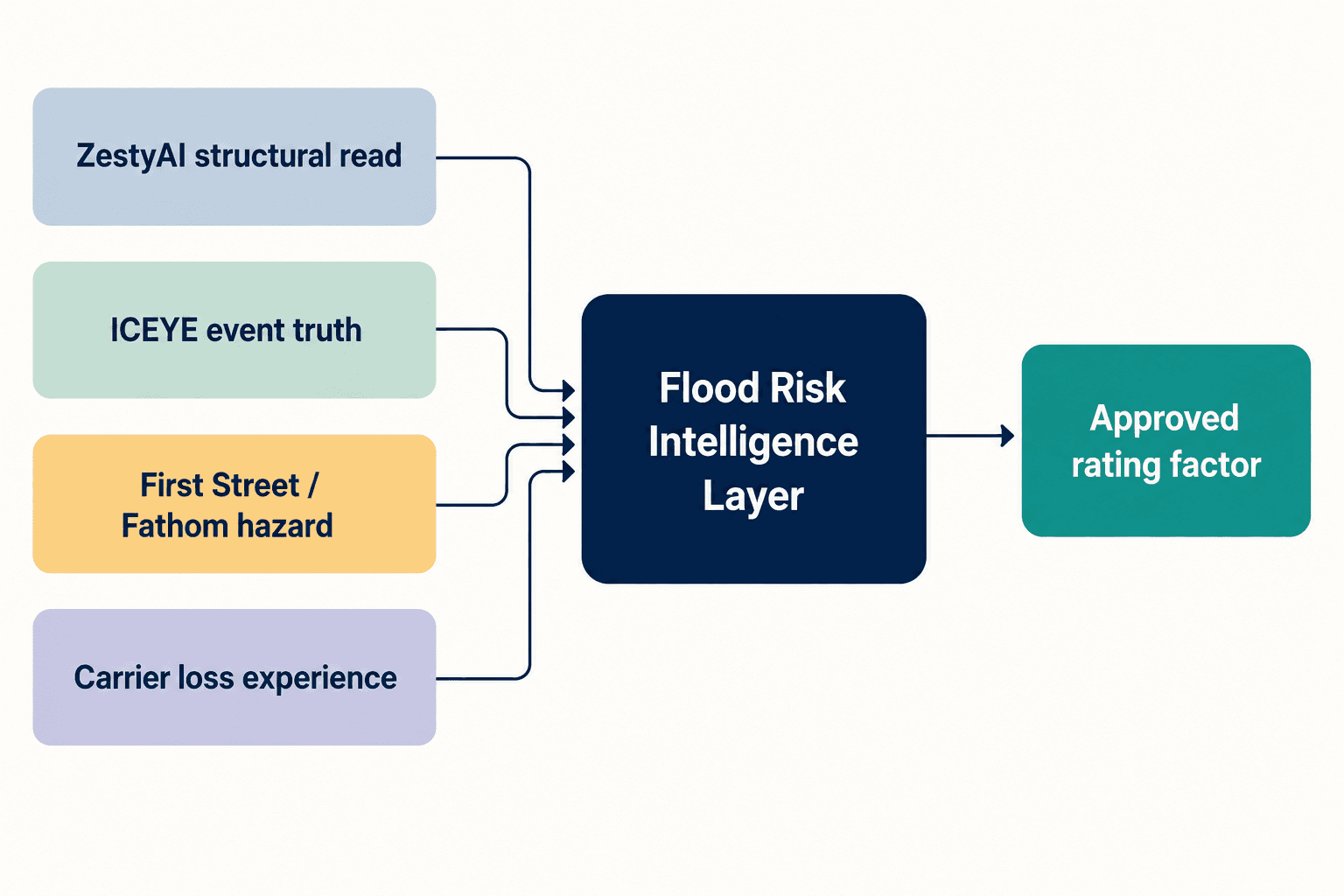
Once you see it that way, the landscape rearranges itself. Each provider owns one slice of the picture and leaves the seams to you.
ZestyAI gives you sharp property-level computer vision, but its scores are largely static — they don't model the storm-drain capacity under that Harris County lot, and they don't fire when an actual event is unfolding. ICEYE flies the world's largest synthetic-aperture-radar satellite constellation — 30-plus satellites that can see flood extent through clouds and update a heatmap every six hours during an event, which is why Munich Re and AXA built it into their platforms in 2026. First Street's Flood Factor scores every US property 1 to 10 and, crucially, does include pluvial hazard — but it's a hazard layer, not a structural-vulnerability model, and it isn't accepted as a regulatory rating factor. Fathom, now inside Swiss Re, builds 50,000-year probabilistic event sets that are superb for forward-looking climate scenarios and awkward if you reinsure with anyone but Swiss Re. Verisk's Flood Score 3.0 carries the deepest DOI familiarity and the slowest innovation cycle.
I'll save you the full roll call. The pattern is the point: the property-intelligence layer, the satellite layer, the hazard layer, and your own claims history each live in a different silo, and no vendor stitches them into one defensible factor — because doing so would mean documenting a competitor's model inside your filing.
The seam is where the money is. A carrier doesn't want six dashboards; it wants one rating factor that fuses ZestyAI's structural read, ICEYE's event truth, First Street or Fathom's pluvial hazard, and the carrier's own loss experience — and an actuarial memorandum that explains all of it to an examiner. That fusion is what we decided to build, and what now sits at the center of our flood risk intelligence layer: not another score, but the connective tissue and the paperwork that turn point solutions into an approved rating plan.
Can a Satellite Tell You Where It Will Flood?
The second thing I got wrong was assuming the satellite data was the easy win.
SAR is genuinely magic — radar that sees through cloud and darkness and tells you, building by building, how deep the water got. The demos are seductive. So we pulled raw ICEYE feeds and started wiring them into a claims-triage pipeline, expecting to overlay flood extent on a book of 50,000 policies and route adjusters automatically.
Then reality. SAR is observation-only — it tells you what flooded, not what will — and in dense urban terrain it carries roughly ±15cm of depth uncertainty from radar double-bounce off walls and pavement. Raw SAR isn't a claims workflow. It's a noisy signal that needs a custom pipeline: cleaning the double-bounce artifacts, fusing depth with each policy's first-floor elevation, deciding which 30 of 50,000 policies an adjuster calls first, flagging the ones whose reported damage doesn't match the observed water. That pipeline is the product. The satellite is an input.
And first-floor elevation — how high the living space sits above grade — turns out to be the hinge of the whole structural question, and it's estimable from imagery to about 0.218 meters of error, per Penn State's work. That Harris County house had a CV-derived first-floor elevation of zero. The front door was at ground level. No map encodes that; a vision model can.
"Why don't you just buy ZestyAI?"
People ask me a version of this constantly, usually framed as: the scores already exist, the satellites already fly, why is there anything left to build?
Because a score is not a rate plan, and a rate plan is not a deployment. What sits between them is the work.
Start with the regulator. Filing an AI-augmented rating algorithm means producing the actuarial memorandum, the disparate-impact analysis, and the explainability documentation that the NAIC bulletin and NY DFS demand — for a model that fuses multiple vendor inputs. Vendors hand you scores; they don't hand you filing-ready documentation, and the EU AI Act's auditable-documentation requirements landing in August 2026 only sharpen that gap.
Then there's the plumbing, which is brutally concrete. A flood score is worthless to an underwriter if it arrives too late. I've watched a quote-to-bind trace where the flood-score API call sat at 480 milliseconds — and sub-500ms is the wall. Past it, the score doesn't get fetched, the underwriter quotes off the old factor, and your expensive intelligence layer is a line item nobody uses. Getting model outputs into Guidewire or Duck Creek with proper caching, fallback handling, and that latency budget is specialized work. The broader agentic-AI shift in insurance makes the prize obvious — Hiscox cut a quote-to-bind from three days to three minutes, a 99.4% reduction — but you only get there if the data plumbing holds.
And even a fast, defensible score has to fit your book. An off-the-shelf model is trained on everyone's. A mid-size carrier writing coastal Florida homeowners and one writing inland Texas commercial have completely different loss patterns — on a commercial book, a single Zone X warehouse with its loading dock at grade can swamp the year the way a hundred scattered homeowner claims never would — and a model tuned to neither will be mediocre for both. The carriers pulling ahead are training to their own book.
Anyone can buy the score for the price of a contract. What you can't buy is the part that survives an examiner, clears a 500-millisecond budget, and fits the book you actually wrote.
The market is already repricing without you
If there's urgency in this, it's competitive, not regulatory.
The private flood market has been compounding at a 20% CAGR from 2020 to 2024, with 140-plus private insurers now writing flood and roughly $500 million in private residential premium in 2024. That growth isn't random — it's sophisticated carriers using property-level models to cream-skim. They identify the genuinely-low-risk homes the NFIP overprices under Risk Rating 2.0 (where 77% of policyholders now pay more, and a Congressional letter in February 2026 urged FEMA to halt the program), write those at a profit, and leave the adverse-selected remainder behind.
The asymmetry should worry any carrier still pricing flood off the zone: the cream-skimmers aren't taking your bad risks. They're taking your good ones — the elevated, well-drained homes your coarse rating overcharges — and leaving you a book increasingly concentrated in the wet Zone X houses you underpriced. You don't feel it as a single bad day. You feel it as a loss ratio that drifts the wrong way every renewal while you wonder why your retention is best on exactly the policies you'd most like to lose.
When I model it on a book of 50,000 southeast-Texas homeowners, the mispriced Zone X pattern alone pencils out to $2.8 to $4.2 million in annual premium leakage — 30 to 40 properties generating six figures of claims each against $450 premiums. That's the cost of the map being wrong, every year, before the next Harvey.
What I actually believe now
I went into this thinking flood underwriting was a data problem — get better data, get better prices. I came out convinced it's a seam problem. The data exists. The satellites fly. The computer vision reads first-floor elevation to within eight inches. What doesn't exist, off the shelf, is the thing that fuses those inputs into one factor, gets it under 500 milliseconds into the rating engine, and hands a state examiner a memorandum that survives the margin note "explain this factor."
That's the layer worth building, and it's why we built ours around integration and documentation rather than around yet another score.
The map will keep saying Zone X. The slab-on-grade house with the 85%-impervious lot and the undersized storm drain will keep flooding anyway. The only question is whether your rating engine knows the difference before the water does — or whether you find out, like everyone did after Harvey, from the claims that came in from the places the map said were safe.