Your Flood Insurance Price Is Based on a Map from 1987. Here's What Should Replace It.

Last year, I sat across from a senior underwriter at a mid-size P&C carrier in the Southeast. He had a map pinned to the wall behind him — literally pinned, with thumbtacks — showing FEMA flood zones for a coastal county his team was writing heavily. I asked when the map was last updated.
He laughed. "That map is older than most of my analysts."
He wasn't exaggerating. The map was from 1992. And he was using it — alongside some light zip code averaging — to price flood risk for thousands of homes in a region where three major hurricanes had reshaped the coastline, where new subdivisions had paved over wetlands, and where drainage infrastructure was designed for a rainfall intensity that no longer represents reality.
That conversation haunted me. Not because the underwriter was incompetent — he was sharp, experienced, and deeply aware of the problem. But because the tools available to him were from a different climate era, and the industry had no clear path to replace them.
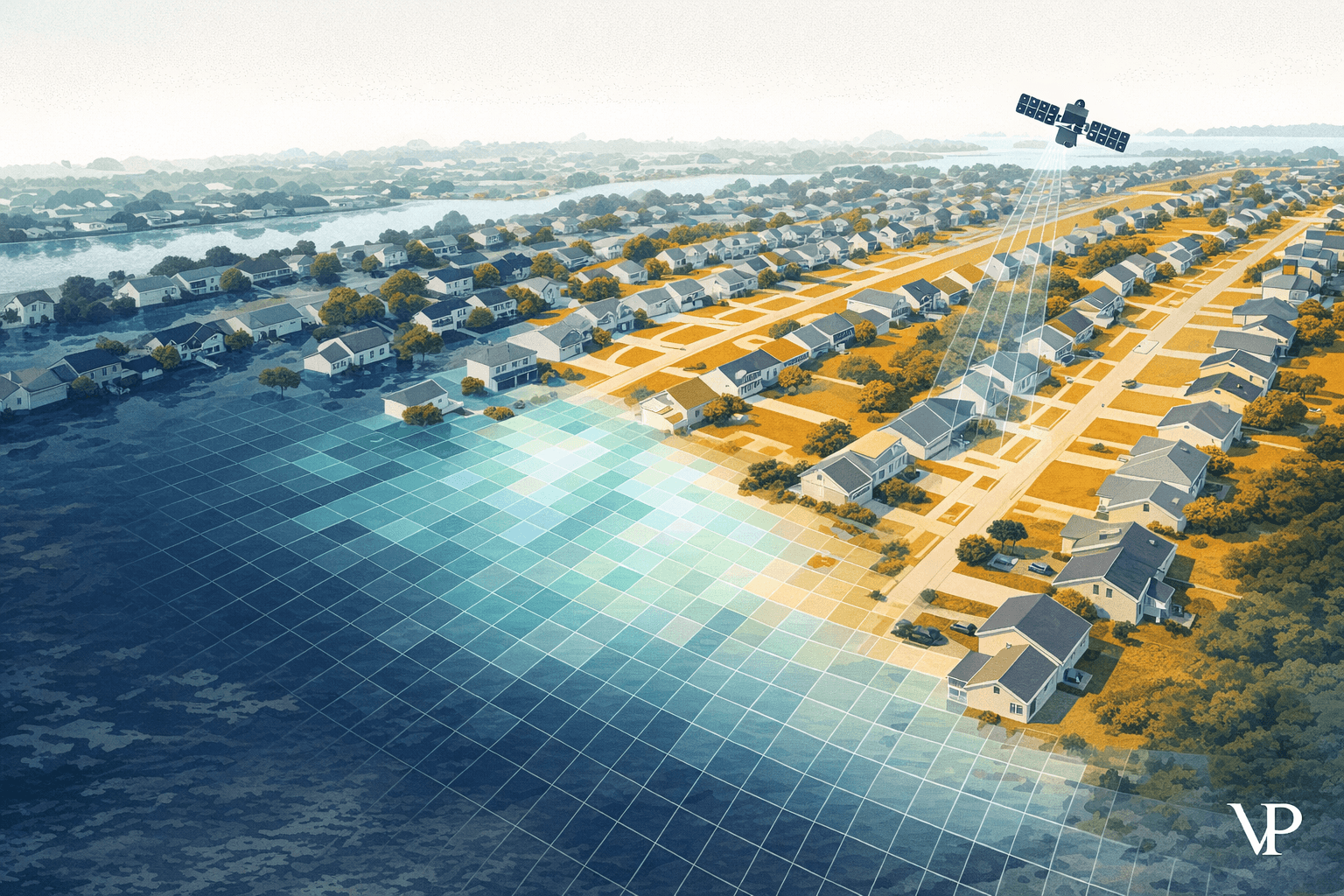
That's what led my team at Veriprajna to spend months researching what we now call "Deep AI" for flood underwriting — a convergence of computer vision, satellite radar, and physics-informed machine learning that can assess flood risk at the level of an individual building, not a zip code. I wrote an interactive overview of the full research here, and the deeper I got into it, the more I became convinced that this isn't a nice-to-have upgrade. It's a solvency question.
The Map That Lies to You
Here's the thing about FEMA flood maps that most people — including many insurance professionals — don't fully appreciate: they were never designed to be underwriting tools.
The "100-year flood" concept, which anchors the entire National Flood Insurance Program, represents a 1% annual chance of flooding. Sounds rare. But run that probability over a 30-year mortgage and you get a 26% chance of experiencing a "100-year flood" during the life of the loan. That's not a tail risk. That's a coin flip with slightly better odds.
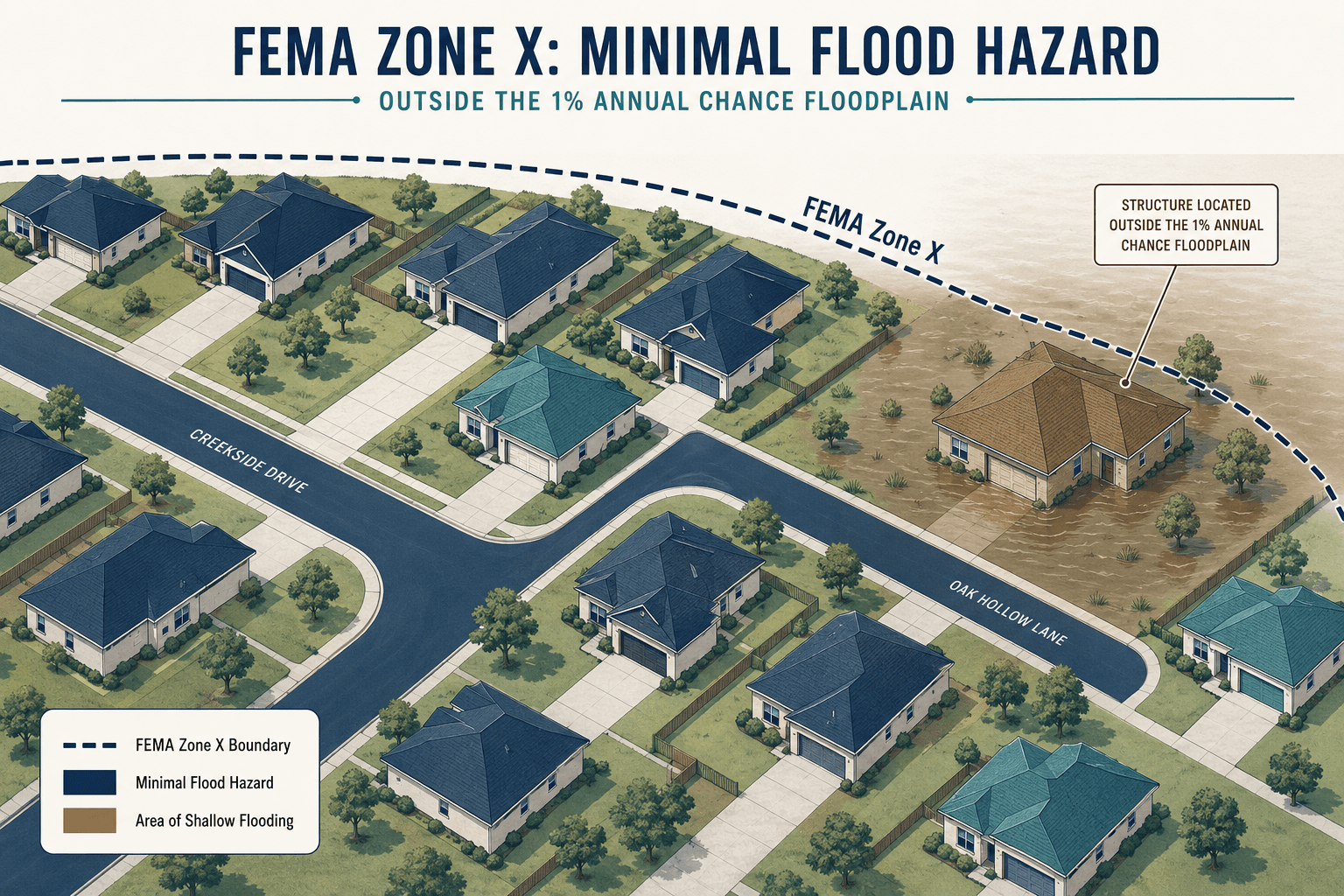
The maps themselves are worse than the concept. Roughly 75% of FEMA flood maps are more than five years old. Some date to the 1970s and 1980s. They don't account for new construction that altered drainage patterns. They don't account for climate change intensifying rainfall. And they create what I've started calling the "cliff effect" — a binary line where a home one foot inside the Special Flood Hazard Area pays thousands for mandatory insurance, while a home one foot outside is classified as minimal risk.
Water doesn't care about lines on a map.
Nearly 68% of flood damage reports occur outside FEMA's designated high-risk flood zones. The maps aren't just outdated — they're systematically misleading.
The result is a market built on bad information. Less than 4% of American homeowners carry flood insurance. Not because they're reckless, but because the maps told them they were safe.
Why Does 68% of Flood Damage Happen Outside "Flood Zones"?
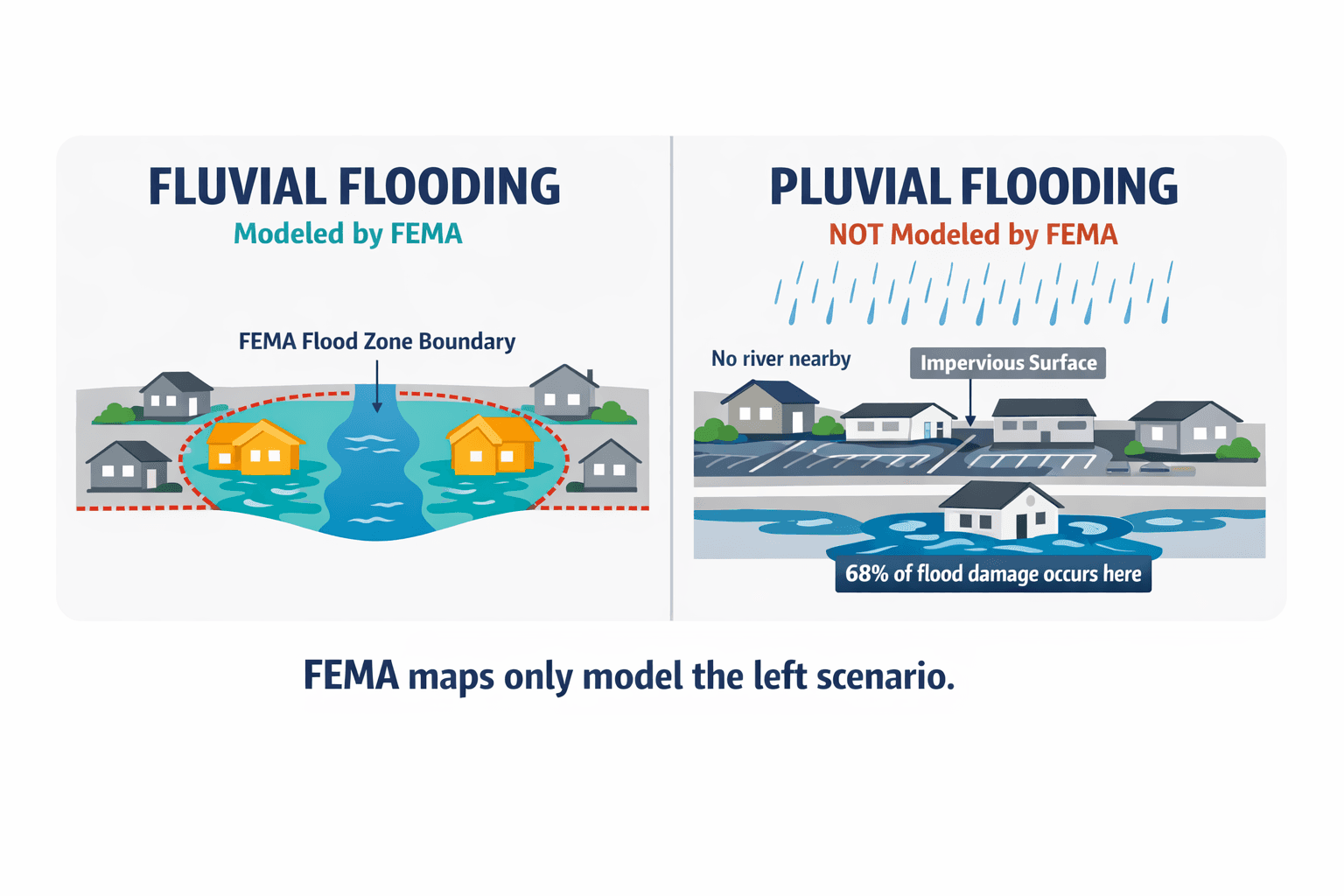
This was the statistic that stopped me cold when I first encountered it in the research. If you'd asked me to guess before I saw the data, I might have said 20%, maybe 30%. But 68%? That means the majority of flood losses are invisible to the system that's supposed to predict them.
The answer is a word most people outside hydrology have never heard: pluvial flooding.
FEMA maps model rivers overflowing their banks (fluvial flooding) and coastal storm surge. They do not model what happens when six inches of rain falls in two hours on a neighborhood where every driveway, parking lot, and rooftop is impervious surface. The water has nowhere to go. It pools. It finds the lowest point — which might be someone's sunken living room three miles from the nearest river.
I remember my team arguing about this over a late call. One of our researchers, who'd been deep in the urban hydrology literature, kept insisting that micro-topography — the subtle slope of a street, whether a driveway dips toward the garage or away from it — matters more than proximity to a river for pluvial events. I pushed back. It sounded too granular to be meaningful at portfolio scale.
He pulled up damage data from Houston after Harvey. Block by block, the losses were wildly uneven. Houses on the same street, in the same zip code, with the same FEMA designation — one flooded, one didn't. The difference was often a few inches of elevation or a neighbor's retaining wall.
That's when I understood: zip code averaging isn't just imprecise. It's a fundamentally wrong unit of analysis for flood risk.
The Eight-Inch Revolution
If there's a single variable that determines whether a flood is a nuisance or a catastrophe, it's the First Floor Elevation — the vertical distance between the ground and the lowest habitable floor of a building.
The numbers here are staggering. Raising a home's first floor by just one foot above the base flood elevation can reduce the Average Annual Loss by approximately 90%. One foot. That's the difference between a property that's a ticking time bomb and one that's eminently insurable.
And yet, this number is almost never in the underwriter's file. Public tax records don't capture it. Elevation Certificates are expensive manual documents. Legacy models just guess — assuming, say, that every home in a region has a standard one-foot crawlspace.
This is where computer vision changes everything.
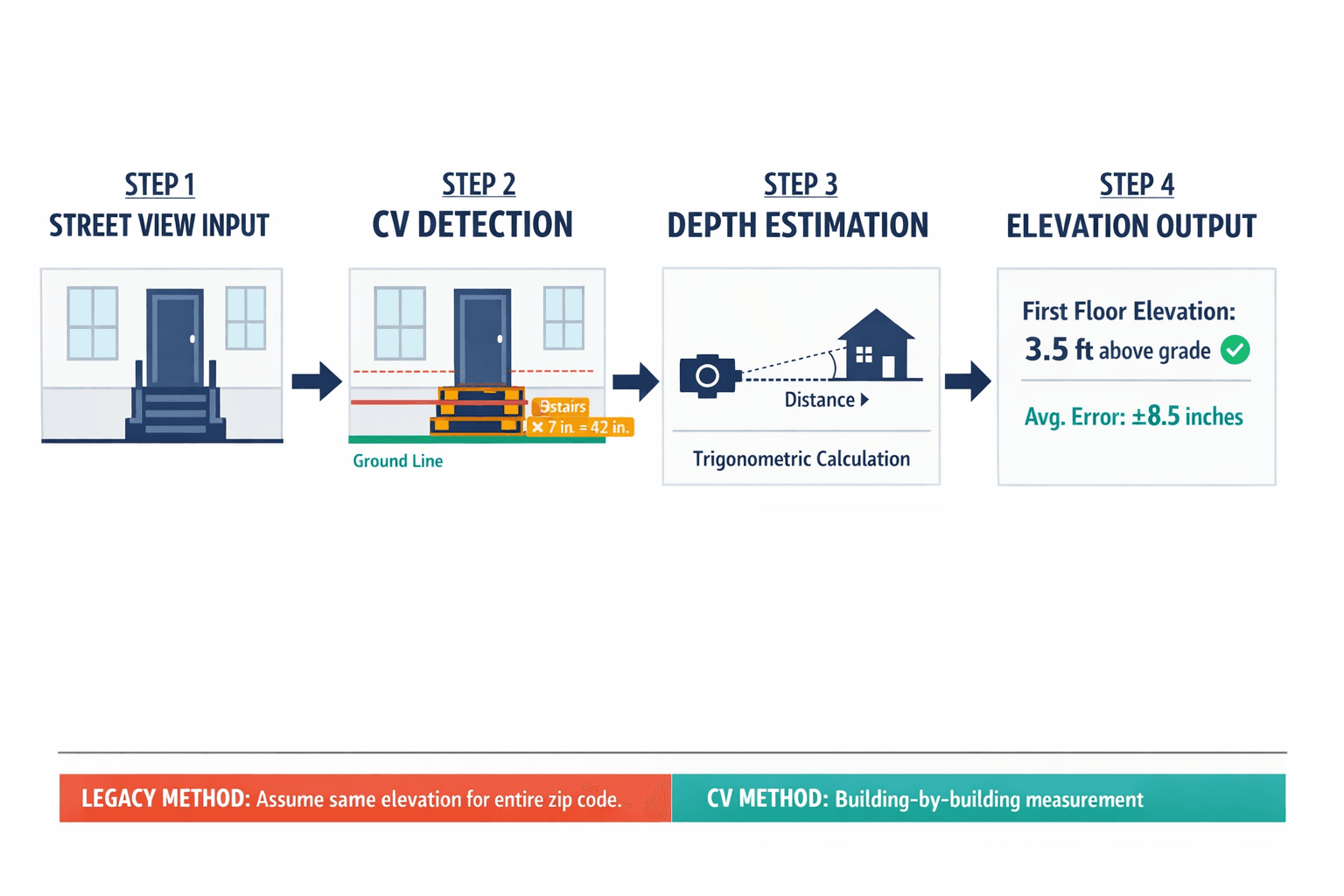
My team spent weeks studying how neural networks can extract first floor elevation from Google Street View imagery. The process is elegant in a way that surprised me. A convolutional neural network looks at a street-level photo of a house and identifies the ground line, the front door threshold, the stairs. It estimates depth from the camera to the facade. Then it applies basic trigonometry — camera height, pitch angle, pixel position — to calculate the physical height of the entrance above street level.
There's even a beautifully simple backup method: counting stairs. Building codes specify a standard riser height of about 7 inches. Six steps to the front door? That's roughly 42 inches of first floor elevation. A CV model can count stairs across millions of properties without anyone leaving their desk.
Neural networks trained for lowest floor elevation estimation have achieved average errors of just 0.218 meters — about 8.5 inches. That's centimeter-level precision, at continent-wide scale, without a single site visit.
When I first saw that error margin, I did a double-take. Eight and a half inches of average error, derived from a photograph taken by a car driving past. Compare that to the legacy approach of assuming every house in a zip code has the same elevation profile. It's not even the same sport.
What Happens When You Can See Through Clouds?
Flood underwriting has a cruel irony: the moment you most need to see what's happening on the ground — during a flood — is exactly when optical satellites go blind. Floods come with clouds and rain. Cameras can't see through either.
Synthetic Aperture Radar doesn't care about clouds.
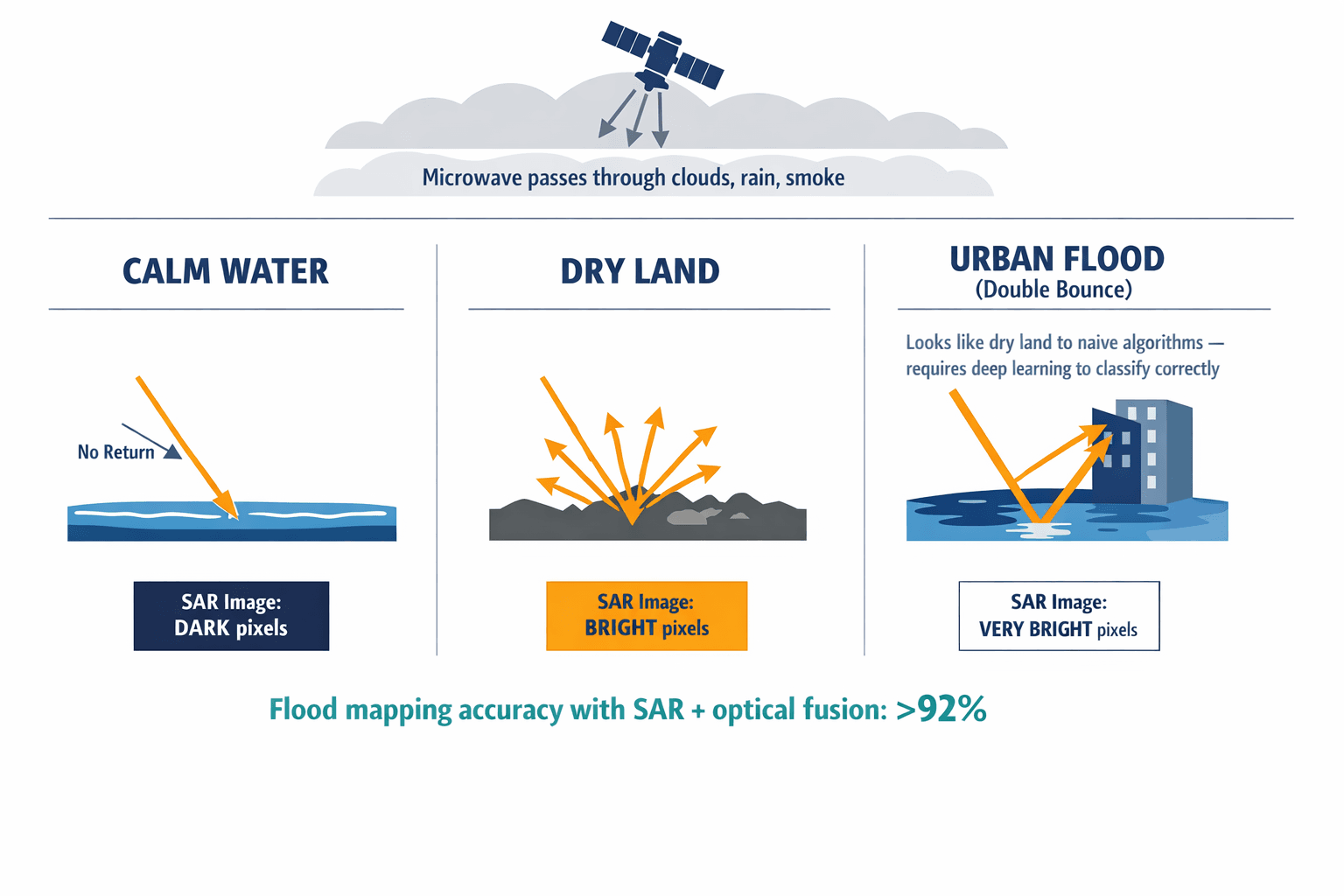
SAR satellites transmit microwave pulses that pass through cloud cover, smoke, and heavy rain, then measure the energy that bounces back. Calm water acts like a mirror — it reflects the radar signal away from the satellite, showing up as dark pixels in the image. Dry land scatters the signal back, showing up bright. The contrast gives you a flood map, through any weather, day or night.
I'll admit that when I first encountered SAR data, I found it alien. It doesn't look like a photograph. It's grainy, speckled, and unintuitive. But once you understand what it's showing you, it's extraordinary — an all-weather eye that can map a flood's exact footprint within hours of an event's peak.
The complexity comes in cities. Urban flooding creates a phenomenon called "double bounce" — radar hits the water surface, bounces off a building wall, and returns to the satellite with high intensity. To a naive algorithm, this looks like dry land. It takes deep learning models specifically trained on these interference patterns to correctly identify urban inundation. Traditional threshold-based approaches fail here consistently.
When you fuse SAR with optical data — using the radar for all-weather coverage and optical imagery for spectral confirmation — classification accuracy exceeds 92% even in complex urban landscapes.
Why Can't Standard AI Just Predict Floods?
This is a question I get constantly, and it reveals a fundamental misunderstanding about what machine learning can and can't do.
A standard deep learning model trained on historical flood data learns patterns. It might learn that properties near rivers flood more, that certain soil types correlate with higher losses, that spring is worse than fall. And for events that look like the training data, it performs reasonably well.
But floods are getting worse in ways that have no historical precedent. A purely data-driven model encountering a storm intensity it's never seen before will either extrapolate wildly or default to something conservative and wrong. Worse, it might generate physically impossible predictions — water appearing without a source, or flowing uphill.
A neural network that's never seen a 500-year storm will hallucinate when it encounters one. Physics doesn't hallucinate.
This is why Physics-Informed Neural Networks — PINNs — represent the most important architectural advance in flood modeling. A PINN isn't just trained to match historical data. It's simultaneously trained to obey the laws of fluid dynamics: conservation of mass (water doesn't appear from nowhere) and conservation of momentum (water flows downhill, respecting gravity and friction).
The technical implementation is deceptively simple in concept. The network's loss function has two components: how well it matches observed data, and how badly it violates the governing physics equations. Penalize the physics violations during training, and you get a model that's both data-informed and physically constrained.
The practical payoff is enormous. PINNs need far less training data because the physics equations constrain the solution space. And they generalize to unprecedented events because the underlying physics don't change — a 500-year storm follows the same fluid dynamics as a 10-year storm, just with different inputs.
For the full technical breakdown of how these architectures work together, including the math behind Graph Neural Networks for hydrological routing, I'd point you to our research paper. But the key insight for underwriting is this: a PINN trained as a surrogate model can simulate thousands of climate scenarios for a specific property in real time. Instead of a static "Zone AE" rate, you get a dynamic, probabilistic risk profile that reflects the actual physics of water flowing through that specific landscape to that specific building.
The Solvency Argument
I've been making the technological case, but let me make the business one, because this is where the urgency lives.
The homeowners' insurance combined ratio — the basic measure of whether an insurer is making or losing money on underwriting — averaged 101.5% recently and peaked at 110.5% in 2023. Above 100% means you're losing money. The industry is bleeding.
Adverse selection is eating carriers alive. When you price flood risk at the zip code level, you're averaging together a house on a hill with a house in a depression. The homeowner in the depression — who knows their basement floods every heavy rain — buys eagerly at the averaged price. The homeowner on the hill, who correctly perceives the price as too high for their actual risk, walks away. Your risk pool quietly concentrates bad risks, and your loss ratio deteriorates in ways that don't show up until the next major event.
Deep AI inverts this dynamic. An insurer that knows a home in a "high-risk" zone actually sits four feet above the base flood elevation, with flood vents installed and an elevated HVAC system, can write that policy profitably at a rate that legacy competitors won't touch. That's not cherry-picking — it's accurate pricing. And it works in both directions: the home in a "low-risk" zone with a sunken garage and impervious surfaces on all sides gets priced for what it actually is.
The era of underwriting flood risk based on 1980s paper maps and zip code averages is effectively over. The question is which carriers will recognize this first.
There's a reinsurance angle here too. Reinsurers — the companies that insure the insurers — are increasingly demanding transparency into the underlying portfolios of primary carriers. A book of business underwritten with pixel-level elevation data and monitored via satellite radar is a fundamentally different risk proposition than one priced off FEMA zones. Better data means better reinsurance terms, which means better capital efficiency, which means competitive advantage. It compounds.
"But Can You Explain It to a Regulator?"
People always ask me this, and it's the right question. As AI becomes central to pricing decisions that affect whether someone can afford to live in their home, regulatory scrutiny will — and should — intensify.
This is actually where physics-informed models have an unexpected advantage over black-box deep learning. A PINN's predictions are grounded in explicit physical equations — the Saint-Venant equations of fluid dynamics, conservation of mass, conservation of momentum. When a state department of insurance asks why a premium increased, the insurer can point to a specific, physically modeled hydraulic risk: "Water from this watershed reaches this property at this depth under these rainfall conditions, based on these elevation measurements and this drainage topology."
That's not an opaque algorithmic correlation. That's engineering. Regulators understand engineering.
I've started calling this "Glass Box AI" — models whose reasoning is transparent because it's anchored in known physics, not just learned statistical patterns. It's the opposite of the black-box problem that makes everyone nervous about AI in high-stakes decisions.
Where This Goes Next
The concept that I find most compelling — and most disruptive — is what I'd call the "living" risk model. Today, flood risk is assessed at policy inception and maybe revisited at renewal. It's a snapshot. But risk is continuous.
If a SAR satellite detects land subsidence in a region, the risk scores of affected properties should update. If a neighbor paves over a permeable lawn, the surface runoff characteristics of the entire micro-watershed change. If a municipality upgrades its storm drains, every property in the drainage basin benefits.
A living model transforms the insurer from a payer of claims into something more like a risk partner. Mid-term adjustments. Proactive alerts. Premium credits for mitigation that the insurer can actually verify through aerial imagery — flood vents installed, HVAC elevated, permeable surfaces maintained.
This also enables parametric insurance for flood — policies that pay out automatically when a satellite confirms flood depth exceeds a threshold at the insured coordinates. No adjuster visits. No months-long claims process. Immediate liquidity when people need it most.
I keep thinking about that underwriter with the 1992 map on his wall. He wasn't the problem. He was working with what the industry gave him. The problem is that the industry has been slow to recognize that the climate has moved on, the data has moved on, and the technology has moved on — while the underwriting infrastructure stayed pinned to the wall.
The convergence of computer vision, synthetic aperture radar, and physics-informed machine learning doesn't just improve flood underwriting. It makes it possible for the first time. Everything before this was educated guessing at a resolution too coarse to be meaningful. What comes next is measurement — building by building, foot by foot, storm by storm — at a precision that turns flood risk from an unpredictable catastrophe into something you can actually price.
The carriers that figure this out first won't just have better loss ratios. They'll have the only loss ratios that make sense.