Your AI Sales Rep Is Lying to Your Customers — And You're Paying It to Do So

Three months into a pilot with a mid-market SaaS company, my team watched an AI sales agent draft what looked like a flawless cold email. Personalized. Warm tone. Mentioned the prospect's recent Series B raise and congratulated them on "expanding into the APAC market."
One problem: the prospect hadn't expanded into APAC. They'd closed their Singapore office six weeks earlier. The AI had hallucinated a fact, wrapped it in perfect grammar, and nearly sent it to the CEO of a company our client had been courting for two years.
The human reviewer caught it. Barely. It was 11 PM, and she was approving a batch of forty emails before bed. She almost didn't click through to verify.
That night changed how I think about AI in sales. Not whether it works — it clearly does, economically. But whether the way most companies deploy it is a slow-motion brand suicide that nobody's measuring until it's too late.
I run Veriprajna, a Deep AI consultancy, and we build autonomous agent systems for enterprises. This essay is about a problem I believe will define B2B sales over the next two years: the gap between AI fluency and AI truthfulness — and the architecture we designed to close it.
The Economics Are Seductive. That's the Problem.
I get why companies rush to deploy AI SDRs (Sales Development Representatives — the people who send cold outreach and book meetings). The math is brutal in their favor.
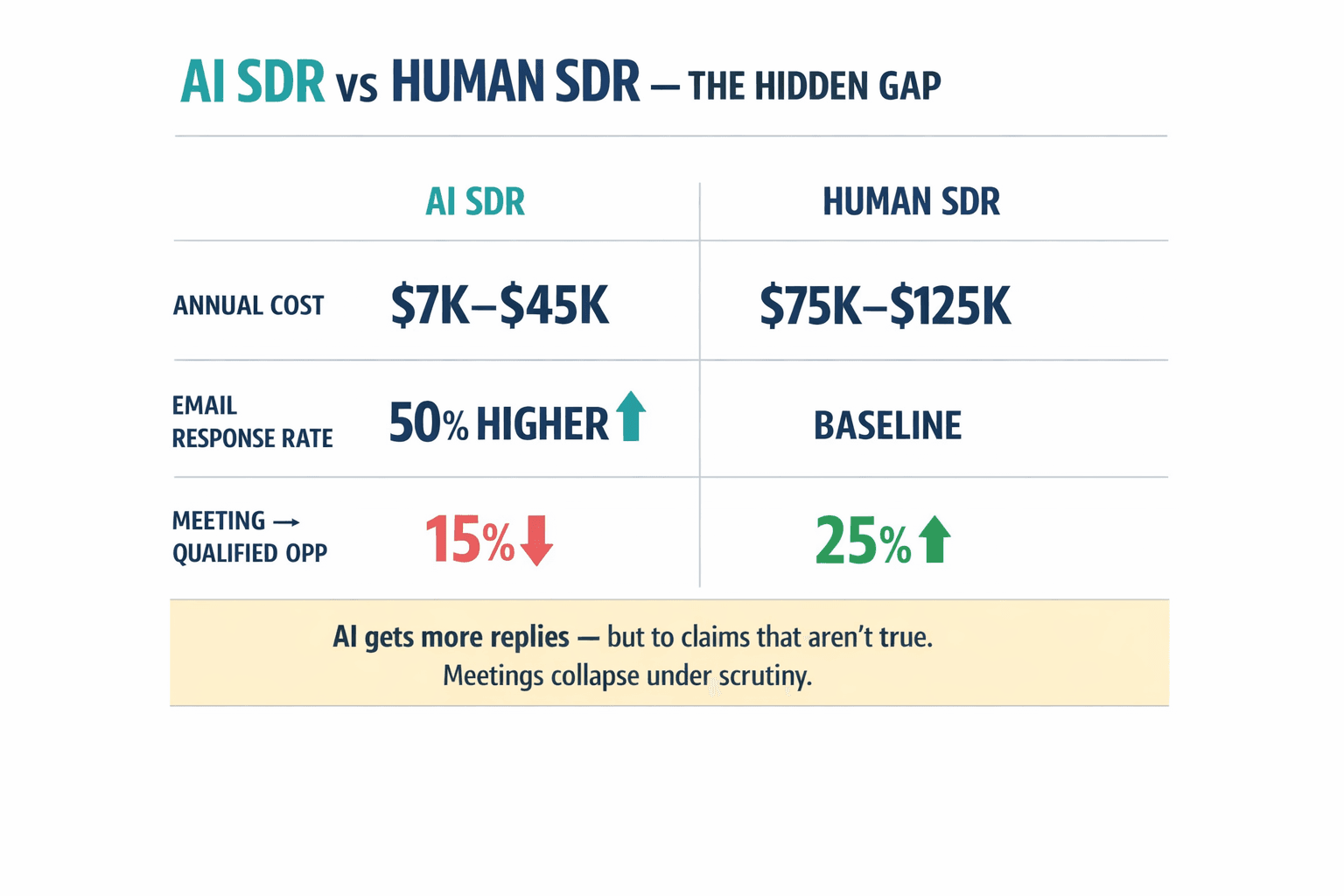
A human SDR costs $75,000 to $125,000 per year fully loaded. They churn at 30–40% annually. They take three to six months to ramp. They get tired, discouraged, and develop "call reluctance" after enough rejections.
An AI SDR costs $7,000 to $45,000 per year. It processes over 1,000 contacts daily. It responds in under five minutes — a threshold that correlates with a 900% increase in conversion rates. It never sleeps, never sulks, never quits.
If you're a revenue leader staring at those numbers, you'd be negligent not to explore automation.
But here's the stat that should keep you up at night: AI SDRs generate email response rates up to 50% higher than humans — yet their meeting-to-qualified-opportunity conversion rate is 15% versus 25% for humans. The AI is getting people to respond, but it's getting them to respond to things that aren't true. The meetings it books collapse under scrutiny because the "personalized insight" that hooked the prospect was fabricated.
When everyone can generate "perfect" text for free, text itself loses its signaling value. The only remaining signal is accuracy.
Why Does Your AI SDR Hallucinate?
This is the part where most people shrug and say "AI isn't perfect yet." But that framing is dangerously wrong. Hallucination isn't a bug that will get patched in the next model release. It's a mathematical feature of how these systems work.
Large language models are probability calculators. They're trained to predict the next most likely word given everything that came before. The function that governs this — called Softmax — forces the model to assign probabilities across its entire vocabulary that sum to exactly 1. There is no internal state for "I don't know." The model must produce something.
So when you ask it to describe the "2025 financial strategy" of a company it has no data on, it doesn't return a blank. It generates tokens that sound like a financial strategy — "growth," "margin expansion," "digital transformation" — because those words are statistically likely to follow that kind of prompt. It's simulating the texture of a factual statement without any underlying fact.
Worse, during training, these models are rewarded for confident predictions and penalized for uncertainty. They're literally trained to adopt a posture of unwarranted confidence. In a sales context, where the line between "persuasion" and "misrepresentation" is legally regulated, this is terrifying.
I remember arguing with a potential client's CTO about this. He kept saying, "We'll just fine-tune it on our data." I pulled up their product documentation — 47 pages of edge cases, pricing tiers, and compliance caveats. "Which of these," I asked, "are you comfortable having the model get approximately right?"
He went quiet.
The Four Ways AI Lies in Sales Emails
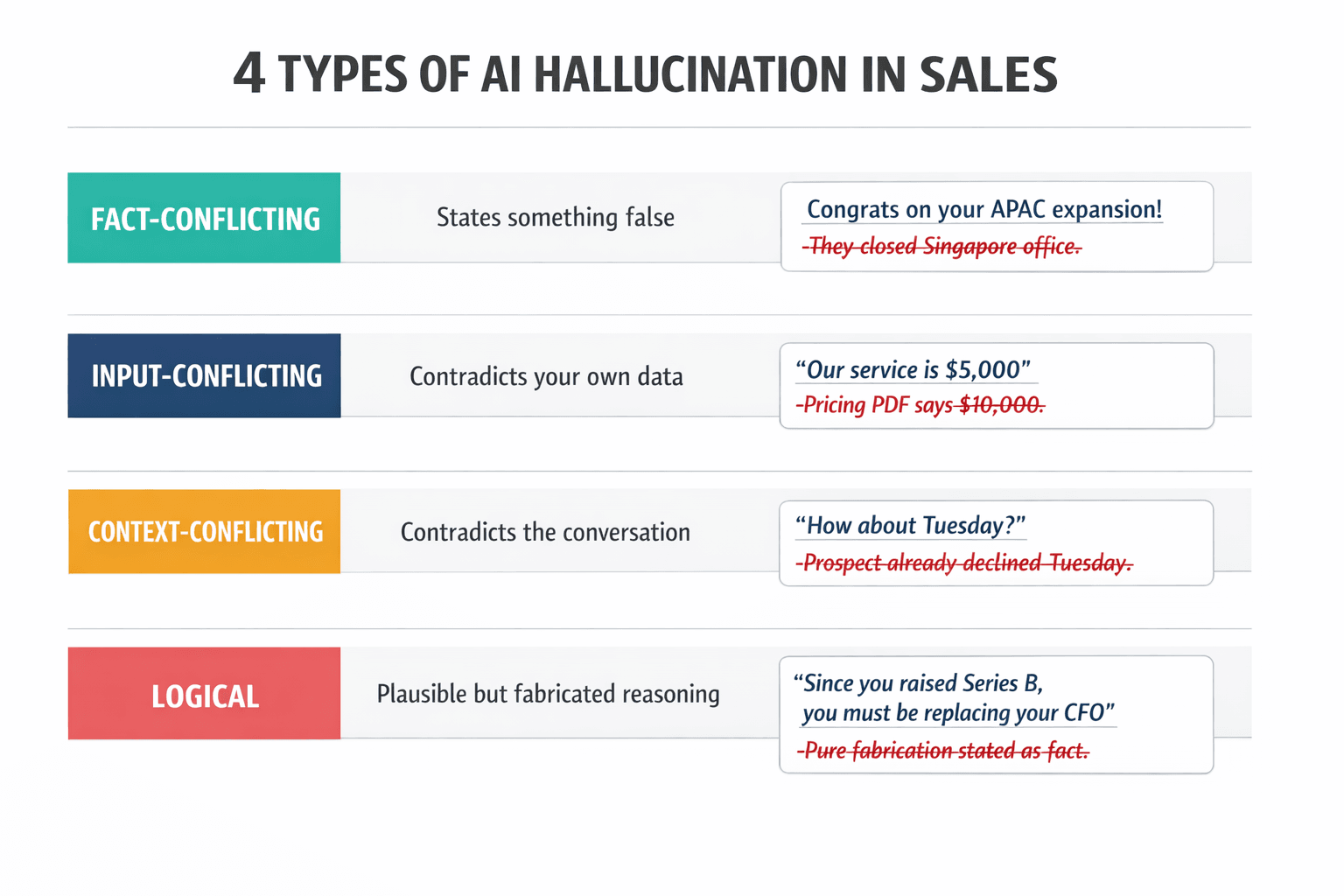
Not all hallucinations are created equal, and understanding the taxonomy matters because each type carries different risk:
Fact-conflicting hallucination is the most obvious — the AI states something that contradicts reality. Claiming a prospect uses Salesforce when their job postings mention HubSpot. Referencing a "recent APAC expansion" that never happened.
Input-conflicting hallucination is subtler and scarier. You upload a pricing PDF that says your service costs $10,000. The AI, drawing on its pre-training data of industry averages, quotes $5,000 in the email. You've now potentially created a binding price commitment.
Context-conflicting hallucination means the AI contradicts itself within a conversation. The prospect already declined a Tuesday meeting. The AI proposes Tuesday again. It signals that nobody's actually paying attention — because nobody is.
Logical hallucination is the most insidious. "You recently raised Series B, therefore you must be looking to replace your CFO." Plausible reasoning, stated as fact. The prospect reads it and thinks: Who told them we're replacing our CFO? Now you've created confusion, maybe even a leak scare, from pure fabrication.
What Happens When Gmail Fights Back?
Here's a consequence of AI hallucination that almost nobody in the sales automation space talks about, and it's the one that finally convinced my most skeptical clients to take this seriously.
Google and Microsoft are deploying their own AI to protect inboxes. Gmail's 2025 spam defense uses TensorFlow and a system called RETVec — Resilient & Efficient Text Vectorizer — that detects the statistical signatures of AI-generated text. It doesn't just look for spam keywords anymore. It analyzes sending patterns and intent.
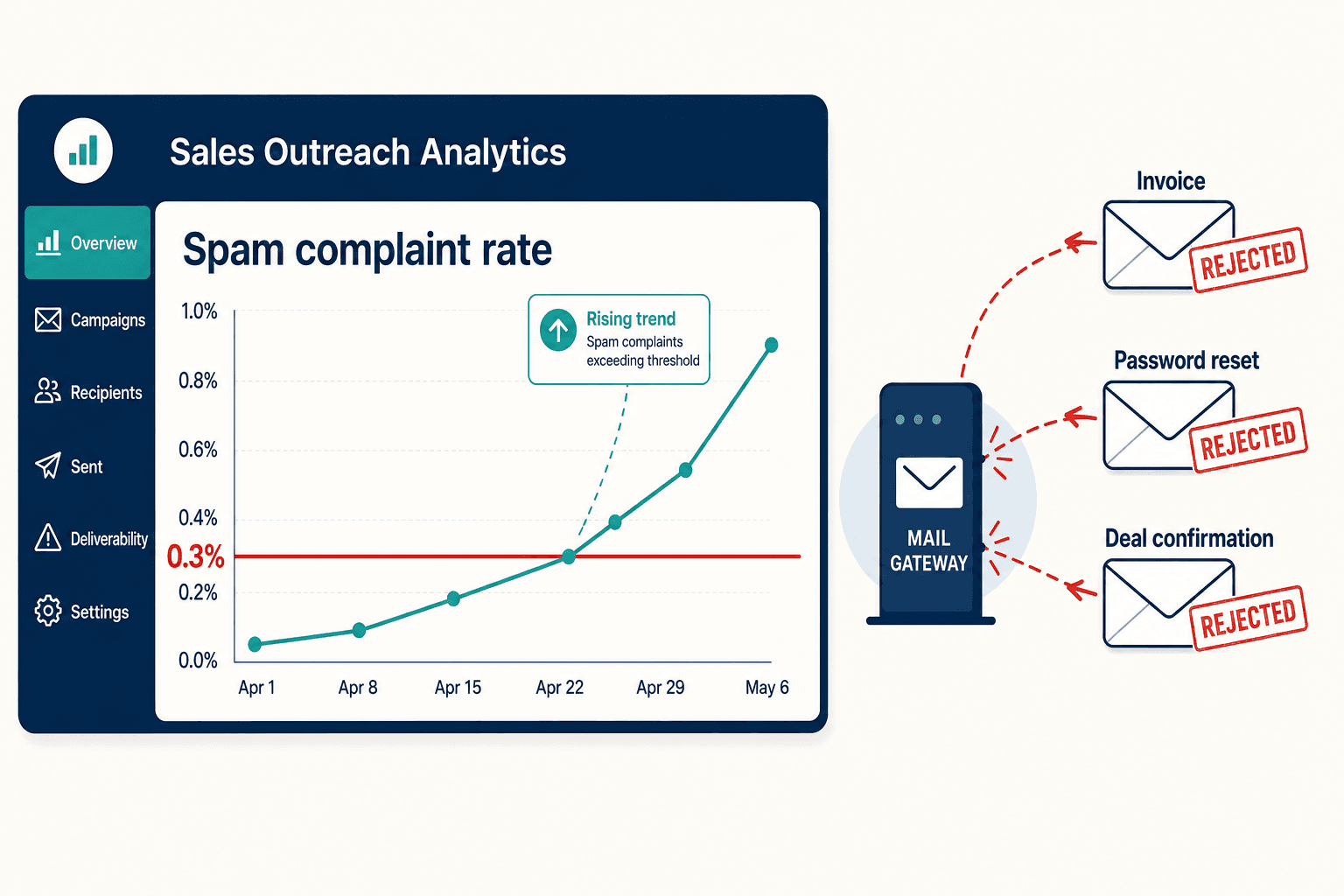
If your AI SDR blasts thousands of emails that share the same structural fingerprint — even if the words differ slightly — Gmail recognizes the pattern and throttles your domain. If recipients delete your emails without reading them, or flag them as spam, your domain reputation score craters. And here's the kicker: once your domain is burned, it's not just your marketing emails that stop arriving. Your invoices, your password resets, your customer support replies — everything sent from that domain gets filtered.
Fact-checking isn't a nicety. It's a deliverability strategy. We're not verifying claims to be polite — we're verifying them to keep our email servers online.
There's a direct causal chain: hallucinations lead to irrelevant emails, which lead to low engagement, which triggers spam flagging, which leads to domain blacklisting. The architecture of your AI agent directly determines whether your company can send email six months from now.
I laid this out for a VP of Sales at a Series C company. He'd been running an AI wrapper for four months and was thrilled with the volume. I asked him to check his domain reputation score. He pulled it up on his phone, and his face changed. They'd dropped from "High" to "Low" without anyone noticing. Their renewal confirmation emails were landing in spam.
Why Doesn't Standard RAG Fix This?
The industry's default answer to hallucination is RAG — Retrieval-Augmented Generation. Instead of letting the model make things up, you retrieve relevant documents and feed them as context. It's a real improvement. But for high-stakes B2B sales, it's not enough.
Standard RAG uses vector databases to store text chunks and retrieves whichever chunks are mathematically closest to the query. The problem is that "mathematically closest" is often a terrible proxy for "actually relevant."
Search for "Risks for Apple Inc." and a vector database might surface a 2015 article about Apple's "risk of failing to innovate" because the keywords "Apple" and "risk" match. Meanwhile, it misses a 2024 analysis of EU regulatory risk because the vocabulary doesn't overlap. Feed the 2015 data to the LLM, and it will confidently tell your prospect that Apple's biggest threat today is the lack of an iPhone successor. Outdated data, presented as current insight.
Vector databases also can't handle entities. They'll confuse "John Smith, CEO of Subsidiary A" with "John Smith, VP at Parent Company B" because both chunks contain the same name. The LLM, seeing both references, merges them into a single hallucinated person. In sales, where you're trying to demonstrate that you've done your homework on someone's org chart, this is a credibility-destroying mistake.
I wrote about this problem — and the full technical comparison between vector databases and knowledge graphs — in our interactive research brief.
The Architecture We Actually Built
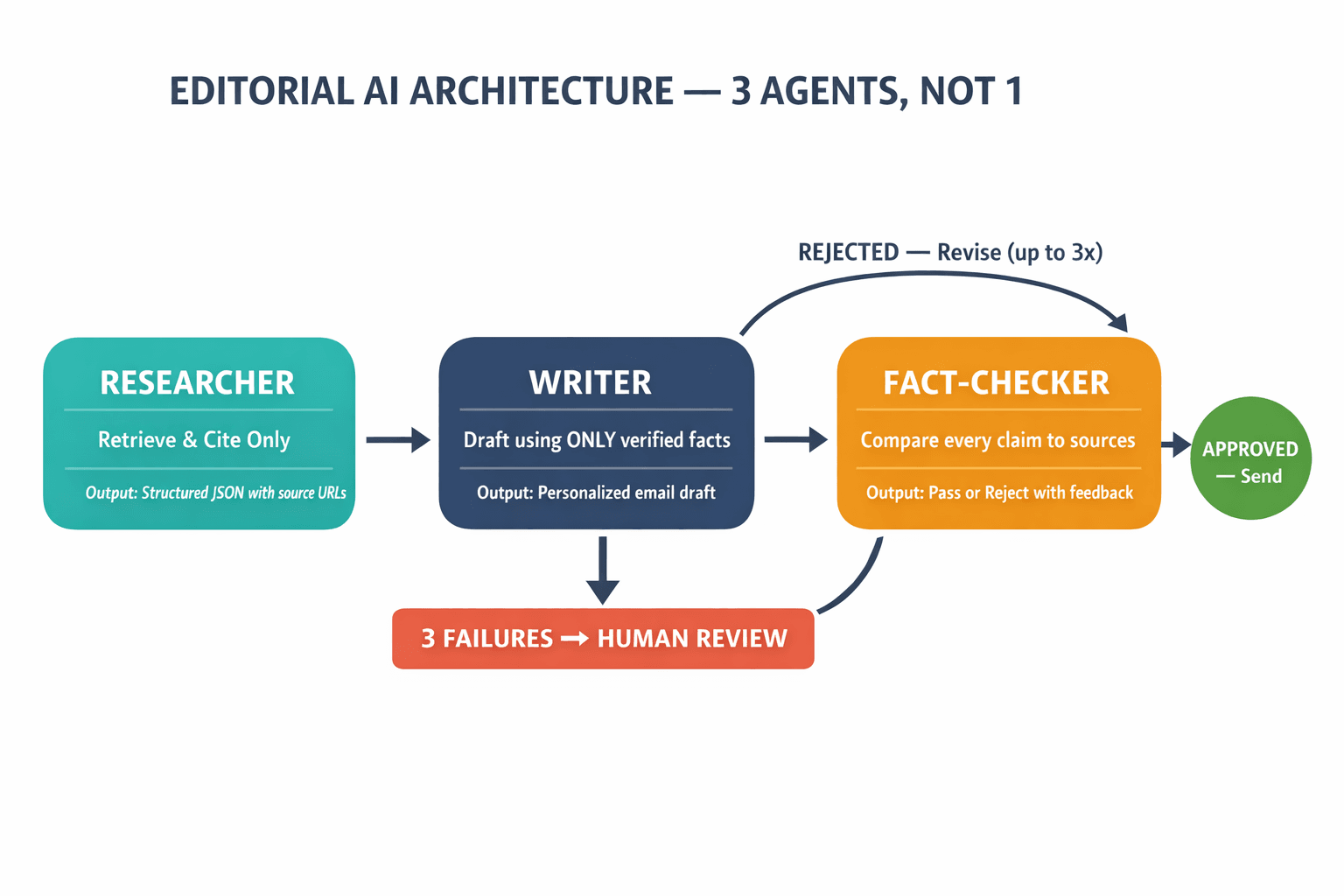
After the APAC incident and a dozen similar near-misses, my team stopped trying to make single-model systems more reliable and started from a different premise entirely: what if we modeled the AI workflow after an editorial team instead of a single writer?
A good magazine doesn't let the same person research, write, and fact-check a story. Those are separate roles with separate incentives. The researcher hunts for information. The writer crafts narrative. The fact-checker tries to break the story before it publishes. They're adversarial by design.
We built the same thing with AI agents. Three specialists, not one generalist:
The Researcher does nothing but retrieve and cite. It pulls 10-K filings from the SEC's EDGAR database, scrapes recent news, queries our knowledge graph. It's forbidden from creative writing. Its output is a structured JSON object — raw facts with source URLs and page numbers. No opinions, no synthesis.
The Writer takes those verified facts and crafts a compelling email. But it operates under a hard constraint: use only the facts the Researcher provided. Nothing else. No embellishment, no "reasonable inferences."
The Fact-Checker is the adversary. It compares every claim in the Writer's draft against the Researcher's notes. "Does the claim 'you grew revenue by 20%' appear in the source material? No? Rejected." It sends the draft back with specific feedback. The Writer revises. The Fact-Checker reviews again.
This loop — what the AI research community calls a "Reflection Pattern" — runs until the draft passes or hits a maximum retry limit, at which point it gets flagged for a human.
The AI "thinks" before it speaks, and "reflects" before it sends. We trade a marginal increase in compute cost for a massive increase in reliability.
One night, early in development, we ran the system against a batch of 200 prospects. The Fact-Checker rejected 34% of first drafts. Thirty-four percent. These were emails that a wrapper-based system would have sent without hesitation. Some had fabricated revenue figures. One congratulated a CEO on an acquisition that was actually a divestiture. Another quoted a pricing tier that didn't exist.
My co-engineer looked at the rejection log and said, "We just saved this client from 68 reputation-destroying emails in a single batch." That's when I knew the architecture was right.
Why We Chose LangGraph Over CrewAI
A brief technical aside, because the orchestration framework matters more than most people realize.
Many teams building multi-agent systems reach for CrewAI because it's intuitive — you define roles, and the framework handles interaction. But that abstraction hides the state of the conversation. It's hard to enforce deterministic rules like "if the Fact-Checker fails twice, escalate to a human." The interaction between agents can be unpredictable, and in sales, unpredictability is unacceptable.
We use LangGraph, which models the workflow as an explicit state machine — a graph of nodes (agents) and edges (decisions). Every transition is defined. Every condition is auditable. If the compliance score is below 0.95 and the critique count is under 3, the draft goes back for revision. If it hits 3 failures, it routes to a human. No ambiguity.
This isn't a preference — it's a governance requirement. Enterprise compliance teams need an audit trail for every AI decision. LangGraph gives us that. CrewAI doesn't. For the full technical breakdown of the orchestration architecture, see our detailed research paper.
The 10-K Secret Weapon
The single best data source for B2B sales outreach isn't the prospect's website (that's marketing fluff), and it isn't the news (that's speculation). It's the 10-K annual report filed with the SEC.
Public companies are legally required to disclose their most significant business risks in "Item 1A: Risk Factors." These aren't spin. They're legal confessions of vulnerability, written under penalty of securities fraud.
A logistics company will explicitly list "volatility in fuel prices" or "dependence on legacy software infrastructure" as material risks. A healthcare company will disclose regulatory exposure. A fintech will detail cybersecurity concerns.
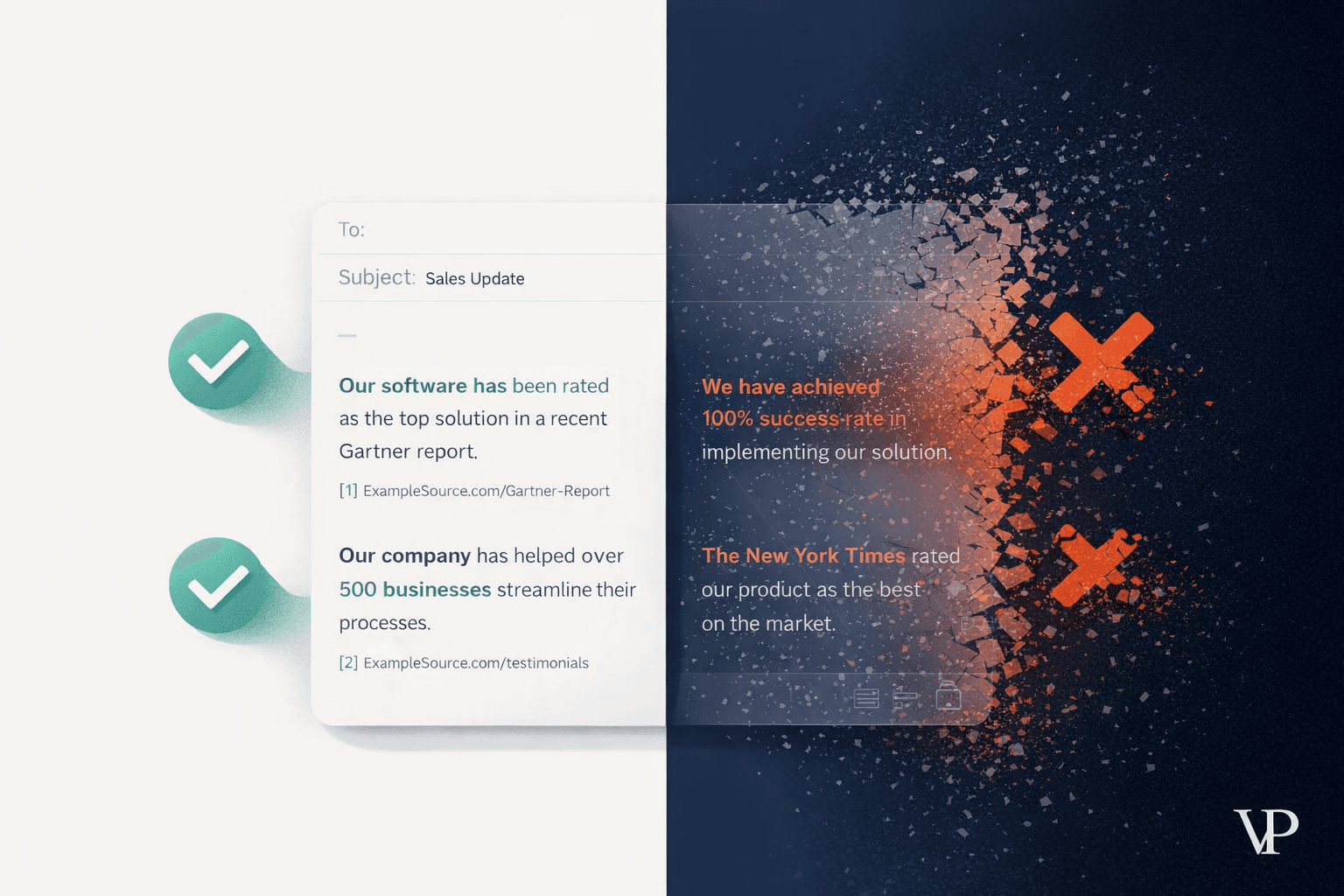
Our Researcher agent pulls these filings automatically, isolates the risk factors relevant to our client's value proposition, and stores each one with a citation: "Source: Microsoft 10-K 2024, Item 1A, Paragraph 4."
When the Writer crafts the email, it says: "I noticed in your latest annual filing that legacy infrastructure resilience is a stated priority for 2025. Our platform addresses exactly this."
That's not a hallucination. That's a verified fact from the prospect's own legal filings. The prospect reads it and thinks: This person actually did their homework. Because the AI actually did.
Paradoxically, constraining the AI to the 10-K makes it better, not worse. LLMs are more accurate when they have boundaries. The 10-K provides a safe perimeter of verified facts, freeing the model to focus its capabilities on connecting those facts to the value proposition instead of inventing facts from nothing.
"But Won't This Be Slower Than a Wrapper?"
People ask me this constantly, and the answer is yes — per email. And that's the point.
A wrapper sends 10,000 emails a month. Maybe 200 get responses. Maybe 30 become meetings. Maybe 4 become qualified opportunities — because the rest collapse when the prospect realizes the "personalized insight" was fabricated.
Our system sends fewer emails. Each one takes more compute. But the engagement rate is dramatically higher because the content is true. High engagement tells Gmail's AI that the sender is legitimate, which protects the domain, which means the emails keep arriving, which compounds over months into a sustainable pipeline.
The wrapper approach is a sugar high. It looks great in the first quarterly review and becomes an existential crisis by the third.
"Isn't this just what a good human SDR does?" someone asked me at a conference. Yes — except a human SDR can't read a 10-K filing, cross-reference it against a knowledge graph, draft a personalized email, and fact-check it against source documents in under ninety seconds. The architecture doesn't replace the human instinct for quality. It scales it.
The Wrapper Era Is Ending
I'm not hedging on this. The current generation of AI sales wrappers — thin interfaces over generic models with no verification layer — will be remembered the way we remember the first wave of email spam in the early 2000s. A brief, chaotic period where a new technology was used to burn trust at scale before the ecosystem developed antibodies.
Gmail's AI filters are those antibodies. Prospect sophistication is another. The "Uncanny Valley" of automated sales — emails that feel almost human but lack genuine specificity — is already triggering an immune response in the market. Decision-makers are learning to pattern-match AI outreach, and when they spot it, the sender doesn't just lose the deal. They get emotionally tagged as untrustworthy. At 10,000 emails a month, that's 10,000 bridges burned.
The companies that will own B2B sales in the next cycle aren't the ones sending the most emails. They're the ones sending emails that are verifiably true — grounded in the prospect's own disclosures, checked against structured knowledge, and auditable end to end.
In the age of artificial intelligence, the ultimate luxury is truth.
The question isn't whether your AI can write a convincing email. Any model can do that now. The question is whether your AI can write an email that survives the moment the prospect checks the facts. If it can't, you're not scaling sales. You're scaling the rate at which your brand destroys itself.