
Your Best Sales Rep Already Wrote a Thousand Emails. Here's How AI Can Learn From Every One.

I was sitting across from a VP of Sales at a mid-market SaaS company when he pulled out his phone and showed me his inbox. He scrolled through it slowly, like a coroner presenting evidence. "Count the ones that sound like a human wrote them," he said.
I counted three. Out of maybe forty cold emails on his screen. The rest were eerily similar — the same cadence, the same hollow enthusiasm, the same words. "Unlock." "Transform." "Leverage." He told me he'd started calling them "the GPT choir." Forty voices, one song, and nobody was listening.
That conversation changed the direction of what we were building at Veriprajna. We'd been working on AI-powered outreach systems, and we'd been asking the wrong question. The industry was asking: How do we get AI to write more emails? The real question was: How do we get AI to write emails that sound like they came from the one person on your team who actually gets replies?
That distinction — between scaling the robot and scaling the human — is the entire ballgame. And the answer turned out to be an architecture, not a prompt.
The Inbox Is a Graveyard of AI Mediocrity
The numbers tell a brutal story. Cold email open rates have dropped to roughly 27.7%, down from 36% just a year ago. Reply rates sit between 1% and 5% for most campaigns. The medium isn't dying — the messages are.
Here's what happened: the cost of generating an email dropped to near zero, so everyone started generating emails. The market flooded. And because most tools use the same foundational models with minimal customization, the output converged. Every email started sounding like every other email. Not because the AI was bad at writing, but because it was too good at writing the average of everything it had ever read.
LLMs are probability machines. Left to their own devices, they generate the most statistically likely next word, which produces text that is smooth, competent, and utterly forgettable. It's the linguistic equivalent of beige paint.
When every AI email sounds the same, "personalized" just means you got the recipient's name right.
The tools that call themselves "personalized" are mostly doing variable injection — swapping in {{First_Name}} and {{Company_Name}} and maybe a line about a recent funding round. That's customization. Personalization is something else entirely. Personalization is when the way you say something makes the recipient feel like you understand how they think.
The Night I Realized We Were Building the Wrong Thing
There was a night — it was late, the kind of late where you're not sure if you're being productive or just stubborn — when I was reviewing A/B test results from one of our early outreach campaigns. We had two variants. Variant A was our AI-generated email, polished, well-structured, hitting all the value props. Variant B was a slightly messy email written by a sales rep named Priya. Shorter. A sentence fragment where there shouldn't be one. A sign-off that was almost too casual.
Variant B crushed it. Not by a little. The reply rate was nearly five times higher.
I remember staring at the data and feeling genuinely confused. Priya's email broke rules. It was too short. The opening was abrupt. But it worked, because it sounded like a real person who was busy and direct and didn't have time to be performative about it.
That's when something clicked for me. The problem with our AI wasn't that it couldn't write well. The problem was that it wrote like an AI. And the solution wasn't better prompting — it was teaching the model to write like Priya.
Why Does Mirroring Someone's Style Actually Work?
Before I get into the architecture, I need to explain why this matters at a cognitive level, because it's not just a nice-to-have.
There's a body of research around something called Linguistic Style Matching — LSM. The core finding is that people are significantly more likely to trust, engage with, and comply with requests from someone whose communication style mirrors their own. This isn't about content. It's about function words, sentence rhythm, formality level, the unconscious texture of how someone strings thoughts together. A 2013 study by Ludwig et al. found that conversion rates in online environments are directly tied to the degree of linguistic congruence between a message and its recipient.
This maps onto something even deeper — mirror neurons. When you encounter communication that reflects your own patterns, it activates neural pathways associated with self-expression. It feels familiar. Safe. In-group. Negotiation studies have shown that mirroring increases successful agreement rates from 12% to 67%. Sales reps have known this intuitively for decades. The best closers are chameleons.
The best sales email doesn't sound like a sales email. It sounds like the recipient talking to themselves.
The problem is that mirroring is an inherently human, inherently manual skill. It doesn't scale. You can't have your top rep personally craft emails for ten thousand prospects. But you can capture what makes their writing work and inject it into an AI system that generates at scale.
That's the thesis. Not "replace the human." Scale the human.
What Is Few-Shot Style Injection, and Why Is It Different from Better Prompting?
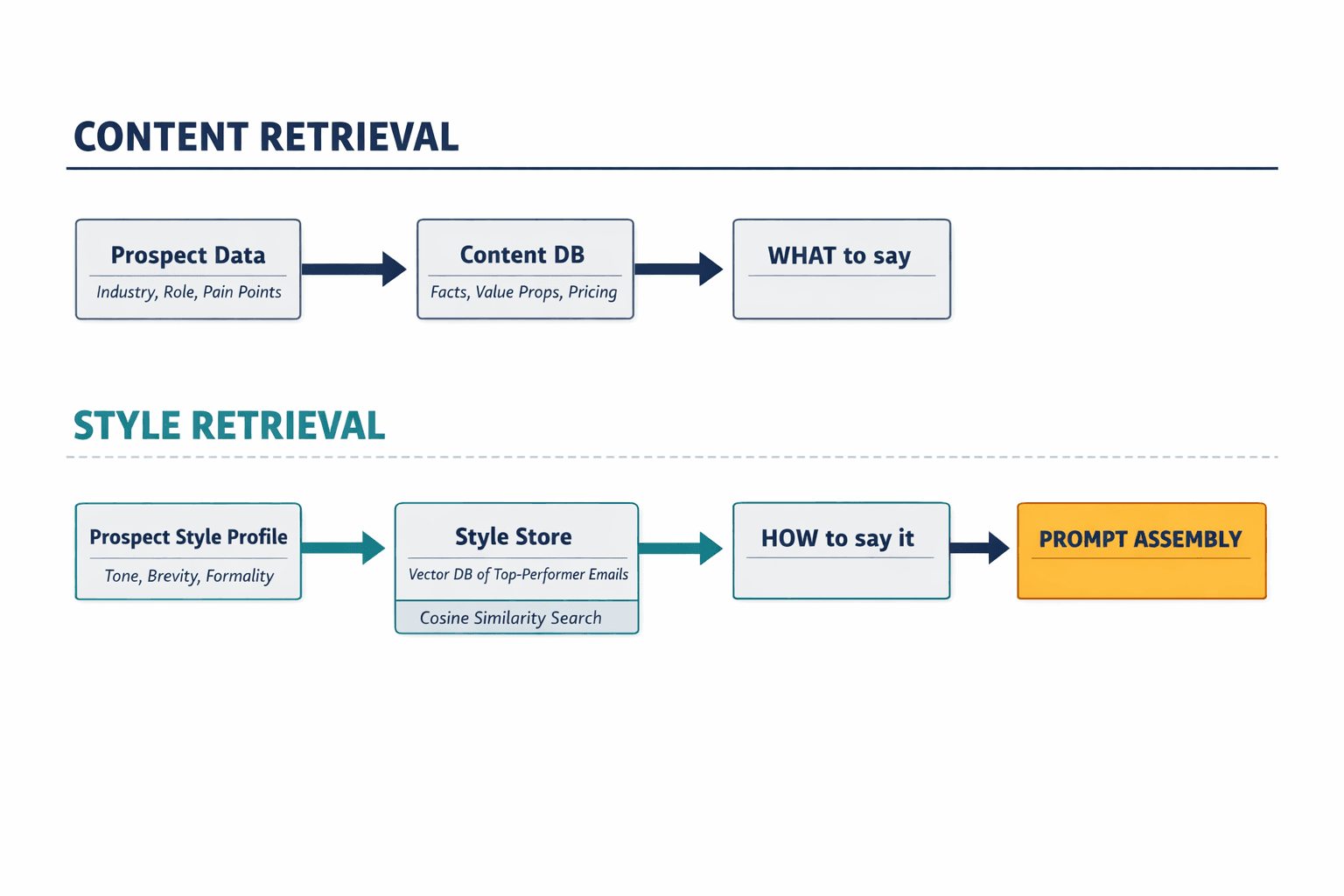
Few-shot prompting is the technique of giving an LLM a handful of examples — "here are three emails that worked, now write one like these." It's been around since GPT-3. What makes our approach different is where those examples come from and how they're selected.
Most people who use few-shot prompting pick examples manually. They paste in two or three emails they like and call it a day. That works fine if you're writing to one type of prospect. It falls apart the moment you need to adjust tone for a CTO versus a VP of Marketing, or for a FinTech buyer versus someone in manufacturing.
What we built is a dynamic retrieval system. We store a curated library of high-performing, human-written emails — what we call a "Style Store" — in a vector database. When the system needs to generate an email for a specific prospect, it doesn't use static examples. It retrieves the most stylistically appropriate examples in real time, based on who the recipient is and what context they're in.
I wrote about the full architecture in the interactive version of our research, but the key insight is this: we separate content retrieval from style retrieval. Two parallel pipelines. One answers "what should we say?" The other answers "how should we say it?"
This separation is everything. Standard semantic search conflates topic with tone. If you search for "email to a CTO," you get emails about CTOs, not emails written for CTOs in the voice that CTOs respond to. By decoupling these, we can send a message about enterprise security using a casual, direct tone — or a formal, measured one — just by switching the style retrieval path.
Building the Style Store: Where the Magic (and the Pain) Lives
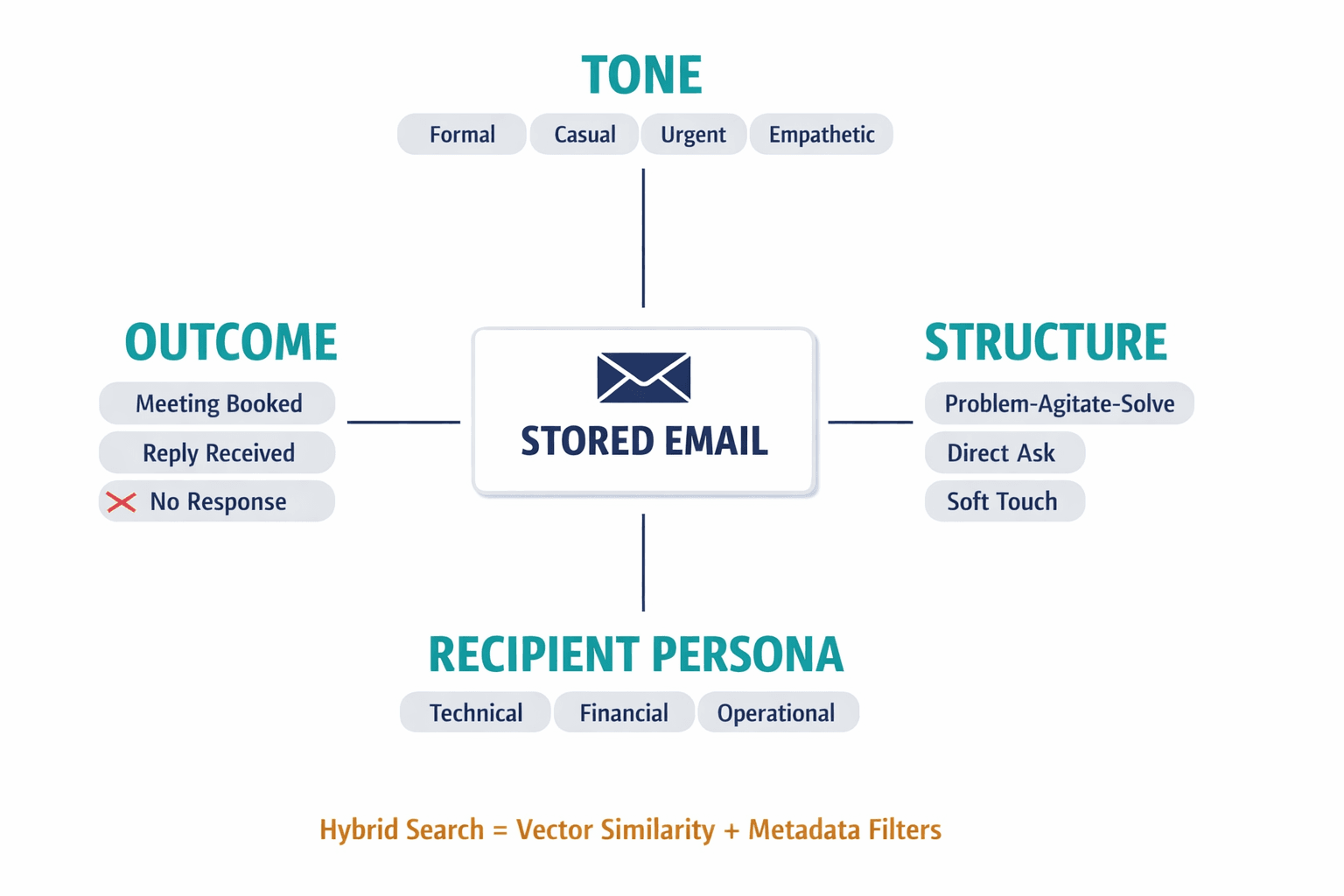
This is where I have to be honest about how hard the unglamorous part is.
The Style Store sounds elegant in theory. In practice, building one requires digging through months of CRM data, cross-referencing emails with outcomes, stripping out personally identifiable information, and then annotating every surviving email with metadata — tone, structure, recipient persona, deal stage.
My team and I argued about the annotation taxonomy for the better part of a week. Should "direct" and "blunt" be the same category? Is "empathetic" a tone or a structure? Where does "challenger" selling end and "aggressive" begin? These aren't academic questions when the quality of your retrieval depends on the precision of your labels.
We settled on a schema that tags each email across four dimensions: tone (formal, casual, urgent, empathetic), structure (problem-agitate-solve, direct ask, soft touch), recipient persona (technical, financial, operational), and outcome (meeting booked, reply received, no response). The vector database — we use a setup optimized for low-latency retrieval — stores both the embedding and this metadata, enabling hybrid search. "Find me vectors close to this prospect's style profile WHERE industry equals SaaS AND outcome equals meeting booked."
Your AI is only as good as the worst email in your training set. Garbage style in, garbage output out.
We learned this the hard way. Early on, we included emails that had technically "succeeded" — they got replies — but the replies were things like "please remove me from your list." Filtering for quality of outcome, not just presence of outcome, was a lesson that cost us a few weeks of bad results before we caught it.
How Does the System Actually Pick the Right Style for Each Prospect?
When a new prospect enters the pipeline — say, a CTO at a FinTech company — the system runs a multi-step process. First, it analyzes the prospect's public communication. LinkedIn posts, their bio, anything available. Is this person brief? Do they use technical jargon or plain language? Are they formal or conversational?
Then it generates a style query: "Retrieve three successful historical emails sent to CTOs in FinTech that use a brief, direct, and slightly technical tone." The vector database runs a cosine similarity search and returns the nearest matches from the Style Store.
Those retrieved emails become the few-shot examples in the prompt. Not static. Not hand-picked. Dynamically selected for this specific person at this specific moment.
Three to five examples is the sweet spot. Fewer than three and the model doesn't get enough signal. More than five and you start burning context window tokens without proportional improvement — and you risk the model overfitting to the most recent example rather than synthesizing the pattern across all of them.
The Truth Problem Nobody Talks About
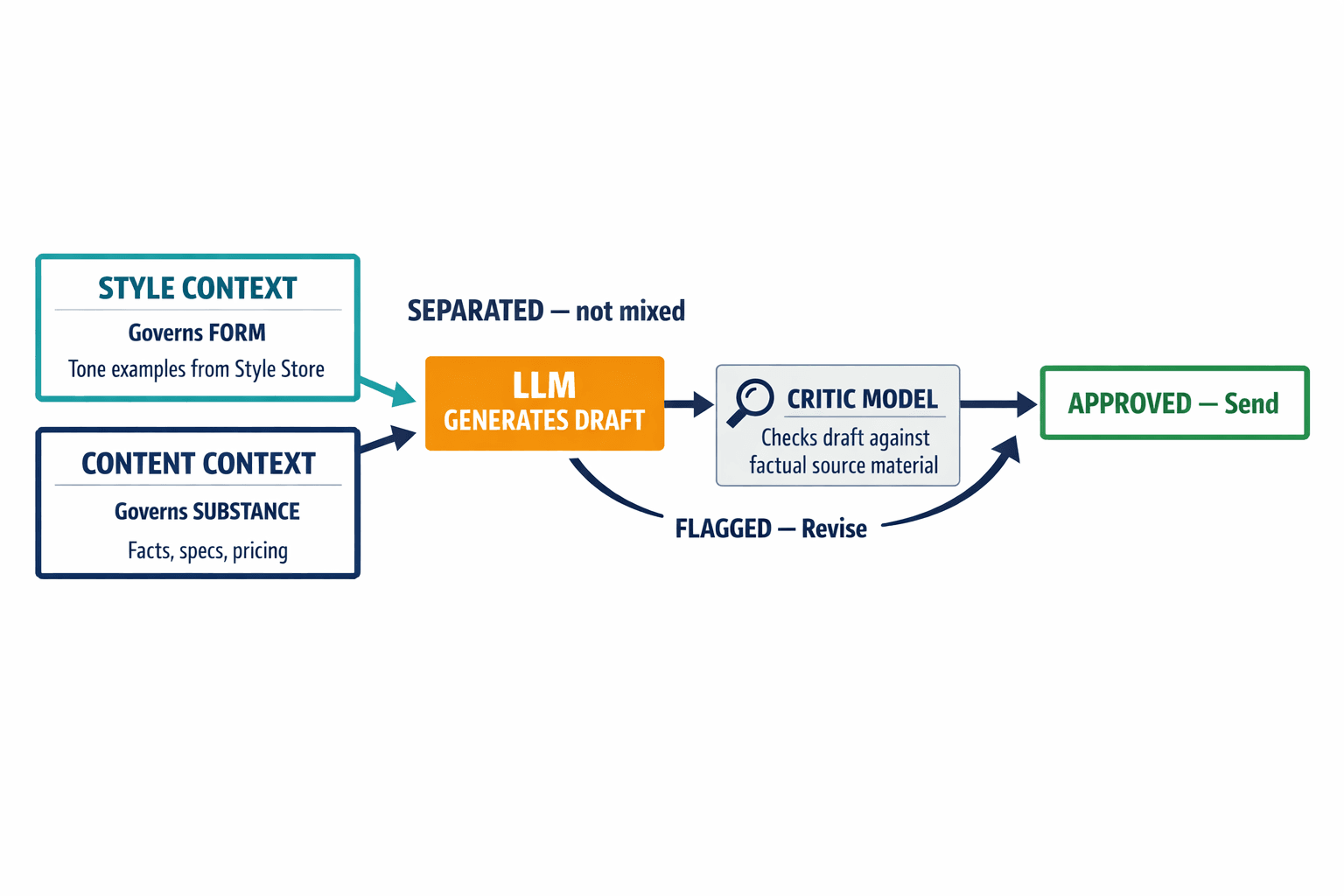
Here's something that kept me up at night during development: style injection can make AI lie better.
When you push an LLM hard toward a particular style — especially a persuasive or casual one — it sometimes starts bending facts to fit the vibe. We'd see emails where the AI, channeling a particularly enthusiastic rep's style, would subtly exaggerate product capabilities. Not hallucinating from nothing, but stretching the truth in ways that felt natural within the style but were factually wrong.
We call this "Stylization-Induced Truthfulness Collapse," and it's a real risk that I don't see enough people in this space talking about.
Our solution was architectural, not just instructional. We keep the content context (facts, value props, pricing) and the style context (tone examples) in separate sections of the prompt. The system instructions explicitly tell the model: style examples govern form, content context governs substance. And we run a secondary verification step — a "critic" model that checks the generated email against the factual source material before it goes out.
For the full technical breakdown of how this works, including the dual-retrieval architecture and our approach to contrastive style embeddings, see our research paper.
Is it perfect? No. But it's the difference between a system that occasionally needs a human to catch an overstatement and a system that routinely fabricates claims. I'll take the former.
"But Won't Spam Filters Catch AI-Generated Emails Anyway?"
This is the question I get most often, and the answer is counterintuitive: style injection actually helps with deliverability.
Modern spam filters — Gmail, Outlook — are increasingly using AI to detect AI. They look for low perplexity (text that's too predictable) and high uniformity (text that lacks the natural variation of human writing). Standard LLM output is almost pathologically smooth. Every sentence is roughly the same length. The vocabulary is drawn from the same narrow band. It's a statistical fingerprint that screams "machine."
Human writing is bursty. Short sentence. Then a longer one that meanders a bit before arriving at its point. Then a fragment. This variation — what linguists call "burstiness" — is exactly what few-shot style injection re-introduces. By forcing the model to match real human examples that contain sentence fragments, rhetorical questions, and abrupt transitions, the output looks less like "AI slop" and more like actual correspondence.
High-volume generic AI blasts are a fast track to the spam folder and domain blacklisting. Style injection is human camouflage for your deliverability.
The domain reputation angle is underappreciated. Sending a thousand robotic emails doesn't just fail to convert — it actively damages your sender reputation, making it harder for your future emails to reach anyone's inbox. It's a compounding penalty. The companies blasting generic AI outreach today are borrowing against their own future ability to communicate.
The Part Where Someone Says "Just Use GPT"
I had an investor tell me this. Not in those exact words, but close. "Why would someone pay for this when they can just prompt ChatGPT to write in a certain style?"
I pulled up two emails on my laptop. Both were written "in the style of a direct, no-nonsense sales leader." One was generated by a vanilla GPT-4 prompt. The other was generated by our system using three real examples from a top-performing rep retrieved from the Style Store.
The GPT-4 version was fine. Professional. Clear. It read like a competent sales email written by someone who had read a book about being direct.
The Style Store version had a weird opening. It started mid-thought, almost like the sender was continuing a conversation that hadn't happened yet. The second sentence was four words. The sign-off was just a first name, no title, no company. It felt like someone who was actually busy and direct, not someone performing busyness and directness.
The investor read both and pointed to the second one. "That one. That sounds like a person."
That's the gap. Prompting an LLM to "be direct" gives you the model's statistical interpretation of directness. Showing it three real examples of a specific human being direct gives you that human's directness. The difference is the difference between a character description and a performance.
What This Means for Sales Teams (Not What You'd Expect)
People always ask me if this replaces sales reps. It doesn't. It does something more interesting: it makes your entire team sound like your best rep.
Think about what happens when you hire a new SDR. They spend weeks, sometimes months, finding their voice. Learning what works. Developing instincts about tone. With a Style Store built from your top performers' best work, a new rep can start sending emails that carry the proven voice of the team from day one.
The data suggests this saves roughly 12.7 hours per week per seller in drafting time. But the real value isn't time savings — it's consistency. No more Monday morning quality dips. No more reps who are great on the phone but terrible in writing. The Style Store becomes institutional knowledge, codified and retrievable.
And it creates a flywheel. Every new email that gets a positive response gets vectorized and added to the Store. The system gets better over time, not because the AI improves, but because the library of human excellence grows.
The Uncomfortable Future
Here's where I'll make a prediction that might age badly: within two years, the companies still using generic AI outreach will be functionally unable to reach their prospects via email. Not because email dies, but because their domains will be so damaged and their content so filtered that they'll be invisible.
The companies that win will be the ones that treated their best sellers' communication patterns as a strategic asset — something to be captured, curated, and scaled. Not replaced by AI. Amplified by it.
Campaigns using advanced personalization and style matching already report reply rates of 40–50%, compared to 1–8.5% for generic approaches. That's not a marginal improvement. That's a different sport.
The era of "Hi {{First_Name}}, I noticed your company recently {{trigger_event}}" is ending. What comes next is cognitive personalization — AI that doesn't just know facts about your prospect, but speaks in the specific register that makes your prospect feel understood.
The most valuable asset in sales isn't your product data. It's the way your best people talk about it.
We didn't build Veriprajna to automate sales. We built it to clone the thing that makes great salespeople great — and give that to everyone on the team. That's not scaling the robot. That's scaling the human. And it's the only version of sales AI that has a future.