We Burned a Sending Domain Before We Understood AI Sales Personalization

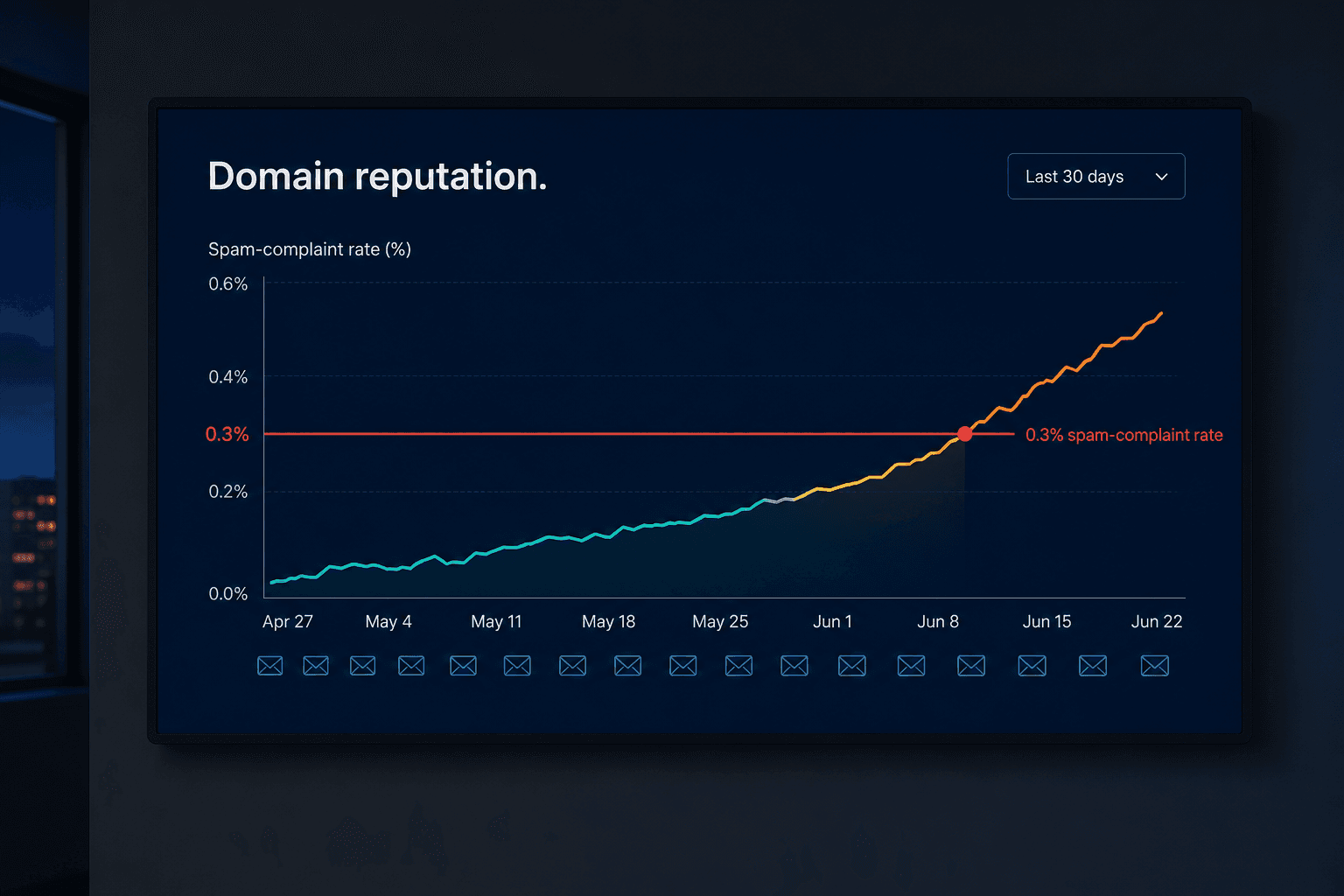
The first time I really understood what we were building, I was staring at a Google Postmaster Tools dashboard at eleven at night, watching a single thin line cross a red threshold I had spent the previous month pretending didn't matter.
The line was the spam-complaint rate. The threshold was 0.3%. We had just tipped over it.
I want to tell you about AI sales personalization — what it actually is when you strip away the demo magic, why the autonomous version of it is collapsing in slow motion across the B2B world, and what my team at Veriprajna ended up building instead. But I can't tell that story honestly without starting at the moment I learned, the hard and expensive way, that the part everyone ignores is the part that decides whether any of it works.
The night the whole company's email stopped landing
Here is what nobody tells you when you wire up an outbound machine that sends thousands of emails: the domain you send from has a reputation, and that reputation is shared with everything else your company sends.
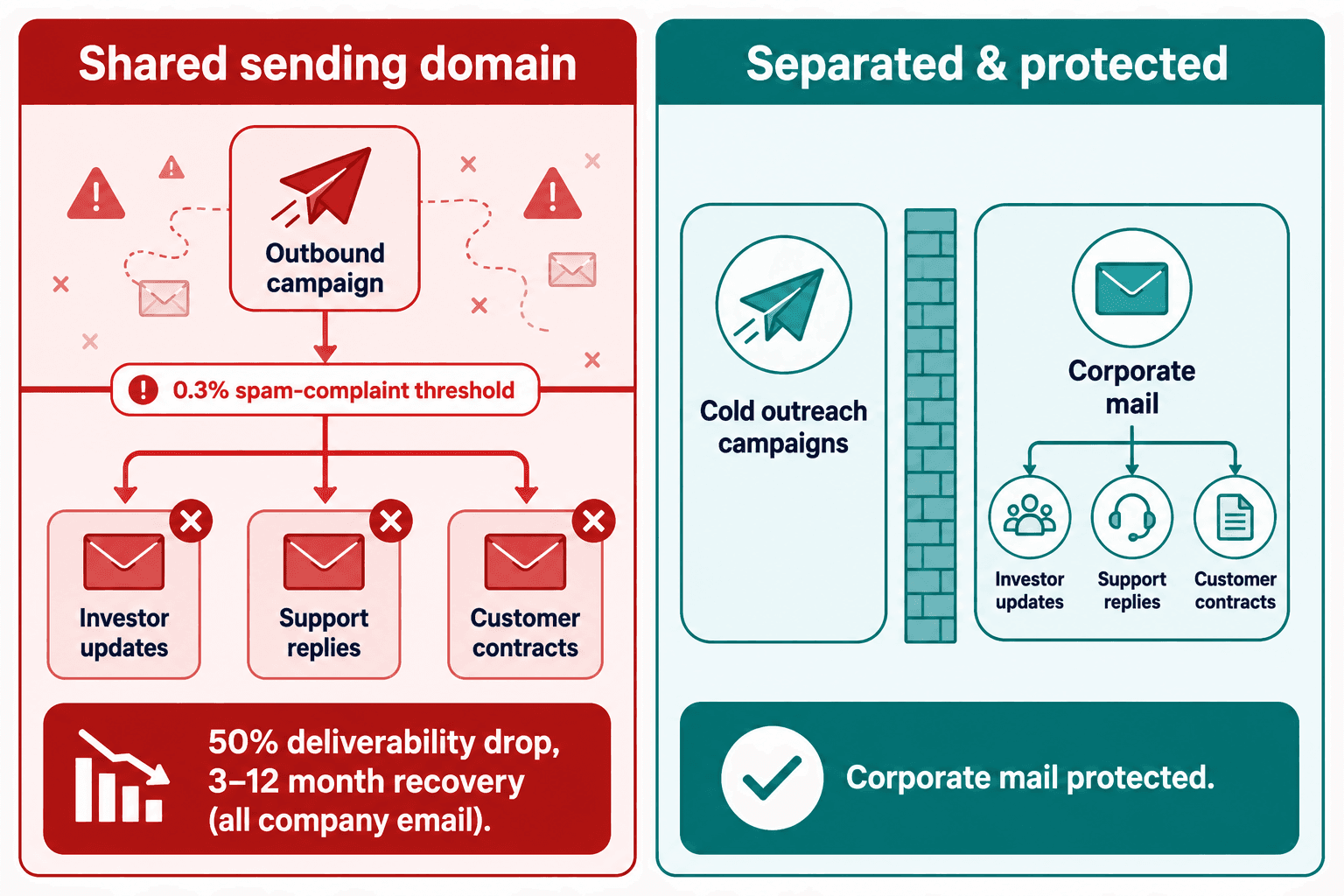
When our complaint rate crossed 0.3%, it didn't just hurt the cold campaign. Over the next few days, deliverability dropped roughly in half across our entire domain. Not "more emails went to spam." Rejected. Our investor updates. Our support replies. A contract I sent to a customer who then called to ask why I'd gone quiet — because my email never arrived.
A single bad campaign doesn't cost you a campaign. It costs you every email your company sends, for months.
I learned afterward that recovery from this kind of reputation damage takes anywhere from three to twelve months, and that there's an entire cottage industry — Mailforge, Warmly — of people you call when your whole company's mail goes dark and you don't know why. I made some of those calls. It was the most humbling week of building this company, and it happened because I'd treated email infrastructure as plumbing instead of as the thing the entire product stood on.
That failure is the reason Veriprajna builds the way it does now. So let me back up and explain what we were even trying to do.
The promise that broke: autonomous AI SDRs
In 2023 and 2024, a whole category of startups promised to replace the sales development rep — the person who sends the cold emails, books the meetings, and feeds the pipeline. The pitch was intoxicating: an autonomous AI SDR that researches a prospect, writes the email, sends it, follows up, and books the meeting, all without a human touching it. Hire software, not people.
The category's poster child was 11x.ai, which raised $74 million from Andreessen Horowitz and Benchmark. In March 2025, TechCrunch reported that 11x had lost 70–80% of its customers within months of signing them. The company had claimed $14 million in annual recurring revenue; actual contracts that survived past the trial period totaled roughly $3 million. ZoomInfo, one of their marquee logos, said publicly that 11x "performed significantly worse than their SDR employees" and churned after a single month.
I don't bring this up to dunk on one company. I bring it up because it wasn't an anomaly — it was a symptom. The autonomous AI SDR category as a whole is seeing 50–70% annual tool churn, roughly double the turnover of the human SDRs these tools were sold to replace. Sales leaders are evaluating a new tool every quarter, getting burned, and switching again.
When I dug into why, the failure had a shape, and the shape was almost mathematical.
What does a fully autonomous SDR actually optimize for?
A fully autonomous system needs a metric to chase. The easiest metric to show progress on is send volume — more emails, more sequences, more activity on the dashboard. So that's what these systems quietly optimize for, because volume is legible and quality is not.
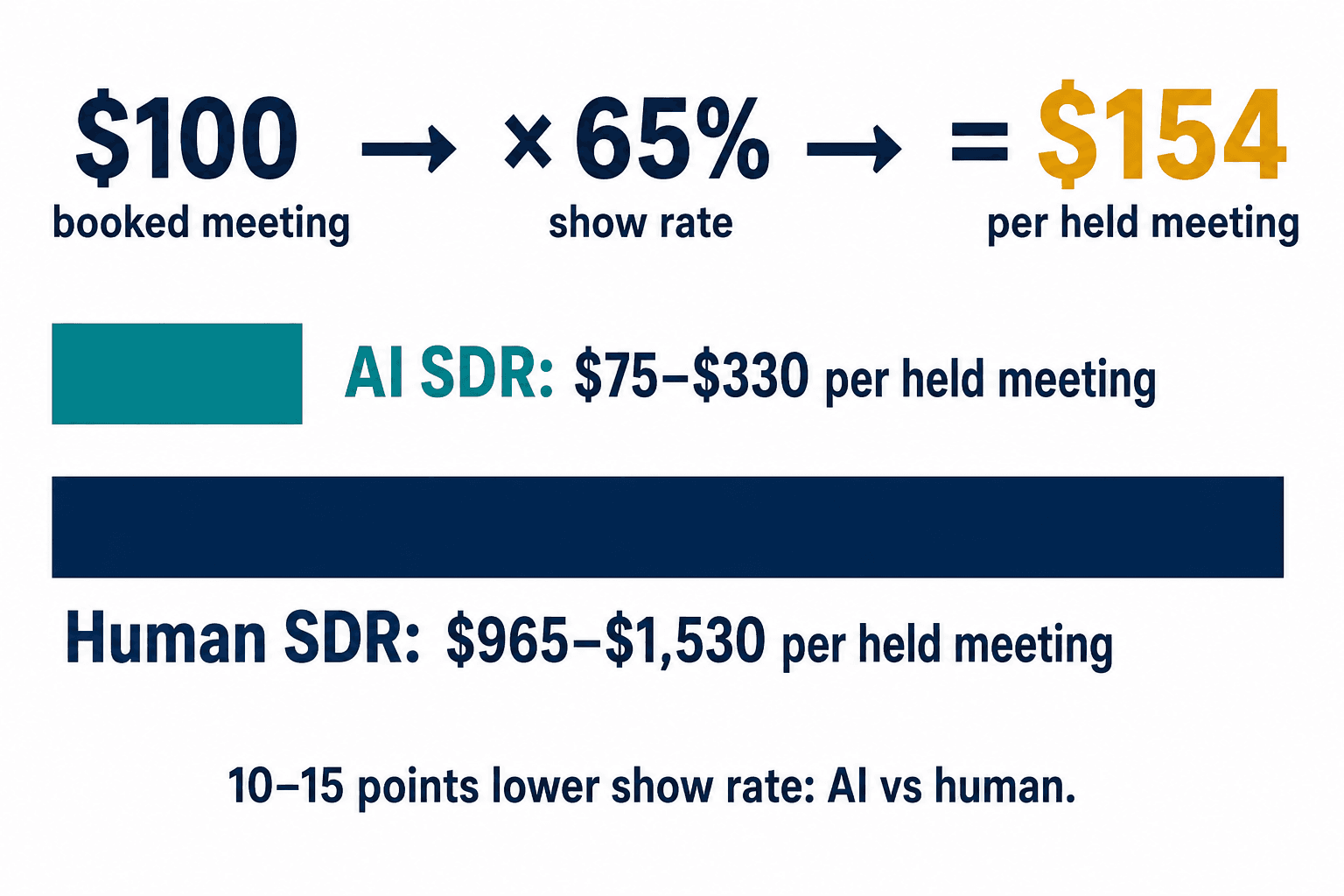
And quality degrades at scale. This is where the number that changed how I think about the whole problem comes in: show rates. Meetings booked by AI run 10 to 15 percentage points lower on show-up rate than meetings booked by a human. That sounds like a footnote until you do the arithmetic.
A $100 booked meeting that only shows up 65% of the time isn't a $100 meeting. It costs you $154 per meeting that actually happens.
This is the single most important reframe I can offer anyone evaluating these tools. The right denominator is not cost per booked meeting — it's cost per held meeting. I keep a spreadsheet for every client engagement with the show-rate column highlighted, because the gap between those two numbers is where the entire economic argument lives. The industry benchmark for AI SDR cost per held meeting lands somewhere between $75 and $330, and where you fall in that range is almost entirely a function of whether the meetings show — which is almost entirely a function of whether the outreach was good enough that the prospect actually wanted the conversation.
Volume-optimized autonomy is structurally incapable of caring about that. It books the meeting and moves on.
Why do sophisticated buyers delete your AI emails unread?
There's a second failure, and it's subtler, and for a while I didn't believe it mattered.
Every off-the-shelf tool generates email from the same handful of foundation models, with broadly the same general-purpose prompts. The output converges on a probabilistic mean: safe, fluent, neutral, and — to anyone who reads a lot of email — unmistakably synthetic. Words like delve, landscape, and transformative have become audible markers of machine-written text. The exact buyers you most want to reach, the sophisticated ones, have pattern-matched this tone completely. They delete on sight, without reading.
I'll admit I was skeptical of this for months. I thought, surely if the email is relevant and the offer is good, the phrasing is a rounding error. I was wrong, and the data is brutal: the average cold email reply rate in 2026 has fallen to 3.43%, and generic AI-written outreach sits below even that floor.
And this is what flips the whole problem on its head. The features that do earn replies — human sentence variation, specific and slightly idiosyncratic vocabulary, the structural quirks of how a particular good writer actually writes — are exactly the features a shared platform cannot produce. Not because the technology is weak, but because the platform has no access to the one thing that would make the email sound like a person: the writing of your best rep. It's optimizing toward the average of the internet. Your best rep is, by definition, not average.
That was the insight that turned into a product. Deep personalization — built on a company's actual top-performer data rather than generic enrichment — lifts reply rates by 142% over generic outreach, according to Martal's 2026 B2B benchmarks. The problem was never that AI can't write a good email. It's that nobody was teaching it to write like the specific human who already writes good emails at your company.
What we actually built
So we stopped trying to build an autonomous robot SDR. The autonomous part was the bug, not the feature.
Instead, Veriprajna builds custom AI sales personalization systems on a company's own top performers' data, inside the CRM they already run, with deliverability engineered from the first day instead of discovered at the first renewal.
The architecture came out of the three things I'd watched fail, taken in order.
Style came first, because it was the failure I'd been most wrong about. Rather than prompt a general model to "write a personalized cold email," we build a retrieval system over a company's best rep's actually-sent emails — the ones that got replies, the ones that booked meetings that showed. The model learns the cadence, the vocabulary, the way that particular human opens and closes, and generates in that voice for the specifics of each prospect. The difference, when you put the output side by side with a generic tool's draft, is not subtle. One reads like a person who knows the space. The other reads like every other email in the inbox.
Then deliverability — the thing that nearly killed us. We treat domain reputation as a hard constraint, not an afterthought. That means cold outreach runs on physically isolated domains, separated from the corporate sending domain so that even a bad week can't take down the CEO's investor mail. It means SPF, DKIM, and DMARC are all aligned and monitored — these are the email authentication standards that Google and Microsoft now strictly enforce — and it means the complaint rate is watched against that 0.3% line continuously, not read off a postmortem after the damage is done. I learned the cost of getting this wrong personally. No client of ours is going to learn it the same way.
And then there was honesty in the numbers. The system writes every touch back to the CRM activity timeline, so there's no silent gap where the AI did something the rep can't see. And we report on cost per held meeting, with show rate front and center, because that's the number that determines whether the whole thing is actually cheaper than a human — and it's the number autonomous platforms are structured to hide.
We didn't build a tool that replaces your best rep. We built one that clones how your best rep writes and guards your domain reputation instead of spending it.
"Why not just buy Outreach?" — the question your VP of Sales will ask
I get a version of this constantly, so let me answer it the way I'd answer it across a table.
The market has roughly six shapes of solution, and each is genuinely good at one thing and structurally weak at another. Data-enrichment platforms like Clay are extraordinary at pulling signal — 75-plus enrichment sources, research agents, real workflow flexibility — but personalization there is data-driven, not style-driven. They can tell the email what to say about a company; they have no system for how it should sound. Cold-email platforms like Instantly and Smartlead give you genuinely good deliverability tooling for $30–$78 a month, but the email generation is commoditized and style control is a prompt field, not a retrieval system. Sales-intelligence suites like Apollo and ZoomInfo are built around the contact database; AI writing is a bolt-on. The autonomous SDRs are the churn story above. And Salesforce Agentforce SDR integrates deeply into the CRM — at $125–$550 per user per month on top of your base Salesforce license, with the personalization quality capped by whatever lives in your Salesforce data and a platform lock-in you don't escape.
There's a seventh option people forget: build it internally. That runs $150K–$400K-plus in engineering time, requires ML talent most sales orgs don't have on staff, competes with the product roadmap for cycles, and — in my experience — stalls right around the deliverability problem, because that expertise is specialized and nobody on the team has burned a domain yet to know it matters.
None of these is a scam. They're just each solving a different slice. The gap we sit in is the one where you want your best rep's voice, inside your existing stack, without a new platform to churn from, and with someone who treats domain reputation as load-bearing.
The compliance line nobody is reading
There's one more thing I have to flag, because almost every vendor in this space is quietly ignoring it.
The EU AI Act's Article 5 has been enforceable since February 2025, and it prohibits AI that uses "subliminal techniques" to distort behavior in ways that cause harm. Personalized outreach is not inherently manipulative — the Commission's own guidance says so. But AI tuned to exploit psychological vulnerabilities, manufacture false urgency, or nudge a decision below the threshold of a person's awareness crosses a line that now carries real regulatory weight. I keep a printed copy of that clause with the "subliminal techniques" language circled, because the line between persuasive and prohibited is exactly the kind of thing a sales AI optimizing purely for conversion will sprint past without noticing. A system built right has that boundary designed in, not patched on after a complaint.
What I'd tell you if we only had five minutes
People ask me whether AI in sales is overhyped. My honest answer is that the autonomous version is, and the market is busy proving it at a 50–70% churn rate. But the underlying capability — generating genuinely personalized outreach in a real human's voice, at a scale no human could match — is the opposite of hype. It works. It just doesn't work the way it was sold.
The companies winning with this aren't the ones who bought the most aggressive autonomy. They're the ones who figured out that the constraint was never "can the AI write" — it was "can the AI write like someone worth reading, without setting your domain on fire, in a way you can actually measure." Get those three right and the economics aren't close: $75–$330 per held meeting against the $965–$1,530 a human SDR costs you for the same outcome. Get any one wrong and you're back on a renewal call, explaining to your board why nobody's email is landing.
I know which side of that I want my clients on, because I've made those calls to Mailforge with the whole company's mail dark behind me, and I'm not going back. If you want to see how we put the pieces together, it's all here.
The robots didn't fail because they were too ambitious. They failed because they optimized for the one number that was easy to show and ignored the three that actually mattered.