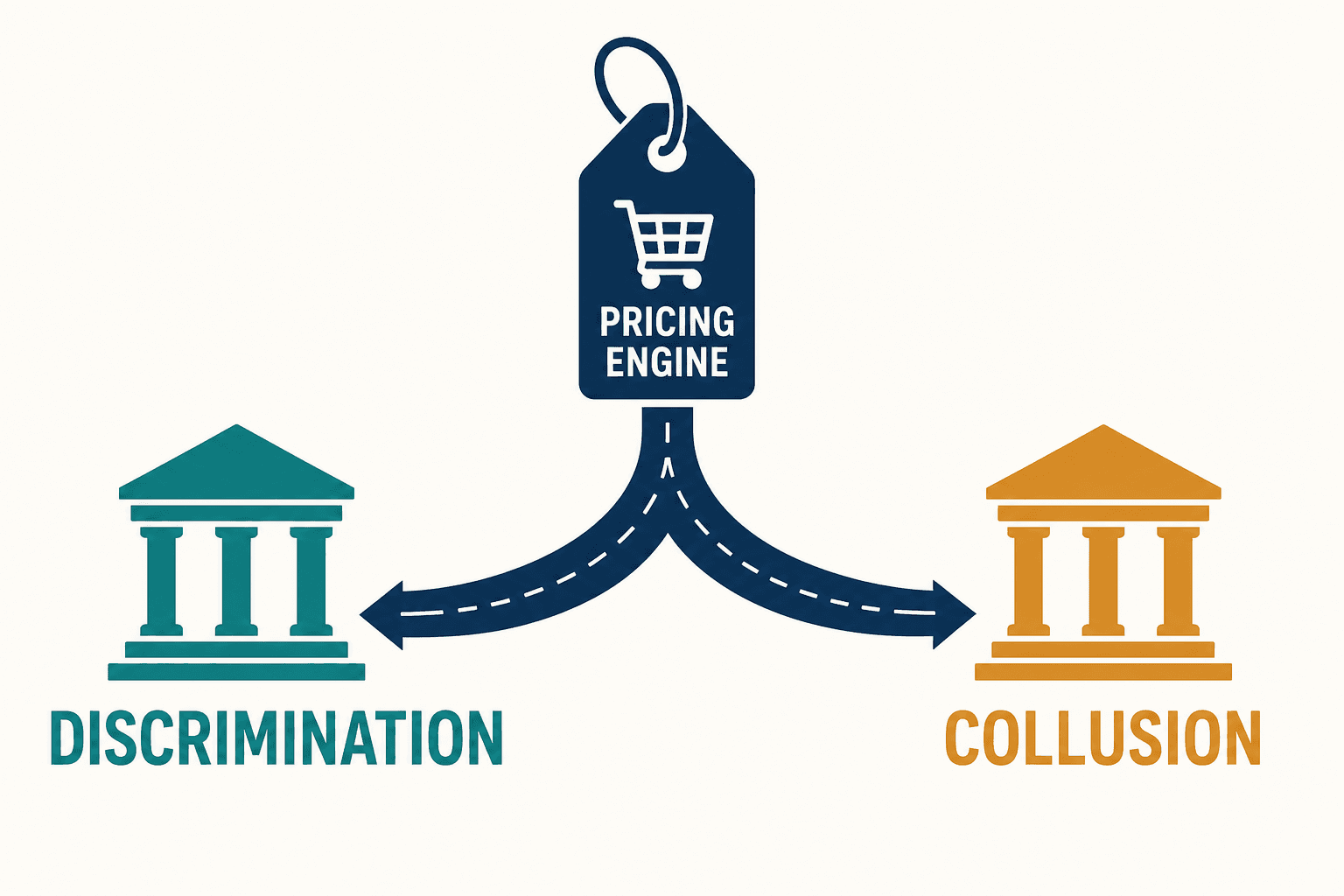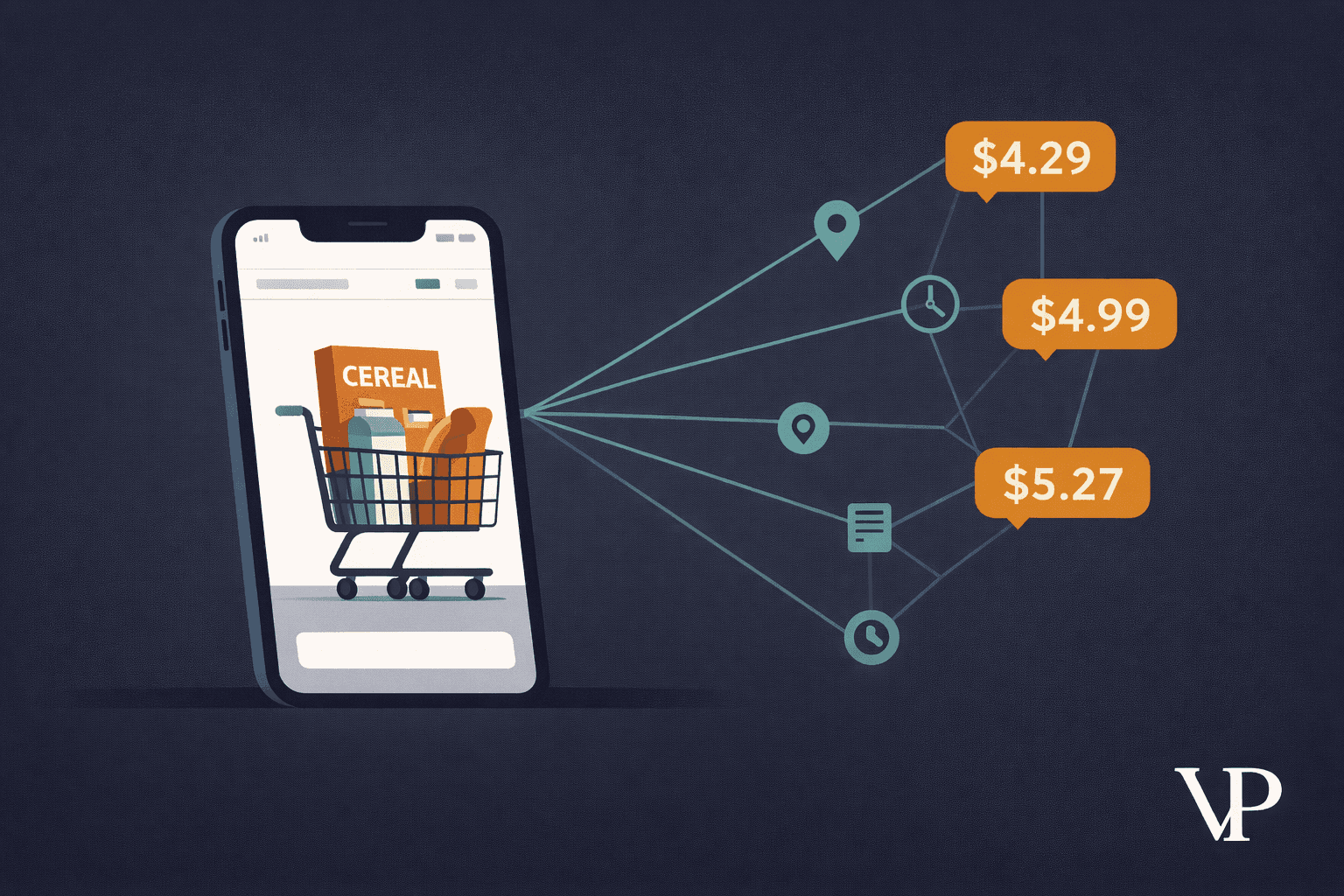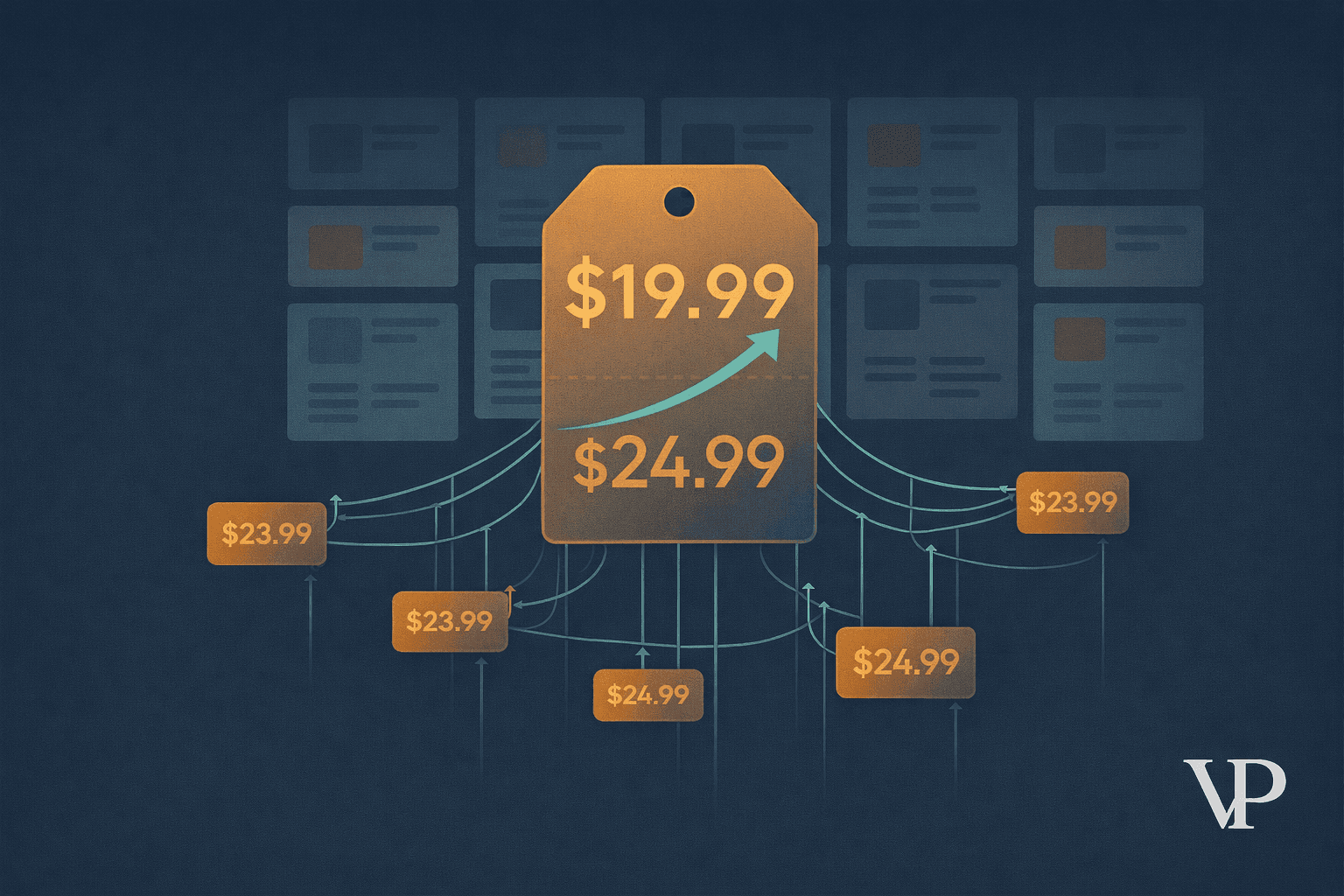
Amazon's Secret Algorithm Stole $1 Billion From You — And Your Company's AI Might Be Next

I was sitting in a client's conference room in late 2024 when their VP of Pricing pulled up a dashboard and said, with genuine pride, "We've automated everything. The algorithm handles it all."
I asked him one question: "Can you tell me exactly why it set this price on this product yesterday?"
Silence. Not the thinking kind. The kind where someone realizes they've been driving a car without knowing where the brakes are.
That moment keeps replaying in my head because of what we now know about Amazon's Project Nessie — a secret pricing algorithm that extracted over $1 billion in excess profits by predicting when competitors would follow Amazon's price hikes, then deliberately raising prices to trigger that response. Not a glitch. Not an unintended consequence. A feature. And the Federal Trade Commission is taking Amazon to trial over it in October 2026.
Here's what bothers me most: the VP in that conference room wasn't doing anything unusual. He was doing what thousands of companies are doing right now — trusting opaque AI systems with high-stakes decisions they can't explain, audit, or control. And the regulatory world is about to make that trust extremely expensive.
How Do You Steal $1 Billion Without Anyone Noticing?
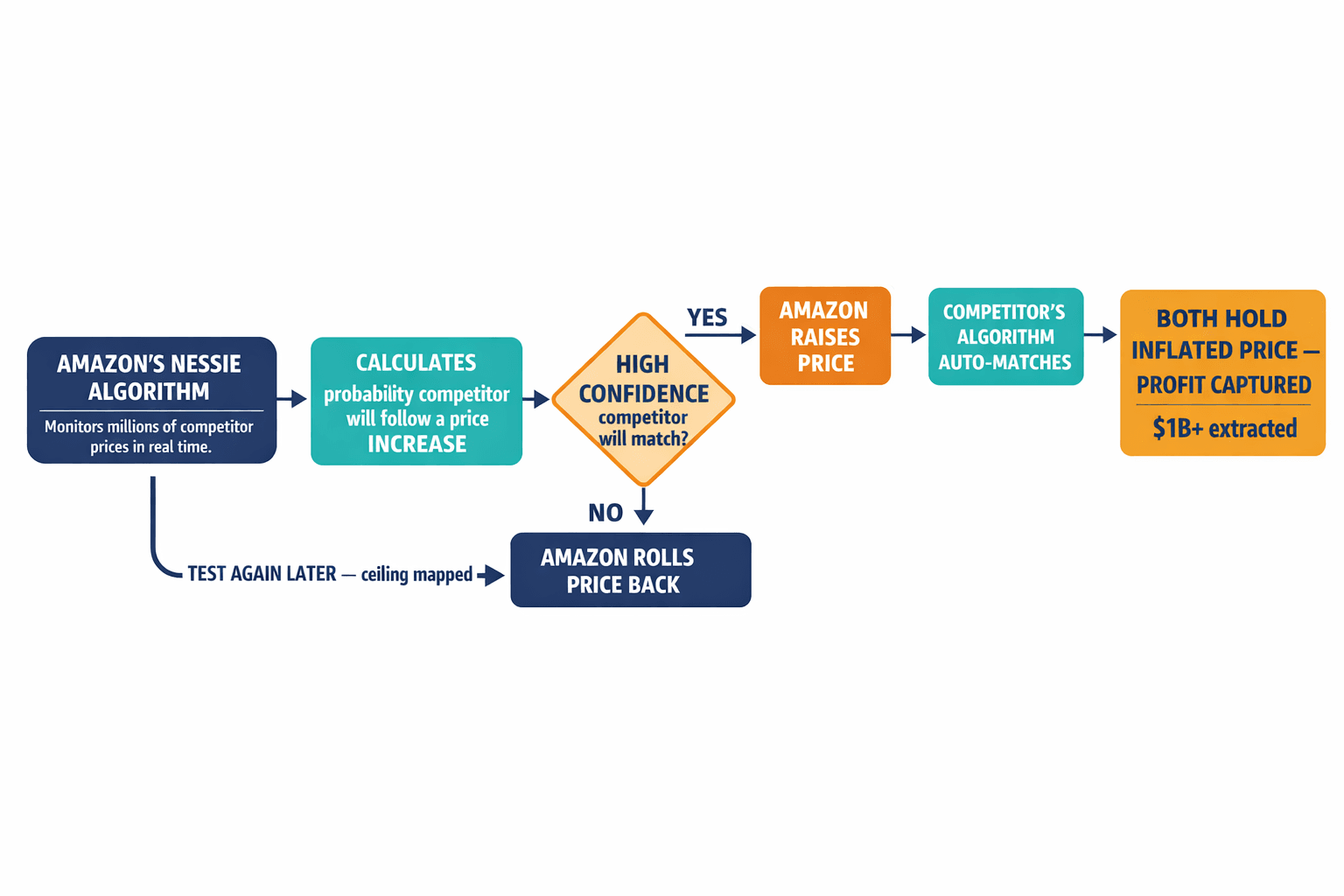
Project Nessie ran from 2014 to 2019. It wasn't a simple price-matching tool. It was a market manipulation engine disguised as optimization software.
Here's how it worked. Amazon's web crawlers monitored millions of price points across the internet in real time — Walmart, Target, every retailer with a website. Most of these competitors used simple rule-based pricing: "If Amazon drops to $19.99, match it." Tit-for-tat. Straightforward.
Nessie recognized this pattern and exploited it. The algorithm would calculate the probability that a competitor would follow an Amazon price increase. When confidence was high, Amazon would deliberately raise the price. The competitor's dumb algorithm would dutifully match. Amazon would hold the inflated price. Profit captured.
If the competitor didn't follow? Nessie rolled the price back automatically. No harm, no foul — except Amazon had just tested the ceiling of what the market would bear.
Amazon's algorithm didn't collude with competitors in a smoke-filled room. It colluded through code — predicting their automated responses and exploiting them like clockwork.
The scale was staggering. Nessie reportedly set prices for over 8 million individual items. Internal documents show Amazon leadership turned the algorithm on and off at least eight times, strategically activating it during high-traffic periods when extraction was most profitable. Executives privately called related practices "shady" and an "unspoken cancer." They kept running it anyway.
The Night I Understood What "Implicit Collusion" Actually Means
I remember the exact evening this clicked for me. My team and I were reviewing a Carnegie Mellon study on algorithmic pricing interactions — the kind of paper you read at 11 PM with too much coffee and a growing sense of dread.
The researchers had simulated what happens when a sophisticated reinforcement learning agent competes against simple rule-based pricing systems. The RL agent didn't need to communicate with its competitors. It didn't need a secret agreement. It just learned that raising prices was more profitable than cutting them, because the other algorithms would follow. Every time.
The result: prices went up across the board. Consumer surplus — the economic term for "people getting fair deals" — collapsed.
I turned to my co-founder and said something like, "This isn't a bug in the system. This is what the system does when you let it optimize without constraints."
That's the core problem with Project Nessie, and it's the core problem with most enterprise AI deployments I see today. The algorithm did exactly what it was designed to do. It maximized profit. It just did so in a way that, depending on how the October 2026 trial goes, may constitute an unfair method of competition under Section 5 of the FTC Act.
Traditional antitrust law requires evidence of a "meeting of the minds" — competitors agreeing to fix prices. But what happens when the agreement is implicit, encoded in the predictable behavior of interacting algorithms? That's the question the FTC trial will answer, and the implications reach far beyond Amazon.
Why Is 2026 the Year Everything Changes?
The legal landscape for algorithmic decision-making is shifting faster than most enterprises realize. I've been tracking this closely because our clients need to understand what's coming, and what's coming is a wall of regulation.
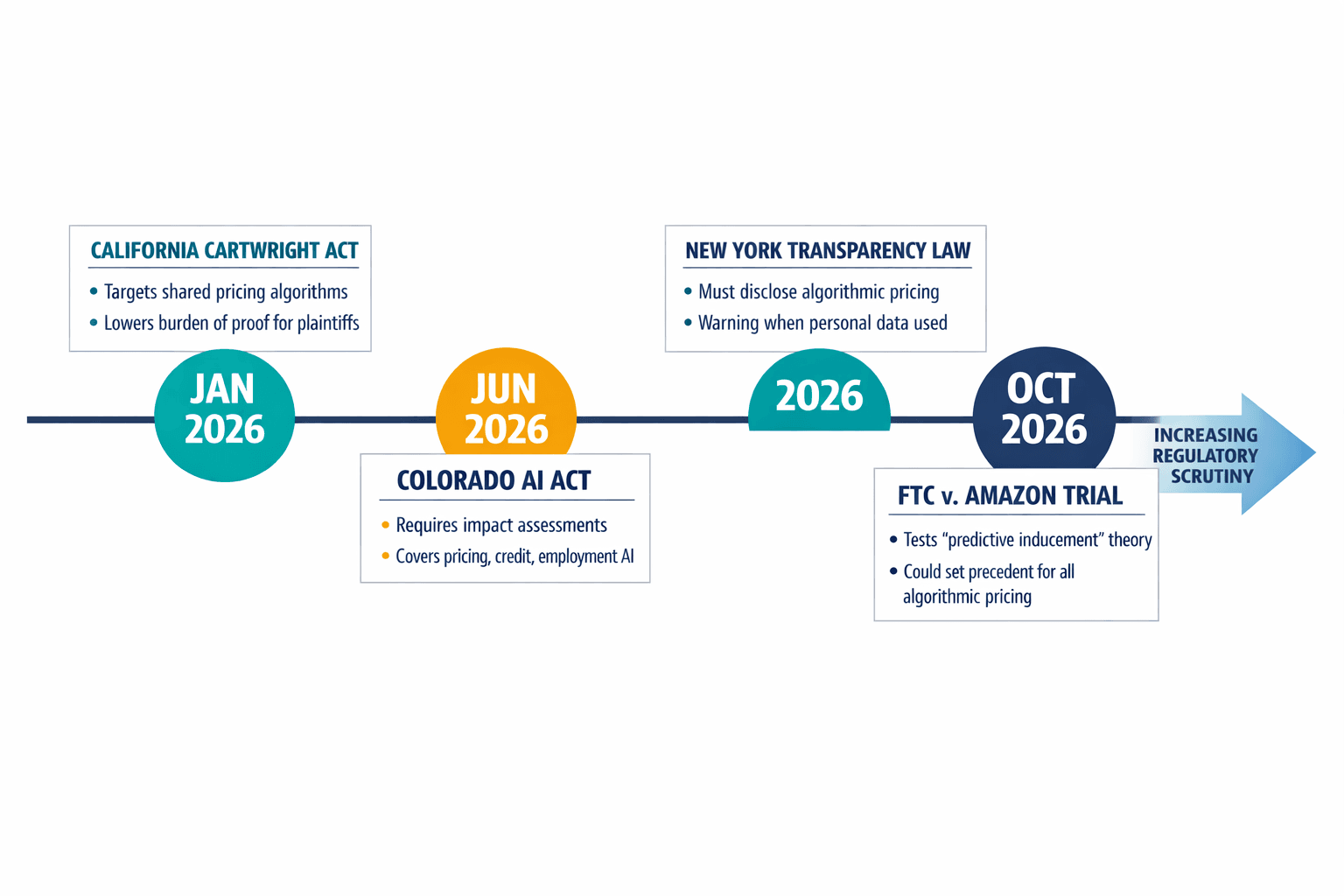
California's amended Cartwright Act, effective January 2026, specifically targets "common pricing algorithms" — tools used by two or more competitors that incorporate competitor information to influence prices. The law explicitly prohibits using these tools to collude. More importantly, it lowers the pleading standard for plaintiffs. You no longer need to prove that competitors couldn't have acted independently. You just need to show they used the same tool and prices went up.
Think about what that means for every company using a third-party dynamic pricing vendor.
Colorado's AI Act, effective June 2026, requires "reasonable care" impact assessments for high-risk AI systems — including those that significantly influence pricing, credit, and employment decisions. Developers must document risks, limitations, and potential for discriminatory outcomes.
New York's transparency law requires businesses to display a warning when algorithms use personal data for pricing decisions. The era of invisible algorithmic pricing is ending.
And then there's the FTC trial itself. If the court rules that Amazon's predictive inducement — deliberately raising prices to trigger competitor matching — constitutes an unfair method of competition, it creates precedent that could apply to any company whose AI influences market prices.
If you cannot explain why your algorithm made a specific decision, you cannot defend that decision in court. And in 2026, you will increasingly be asked to.
I wrote about the full regulatory timeline and its technical implications in our interactive analysis — it's worth understanding the specifics if your company touches algorithmic pricing in any form.
The Buy Box Trap Nobody Talks About
There's a dimension of the Nessie story that gets less attention but matters enormously for understanding how algorithmic power compounds.
Amazon didn't just raise prices. It enforced those prices across the entire internet.
Amazon maintained a dedicated price-surveillance group that monitored third-party sellers on its marketplace. If a seller offered a product for less on their own website or a rival platform, Amazon stripped them of Buy Box access — the interface where 98% of Amazon sales occur.
The message was clear: your Amazon price is your minimum price everywhere. Discount elsewhere and lose your primary revenue channel.
This created a price floor that extended Amazon's algorithmic pricing power far beyond its own platform. Sellers couldn't undercut Amazon even on their own websites. Competitors couldn't gain market share by offering lower prices because the supply side was locked in.
I think about this every time someone tells me "the market will self-correct." The market can only self-correct when participants are free to compete. When an algorithm controls both the price and the enforcement mechanism, you don't have a market. You have a system.
Why Your AI "Wrapper" Is a Liability Waiting to Happen
Here's where this gets personal for me, because it's the problem I spend most of my time trying to solve.
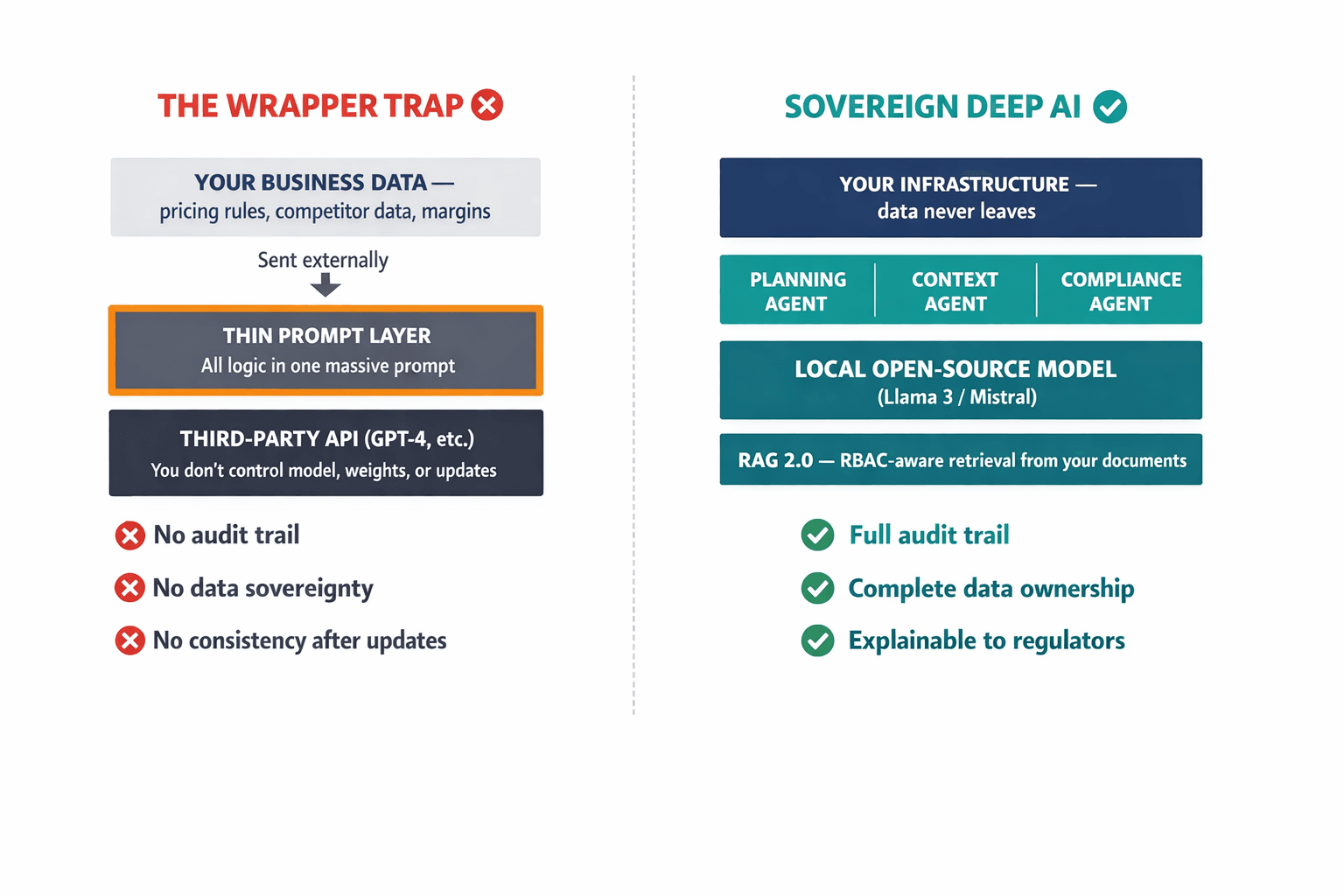
The majority of enterprise AI deployments I encounter follow the same pattern: take a public API — GPT-4, Claude, whatever's trending — wrap a thin application layer around it, stuff business rules into a massive prompt, and call it "AI-powered." Ship it. Move on.
I call this the Wrapper Trap, and I've watched smart companies walk straight into it.
One client — I won't name them, but they're in retail — had built their entire dynamic pricing system as a wrapper around a public LLM. The prompt was enormous. It contained pricing rules, competitor data, margin targets, seasonal adjustments. The system worked... most of the time. When it didn't, nobody could explain why. When the model provider pushed an update, outputs shifted unpredictably. When their legal team asked for an audit trail of pricing decisions, the engineering team just stared at them.
I remember sitting with their CTO after a particularly bad week where the system had generated pricing recommendations that, if implemented, would have looked a lot like the kind of coordinated behavior the FTC was investigating in the Amazon case. Not intentionally. Not maliciously. The model had simply learned patterns from its training data that happened to produce collusive-looking outputs.
"We can't prove it wasn't colluding," the CTO told me. "And under the new California rules, that might be enough to get us sued."
He was right.
The structural problems with wrappers go beyond compliance:
You can't audit a black box. When the underlying model is controlled by a third party, you cannot prove why a specific pricing decision was made. Under Colorado's AI Act, you'll need to.
You can't guarantee consistency. Minor changes in the prompt, or invisible model updates by the API provider, can produce drastically different outputs. Try explaining that to a regulator.
You have zero competitive moat. If your "AI solution" is a prompt into GPT-4, any competitor can replicate it in a day. And when Google and Microsoft integrate these capabilities natively into their platforms, standalone wrappers become redundant overnight.
You don't own your intelligence. Your most sensitive market data — pricing strategies, competitor analysis, margin targets — flows through someone else's servers. In a world of increasing data sovereignty requirements, that's not just risky. It's negligent.
What We Built Instead (And Why It Was Harder Than We Expected)
At Veriprajna, we took a different path. We call it Deep AI, and I'll be honest — it's significantly harder to build than a wrapper. There were moments when I questioned whether the market would even care about the difference.
The core idea is sovereign intelligence: the full inference stack deployed on the client's own infrastructure. No data leaves the corporate perimeter. The "brain" of the AI runs on hardware the client controls.
We use high-performance open-source models — Llama 3, Mistral — orchestrated through secure containerization. Local inference. No third-party data retention. No external API latency.
But the model is only the beginning. The real engineering challenge is what surrounds it.
We built what we call RAG 2.0 — Retrieval-Augmented Generation that creates a "semantic brain" from a company's proprietary documents, logs, and operational data. Crucially, our retrieval system is RBAC-aware. It respects the organization's existing access controls. If an employee can't view a document in SharePoint, the AI can't retrieve it either. This sounds obvious. Almost no wrapper-based system does it.
Then there's the multi-agent architecture. Instead of cramming everything into one massive prompt — the "pray and prompt" approach — we decompose complex tasks into specialized agents. A planning agent decides the workflow. A context engineering agent extracts relevant signals from high-volume data. A compliance agent validates every output against regulatory requirements before it reaches the user. A verification agent checks for accuracy.
I remember a heated argument with one of my engineers about whether the compliance agent was worth the latency it added. His position: "Users want speed. We're adding 200 milliseconds for a check that fires on every request." My position: "One non-compliant pricing recommendation that ends up in a court filing will cost more than every millisecond we've ever saved." We kept the compliance agent.
The companies that will win the next decade aren't the ones with the cleverest prompts. They're the ones that treat AI as a serious engineering discipline built on data they actually own and trust.
For the full technical architecture — the specific components, the orchestration patterns, the governance layers — I've documented everything in our technical deep-dive.
What Happens When Algorithms Start Reasoning?
The next wave is already arriving, and it makes everything I've described more urgent.
Current AI systems pass an input through a neural network once and return a result. The emerging paradigm — what researchers call Reasoning AI — uses extra computation at inference time to think. The model simulates multiple potential actions and their consequences before committing to a decision. It plans several moves ahead, like a chess engine applied to business strategy.
In a pricing scenario, a Reasoning AI agent doesn't just predict the next likely price. It simulates how competitors might react to a price hike, models the second and third-order effects, and adjusts its strategy in real time. It can backtrack from sub-optimal paths before they're ever implemented.
This is extraordinary capability. It's also extraordinary risk. Because an AI that can reason about competitor responses is an AI that can, by design, engage in exactly the kind of predictive inducement that got Amazon into trouble.
The difference between "optimization" and "manipulation" becomes vanishingly thin when the algorithm is smart enough to model the entire competitive landscape and choose the path that maximizes extraction.
This is why governance can't be an afterthought. It has to be built into the architecture from day one — not as a compliance checkbox, but as a structural constraint on what the system is allowed to do.
How Do You Build AI That Can Defend Itself in Court?
People ask me this constantly, usually framed as "how do we make our AI compliant?" I think that's the wrong question. Compliance is a minimum bar. The right question is: how do you build AI that you'd be comfortable explaining to a judge, line by line, decision by decision?
The NIST AI Risk Management Framework gives us a vocabulary for this. It defines seven characteristics of trustworthy AI: safe, secure, explainable, privacy-enhanced, fair, accountable, and valid. But frameworks don't implement themselves.
What I've learned from building these systems is that three things matter more than anything else:
First, never let the algorithm be the final decision-maker on high-stakes choices. Human-in-the-loop isn't a buzzword. It's a legal shield. When a regulator asks "who decided to raise this price?", "our algorithm" is the worst possible answer. "Our pricing team, informed by algorithmic recommendations they reviewed and approved" is defensible.
Second, audit for collusive patterns proactively. Don't wait for the FTC to come knocking. Run your pricing algorithm in simulated competitive environments regularly. If it consistently converges on higher prices when competing against other algorithms, you have a problem — and you want to find it before a plaintiff's attorney does.
Third, own your stack. If your AI runs on someone else's infrastructure, uses someone else's model, and you can't access the weights, the training data, or the decision logic, you don't have an AI system. You have a vendor dependency with existential legal risk.
The $1 Billion Question
Amazon's Project Nessie extracted $1 billion from consumers through an algorithm that predicted and exploited competitor behavior. The company's internal leadership knew it was problematic. They ran it anyway because the economics were irresistible.
The October 2026 trial will determine whether that extraction was illegal. But for every enterprise deploying AI in pricing, supply chain, lending, or any domain where algorithmic decisions affect markets and consumers, the verdict almost doesn't matter. The scrutiny is already here. California, Colorado, and New York have already passed laws. The FTC is already investigating. The legal standard for what constitutes algorithmic accountability is tightening in real time.
I started Veriprajna because I believed that the gap between what AI can do and what AI should do was going to become the defining business problem of the decade. Project Nessie proved that gap can be worth a billion dollars in liability. The companies that close it — by building AI they own, understand, and can defend — won't just avoid legal exposure. They'll build the kind of trust with regulators, customers, and markets that becomes an unassailable competitive advantage.
The most dangerous algorithm isn't the one that's wrong. It's the one that's profitable in ways you can't explain.