The AI Industry Has a Physics Problem — And It's Costing Retailers $890 Billion

A fashion brand showed me their new AI virtual try-on tool last year. They were proud of it — and honestly, it looked incredible. A user could upload a selfie, pick a dress, and the AI would render a gorgeous image of them wearing it. The lighting was soft, the fabric draped beautifully, the fit was flawless.
That was the problem. The fit was always flawless.
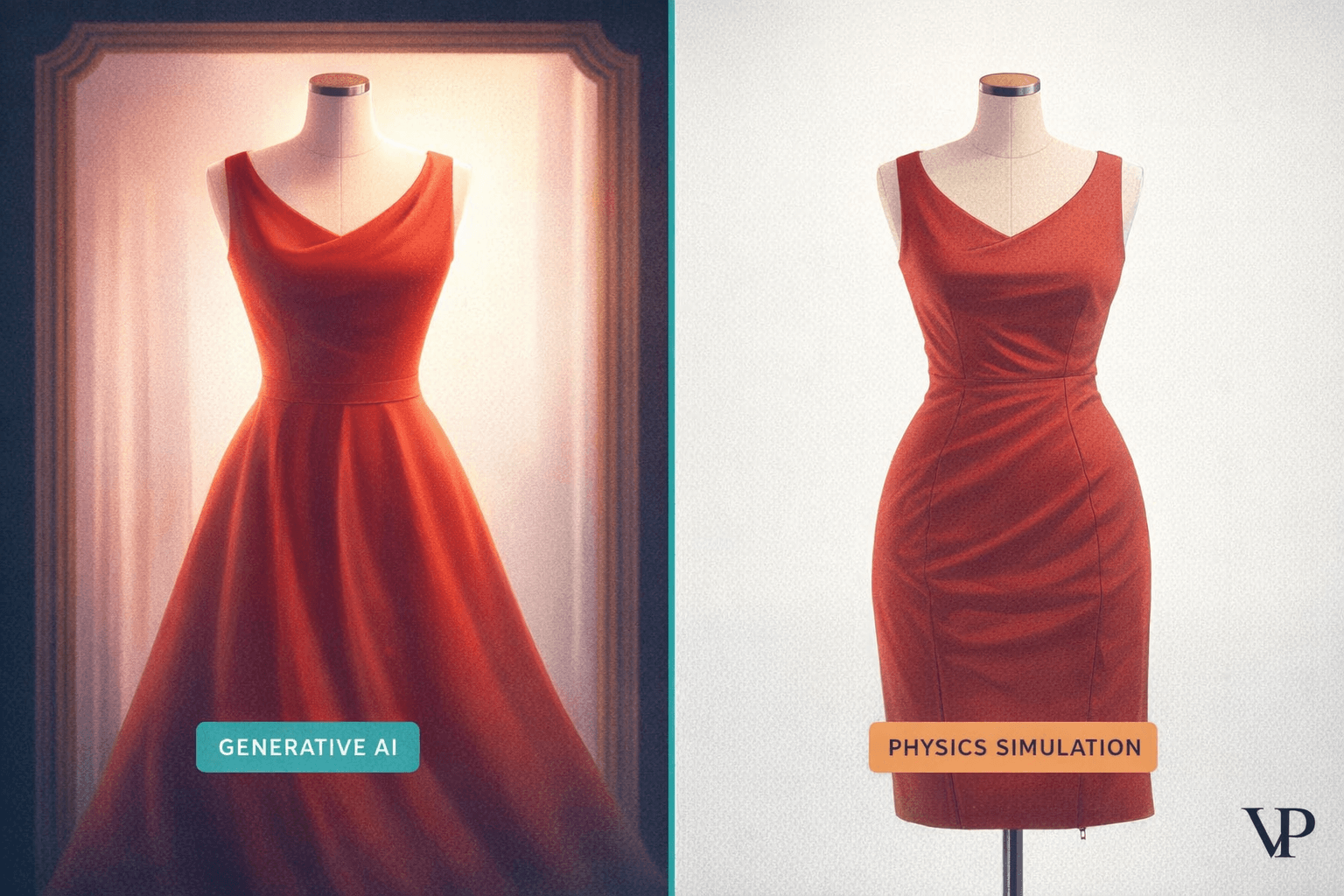
I asked them to try something: upload a photo of someone clearly a size 12 and select a size 6 dress. The AI didn't show the zipper straining. It didn't show the fabric pulling at the seams. It warped the dress to cover the body perfectly — or worse, subtly warped the body to fit the dress. It was a fantasy mirror, not a fitting room. And every customer who bought based on that fantasy was going to return the product.
That demo crystallized something I'd been wrestling with for months at Veriprajna. The AI industry doesn't have an intelligence problem. It has a physics problem. Generative models optimize for pixel coherence — for making images look right. But in the real world, fabric has tensile strength. Sound waves have copyright owners. And "mostly right" isn't a business model when you're hemorrhaging margins on returns or facing a lawsuit from Universal Music Group.
This is the story of why we abandoned the dominant approach to enterprise AI and built something fundamentally different.
The $890 Billion Fantasy Mirror
Here's a number that should make every e-commerce executive lose sleep: consumer returns in retail totaled an estimated $890 billion in 2024, according to the National Retail Federation. Not million. Billion. And apparel is the worst offender — online clothing return rates consistently exceed 25-30%, with some high-fashion categories hitting 50% during peak seasons.
The root cause isn't complicated. People can't tell if clothes will fit from a photo. "Incorrect size, bad fit, and color" account for 55% of all returns. This uncertainty has spawned a consumer behavior called "bracketing" — buying three sizes of the same shirt, trying them on at home, returning two. In 2024, 51% of Gen Z consumers admitted to doing this. They've turned their bedrooms into fitting rooms and the postal service into a returns conveyor belt.
Processing a single return costs retailers an average of 27% of the item's purchase price. Shipping, inspection, cleaning, repackaging — all for an item that might end up marked down anyway. It's a margin incinerator.
The fashion industry doesn't have a conversion problem. It has a truth problem. AI that flatters instead of informing is just accelerating the returns cycle.
So the industry turned to technology. Virtual try-on tools powered by generative AI — GANs, diffusion models, the whole arsenal. And these tools are brilliant at one thing: making sales. They optimize for click-through rates and initial conversions. They sell the dream.
They just can't deliver the reality.
Why Does Generative AI Hallucinate Fit?
I remember the exact moment my team stopped believing in generative virtual try-on. We were benchmarking a diffusion-model-based system — one of the well-funded ones — against physical garment samples. We had a denim jacket, raw and unforgiving, the kind of fabric that has essentially zero stretch. We fed the system a user photo and the jacket image.
The AI rendered a beautiful result. The jacket fit perfectly. On a body that, in physical reality, couldn't have gotten the left arm through the sleeve.
My co-founder looked at the screen and said, "It's not trying on the jacket. It's Photoshopping the jacket." And that's exactly right. A diffusion model's objective function is pixel coherence — making the output image look statistically plausible given its training data. It has no concept of tensile stiffness. It doesn't know that raw denim won't stretch. It doesn't know anything about fabric at all.
This creates three cascading failures:
The fit hallucination. The model warps the garment to cover the body, or warps the body to fit the garment. Either way, the customer sees a lie. Industry analysis has been blunt about this: "Virtual try-ons lack real-world accuracy, ignore fabric behavior, and can mislead customers about how a garment truly fits and feels."
Texture degradation. GANs suffer from mode collapse — fine details like lace, embroidery, or complex weaves get blurred into generic patterns. Diffusion models sometimes invent details that don't exist on the physical product. Now the customer is surprised by both the fit and the appearance.
The paper doll effect. Most 2D-based systems paste a flat image of clothing over a user. No depth perception. No understanding of how fabric drapes over the curve of a hip or gathers at a waist. For anything loose or flowing — where the drape is the style — the result is useless.
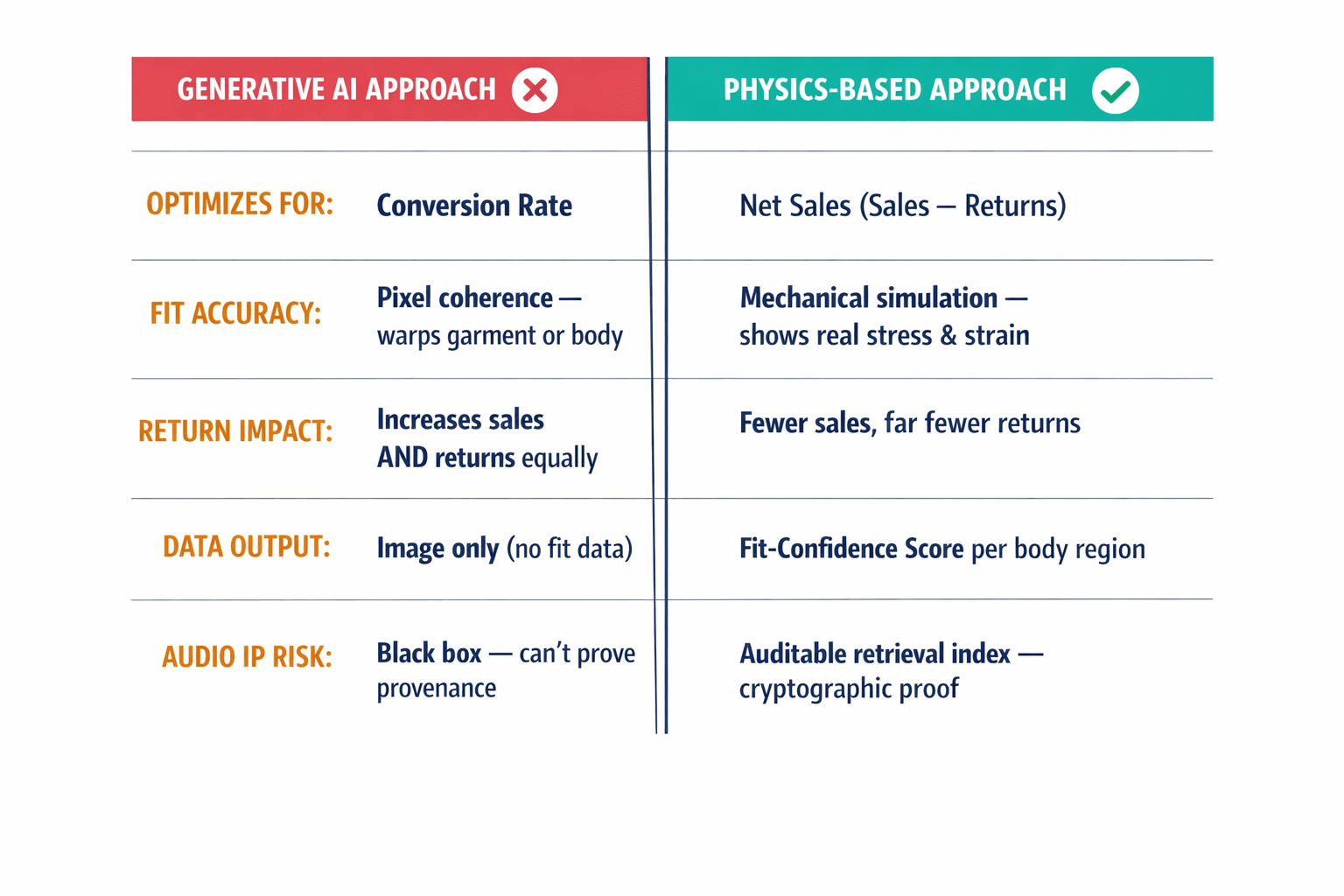
We were looking at a technology that increased sales and increased returns in roughly equal measure. Net impact on margin: negligible, possibly negative. That's when I knew we needed a completely different architecture.
Simulating the Dress Instead of Imagining It
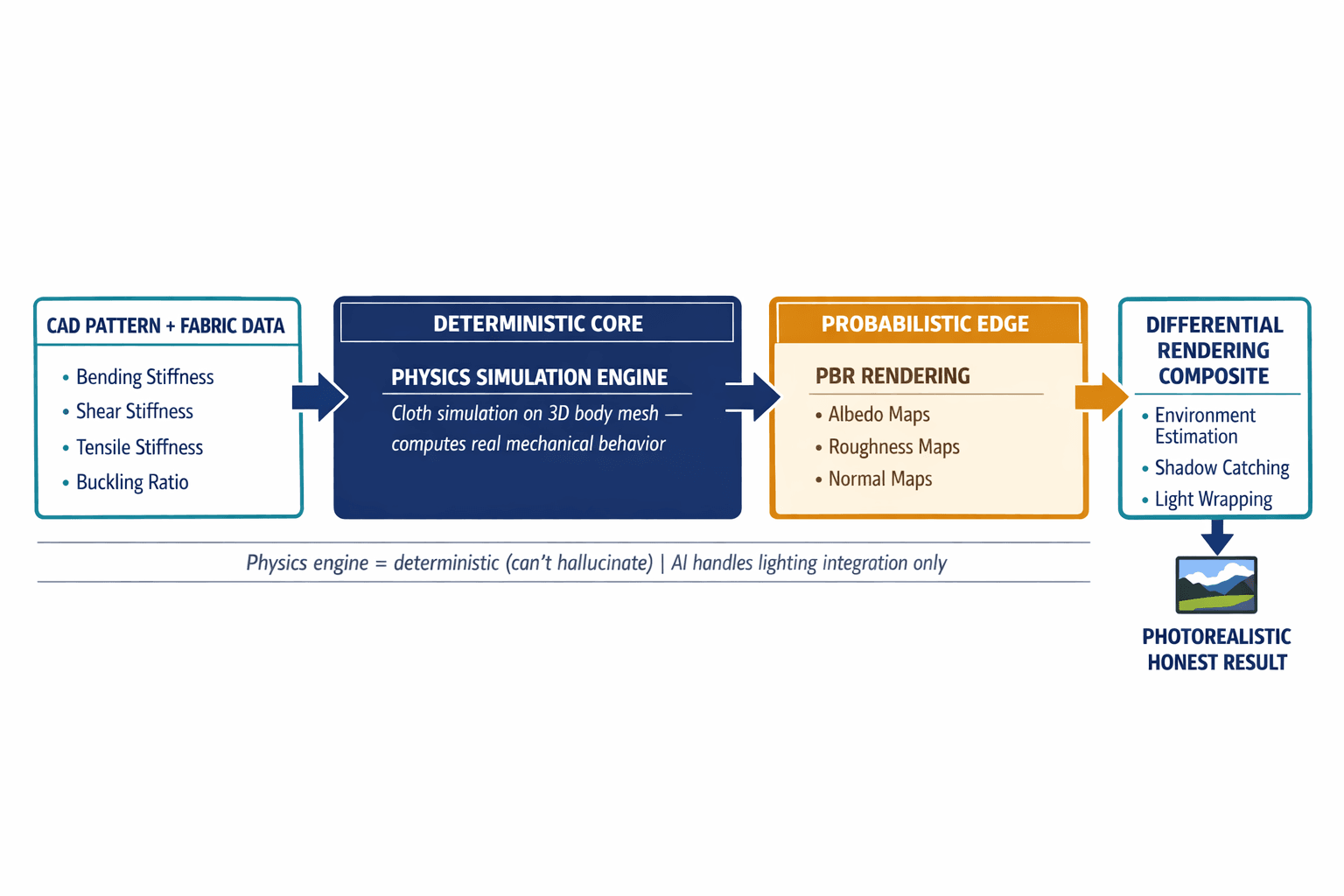
The breakthrough wasn't a better neural network. It was a decision to treat virtual try-on as a mechanical engineering problem instead of an image generation problem.
At Veriprajna, we built what I call a "Deterministic Core, Probabilistic Edge" architecture. The core — the part that determines whether a garment fits — is a physics simulation engine, similar to what professional fashion designers use in tools like CLO3D or Marvelous Designer. We don't train a neural network on images of clothes. We ingest the actual CAD patterns of the garments and assign them the physical properties of their real-world fabrics.
This matters more than it might sound. Every fabric has measurable mechanical properties: bending stiffness (does it drape like silk or hold rigid like denim?), shear stiffness (how does it behave on the bias?), tensile stiffness (how much does it stretch under tension?), internal damping (how does it settle on the body?), buckling ratio (how does it bunch and gather?). Our simulation calibrates against all of these.
The result is that when a size 12 body tries on a size 6 dress in our system, the simulation shows exactly what would happen in a physical fitting room. Stress lines appear. The "X" pattern at the waist that any tailor would recognize. The fabric visibly fails to close. It's not flattering. It's honest.
We replaced the fantasy mirror with a physics engine. If the garment doesn't fit, the simulation shows you — stress lines, pulling, fabric that won't close. Honesty turns out to be better for business than flattery.
I wrote about the full technical architecture — the PBR rendering pipeline, the cloth simulation parameters, the differential rendering compositing — in the interactive version of our research. But the core insight is simple: a physics engine can't hallucinate. It computes. And computation, unlike generation, is deterministic.
The Hardest Part Wasn't the Physics
Here's what I didn't expect: the physics simulation was the easy part. The genuinely hard problem was making the result look real enough that customers would trust it.
A perfectly accurate physics simulation rendered with bad lighting looks like a video game asset pasted onto a photo. Customers take one look and dismiss it. We'd solved the accuracy problem and created a credibility problem.
This is where we brought AI back in — not to generate the garment, but to solve the lighting and integration challenge. We use Physically Based Rendering (PBR) to model how light interacts with fabric surfaces using physically accurate formulas. Albedo for base color, roughness maps for how light scatters (cotton versus satin), normal maps for microscopic surface texture like the weave of twill.
But the real magic is in what happens when you place that 3D garment into a customer's 2D photo. If the lighting on the digital dress doesn't match the lighting in the customer's room, the whole thing looks fake — like a sticker slapped onto an image.
We spent weeks on this. Late nights arguing about whether the CNN-based environment estimation was good enough, whether the shadow catching was too aggressive, whether the light wrapping at the garment edges was too subtle. There was a specific Thursday — I remember because we'd ordered pizza and it had gone cold — when our rendering lead pulled up a comparison: our composite next to a real photograph of the same garment on the same person. Three of us couldn't tell which was which. The fourth could, but only because she noticed a slight color temperature mismatch on a zipper pull.
That was the moment I knew we had something.
The technique is called differential rendering — you calculate the effect of the 3D object on the scene without re-rendering the scene itself. Shadow catchers, environment maps estimated from the user's photo, light wrapping at the edges to simulate subsurface scattering. The garment casts a realistic shadow onto the user's real legs. The buttons reflect the same window light that's in the user's eyes.
What Metric Should Virtual Try-On Actually Optimize?
This is where the business case gets interesting, and where I think most of the industry has it backwards.
Generative AI virtual try-on optimizes for conversion rate. It sells the fantasy. Our system optimizes for net sales — sales minus returns. By showing the truth, even when the truth is "this doesn't fit you," we prevent the margin-killing returns cycle.
We also output data, not just images. Our system generates a Fit-Confidence Score — something like "95% match for waist, 60% match for hips." This does something counterintuitive: it sometimes discourages a purchase. But the purchases it doesn't discourage almost never come back. And the customer trusts the system more next time. Trust compounds. Returns don't.
People ask me whether showing unflattering fit information hurts conversion rates. Short answer: yes, initially. Longer answer: the customers you lose are the ones who would have returned the product anyway. You're not losing revenue — you're losing the illusion of revenue that was going to evaporate in two weeks when the return showed up.
The Other Minefield: Why Generative Audio Is a Legal Time Bomb
While we were building physics engines for fashion, we were simultaneously navigating an equally treacherous domain: audio. And here, the problem isn't physics — it's law.
The music and voice industries are in the middle of an existential crisis over generative AI. Universal Music Group, Sony Music, and the RIAA have filed major lawsuits against AI companies like Suno and Udio. The core issue: most generative audio models were trained on copyrighted music scraped from the web. If an enterprise uses one of these models to generate a jingle and that output inadvertently mimics a copyrighted work — a phenomenon called "regurgitation" — the enterprise is liable for infringement. And because the models are black boxes, you can't verify the provenance of what comes out.
It gets worse. Under current U.S. Copyright Office guidance, works created solely by AI without significant human intervention aren't eligible for copyright protection. Which means if a brand uses a pure generative tool to create a sonic logo, they can't own it. It enters the public domain. Competitors can use it freely. For commercial IP, this is a non-starter.
If you can't prove where your AI audio came from and you can't own what it produces, you don't have an asset — you have a liability.
We ran into this wall early. An advertising agency came to us wanting AI-generated voice work for a campaign. They'd been using a popular text-to-speech tool and had just received a cease-and-desist letter. The tool had apparently been trained on voice data that included samples from a recognizable actor. Nobody could prove it definitively — black box — but nobody could disprove it either. The campaign was shelved.
How Do You Make AI Audio That's Actually Legal?
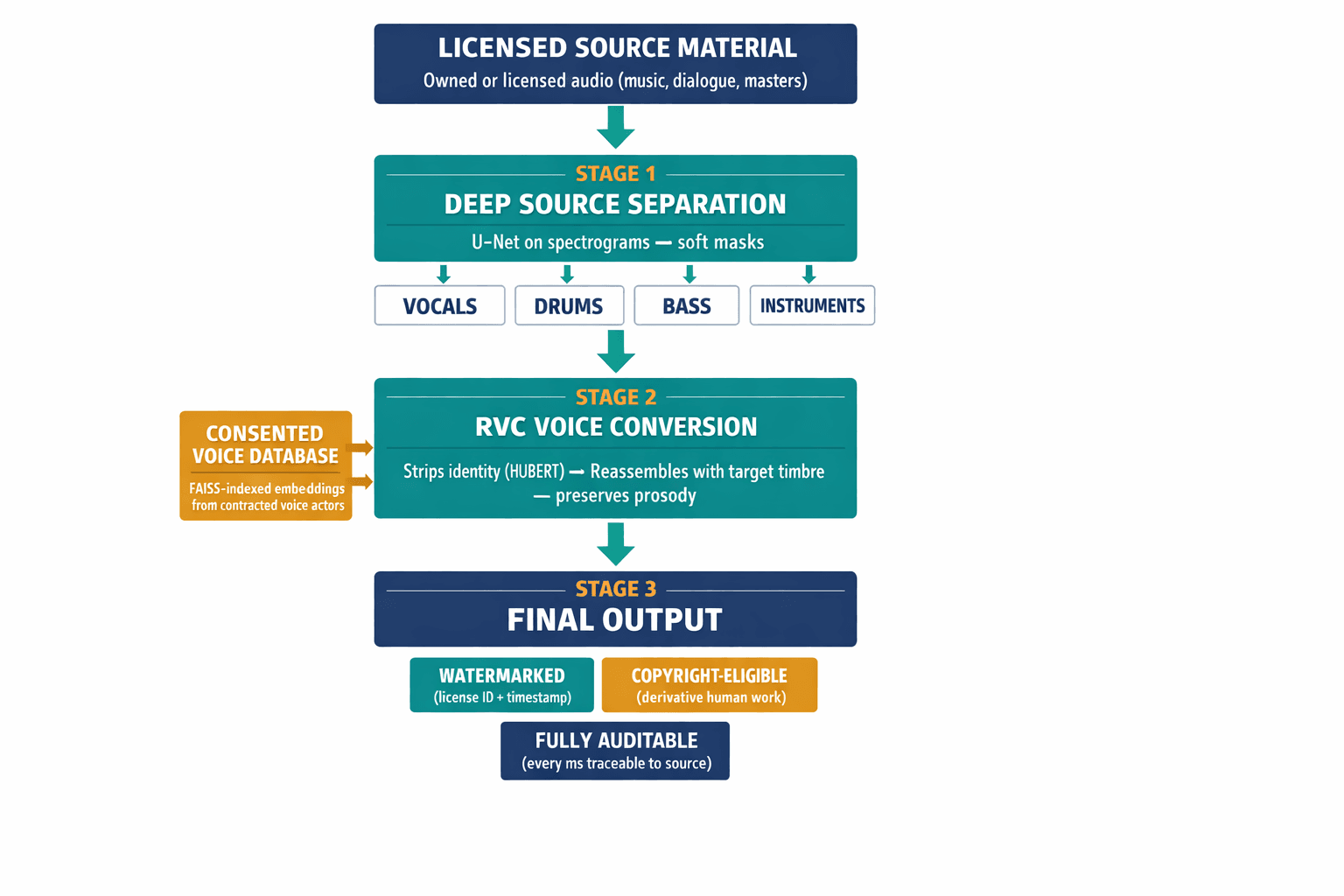
We solved this by rejecting the "generate from scratch" paradigm entirely. Instead, we built a transformative workflow using two deep technologies: Deep Source Separation and Retrieval-Based Voice Conversion (RVC).
Deep Source Separation is the process of unmixing a finished audio file into its component stems — vocals, drums, bass, instruments. Think of it as un-baking a cake, which sounds impossible but modern deep learning has made remarkably effective. Our engine uses a U-Net architecture that operates on audio spectrograms, outputting soft masks that isolate each stem's frequencies. We use waveform-domain variants to avoid the "watery" phase artifacts that plague standard spectrogram-based approaches.
This unlocks enormous value from existing, licensed IP catalogs. A media company can separate dialogue from a film's orchestral score to create dubbed versions. Record labels can "unlock" legacy masters where the original multi-track tapes are lost, creating new remixes or immersive Dolby Atmos mixes. Every step respects existing rights because we're working with owned or licensed source material.
For voice modification, we use RVC — a speech-to-speech framework that changes the timbre of a voice while preserving the prosody (rhythm, pitch, emotion) of the original performance. The system strips the identity from a voice using self-supervised models like HuBERT, then reconstructs it using a FAISS-indexed database of the target speaker's actual voice embeddings. It's not hallucinating a voice — it's reassembling one from microscopic slices of real, consented recordings.
For the full technical breakdown of both the source separation architecture and the RVC pipeline, see our deep-dive research paper.
The Consent Infrastructure Nobody Talks About
The technology is only half the story. What makes this enterprise-ready is the compliance framework around it.
We don't use public RVC models trained on scraped celebrity data. We build custom models trained exclusively on voice actors who have signed specific AI Commercialization Releases — explicit consent for specific uses, with royalties tracked whenever their voice model is deployed.
Here's the part that matters most for legal defense: because the RVC system uses a retrieval database, we can mathematically prove which voice model produced any given output. If someone claims "this sounds like Celebrity X," we can audit the FAISS index and demonstrate that every embedding came from Consented Voice Actor A. That's not a "we believe" defense — it's a cryptographic one.
And because the output is a derivative work based on a human performance and a human-created composition, it qualifies for copyright protection. The enterprise can actually own the final asset. Try getting that from a text-to-music generator.
There was a moment — I think it was during a call with a media company's legal team — when their general counsel paused and said, "Wait, you can actually show us which voice was used for every millisecond of audio?" When I said yes, there was a long silence. Then: "Do you understand how much money we've spent on legal review for AI-generated content?" That's when I understood that the compliance infrastructure isn't a feature. It's the product.
Why Can't Enterprises Just Use GPT for This?
I get this question constantly. Usually from investors, sometimes from potential clients who've seen impressive demos from foundation model providers. The answer is architectural, not philosophical.
When you build on a third-party API, you inherit that model's stochastic nature. If the model hallucinates — a wrong fit, a copyrighted melody, a cloned voice — you can't fix it. The weights are proprietary. You're powerless. You've also likely leaked proprietary data: unreleased fashion collections uploaded to a cloud model might end up in its training data. Our systems are containerized with Docker and Kubernetes, deployable entirely within a client's private cloud or on-premise servers. They don't require internet access. They don't phone home. The air gap isn't paranoia — it's a contractual requirement from every serious enterprise client we've worked with.
There's also the defensibility question. PitchBook analysts have been blunt: the market is oversaturated with startups that are "thin wrappers around foundation models" with no structural defensibility. These companies are sandwiched between hyperscalers who control the underlying intelligence and end-users who can switch to the next wrapper overnight. When OpenAI changes its pricing or capabilities, wrapper companies have no recourse.
The sustainable value in AI won't accrue to companies that resell API access. It will accrue to those that solve the hard, domain-specific problems that generic models are structurally incapable of solving.
We've optimized for latency too — model quantization lets our RVC pipeline run on consumer-grade hardware with latency under 50 milliseconds, eliminating expensive cloud GPU round-trips. Every image and audio clip we produce carries an invisible watermark encoding the licensing ID, user ID, and timestamp. If an asset leaks or gets challenged, the watermark proves its origin.
The End of "Mostly Right"
I've been building at Veriprajna long enough now to see the pattern clearly. The first wave of enterprise AI was about excitement — what could generative models do? The second wave, which we're entering now, is about accountability — what should they do, and what happens when they're wrong?
In fashion, "mostly right" means a 30% return rate and a customer who never comes back. In audio, "mostly right" means a lawsuit and an asset you can't own. The wrapper approach — fast, cheap, probabilistic — works fine for prototyping and low-stakes consumer apps. But for any domain where accuracy, compliance, and defensibility matter, it's not a shortcut. It's a liability.
The architecture we've built at Veriprajna isn't glamorous. Physics engines don't demo as well as generative AI. Compliance frameworks don't make for exciting pitch decks. Deterministic systems don't produce the kind of magical, surprising outputs that go viral on social media.
But they work. They work when the dress doesn't fit and the customer needs to know before she buys. They work when the voice actor deserves to be paid and the legal team needs proof. They work when the enterprise needs to own its assets and keep its data behind its own walls.
The AI industry will eventually figure out that the hardest problems aren't solved by making models bigger. They're solved by making solutions deeper — rooted in physics where physics matters, rooted in law where law matters, and rooted in the unglamorous, painstaking work of engineering systems that tell the truth.
That's what we're building. Not the most exciting AI company. The most honest one.