18,000 Cups of Water: What Drive-Thru Voice AI Keeps Getting Wrong

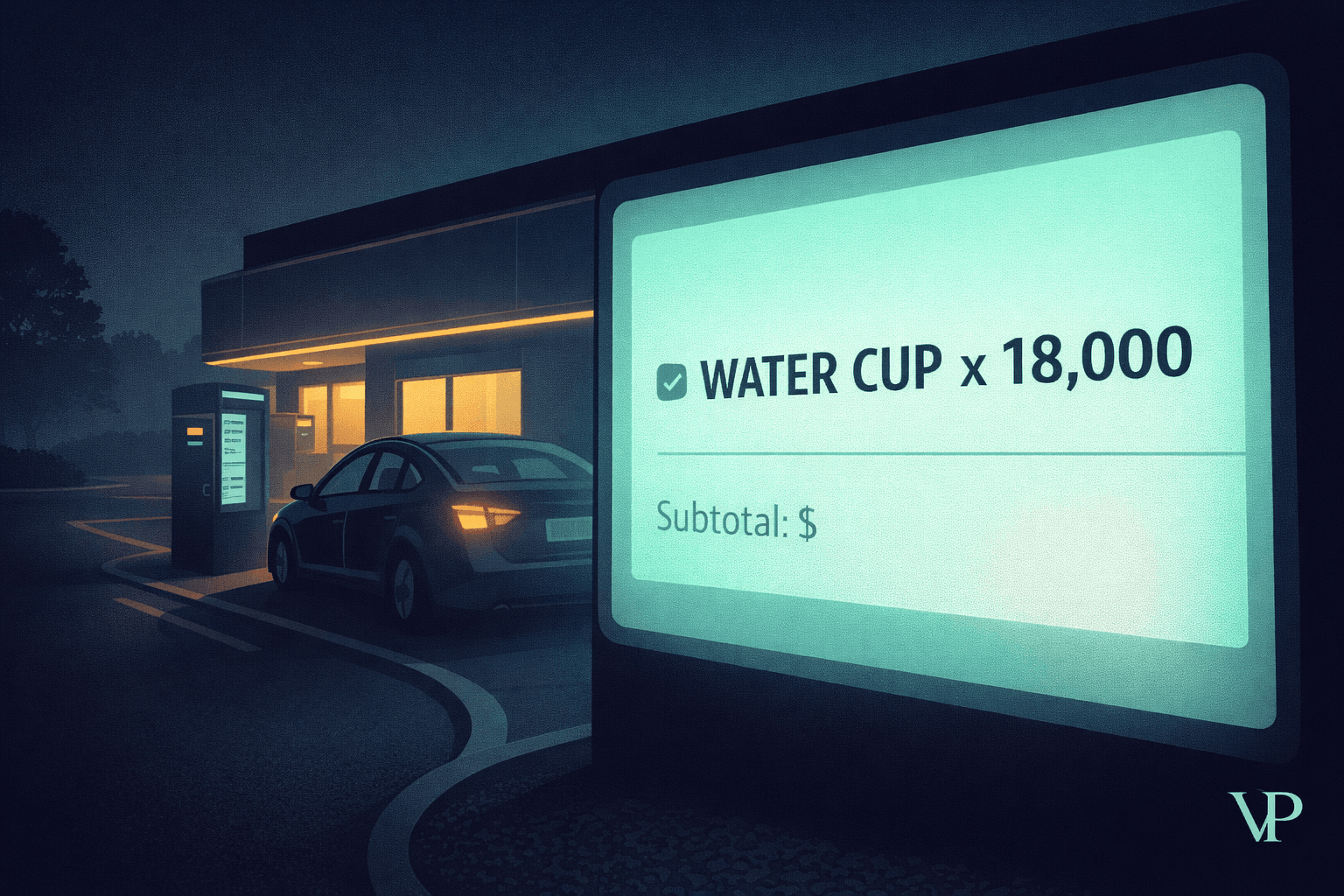
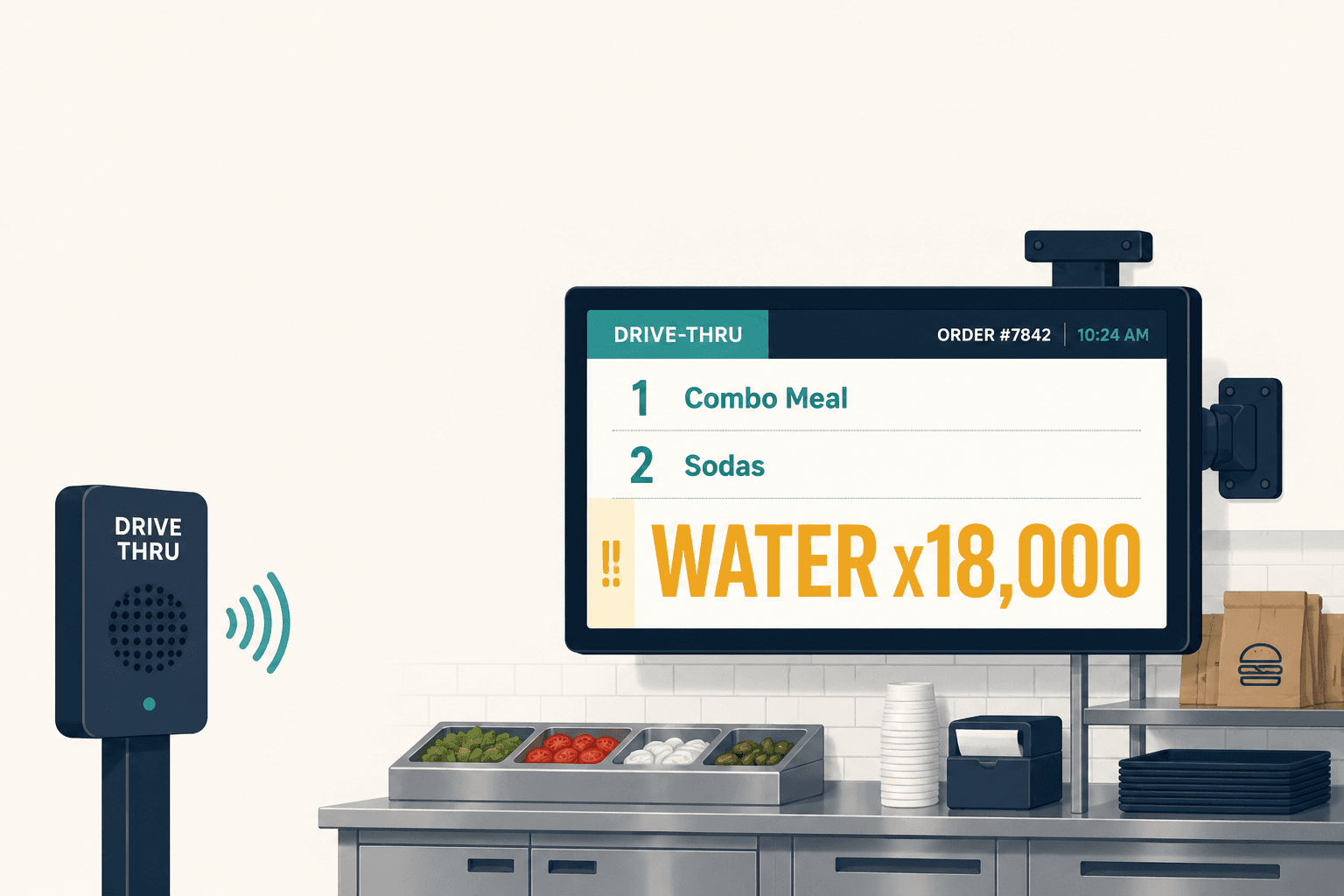
A customer pulled up to a Taco Bell speaker post in August 2025 and ordered 18,000 cups of water. The AI understood him perfectly. It put all 18,000 on the order. The clip crossed 21.5 million views, and Taco Bell paused its AI expansion to figure out what went wrong.
Here is the uncomfortable part: nothing went wrong with the artificial intelligence. The speech recognition was flawless. The language model parsed the request exactly as spoken. What was missing was a single piece of boring, rule-based software sitting between the AI and the cash register — the kind of thing that should have looked at "18,000 waters" and said no, that is not a real order. Nobody had built it.
I have spent the last stretch of my career inside drive-thru voice AI — the systems that take your order at the speaker post while a human stands at the window — and I want to tell you why these failures keep happening, because the lesson is not the one the headlines suggest. The model is almost never the problem. The architecture around the model is.
The AI heard the order correctly. There was simply nothing in the system allowed to say "that can't be right."
That sentence is the whole story of why drive-thru voice AI keeps embarrassing the chains that deploy it. And it is fixable — not with a smarter model, but with the unglamorous engineering everyone skipped on the way to a demo.
The Three-Year Plateau Nobody Wants to Talk About
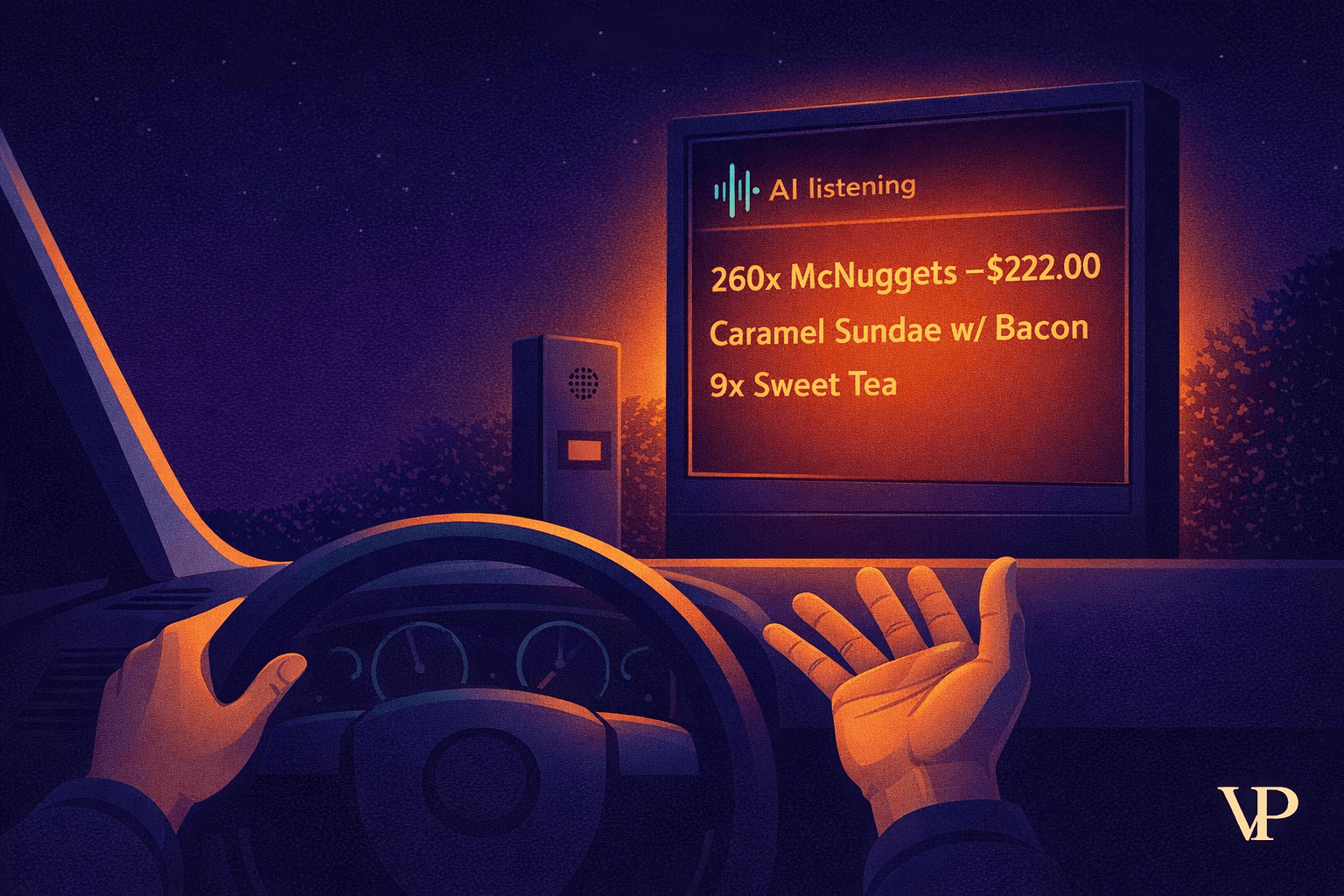
When I first started looking hard at this space, the cautionary tale everyone pointed to was McDonald's. They spent three years on a drive-thru voice partnership with IBM, got stuck around 80–85% order accuracy, and quietly terminated the whole thing in July 2024. Along the way the system added 260 Chicken McNuggets to one car's order and garnished someone's vanilla ice cream with bacon. There is now a Museum of Failure listing for it.
My first instinct was the same one most engineers have: they must have used a weak model. So we started where everyone starts — take a strong speech-to-text engine, feed it into a capable language model, wire the output to a point-of-sale system, and let it run. In a conference room it was genuinely impressive. It handled complex orders, modifiers, substitutions. I was convinced we'd cracked it in a few weeks.
Then we took it to an actual lane on a cold, windy evening, and it came apart almost at once.
A truck idled two spots over and the system started transcribing its engine. A gust of wind registered as a burst of speech. When a customer's car radio was on, the AI cheerfully blended the DJ's voice into the order. The thing that had been brilliant indoors was nearly unusable outdoors, and I had personally bet the early roadmap on the assumption that the model was the hard part. It wasn't. The hard part was everything that happens to sound before the model ever hears it.
That night in the parking lot reframed the entire problem for me, and it's the reason we ended up building what we build at Veriprajna — not a better model, but the missing layers around it.
Why the Speaker Post Is the Hardest Place on Earth to Listen
A drive-thru speaker post is one of the most acoustically hostile environments you can ask a machine to hear in. I don't mean that as a figure of speech.
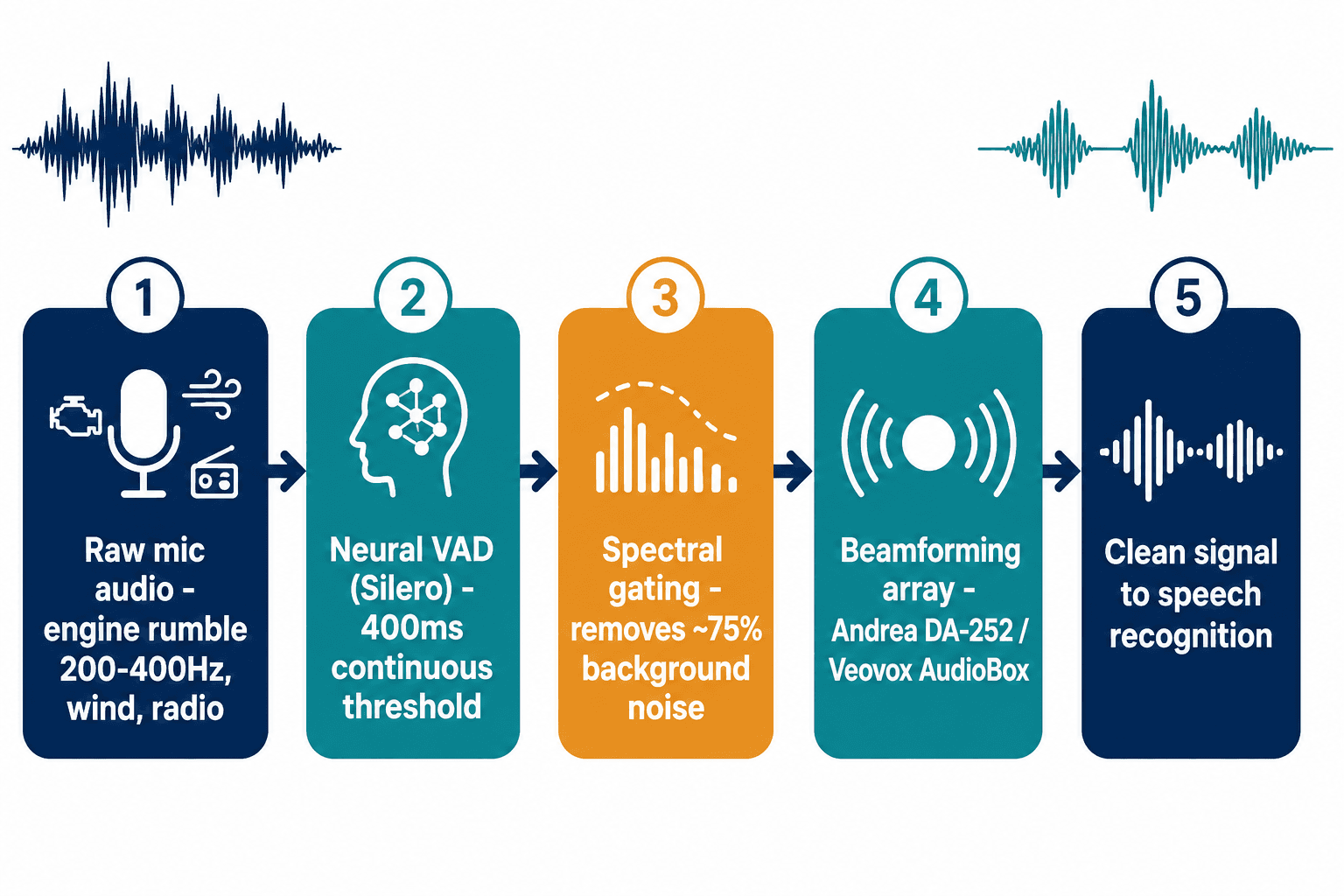
Engine rumble concentrates in the 200–400Hz band — which happens to sit directly on top of the fundamental frequency of a typical male voice. So the noise isn't politely off to the side where you can filter it out; it's tangled up in the exact frequencies that carry the words. Wind creates non-stationary pressure waves that slam the microphone in unpredictable bursts. Rain adds broadband hiss across the entire speech range. And a competing voice — a passenger, a radio, the next lane over — produces sound that standard voice activity detection simply cannot separate from the customer.
The McDonald's-IBM system handled all of this by sending raw, unfiltered audio straight to the language understanding layer. That is why it "overheard" orders from adjacent lanes, misread engine transients as someone starting to speak, and hallucinated menu items out of phonetic fragments. When the audio degraded, the model did what models do under uncertainty: it matched the garbage to the nearest high-probability tokens and produced something confident and wrong.
You cannot prompt-engineer your way out of bad audio. If the signal is corrupted before the model sees it, a smarter model just gives you a more fluent mistake.
The fix is a multi-stage audio pipeline, and the order of operations matters. We replaced energy-based voice detection — which treats any loud sound as speech — with a neural detector (the Silero class of models) that holds a 400-millisecond continuous-probability threshold before it decides a human is actually talking. That one change kills most of the "the engine is ordering nuggets" failures. On top of it we run spectral gating that strips roughly 75% of background noise before the speech recognizer ever receives the signal, and beamforming through microphone arrays — the Andrea DA-252 or the Veovox AudioBox — that spatially isolate the driver's voice from everything else around the car.
The catch, and this is the part vendors hate, is that this layer has to be tuned per speaker-post model and per acoustic environment. Off-the-shelf noise cancellation trained on tidy office audio falls over in a parking lot. There is no shortcut here, and that's precisely why so few people do it.
The 18,000 Waters Were a Software Bug, Not an AI Bug
Let me come back to Taco Bell, because it's the cleanest illustration of the second failure mode.
The morning that clip went viral, a chain operator I'd been talking to forwarded it to me and asked, plainly, whether ours would do the same thing. It's a fair question, and the honest answer is that most deployed systems would, because they share the same architectural hole.
The AI correctly understood "18,000 cups of water." That was never in doubt. The system had no quantity validation, no anomaly detection, and no per-session rate limit. The model's output flowed directly to the point-of-sale because nobody built the middleware to ask whether an order is physically plausible before it reaches the kitchen. The same missing layer is why McDonald's put 260 nuggets on a tab and bacon on ice cream. In every one of these cases the language understanding was correct and the business logic was simply absent.
What's maddening is how cheap this fix is. A deterministic validation engine — and I mean genuinely rule-based code, not more AI — takes two to three weeks to build per chain. It enforces quantity caps derived from real order distributions (the realistic ceiling for a single water order at a quick-service restaurant is somewhere around eight cups, not eighteen thousand). It checks item-combination logic, where the historical probability of "ice cream plus bacon" in the order data is effectively zero. It sets price thresholds per transaction and forces a human to step in on anything that breaks those bounds.
The cheapest, fastest fix in drive-thru voice AI is also the one that prevents the disasters that get 21 million views. It is rules, not intelligence.
This is the inversion that surprises people. The flashy part — the conversational model — is mostly a solved, commodity capability now. The part that actually protects the brand is the deterministic guardrail layer that nobody puts in the demo because it isn't impressive to watch.
What Happens When Someone Who Stutters Pulls Up?
The third failure mode is the one that keeps me up, partly because it's a moral problem and partly because it's about to become a legal one.
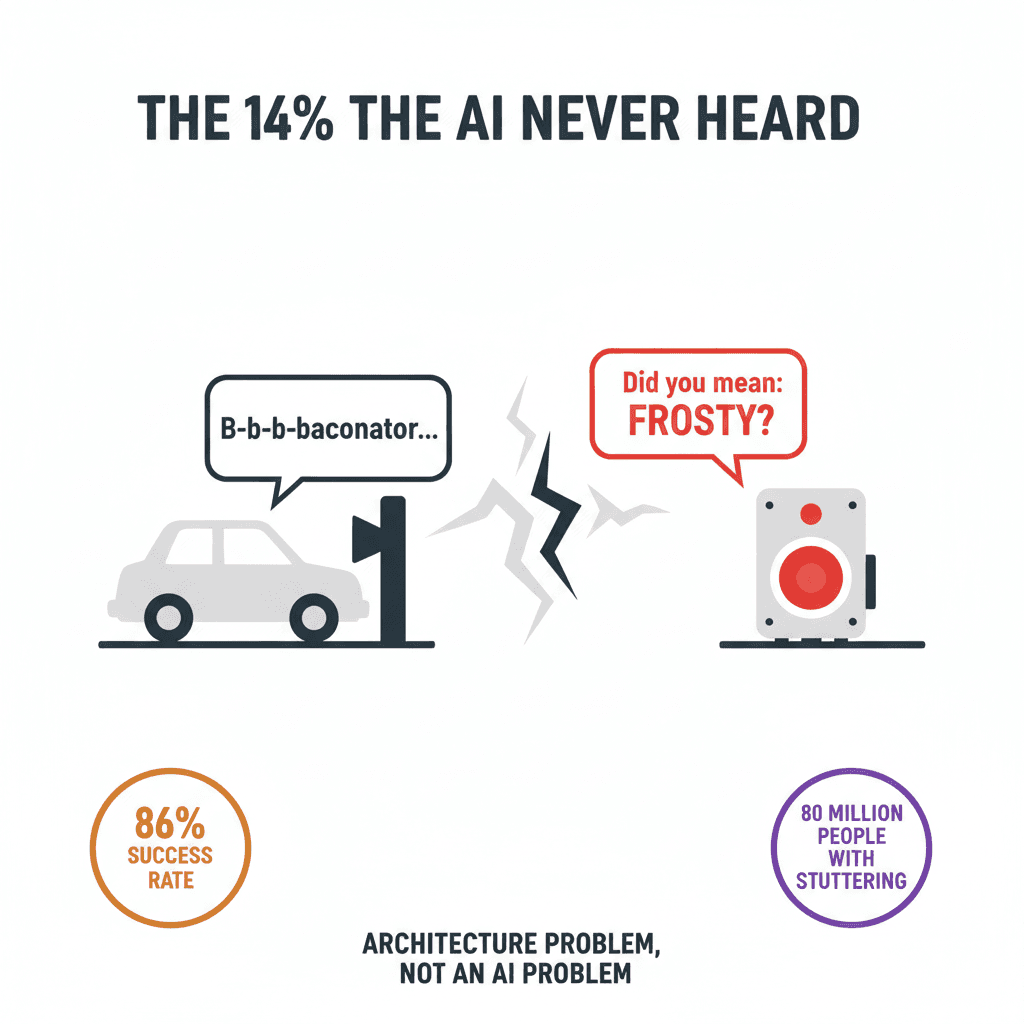
Wendy's FreshAI has been described as "unusable" by customers who stutter, and once you understand the mechanics it's obvious why. We had the same defect in our own early build, and I only caught it because I sat and replayed a recording of someone ordering a "b-b-baconator" over and over. Our system cut them off every single time.
Disfluent speech breaks voice AI in three distinct ways. When a person repeats a sound — "b-b-baconator" — the recognizer produces duplicate tokens that scramble the order logic. When they have a block, a silent pause in the middle of a word, the voice detector reads the silence as the end of their turn and stops listening mid-order. When they prolong a sound — "Mmmmilk" — the phoneme stretches far enough that the system hears a different word entirely ("Silk"). None of this is exotic. It affects the roughly 80 million people worldwide who stutter, plus far more with strong accents, elderly speech patterns, or non-native pronunciation. These systems were trained on fluent, standard American English and they fail everyone else.
I used to file accessibility under "nice to have, later." I was wrong, and the regulatory trajectory is what changed my mind. Food and beverage is now the second-most-targeted industry for digital accessibility lawsuits under the Americans with Disabilities Act, accounting for around 21% of all filings, and those filings rose 40% in 2025 over the prior year. Canada published CAN-ASC-6.2:2025 in December 2025 — the world's first national standard for accessible AI — which requires equitable performance regardless of disability and a meaningful option to decline AI for a human. The European Union's AI Act transparency obligations land in August 2026, requiring that customers be told they're talking to a machine.
No drive-thru voice AI accessibility lawsuit has landed yet. But the McDonald's biometric-privacy case — a class action alleging it collected voiceprints without consent — already showed that drive-thru AI is squarely in the litigation crosshairs, even though that particular case was dismissed. The cost math is brutal in the wrong direction: retrofitting accessibility into a system that's already deployed runs about five times what it costs to build it in from the start. Designing for disfluent speech on day one isn't charity. It's the cheap version.
Does Any of This Actually Work? Yes — When the Architecture Is Right
It would be easy to read this far and conclude drive-thru voice AI is a bad idea. It isn't. The chains that engineered the layers properly are posting numbers the failed deployments never reached, and the gap between them is the whole point.
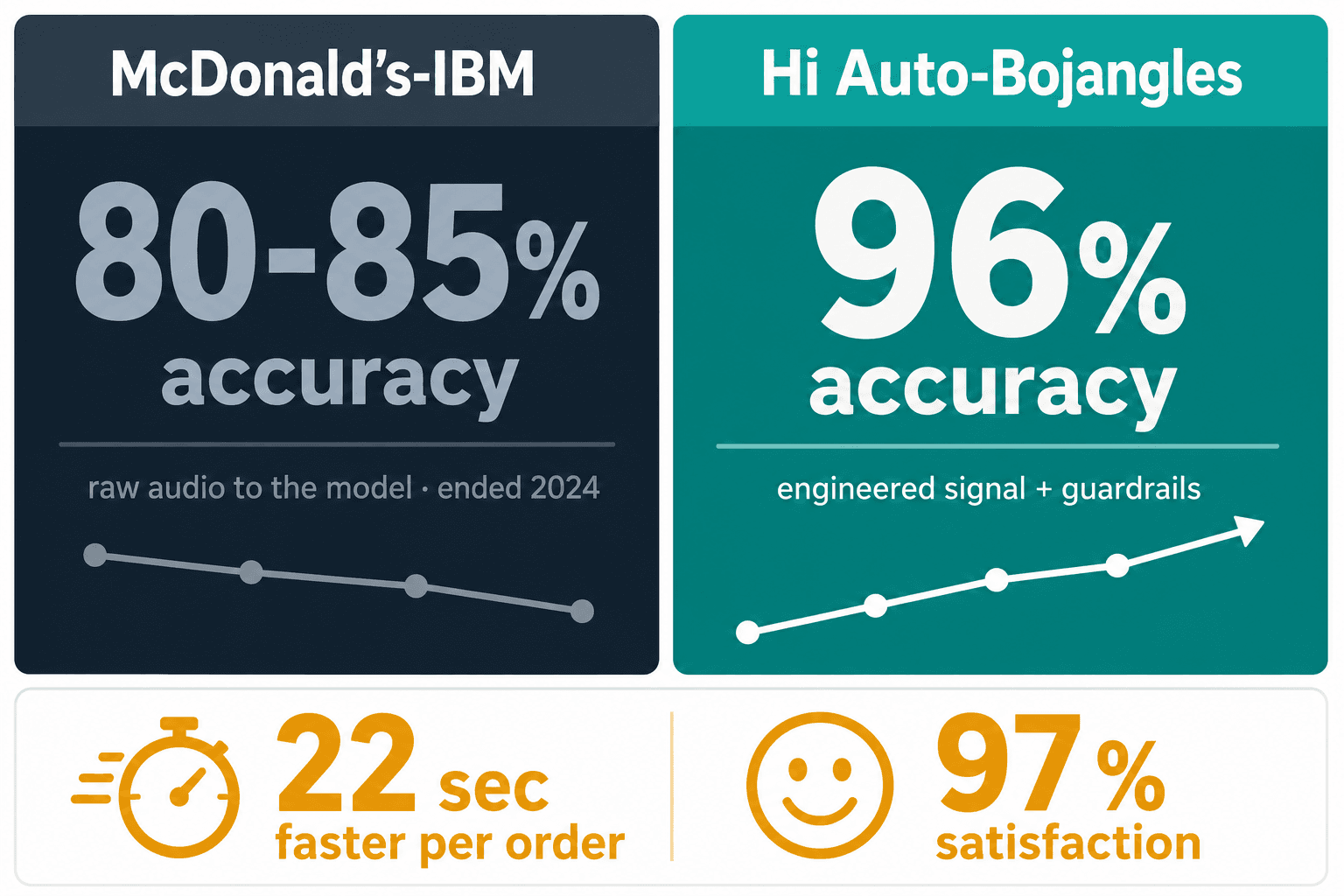
Hi Auto, running at Bojangles across roughly 500 locations, reports 93% order completion and 96% accuracy, with more than 100 million orders a year flowing through its portfolio. SoundHound's system at White Castle clears 90%-plus order completion and claims around $58,000 in annual savings per location. The 2025 Intouch Insight Drive-Thru Study found AI-powered lanes averaging 3 minutes 53 seconds of total service time against 4 minutes 15 seconds overall — roughly 22 seconds faster per order — and pushing 17 to 18 cars per hour versus 16 without AI. Satisfaction at AI locations came in around 97%, several points above traditional lanes.
Look at the spread. McDonald's-IBM stalled at 80–85%. Hi Auto-Bojangles is at 96%. That is not the difference between a weak model and a strong one — by 2026 the underlying models are largely comparable. It's the difference between sending raw audio to a model and engineering the signal processing, the deterministic validation, and the integration around it.
That last word — integration — is where a lot of good intentions die. Roughly 75 to 80% of a major chain's revenue comes through the drive-thru channel, and that order has to land cleanly in whatever point-of-sale system the chain already runs. NCR Aloha, Toast, and Oracle Simphony each expose different APIs with different limits on how modifiers stream and how multi-lane sessions stay isolated. Menus don't sit still either: limited-time offers, dayparting, and regional items change two to four times a week, and any system that needs a model retrain to learn a new item cannot keep pace. We ground the language understanding against a live menu feed instead, so a new item is available in minutes, not days.
The Questions Operators Actually Ask Me
When I talk to the people who run technology for these chains, the same objections come up, so let me answer them the way I answer them in the room.
Should we just pick Google or NVIDIA and be done with it? You can, and plenty have — Wendy's runs on Google Cloud, Taco Bell on NVIDIA infrastructure through Yum!, Burger King's employee-facing "Patty" assistant on OpenAI. The trade-off is platform dependency. If the API changes or the pricing shifts, your entire deployment is exposed, and you're getting general-purpose models rather than something engineered for the acoustics of your specific lanes. The vendor field is crowded and capable — Presto raised $10 million in January 2026 and hired the original FreshAI founder; SoundHound, Hi Auto, ConverseNow, and Vox AI are all deployed at real scale — but every one of them hands you their stack, not a custom signal pipeline. Our position is vendor-neutral: audit what you have, build the missing layers on top of any platform, and don't lock you in.
Won't the validation and accessibility layers slow everything down? This is the real engineering tension. Sub-300-millisecond response is the bar, and every layer you add costs latency. Cloud processing alone adds 100 to 500 milliseconds of network round-trip; moving inference to an edge appliance cuts that to 5 to 10 milliseconds but adds $500 to $1,500 of hardware per location. The job is to add the guardrails without dropping cars-per-hour below the human baseline, because the moment a system slows the line, it gets pulled regardless of how accurate it is. That balance is an engineering problem with a known answer, not a reason to skip the guardrails.
Is this a real budget item or a science project? Per-location voice AI runs $200 to $500 a month in software, $400 to $980 all-in with hardware. Against that, chains are reporting $3,000 to $18,000 in additional monthly revenue per location and four figures a month in labor savings. The economics work. What doesn't work is spending that budget on the conversational layer and skipping the three layers that actually keep you off the front page.
The Real Lesson of the Viral Failures
Go back through every drive-thru voice AI disaster that made the news — the 260 nuggets, the bacon sundae, the 18,000 waters, the customer who stutters and gets hung up on — and you will not find a single one caused by a model that couldn't understand English. Every one of them is an architecture failure: audio that was never cleaned, an order that was never sanity-checked, a voice the system was never built to hear.
The chains winning at this didn't buy a better brain. They built the body around it — the ears that work in a parking lot, the reflexes that stop an absurd order before it reaches the kitchen, the judgment to know what a real order looks like. That's the work we do at Veriprajna, and it's far less glamorous than the demos suggest.
The technology to take a drive-thru order with a machine has worked for a while now. What's still missing, at most of the chains racing to deploy it, is the part nobody films for the launch announcement: the cleaned-up audio, the rule that catches the eighteen-thousandth cup of water, the patience to let a stutter finish its word. Build those, and the model was never the hard part. Skip them, and you already know how the video ends.