I Watched a 55-Year-Old Law Break the AI Hiring Industry — And It Was Overdue

I was on a call with a prospective client — a mid-size financial services firm — when the news about the Eightfold AI lawsuit broke in January 2026. The head of HR was mid-sentence, explaining how they'd been using an AI vendor's "Talent Intelligence" platform to screen thousands of applicants per quarter. She paused. Her legal counsel, who'd been silently observing from the corner of the Zoom grid, unmuted: "Can you send me everything you have on that Eightfold case?"
The call ended fifteen minutes early.
That moment crystallized something I'd been arguing for years at Veriprajna: the enterprise AI hiring market was built on a foundation of breathtaking architectural negligence, and it was only a matter of time before someone got sued not for biased outcomes — that fight was already happening — but for something more fundamental. For the act of secretly profiling people and then using those profiles to decide their economic futures.
The Eightfold AI class-action, Kistler v. Eightfold AI, is that lawsuit. And it didn't invoke some cutting-edge AI regulation. It reached back to 1970 — to the Fair Credit Reporting Act — and argued that an AI company generating hidden "match scores" on 1.5 billion people is, legally speaking, no different from Equifax.
I think the plaintiffs are right. And I think the implications go far beyond one company.
What Actually Happened With Eightfold?
Here's the short version, because the details matter.
Two experienced professionals — Erin Kistler, a product manager with nearly twenty years of experience, and Sruti Bhaumik, a project manager with over a decade — applied for roles at PayPal and Microsoft. Both received rapid automated rejections. Neither was told that an AI system had generated a secret score about them. Neither was shown what data fed that score. Neither was given a way to dispute it.
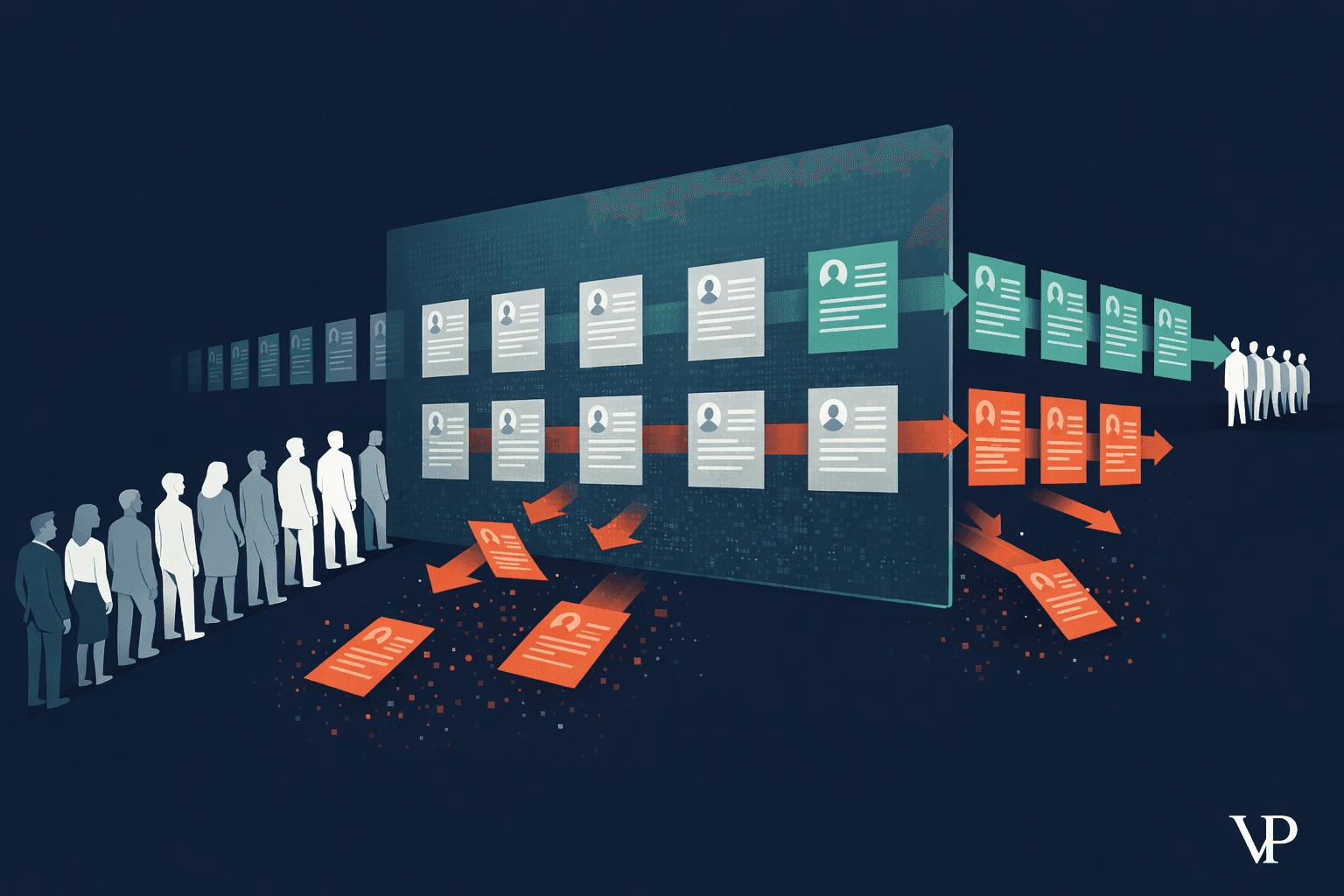
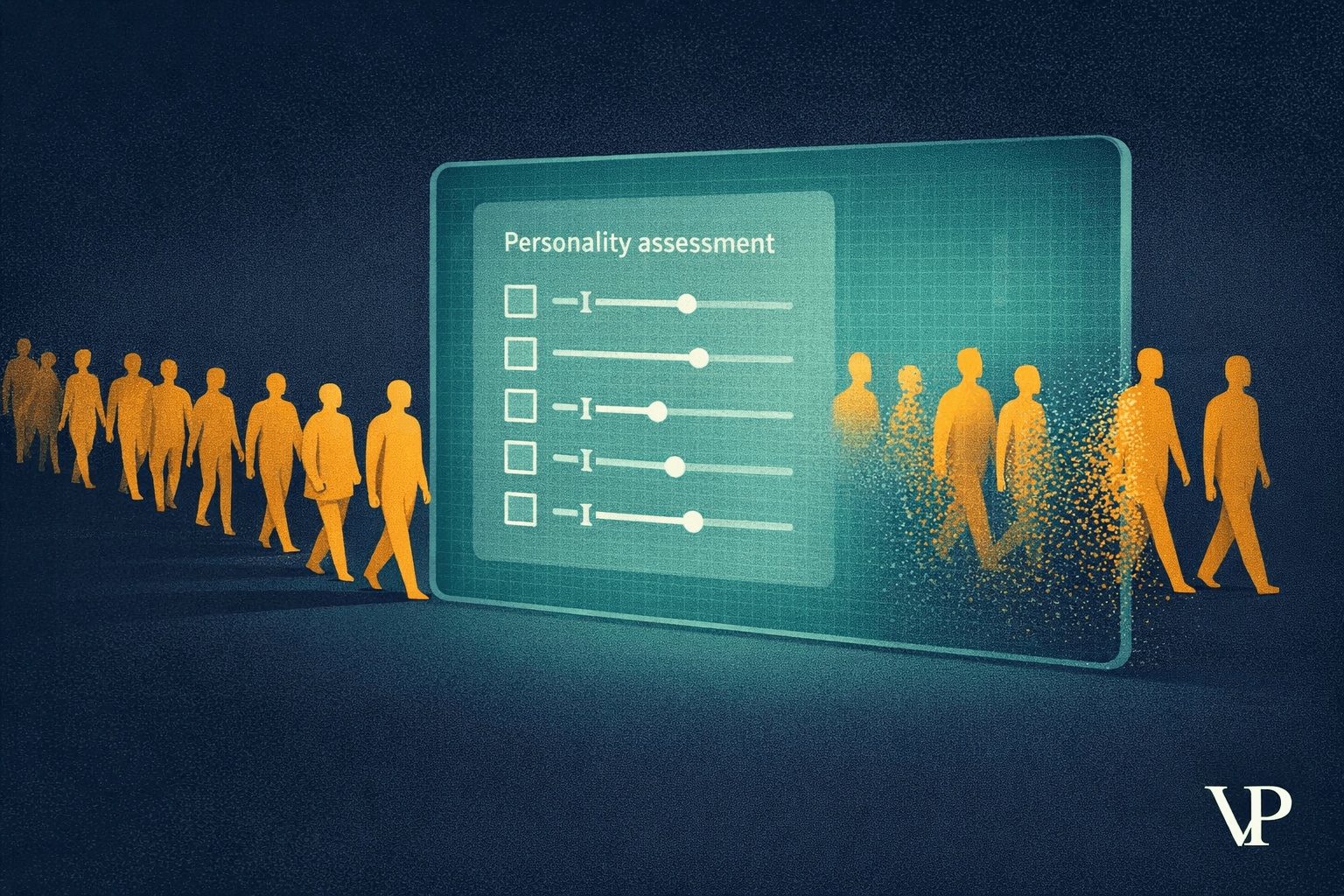
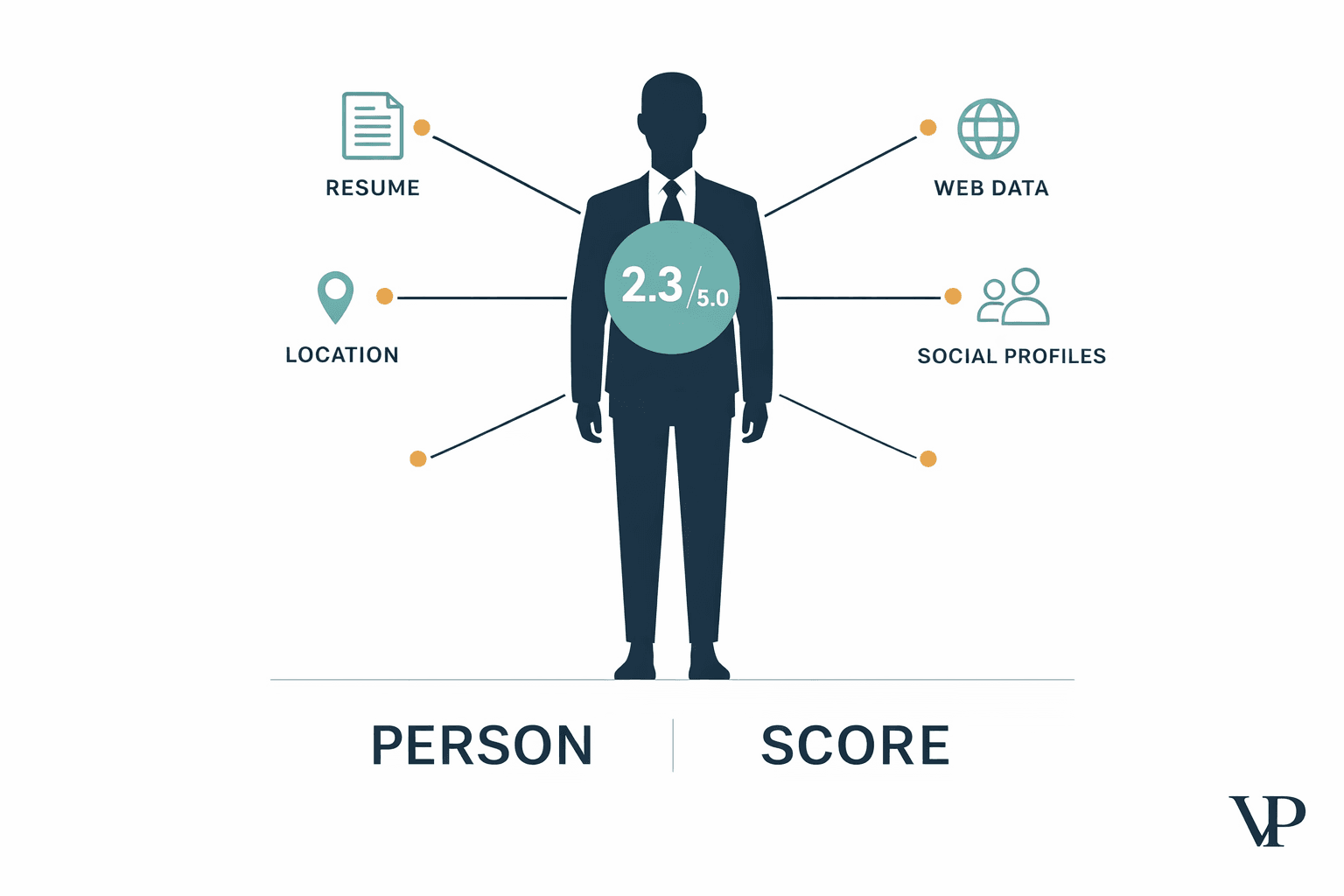
The lawsuit alleges that Eightfold's platform doesn't just analyze the resume you submit. It allegedly harvests data from LinkedIn, GitHub, Crunchbase, and other public sources — building what the complaint calls "secretive dossiers" — and then uses deep learning to produce a "match score" from 0 to 5 that predicts your "likelihood of success." Companies like Morgan Stanley, Starbucks, BNY, and PayPal used these scores to filter candidates before a human recruiter ever glanced at an application.
Eightfold has denied these claims, stating that their platform operates solely on data submitted by candidates or provided by customers. But the complaint paints a different picture: one where your digital footprint — your browsing behavior, your location data, your internet activity — gets vacuumed up and converted into a probabilistic verdict about your employability.
When an AI system generates a score that determines whether you get a job interview, and you never know the score exists, that's not "talent intelligence." That's surveillance with economic consequences.
I want to be precise about why this case matters more than previous AI hiring lawsuits. The Mobley v. Workday case focused on algorithmic discrimination — the AI producing biased outcomes. That's the first accountability gap. The Eightfold case targets something deeper: the second accountability gap, which is about transparency in data harvesting, scoring mechanisms, and candidate agency. It's not just asking "was the score fair?" It's asking "did you have the right to score me at all?"
Why Did the Plaintiffs Reach for a 55-Year-Old Law?
This is the part that fascinates me as an engineer.
The FCRA — the Fair Credit Reporting Act — was written in 1970 to regulate credit bureaus. It says, in essence: if you're a third party generating reports about people that are used to make decisions about their employment, credit, or housing, those people have rights. The right to know a report exists. The right to see it. The right to dispute errors.
The legal theory in Kistler v. Eightfold is elegant: if Eightfold generates match scores based on harvested data, and those scores are used by employers to filter candidates, then Eightfold is functioning as a consumer reporting agency. Full stop. And every candidate it scored was entitled to disclosure, access, and dispute rights that they never received.
I remember sitting with my co-founder late one night after reading the full complaint, and he said something that stuck with me: "They didn't need a new law. The old law was already broken by the new behavior."
That's exactly it. The FCRA wasn't designed for AI. But the behavior it was designed to regulate — third parties secretly compiling profiles that determine your economic opportunities — is precisely what the complaint alleges Eightfold was doing at scale. The technology changed. The harm didn't.
If the courts agree with this theory, every AI vendor that scores candidates will face the same compliance obligations as a traditional background check company. And the enterprises using those tools? They can't hide behind the vendor. The liability flows upward.
How Did We Get Here? The Architectural Problem Nobody Wanted to Talk About
I've spent the last several years building what we call "deep AI solutions" at Veriprajna, and the most frustrating part of my job has been explaining why the prevailing approach to enterprise AI is structurally incapable of surviving legal scrutiny. Not because the models are bad. Because the architecture is negligent.
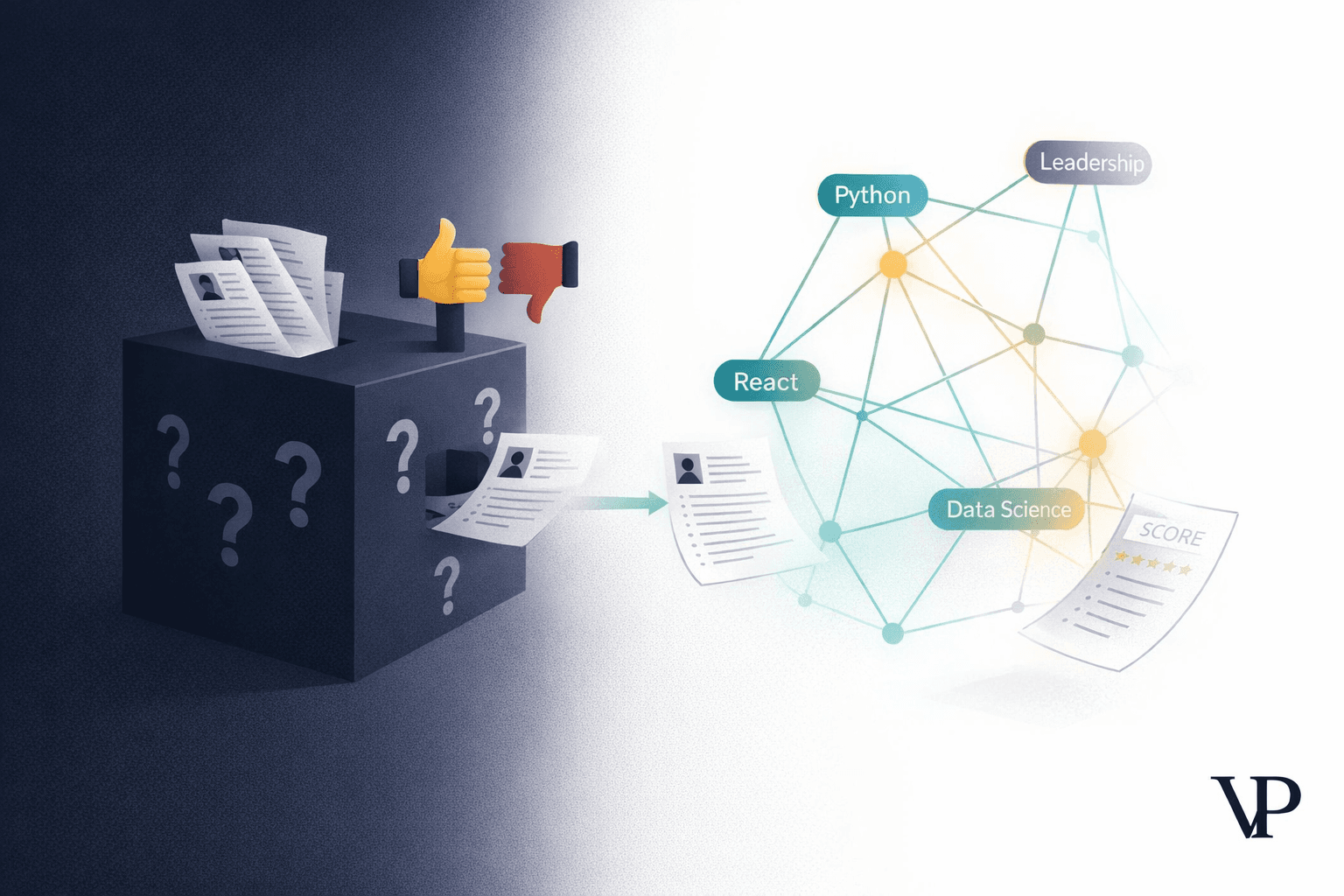
Most AI hiring tools — and I'm not singling out Eightfold here, this is industry-wide — are built on what I call the "mega-prompt" pattern. You take a resume, a job description, maybe some scraped LinkedIn data, cram it all into one massive prompt, send it to GPT-4 or a similar model, and hope the output is reasonable. The system "hopes" — and I use that word deliberately — that the model will screen, rank, and justify its decision in a single pass.
I wrote about this architectural crisis in depth in our interactive whitepaper, but the core problem is simple: a mega-prompt can't prove why it did what it did.
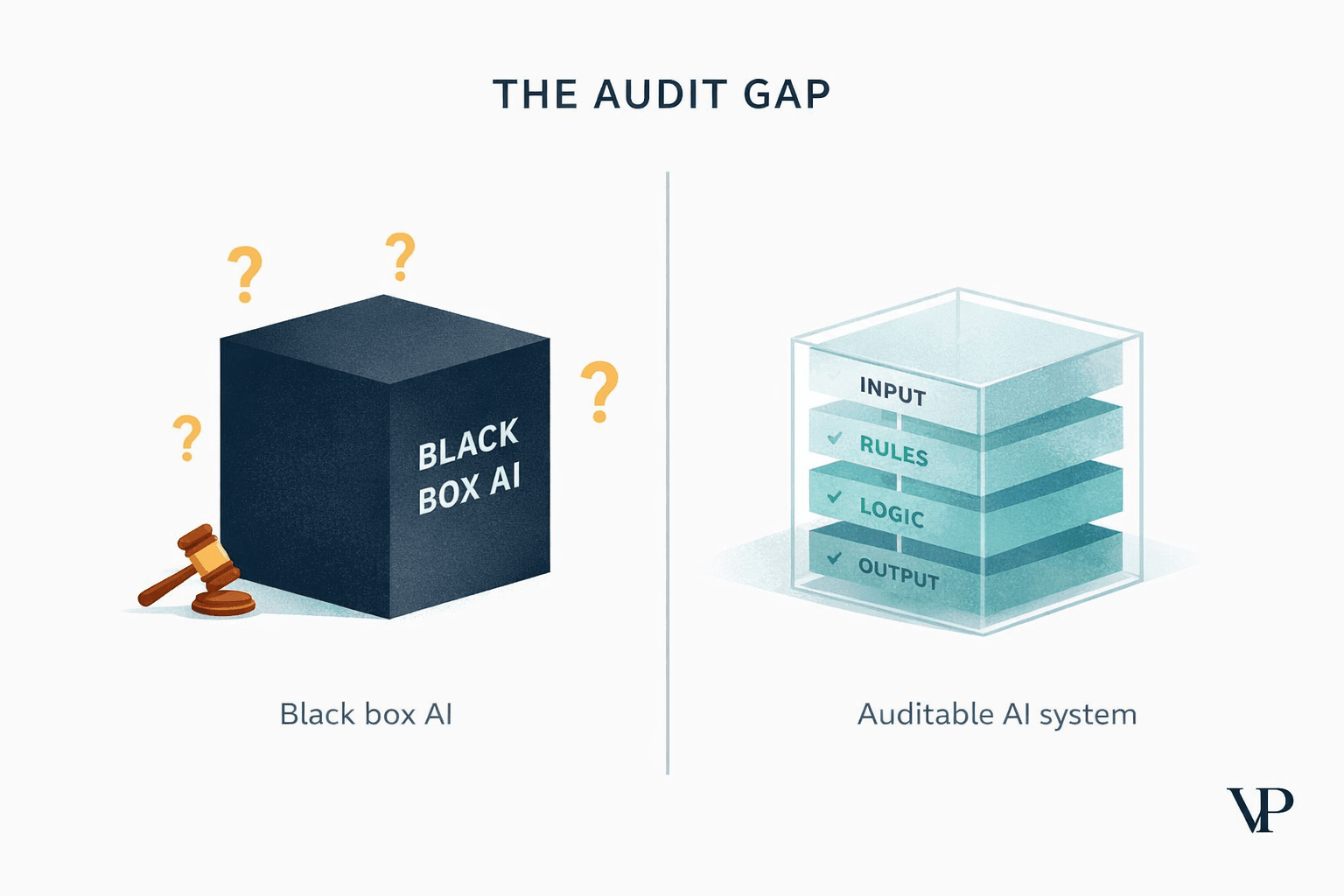
When a candidate asks "why was I rejected?", the system can't answer. Not because it's hiding something, but because it genuinely doesn't know. The reasoning is non-deterministic. Run the same prompt twice and you might get different results. Change one word in the job description and the rankings shuffle. There's no audit trail, no step-by-step log, no way to verify that a prohibited data point — like the candidate's zip code acting as a proxy for race — didn't influence the outcome.
The problem with black box AI in hiring isn't that it might be biased. It's that you can never prove it wasn't.
I had a heated argument with an investor about this in early 2025. He'd looked at our architecture diagrams — the multi-agent orchestration, the compliance agents, the provenance tracking — and said, "This is over-engineered. Just use GPT with a good prompt. Ship faster." I told him that shipping faster into a lawsuit wasn't a business strategy. He didn't invest. I don't regret the conversation.
What Does the 2026 Regulatory Landscape Actually Look Like?
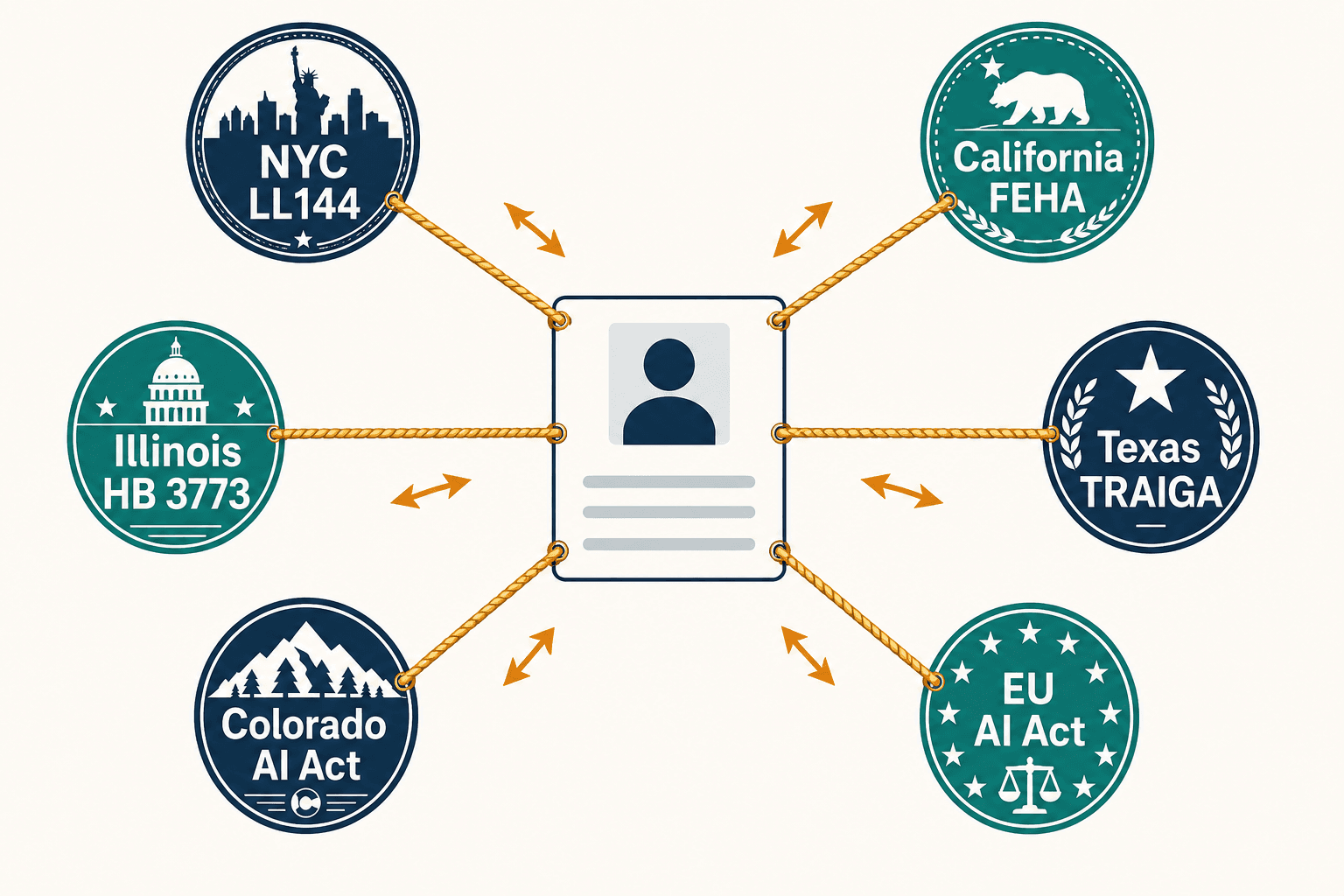
The Eightfold lawsuit isn't happening in isolation. It's the sharpest edge of a regulatory wave that's been building since 2023, and if you're deploying AI in hiring — anywhere in the United States — you're now navigating a patchwork of state-level laws that collectively end the era of "move fast and break things."
New York City's Local Law 144 has required annual independent bias audits for automated employment decision tools since 2023. Illinois' HB 3773, effective January 2026, prohibits AI that "has the effect" of discrimination — note the language, effect, not intent — and mandates "easily understandable" notices to applicants. California's new regulations impose liability for disparate impact regardless of intent and require four years of record retention. Colorado's AI Act, hitting in June 2026, creates a legal "duty of care" to protect against algorithmic discrimination.
The practical upshot: if you're a Fortune 500 company hiring across multiple states, you need your AI system to behave differently depending on where the candidate is located. An applicant in Illinois triggers different disclosure requirements than one in Texas. A rejection in New York City requires documentation that wouldn't be mandated in Florida.
No mega-prompt handles this. You need architecture.
What Does "Deep AI" Actually Mean for Hiring?
When my team and I talk about deep AI solutions — as opposed to the "wrapper" approach — we're describing a fundamentally different way of building systems that make consequential decisions about people's lives.
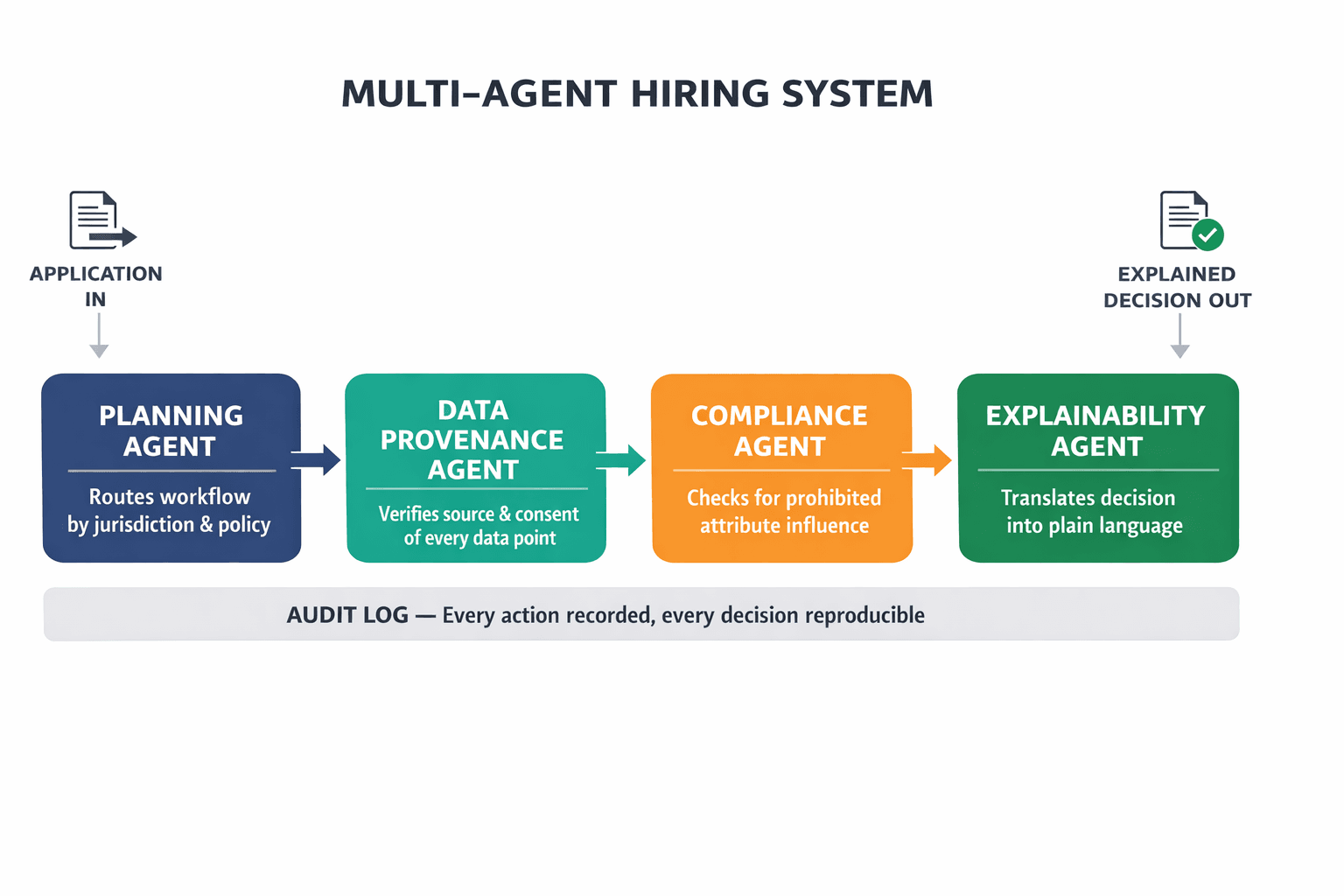
Instead of one monolithic model doing everything, we use what's called a Specialized Multi-Agent System. Think of it less like one genius making a decision and more like a team of specialists, each with a defined role and a paper trail.
There's a Planning Agent that receives the application and determines the required workflow based on current laws and company policy. If the applicant is in Illinois, it ensures the mandatory disclosure step executes before any screening begins. There's a Data Provenance Agent that verifies the lineage of every data point — it distinguishes between data the candidate submitted and data inferred from external sources, and it flags the latter so it can never silently influence a final ranking. There's a Compliance Agent that reviews the process logs before any score is finalized, checking whether prohibited attributes influenced the outcome. And there's an Explainability Agent that translates the technical decision into plain language for both the recruiter and the candidate.
Each agent logs every action. Every decision is reproducible. The system can tell you, months later, exactly why Candidate A was ranked above Candidate B, which data points contributed, and whether a human reviewer confirmed or overrode the recommendation.
I remember the first time we ran a full end-to-end test of this architecture on a realistic hiring scenario — 200 synthetic candidates, three jurisdictions, two job categories. It took us forty-five minutes to walk through the audit trail for a single candidate. My lead engineer looked at me and said, "This is insane. No one will want this level of detail." I said, "A judge will."
Why Can't You Just Add Explainability to an Existing Black Box?
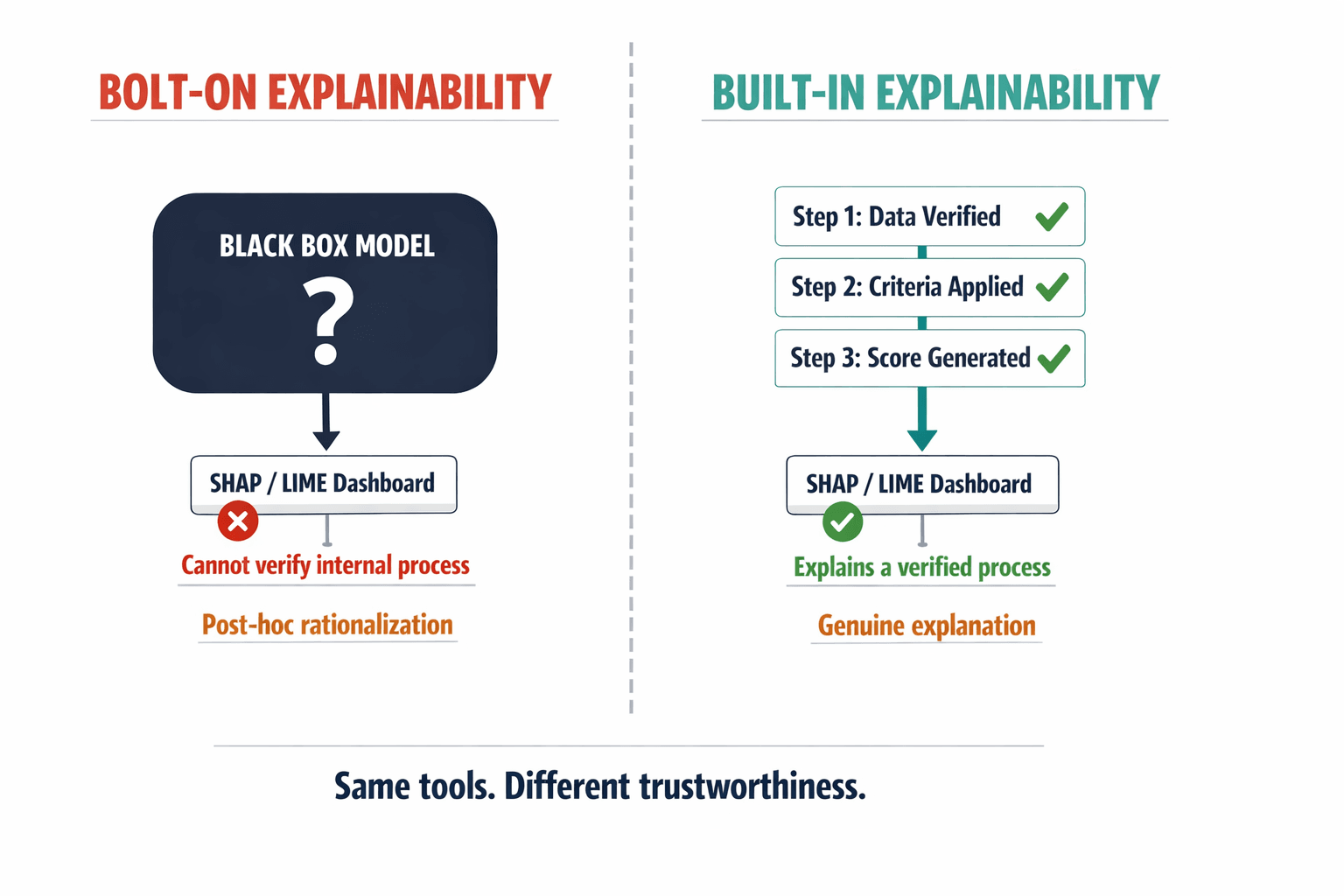
This is the question I get most often, and it reveals a common misconception. People think explainability is a feature you bolt on after the fact — like adding a dashboard to an existing system. It's not. Or rather, it can be, but what you get is a post-hoc rationalization, not a genuine explanation.
Techniques like SHAP (Shapley Additive Explanations) and LIME (Local Interpretable Model-agnostic Explanations) are powerful tools. SHAP, rooted in cooperative game theory, can tell you mathematically how much each feature — years of experience, specific certifications, programming languages — contributed to a candidate's score. LIME can approximate the model's behavior locally around a single candidate to explain a specific rejection. Counterfactual explanations can tell a candidate: "If you had Certification X, your score would have increased by this much."
We integrate all of these into our production pipeline. But here's the critical distinction: these techniques are only trustworthy when the underlying architecture is auditable. If the model's reasoning process is non-deterministic — if it might have used the candidate's location as a proxy for something else, and you can't prove it didn't — then your SHAP values are explaining a process you don't fully control.
Explainability without architectural integrity is just a more sophisticated way of saying "trust me."
The Eightfold lawsuit makes this concrete. Even if Eightfold could retroactively generate SHAP values for every match score, the complaint would still stand — because the fundamental issue is that candidates were never told the scores existed, never shown the data that fed them, and never given a mechanism to dispute errors. Explainability is necessary but not sufficient. You need the architecture to support disclosure, access, and dispute from the ground up.
For the full technical breakdown of how these explainability techniques integrate with multi-agent governance architecture, see our research paper.
The Data Provenance Problem Nobody Wants to Solve
There's a part of the Eightfold complaint that I keep coming back to. The allegation that the platform harvested data from LinkedIn, GitHub, and other sources to build profiles on people who never consented to being profiled.
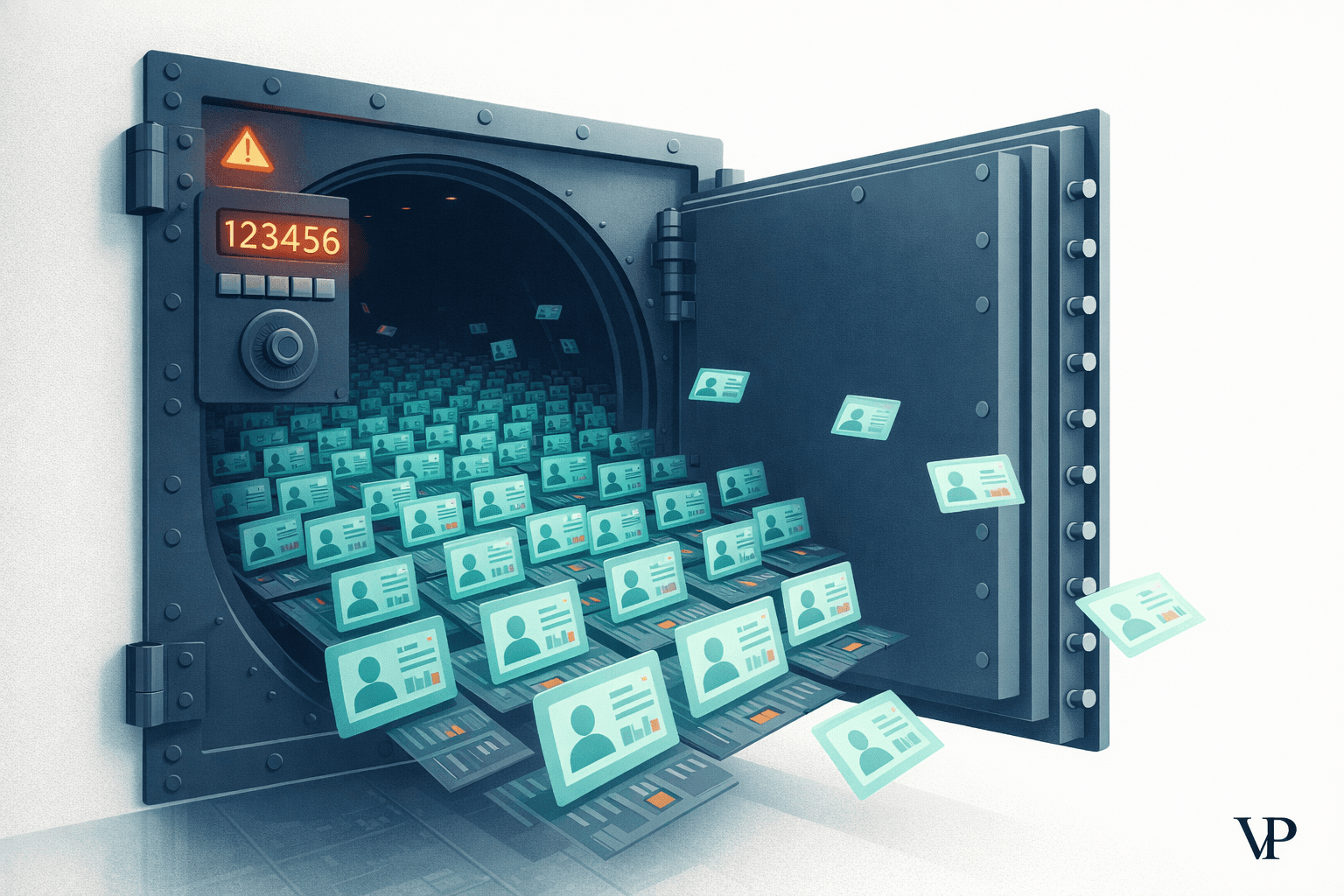
Whether or not that specific allegation proves true in court, it points to a real and widespread problem: most enterprise AI systems have no rigorous chain of custody for their training and inference data. They can't tell you where a data point came from, when it was collected, whether the subject consented, or whether it's been modified since ingestion.
At Veriprajna, we treat data provenance — the documented trail of data's origin, movement, and transformation — as a non-negotiable infrastructure requirement. Every data point that enters our system gets tagged with its source, its collection method, and its consent status. Data the candidate submitted is treated differently from data inferred from external sources. Cryptographic hashing ensures that once a resume is ingested, any unauthorized modification is detectable.
This sounds like table stakes. It should be. But I've talked to dozens of enterprise AI vendors, and the honest answer from most of them is that they can't trace a specific data point back to its origin with certainty. They built for speed and scale. Provenance was an afterthought, if it was a thought at all.
The 2026 regulatory environment makes this untenable. California's new regulations require platforms to detect and disclose if content has been significantly altered by generative AI. Colorado's AI Act demands documented risk assessments. The FCRA, if applied to AI scoring platforms, requires that subjects be able to see and dispute the data used about them. You can't comply with any of this if you don't know where your data came from.
What Should Enterprises Do Right Now?
People always ask me whether they should panic about their current AI hiring tools. I don't think panic is productive, but I do think urgency is warranted. Here's what I tell them.
First, know what you're actually using. Conduct a thorough inventory of every AI tool in your hiring pipeline. Don't assume that a tool isn't "AI" just because the vendor markets it as "Talent Intelligence" or "Predictive Analytics." If it generates scores, rankings, or recommendations that influence hiring decisions, it's an automated employment decision tool, and it's subject to the emerging regulatory framework.
Second, interrogate your vendors. Ask them: What data sources do you use? Do you pull information from outside the candidate's application? Do you generate scores or rankings? Can you produce an audit trail for a specific candidate's evaluation? Can you provide a plain-language explanation of why a candidate was scored the way they were? If they can't answer these questions clearly, that's your answer.
Third — and this is the one that requires real commitment — start treating AI recommendations as input, not verdicts. The most legally defensible position in 2026 is one where a human reviewer sees the AI's recommendation, considers it alongside other factors, and documents their reasoning for the final decision. This isn't just good practice. In jurisdictions like New York City and Illinois, it may soon be a legal requirement.
The long game, though, is architectural. You need systems that are built from the ground up for transparency, auditability, and candidate agency. Not wrappers with explainability dashboards bolted on. Not mega-prompts with compliance checklists appended. Systems where every decision can be traced, explained, and disputed.
The Uncomfortable Truth About "AI-Powered Hiring"
I want to end with something that's been on my mind since that call with the financial services firm.
The AI hiring industry sold a seductive story: give us your applicants, and we'll find the best ones faster, cheaper, and with less bias than humans. And parts of that story are true — AI can process volume that no human team can match, and well-designed systems can surface candidates who might otherwise be overlooked.
But the industry built that capability on a shortcut. Instead of engineering systems that could explain and defend their decisions, it built black boxes that produced convenient numbers. Instead of respecting candidate agency, it treated job seekers as data points to be harvested and scored. Instead of investing in the hard architectural work of compliance and transparency, it shipped wrappers and hoped nobody would ask hard questions.
Someone asked hard questions. Two people, actually — Erin Kistler and Sruti Bhaumik — who had the standing and the persistence to file a lawsuit that could reshape the industry.
The era of consequence-free AI experimentation in hiring is over. What replaces it will be defined by whether we choose architectural accountability or just better PR.
At Veriprajna, we named the company after the Sanskrit word "Prajna" — transcendent wisdom. It's a deliberate choice. Wisdom isn't just knowing the answer. It's knowing how you arrived at the answer, being able to show your work, and being willing to be challenged on it. That's what enterprise AI owes to every person it evaluates.
The companies that understand this will build systems that are not only more defensible but more trustworthy, more effective, and — in a way that matters — more human. The companies that don't will keep hoping that nobody asks to see the score.
Somebody always asks.