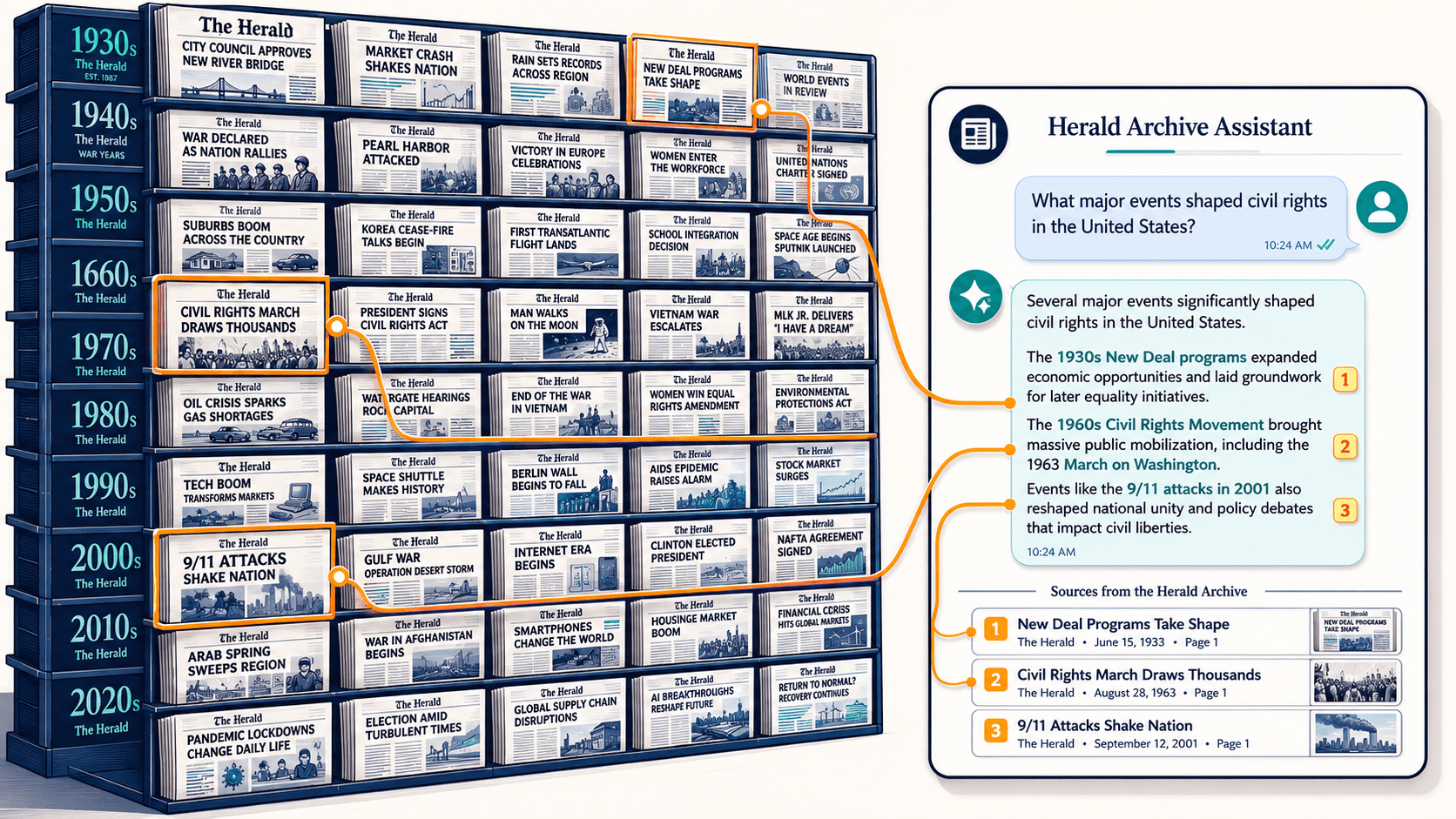
The News Article Is a Buggy Whip and Your Archive Is a Gold Mine

I was sitting across from the digital director of a legacy newspaper — one you've definitely read — when he pulled up a chart on his laptop and turned it toward me. Organic traffic, month over month, for the past eighteen months. It looked like someone had pushed a boulder off a cliff.
"We're doing everything right," he said. "More stories, better SEO, faster page loads. And we're losing."
He wasn't wrong about the execution. He was wrong about the game. The game had changed underneath him while he was optimizing for the old one. And that conversation — which happened over lukewarm coffee in a conference room with a view of a parking garage — is the reason I spent the next several months building something I believe will redefine how media companies survive.
The core idea is simple, almost painfully so: media companies need to stop selling articles and start selling answers. The news feed is dead. The archive is alive. And the technology to bridge that gap — to turn fifty years of journalism into a conversational intelligence engine — already exists. We just have to build it right.
I wrote an interactive deep-dive on this entire thesis if you want the full picture. But let me tell you the story of how we got here, because the numbers alone don't capture the vertigo of watching an entire industry's foundation crack.
Why Is Nobody Clicking Anymore?
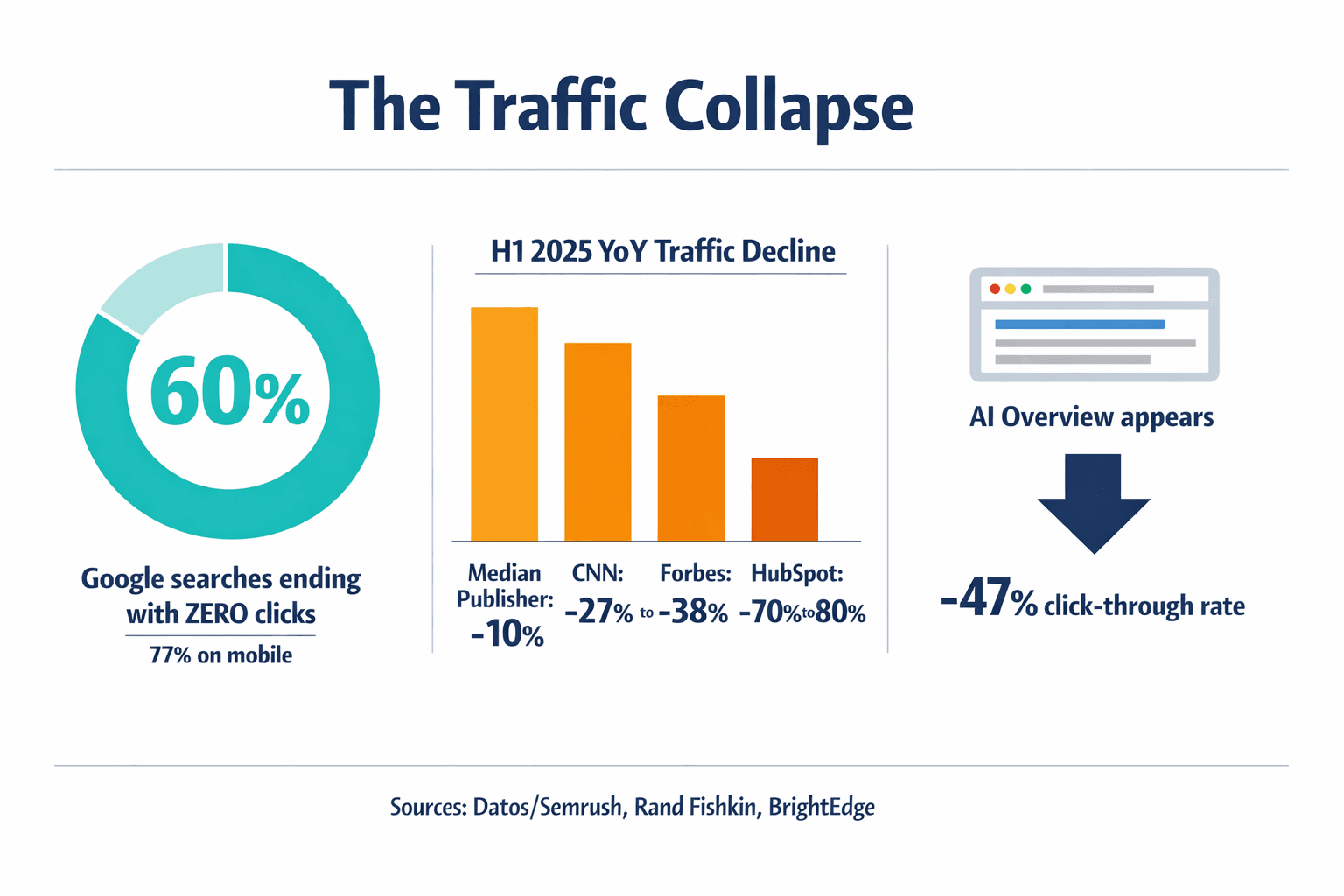
Here's the fact that keeps media executives awake: 60% of Google searches now end without a single click to any website. On mobile, it's 77%. Google has become the destination, not the doorway. The search engine that built the digital publishing economy has quietly become its biggest competitor.
And the scale of the damage is staggering. In the first half of 2025, the median publisher saw a 10% year-over-year traffic decline. But "median" hides the carnage. CNN dropped between 27% and 38%. Forbes and Business Insider fell nearly 50%. HubSpot — a company that essentially invented modern content marketing — lost 70-80% of its organic traffic.
The culprit is AI Overviews. When Google's AI summary appears at the top of search results — which now happens for roughly 13% of queries — click-through rates to organic links collapse by about 47%. The AI reads the articles so the user doesn't have to.
I remember my team and I staring at these numbers during a late evening work session. Someone said, "So the publishers create the content, Google's AI eats it, and the user never visits the site?" That's exactly right. And it gets worse.
The search engine is no longer a referrer of traffic. It's a competitor for attention.
Traffic to generative AI platforms — ChatGPT, Perplexity, Claude — is growing 165 times faster than traffic to traditional search. Users are asking longer, more complex questions. Searches with five or more words are growing 1.5 times faster than short keyword queries. People don't want ten blue links. They want one good answer.
The Article Is a Relic (and I Say That With Love)
I need to be careful here because I genuinely love long-form journalism. I read it constantly. But I also have to be honest about what the article format actually is: a container designed for print distribution.
Think about it. You printed an 800-word story in a newspaper because you couldn't print 800 individual answers. Physical distribution was expensive and sporadic, so you bundled information into narratives. That made perfect sense in 1975. It made decent sense in 2005, when the article migrated online but the reading behavior stayed roughly the same.
It makes almost no sense in 2025.
A user searching "What is the mayor's stance on housing?" doesn't want a 1,000-word feature on the history of city zoning. They want the mayor's stance on housing. The traditional model forces them through a gauntlet: Search → Click → Scroll → Scan → Read → Extract. Every step is friction. Every step is a chance to lose them.
I had this argument with a journalist friend who pushed back hard. "You're reducing journalism to facts," she said. "Stories matter. Context matters. Narrative matters." She's absolutely right — for opinion pieces, investigations, profiles, features. Those are art forms. But the vast majority of what fills a news feed isn't art. It's information trapped inside an inefficient format. And users are voting with their behavior: they'd rather ask an AI than wade through it.
What If the Archive Isn't a Graveyard?
This is where the conversation with that digital director shifted from depressing to electric.
I asked him how many articles were in their archive. He paused. "Probably... a few million? Going back to the seventies?" He said it like it was a liability — a server cost, a maintenance headache.
I told him it was the most valuable asset his company owned. More valuable than the brand. More valuable than the subscriber list. Because those millions of articles, spanning five decades of local politics, business, crime, culture — that's a dataset no AI company on earth can replicate without his permission.
The problem isn't the data. The problem is that it's locked inside unstructured text blobs that are disconnected from one another. Article A mentions Person X works at Company Y. Article B, published three years later, mentions Company Y is embroiled in Scandal Z. No single article connects Person X to Scandal Z. But the connection exists — buried across the archive, invisible to any search bar, waiting for someone to stitch it together.
Publishers who view their product solely as "articles" are manufacturing buggy whips in the age of the automobile.
That stitching is what we build at Veriprajna. Not chatbots. Not GPT wrappers. Intelligence engines.
The Mayor Question That Changed Everything
Let me make this concrete. Imagine a user — a local policy researcher, a concerned citizen, a journalist at a competing outlet — who wants to understand how the mayor's stance on housing has evolved since 2010.
In the old model, they search the newspaper's site for "mayor housing stance." They get fifty results. They open the 2010 article: "Mayor opposes high-rise development." They open the 2015 article: "Mayor softens stance amid affordability crisis." They open the 2022 article: "Mayor champions Build Now bill." They mentally synthesize the evolution. It takes forty-five minutes if they're fast.
In the model we're building, they type the question. The system decomposes it into temporal sub-queries. It traverses a knowledge graph — not just searching for keywords, but following the relationships between the Mayor entity and the Housing Development entity across time-stamped edges. It finds the stance shift from negative (2010) to neutral (2015) to positive (2022). It generates a narrative with citations linking to the original articles. It renders a timeline visualization.
Ten seconds.
That's not a chatbot. That's an intelligence product. And it's the kind of thing professionals — lobbyists, analysts, lawyers, corporate strategists — would pay serious money for.
Why Can't You Just Throw GPT at an Archive?
I wish you could. It would make my job a lot easier.
We tried the naive approach early on. Take articles, chop them into 500-word chunks, embed them as vectors, do similarity search, feed the results to an LLM. This is what most "AI chatbot" implementations do. And for simple, single-fact lookups in static documentation, it works fine.
For news archives, it fails in ways that are subtle and dangerous.
It loses the thread. Chunking breaks narrative arcs. A chunk discussing a verdict gets separated from the chunk describing the crime. The system literally can't follow a story that unfolds across multiple articles over multiple years.
It's blind to time. Vector similarity doesn't know what year it is. An article from 2010 saying "the housing market is crashing" is semantically identical to one from 2024 saying the same thing. The system conflates old reality with current reality. It can't distinguish what was true from what is true.
It can't connect dots. If Person X and Scandal Z never appear in the same article, naive retrieval will never find the connection — even if Company Y links them. The system lacks what researchers call "multi-hop reasoning."
It hallucinates to fill gaps. When retrieval misses relevant context, the LLM doesn't say "I don't know." It invents. It fabricates quotes. It creates events that never happened. In journalism, this isn't a bug report. It's a lawsuit.
We learned all of this the hard way. There was a specific test — I won't name the publication — where the naive system confidently attributed a quote to a politician who had never said anything remotely like it. The quote sounded plausible. It was grammatically consistent with how the politician spoke. It was completely fabricated. That was the moment I knew we needed a fundamentally different architecture.
How Do You Build an Intelligence Engine That Actually Works?
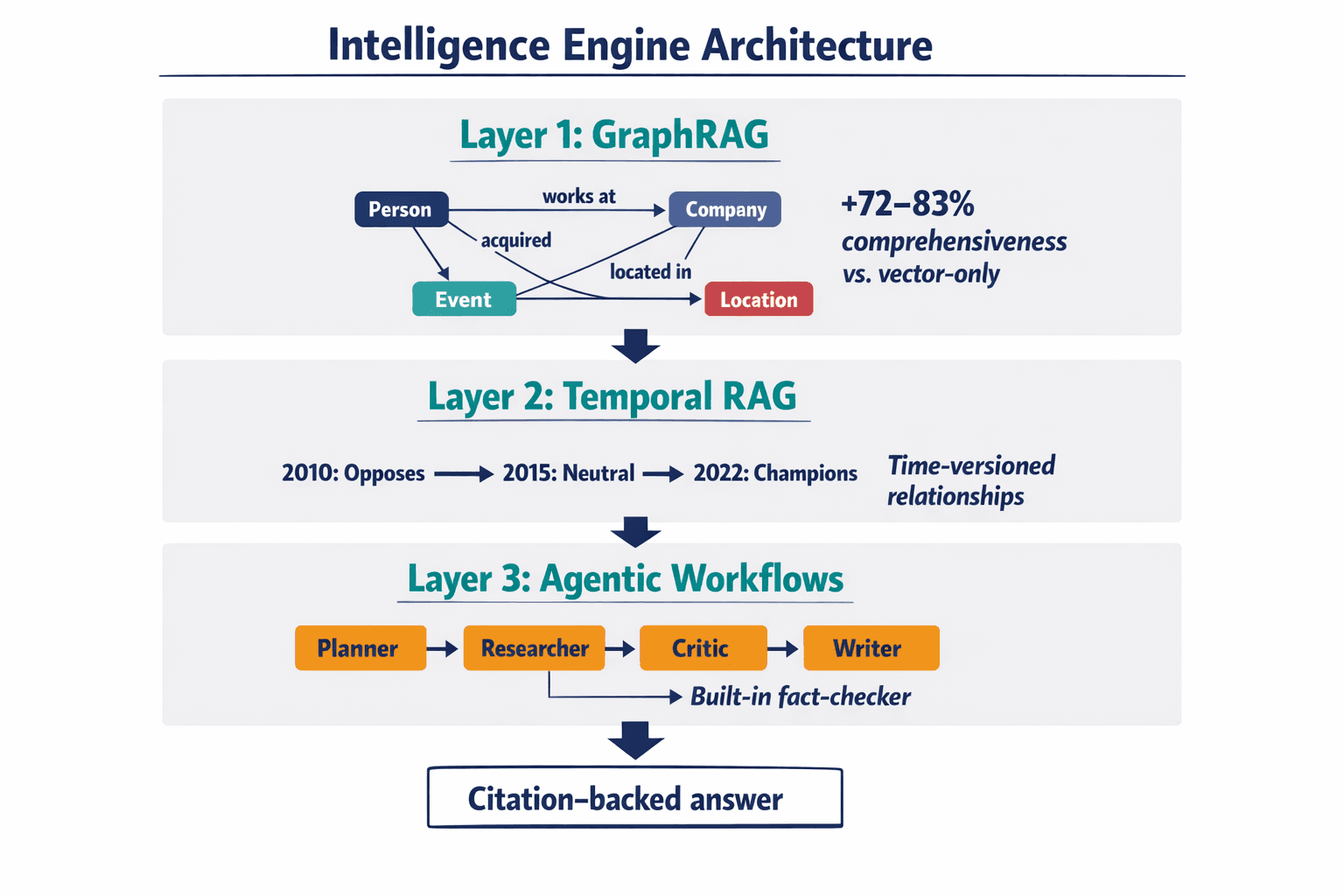
The architecture we developed at Veriprajna has three layers, each solving a specific failure mode. I'll sketch them briefly here — for the full technical breakdown, see our research paper.
Layer one: GraphRAG. Instead of treating the archive as a bag of disconnected text chunks, we extract a knowledge graph — entities (people, organizations, locations, events) and the relationships between them. "Elon Musk" → acquired → "Twitter." These get stored in a graph database where every article is interconnected. When a user asks a complex question, the system doesn't just search for keywords. It traverses the graph, hopping from node to node, finding connections that span decades and thousands of articles.
The results are dramatic. On multi-hop reasoning tasks, GraphRAG has shown improvements in comprehensiveness of 72-83% compared to vector-only approaches. It can answer "What are the main themes in five years of climate coverage?" — a question naive RAG can't even attempt.
Layer two: Temporal RAG. Every chunk and every graph edge gets tagged with valid-time metadata. Relationships are versioned — the "CEO of Apple" edge for Steve Jobs has different time bounds than the one for Tim Cook. When a user asks an evolutionary question, the system decomposes it into temporal sub-queries and assembles the results chronologically. The archive becomes a time machine.
Layer three: Agentic workflows. The LLM doesn't just retrieve and answer. It plans. A Planner agent breaks down a complex request ("Write a due diligence report on Company X") into sub-tasks. A Researcher agent executes targeted queries. A Critic agent reviews the results for gaps and contradictions before the user sees anything. A Writer agent synthesizes the final output with citations.
We don't wrap APIs. We rebuild the foundations of knowledge infrastructure.
That Critic agent is crucial. It's essentially a built-in fact-checker — a second LLM call that compares every generated claim against the source documents and strips out anything unsupported. Combined with strict grounding instructions and citation enforcement, it's how we maintain what I think of as a zero-tolerance policy for fabrication.
What Does the Financial Times Know That Everyone Else Doesn't?
The FT launched "Ask FT" — a conversational interface that lets professional subscribers interrogate their archive. Every answer is grounded solely in FT journalism. Every claim has a clickable citation. It's designed for specific professional workflows: meeting prep, rapid due diligence, trend analysis.
Bloomberg went even further with BloombergGPT, a domain-specific LLM that translates natural language into Bloomberg Query Language. An analyst can ask "Show me revenue growth for tech companies in Q3 2024" and get a formatted table. They can interrogate earnings call transcripts — asking about a CEO's tone on a specific risk factor — instead of reading hundreds of pages linearly.
These aren't experiments. They're business models. And they point to where the money actually is.
Where Does the Money Come From?
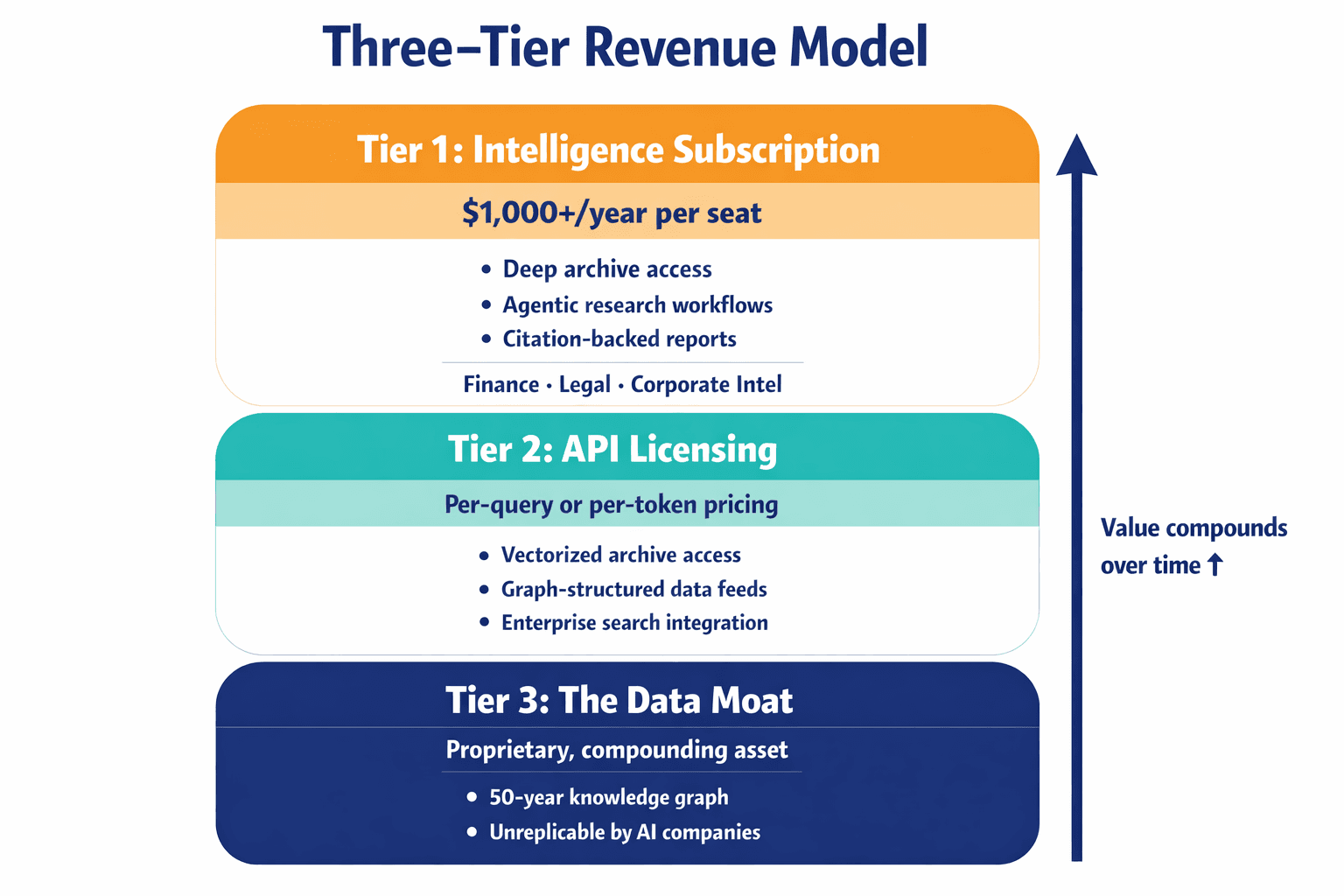
People always ask me whether this "intelligence-as-a-service" model can actually replace ad revenue. My honest answer: it doesn't need to replace all of it. It needs to replace the part that's disappearing.
The economics break down into three tiers.
First, an Intelligence Tier subscription — not $10/month for "read the news," but $1,000+/year for professionals who need deep archive access, agentic workflows, and citation-backed research. Finance professionals, corporate intelligence teams, law firms doing regulatory research. These users exist. They're currently paying analysts to manually do what a well-built system does in seconds.
Second, API licensing. Instead of fighting AI crawlers with robots.txt, formalize the data exchange. Sell clean, vectorized, graph-structured archive access to enterprise search platforms, financial terminals, and third-party developers. Charge per query or per token. The publisher's intelligence lives inside the client's workflow.
Third, and this is the part most people miss: the data moat itself. In a world where anyone can access GPT-4, the model is not the competitive advantage. The data is. A fifty-year archive of local news is a dataset that OpenAI cannot replicate. The knowledge graph derived from that archive — the web of local power players, the timeline of policy shifts, the network of corporate relationships — is proprietary intellectual property that compounds in value over time.
In a world of commoditized AI models, the moat isn't the algorithm. It's the archive.
What About the Journalists?
I get this question constantly, and I think it deserves a direct answer rather than a dodge. This pivot doesn't eliminate journalism. It eliminates the inefficiency of how journalism reaches people. The reporter who spends three months investigating a corruption scandal is doing work no AI can replicate. The system we build makes that work more discoverable, more queryable, more valuable over time. It turns a story that gets read for a week and then buried on page 47 of search results into a permanent, retrievable node in a knowledge graph that surfaces every time someone asks a related question for the next fifty years.
The threat to journalism isn't conversational AI. The threat is the collapsing referral economy that funds journalism. If the traffic is gone — and it is — then clinging to the ad-supported feed model isn't loyalty to the craft. It's denial.
What Happens If Media Companies Don't Pivot?
Something worse than decline: irrelevance. Their archives get scraped by AI companies, synthesized into training data, and served back to users without attribution, without payment, and without the trust layer that editorial standards provide. The publisher becomes an unpaid content supplier to someone else's intelligence product.
Some publishers are already signing licensing deals with OpenAI and others. That's a start, but it's a low-margin, one-off transaction. You're selling raw materials when you could be selling refined intelligence. It's the difference between exporting crude oil and building a refinery.
The future of news consumption isn't the feed. It's the conversation. We're moving toward what I think of as Generative UI — interfaces that adapt to the answer. Ask for a timeline, get a timeline. Ask for a comparison, get a table. Ask for a briefing, get a PDF. The static website dissolves into a fluid, adaptive canvas for intelligence.
Media companies that master the underlying data structures — the vectors, the graphs, the temporal logic — will define this future. They won't just survive the death of the news feed. They'll build something better than the feed ever was.
The archive isn't a cost center. It's the entire business. The only question is whether you'll be the one to unlock it, or whether you'll watch someone else do it with your data.
Stop selling words. Start selling answers.