Retention AI Needs a Reason to Make an Offer

A subscriber who is likely to cancel is an obvious candidate for a retention offer. That makes churn prediction a tempting starting point for automation. But the useful question is whether this particular intervention improves the outcome enough to justify its cost. Someone can be likely to leave and unlikely to benefit from a discount. Someone else can be likely to stay until the intervention makes things worse.
I want retention systems to earn the decision to make an offer before they earn the ability to write one. A persuasive draft cannot supply the missing evidence that an intervention is useful. And evidence that an offer might help cannot establish that the actual message is acceptable. These are separate judgments, with separate reasons for withholding action.
The same number of offers can produce different value
Our Ethical Subscription Retention AI demo uses a synthetic subscription cohort to make that distinction inspectable. The comparison evaluates policies against hidden synthetic outcomes, so it can compare what happens with an intervention against what happens without one. Those hidden outcomes are used for evaluation, not supplied to the model as training labels.
Predictive churn targeting and causal uplift each contact 2,239 of the cohort's 6,000 subscribers with current cancellation intents. The former ranks churn risk. The latter targets estimated intervention benefit after the configured discount cost. Predictive targeting produces $144,162 in annualized incremental revenue relative to leaving the cohort alone; uplift produces $187,956. These are synthetic policy evaluations, separate from the demo's full subscriber routing constraints. They are neither realized revenue nor a forecast for a deployed service.
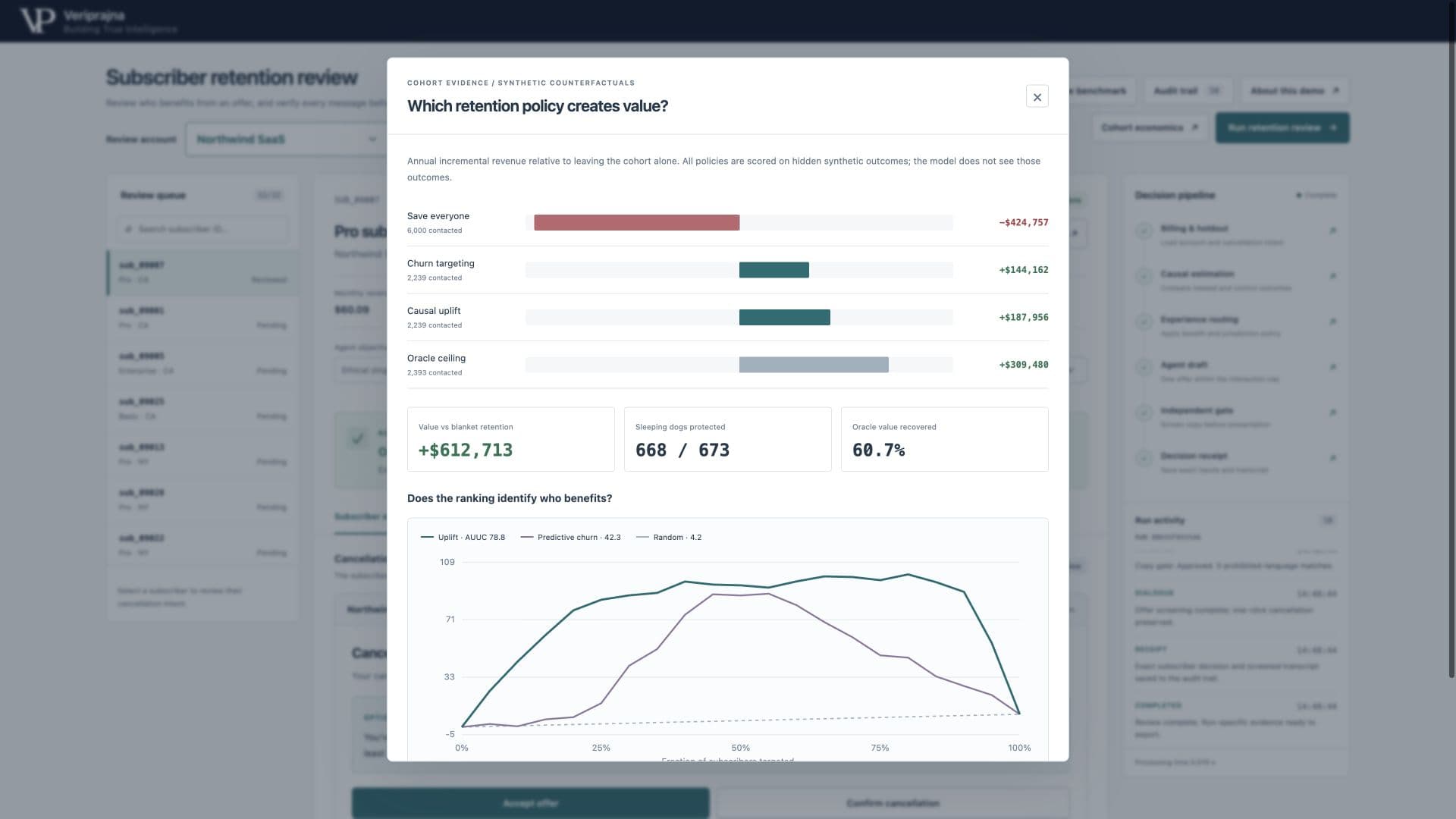
The equal contact budget matters. The uplift policy's advantage here does not come from sending fewer offers. It comes from choosing a different set of recipients. A team could meet a contact-volume target and still spend its discounts on people who would stay anyway, people the offer cannot persuade, or people the intervention harms.
This also changes how I interpret a successful save. A subscriber who accepts a discount is a visible success for an offer flow. If that subscriber would have renewed at full price, the flow has bought an outcome that did not need buying. Counting accepted offers alone cannot reveal that cost. Evaluation needs a comparison with no intervention, as well as the cost of the offer.
Restraint needs a route, not just a score
The demo estimates retention with and without intervention from randomized treated and control history. Their difference is estimated causal uplift: the change attributed to the intervention under the model. It is an estimate, not a known causal outcome for an individual subscriber.
One synthetic subscriber has substantially lower estimated retention with intervention than without it. The selected-subscriber route records no retention contact and skips drafting. The modeling label for these harmed-by-intervention cases is Sleeping Dogs. In that route, restraint happens before a persuasive message can become the default next step.
The aggregate policy is imperfect. It leaves 668 of 673 true Sleeping Dogs uncontacted in the synthetic cohort, but still contacts five. The hidden fixture labels let us count those misses. They would not be available as individual ground truth in a deployed system. I treat the result as a reason to inspect harmful interventions, not permission to claim that a causal model eliminates them.
That is an uncomfortable boundary for a retention team: declining an offer can forgo a genuine save, while approving one can waste a discount or make retention worse. My design position is to make both costs visible. A conservative route is a choice under uncertainty, and should carry a reason that someone can challenge.
What to do when the evidence is thin
A second synthetic account in the demo has too little data for its configured evidence requirements. The interface withholds causal decision predictions, skips the agent and offers a clean exit. The thresholds are demonstration rules, not a universal test of statistical sufficiency. Internal computations may still exist; the important behavior is that they do not become evidence for an automated offer.
It would be easy to replace that missing causal recommendation with a churn score. That preserves automation, but it answers a different question. A high likelihood of leaving does not establish that the proposed discount changes the decision. Calling the substitution a fallback can hide the very distinction the system was built to preserve.
For a hypothetical production team in this situation, I favor a temporary exit without an automated retention discount while it gathers evidence relevant to the intervention. That costs potential saves in the short term. It also avoids making broad discount decisions on a score that does not measure their benefit. The choice should be explicit in evaluation, rather than disappearing as a successful abstention metric.
If the team chooses to learn through a new experiment, the experiment needs a treatment group, a no-intervention comparison and a defined offer cost. In that hypothetical setting, I would restore automated discounts when the comparison on the relevant population supports incremental value after cost. More accepted offers alone would not change my decision. The experiment still needs independent message and cancellation controls. Simply accumulating more churn observations will not answer what the offer changes. This is a separate, deliberately authorized action; the demo does not implement that production learning process.
Offer value does not approve the message
Even an economically promising offer needs another decision before it reaches a subscriber. The demo's authored artificial-countdown benchmark makes that concrete: a deterministic lexical gate outside the drafting model blocks the pressure message, and the words stay out of the subscriber preview. Cancellation remains available. This is a reference copy case, not a rejected model response. It demonstrates authority to withhold a message after the decision to consider an offer.
The gate detects configured language patterns, so clearing it does not certify every fact or meaning. Offer and cancellation buttons also affect only the local preview, with no production billing integration. Within those limits, the control provides a useful evaluation test: a disallowed draft must stop at the gate. A warning that leaves the same words on their path to the subscriber would not deliver that behavior.
A team evaluating this architecture should therefore test two things independently: whether targeting creates incremental value after cost, and whether a disallowed message is actually withheld. Strong economics cannot excuse pressure in the message. Clean language cannot rescue an offer whose expected benefit does not cover its cost.
Here is the founder walkthrough of the demo, including the decisions to make an offer or leave a subscriber alone.
The demo explainer shows the synthetic workflow and its decision evidence. What I want a builder to take from it is a purchasing and evaluation standard: ask for the reason an offer was made, the reason another was withheld, and the evidence that could change either decision. A system that can only explain its successful offers leaves the harder judgment to everyone downstream.