Your Save Flow Is Quietly Manufacturing Churn — Here's the Number That Proved It

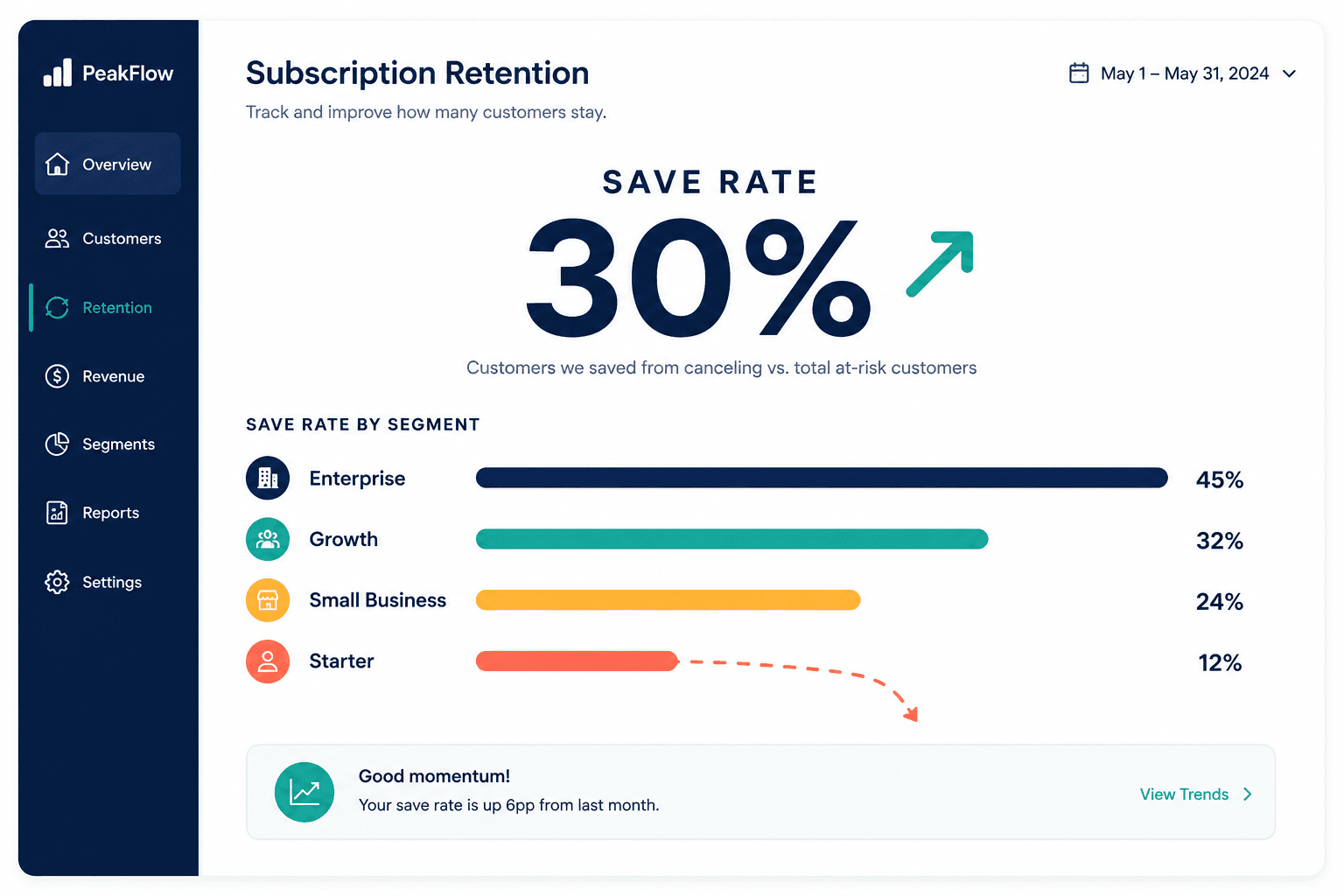
The first time I felt genuinely good about a retention dashboard, I was looking at a 30% save rate. Thirty percent of the people who clicked "cancel" didn't go through with it. On paper, that flow had paid for itself ten times over. I remember thinking the hard part was over.
Then I pulled the cohort underneath the number, and it stopped adding up.
Some of those "saved" users had clicked cancel by accident, browsed the offer, and stayed — they were never leaving. Some had taken the discount and churned the next month anyway. And a quieter group bothered me more: people we had emailed during their cancellation window who, as far as I could tell, hadn't been trying to cancel at all. We'd reached into a renewing customer's inbox to say "we'd hate to see you go," and reminded them they were paying $49 a month for something they hadn't opened since winter. That is the whole story of why I now build ethical subscription retention AI the way I do, and why the system we eventually shipped at Veriprajna starts by refusing to treat all cancellers the same.
Save rate is a vanity metric that conflates four completely different people into one congratulatory number.
The 30% That Isn't What You Think
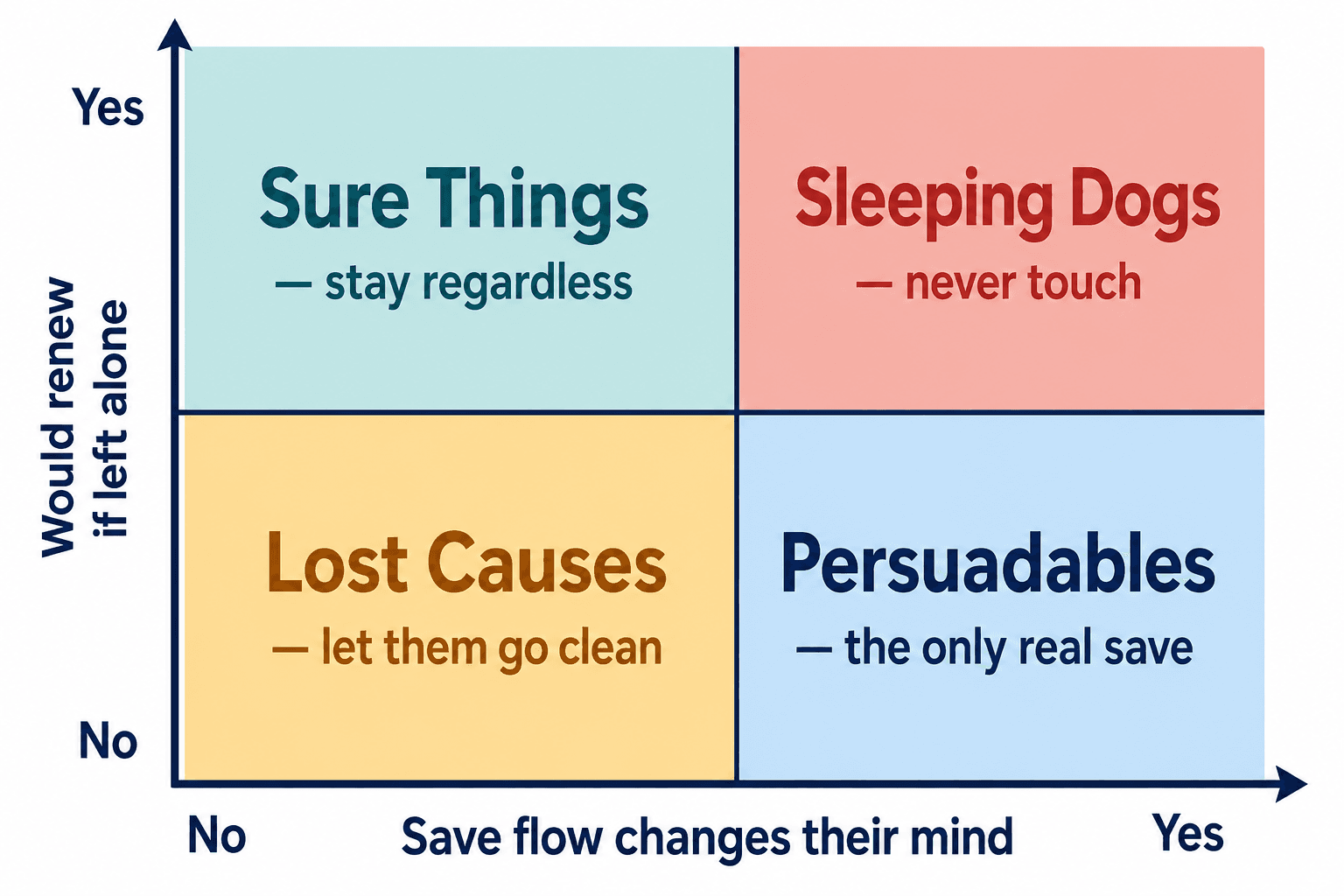
Spend any time inside a cancellation funnel and you learn that "people who click cancel" is not one population. It's four, and they want opposite things from you.
There are Persuadables — they'll leave unless they get the right nudge, a feature they didn't know existed, a plan that fits how they actually use the product. These are the only users where a save flow creates real value. There are Sure Things, who will stay no matter what; handing them a 20% discount just burns margin on revenue you already had. There are Lost Causes, who have decided and aren't coming back; a four-page interrogation only makes them angry and turns into the support ticket — and the kind of "labyrinthine" experience that, as I'll get to, is exactly what regulators now go looking for.
And then there are Sleeping Dogs: customers who are quietly renewing and would have kept renewing, right up until your retention campaign woke them. Touch them and you create churn that would not have existed otherwise.
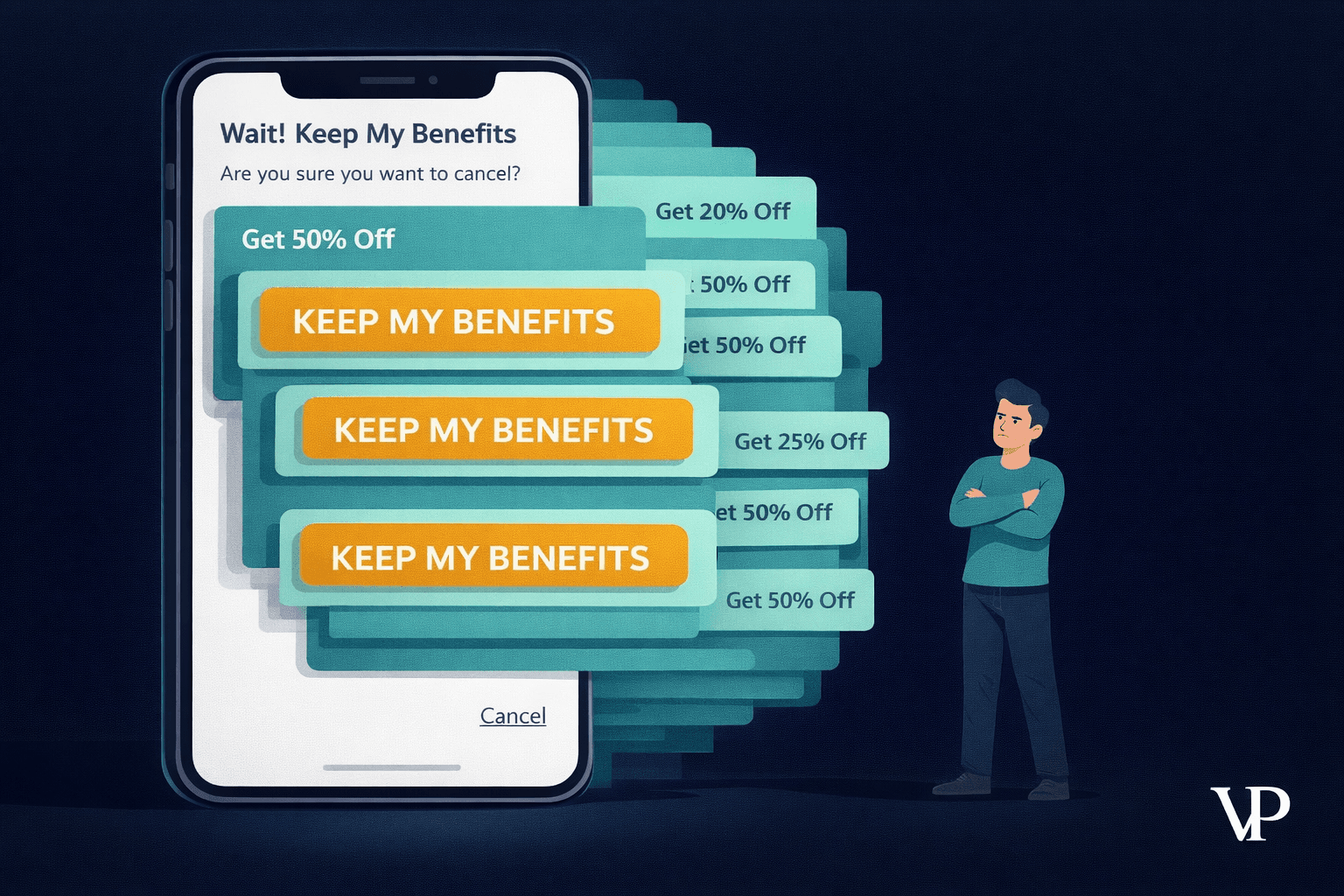
The trap is structural. A blanket save flow — the kind every off-the-shelf tool ships by default — treats all four as the same canceller and runs the same offer at all of them. Your save rate counts the Sure Things as wins. It says nothing about the Sleeping Dogs you just lost, because those losses never show up in the cancellation funnel. They show up as a renewal that silently didn't happen.
The Holdout Test I Didn't Want to Run
I'd love to tell you we designed around this from the start. We didn't. The first retention model I backed optimized save rate, because save rate was the number everyone in the room trusted, and it went up, and we shipped it.
What changed my mind was a holdout test I almost didn't bother running. The argument against it is always the same: why deliberately withhold the save flow from a control group and "lose" the saves you could have made? I ran it anyway, mostly to have a clean baseline. When the results came back, the treatment group — the users we'd "helped" — had churned at a higher rate than the control group we'd left alone.
I sat with that table for a long time. We weren't reducing churn. In one slice of the audience, we were producing it.
It turns out we'd reinvented a mistake with a paper trail. Telenor, the Norwegian telecom, ran retention campaigns that caused roughly 2% higher churn in the treated group than in the control — they only discovered it because they ran a proper holdout. Most subscription businesses never do. They A/B test which offer converts best and never ask the prior question of whether intervening at all helps. The uncomfortable arithmetic: a company with 200,000 subscribers and 3% monthly voluntary churn sees about 6,000 cancel-intent users a month, and industry research puts 10–20% of those at Sleeping Dogs. Contact all 6,000 — which is what the default tools do — and you're nudging 600 to 1,200 people a month toward a cancellation they weren't going to make. At $50 average revenue per user, that's $360,000 to $720,000 a year in revenue your own retention system destroyed.
We didn't have a churn problem. We had a retention system that was generating churn and hiding it inside a metric that only counts wins.
Why Couldn't a Smarter Churn Model Just Fix This?
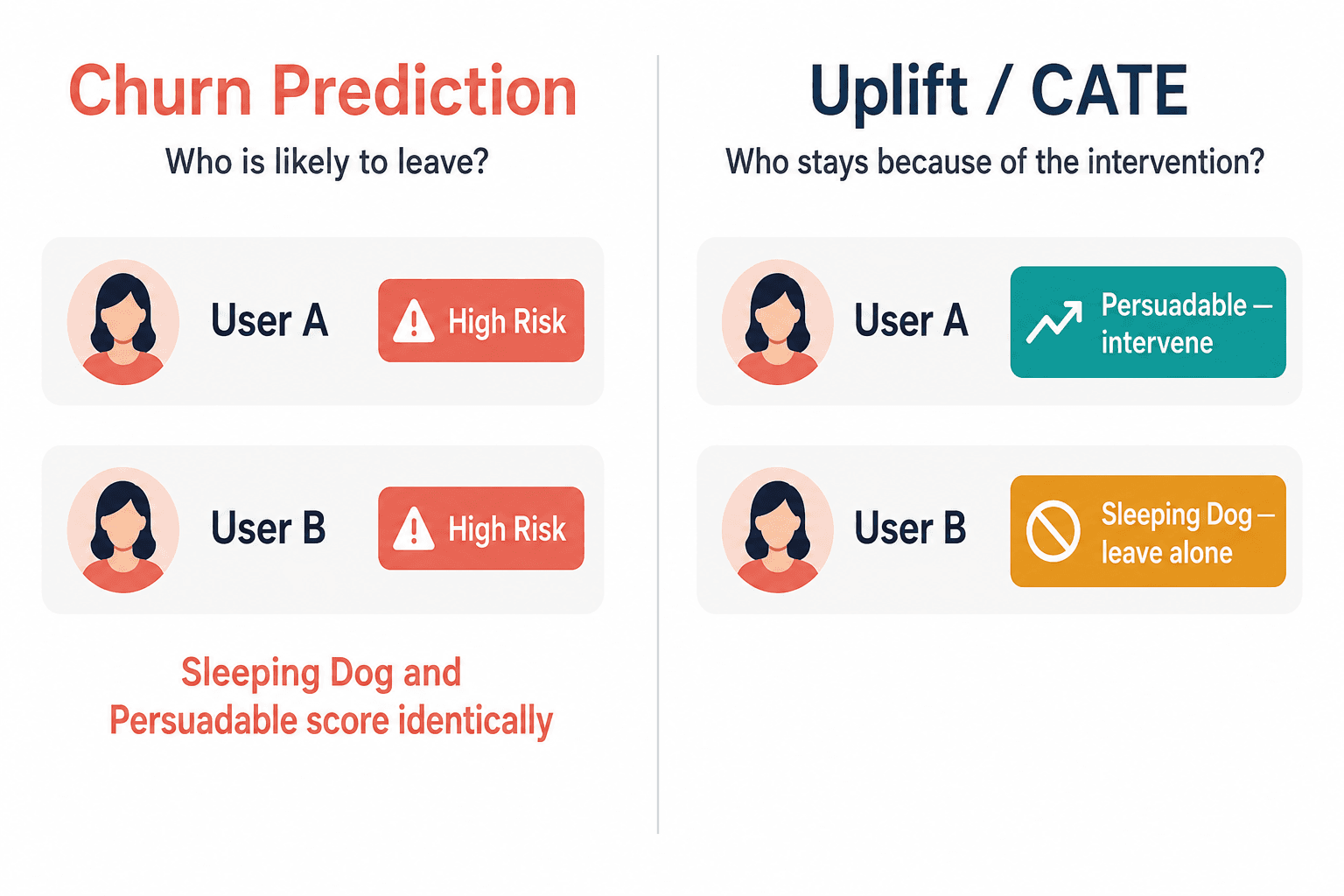
My first instinct was to get smarter about prediction. If the problem was contacting the wrong people, surely a better churn model — one that scored who was most likely to leave — would fix it.
It wouldn't, and the reason is the heart of this whole thing. Standard churn prediction answers "who is likely to leave?" But a Sleeping Dog and a Persuadable can score identically on a leave-likelihood model and need opposite treatment. The question that actually matters isn't who will leave. It's who will leave because of your intervention, or stay because of it — and a predictive model structurally cannot answer that, because it never sees the counterfactual.
That counterfactual question has a name: uplift modeling, or estimating the Conditional Average Treatment Effect — the change in a specific user's behavior caused by the intervention, not just correlated with their profile. The financial-services world figured this out earlier than SaaS did; uplift models there consistently outperformed predictive ones and made retention spend actually profitable, because they stopped spending it on people whose minds were already made up in either direction.
The catch — and this is the part nobody selling you a "retention platform" mentions — is that uplift modeling needs experimental data. Randomized holdouts, or strong instruments. You cannot retrofit it onto a flow that has only ever shown everyone the same screen, because you have no record of what happens when you don't intervene. Most subscription companies have never collected that data. It's the same blind spot that lets 82% of SaaS companies offer promotional pricing while only 36% can measure whether it returns anything. You can't manage a treatment effect you've never measured.
The $2.5 Billion Reason This Stopped Being Just a Margin Problem
For a while I thought of all this as an optimization story — leave money on the table or don't. Then the cost of getting it wrong changed by three orders of magnitude.
In September 2025, the FTC settled with Amazon over Prime for $2.5 billion — a $1 billion penalty plus $1.5 billion in refunds, the largest penalty for a rule violation in the agency's history. The substance was the cancellation experience: the so-called "Iliad Flow," a four-page, six-click, fifteen-option gauntlet that the complaint said enrolled 35 million people without clear consent. That same year, Vonage paid $100 million for a hidden cancellation mechanism and charges that continued after customers asked to stop; Epic Games settled for $245 million. Chegg and HelloFresh each paid $7.5 million. Uber is in it now too — the FTC's complaint describes Uber One taking up to 23 screens and 32 actions to cancel, and by December 2025, 21 states plus DC had joined.
People assume the FTC's "click-to-cancel" rule getting vacated by the Eighth Circuit in July 2025 took the pressure off. It did the opposite. The rule fell on a procedural technicality — the agency skipped a required regulatory analysis — not on any finding that dark patterns are fine. Enforcement just routed around it, back to ROSCA and Section 5 of the FTC Act, which were doing this work before the rule existed. The FTC restarted negative-option rulemaking with a new notice in January 2026.
And here is the operational fact I wish more product teams internalized: ROSCA doesn't require regulators to prove a specific named dark pattern. It only requires them to show cancellation wasn't "simple." That's a far lower bar than most companies build against. The rough test I give teams is brutal in its simplicity — if your cancel flow has more steps than your signup flow, you already have exposure.
The legal test is almost insultingly simple: if leaving takes more steps than joining, a regulator already has most of its case.
Which State's Law Are You Actually Building Against?
The other thing that makes this genuinely hard — harder than a single rule would be — is that there is no single rule. The federal floor moved, but the states didn't wait.
California's automatic renewal law, amended effective July 2025, requires cancellation to be "immediately accessible" online and adds a "One Save" rule that limits you to a single retention offer per cancellation — which quietly outlaws the multi-screen offer gauntlet most flows rely on. New York requires online-only cancellation for anything signed up for online. Maryland has its own disclosure timing; Connecticut wants pre-renewal notices. If you serve customers across states, your compliance floor isn't the average — it's the strictest law anyone in your subscriber base lives under.
I've sat on the other side of that floor, in the ROSCA reviews where outside counsel finally sees a flow the growth team shipped months earlier to lift save rate — and now has to defend it after the fact. A marketing team A/B-tests cancellation copy on Tuesday; legal reviews the flows quarterly, if that. Everything that ships into the window between those two clocks is exposure nobody actually signed off on. That window is the single most expensive thing in the whole picture, and it exists because the people optimizing the funnel and the people answerable for it are looking at different screens on different schedules.
There's a newer frontier too, and it's the one I watch most closely. In January 2026 the FTC moved against JustAnswer over an AI chatbot named "Pearl" that allegedly steered consumers into recurring charges — one of the first enforcement actions aimed at an AI agent in a subscription flow. The lesson lands hard for anyone bolting a large language model onto their save flow: an AI that adds conversational friction, or leans on confirm-shaming to talk someone out of leaving, gets judged by the same standard as a manual dark pattern. Possibly a harsher one, because it scales the manipulation and logs every word it used to do it.
What We Actually Built
So the system we ended up building isn't one model. It's three capabilities that the market, oddly, only sells separately.
The first is causal segmentation — uplift models that connect to your billing event stream, the live feed of cancel-intent timestamps and plan changes coming out of Stripe, Chargebee, or Recurly, and sort each cancelling user into Persuadable, Sure Thing, Lost Cause, or Sleeping Dog by their estimated treatment effect, not their leave-likelihood. The Sleeping Dogs get the most valuable intervention of all: silence. The second is a cancellation flow designed around those segments that stays inside the legal floor — single-offer where "One Save" applies, online-cancel where New York demands it, no more friction to leave than to join. The third is the piece I've never seen anyone else ship: automated auditing that reads a flow — including an AI agent's actual transcripts — and flags dark-pattern behavior before it goes live, instead of after a state attorney general does the flagging for you.
I went looking for an off-the-shelf tool that did all three and there isn't one. Chargebee Retention and ProsperStack build genuinely good cancellation experiences and optimize offers, but they treat every canceller the same and can't tell a Persuadable from a Sleeping Dog. Pega can do next-best-action decisioning at enterprise scale, but it's a legacy platform with implementations that start around half a million dollars and audits nothing for compliance. The customer-success platforms score churn risk but don't touch the cancellation moment. Nobody audits the AI save agents at all. The connective tissue — causal models plus compliant flow design plus dark-pattern auditing, wired into billing you already have — is the gap, and it's where we live.
The Objections I Hear Every Time
The first one is always: won't a "kinder," lower-friction cancel flow just gut my retention? In practice the opposite, because the friction was never what kept the Persuadables — a relevant offer kept them, and friction mostly enraged the Lost Causes and woke the Sleeping Dogs. Strip the friction and aim the offer, and you stop paying for churn you were manufacturing.
The second: we already discount aggressively, isn't that retention? It's expensive retention with a tail. The median retention discount runs about 16.7% — roughly two months free — and heavily discounted customers go on to retain 15–20% worse afterward. You're not saving them; you're renting them at a loss and resetting the clock.
The third, the honest one: we've never run a holdout, so we have no idea which group is which. That's not a disqualification — it's the starting line. It's where we started too, with a dashboard I was proud of and a test I almost skipped. You can read how we approach the build at the Veriprajna solution page, but the first move is always the same: measure what happens when you do nothing.
A 30% save rate told me I was winning. A holdout test told me that on one slice of my own customers, the saves I was busy counting were being canceled out by renewals I'd quietly talked out of happening. The number that matters in retention was never how many cancellations you stopped. It's whether the person would have stayed if you'd simply left them alone — and until you can answer that for each user, you're not retaining customers. You're spending margin to find out which ones you're about to lose.