73,000 "Smart" Meters Went Dark Overnight — And It Revealed Everything Wrong With How We Build Infrastructure AI

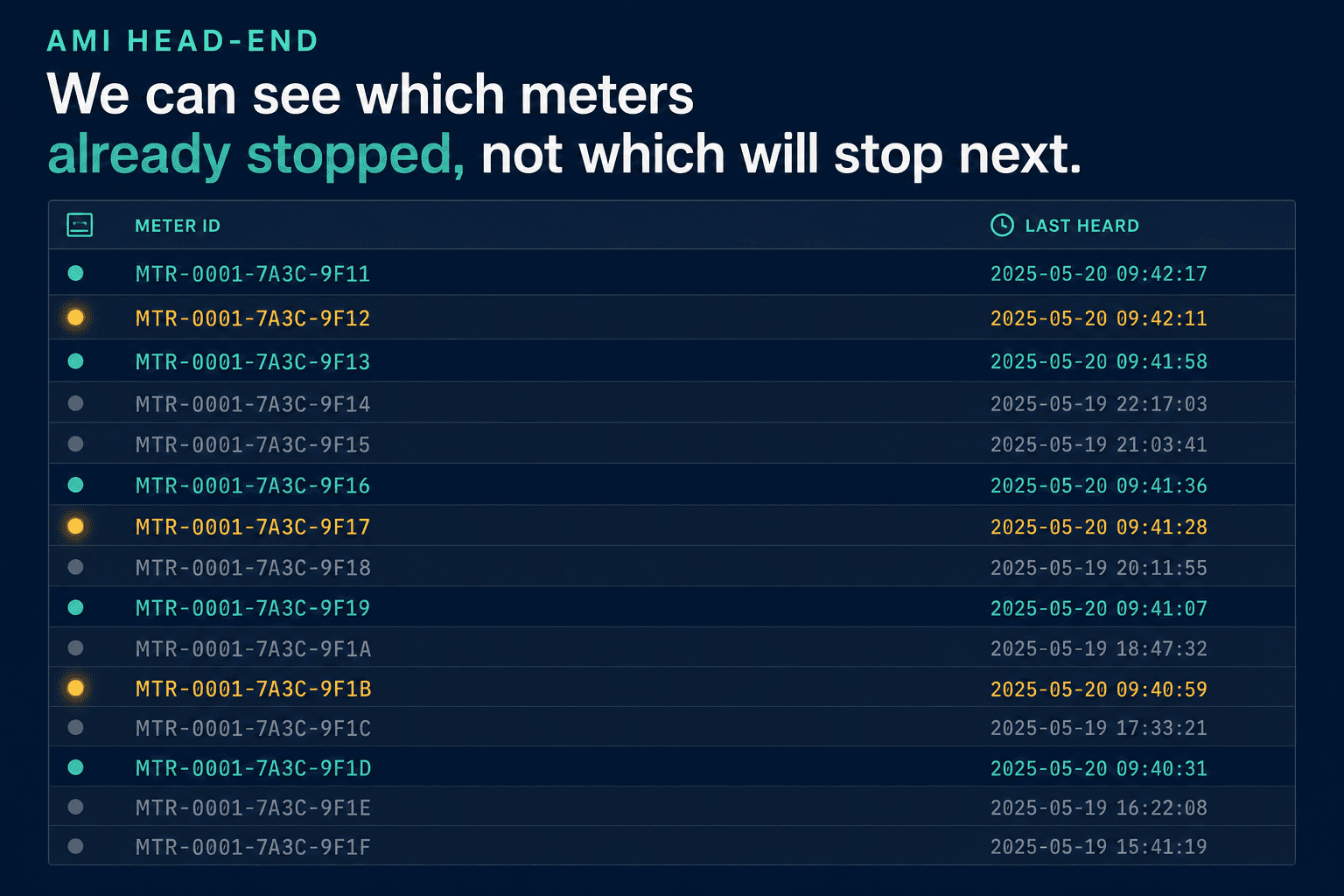
A friend who runs operations for a mid-size water utility called me on a Saturday morning. Not to catch up — to vent. His team had just discovered that a firmware update pushed to their smart meter fleet the previous week had quietly corrupted the billing data for thousands of accounts. The meters looked fine on the dashboard. Green lights everywhere. But the numbers flowing into the billing system were wrong, and nobody noticed until a wave of customer complaints hit.
"The vendor says it's a known issue," he told me. "They're working on a patch."
I asked how long the meters had been sending bad data. He paused. "We think about nine days."
That conversation stuck with me — not because the technology failed, but because of how invisible the failure was. These weren't meters that went offline. They were meters that kept humming along, transmitting data that looked plausible but was silently wrong. And when I started pulling the thread on smart meter failures across North America and the UK, I realized my friend's Saturday morning crisis was a footnote in a much larger story.
The Night 73,000 Meters Went Silent
In Plano, Texas, the city had spent $10.2 million on 87,000 smart water meters from Aclara Technologies, expecting them to last twenty years. By 2023, batteries were dying early. The vendor's fix? A remote firmware update pushed in November 2024 to optimize power consumption.
That update bricked 73,000 meters.
Not "degraded performance." Not "intermittent issues." The electronic transmission systems simply stopped working. Plano — a city of nearly 300,000 people in the Dallas-Fort Worth metroplex — had to hire 20 temporary meter readers and revert to walking routes door to door. Cost: $765,000 over two years, just for the manual labor.
I keep coming back to the bitter irony of this. The firmware was supposed to fix the battery problem. Instead, it turned a localized hardware issue into a network-wide collapse. I've started calling this the Firmware-Battery Paradox — the software designed to extend hardware life becomes the primary mechanism of its failure.
The software designed to extend hardware life often becomes the primary mechanism of its failure.
And Plano isn't alone. Toronto lost 470,000 transmitters to early degradation — $5.6 million in initial remediation costs. Memphis Light, Gas and Water faced an 8% systemic failure rate across their smart meter fleet, setting aside $9 million for repairs. In the UK, over 900,000 smart meters have been repaired or replaced since regulators started paying attention.
I wrote about the technical architecture behind these failures in more depth in the interactive version of our research, but the pattern is consistent everywhere I look: utilities spent billions digitizing their grids, and the "smart" infrastructure is failing faster than the mechanical meters it replaced.
Why Do Smart Meters Die Young?
When my team started analyzing the root causes, we expected to find sloppy manufacturing or cheap components. The reality was more unsettling.
Smart meters aren't simple measurement devices. They're networked computers — integrated processors, edge AI chips, secure communication protocols, flash memory for data storage. And like any computer, they're subject to failure modes that mechanical meters never had.
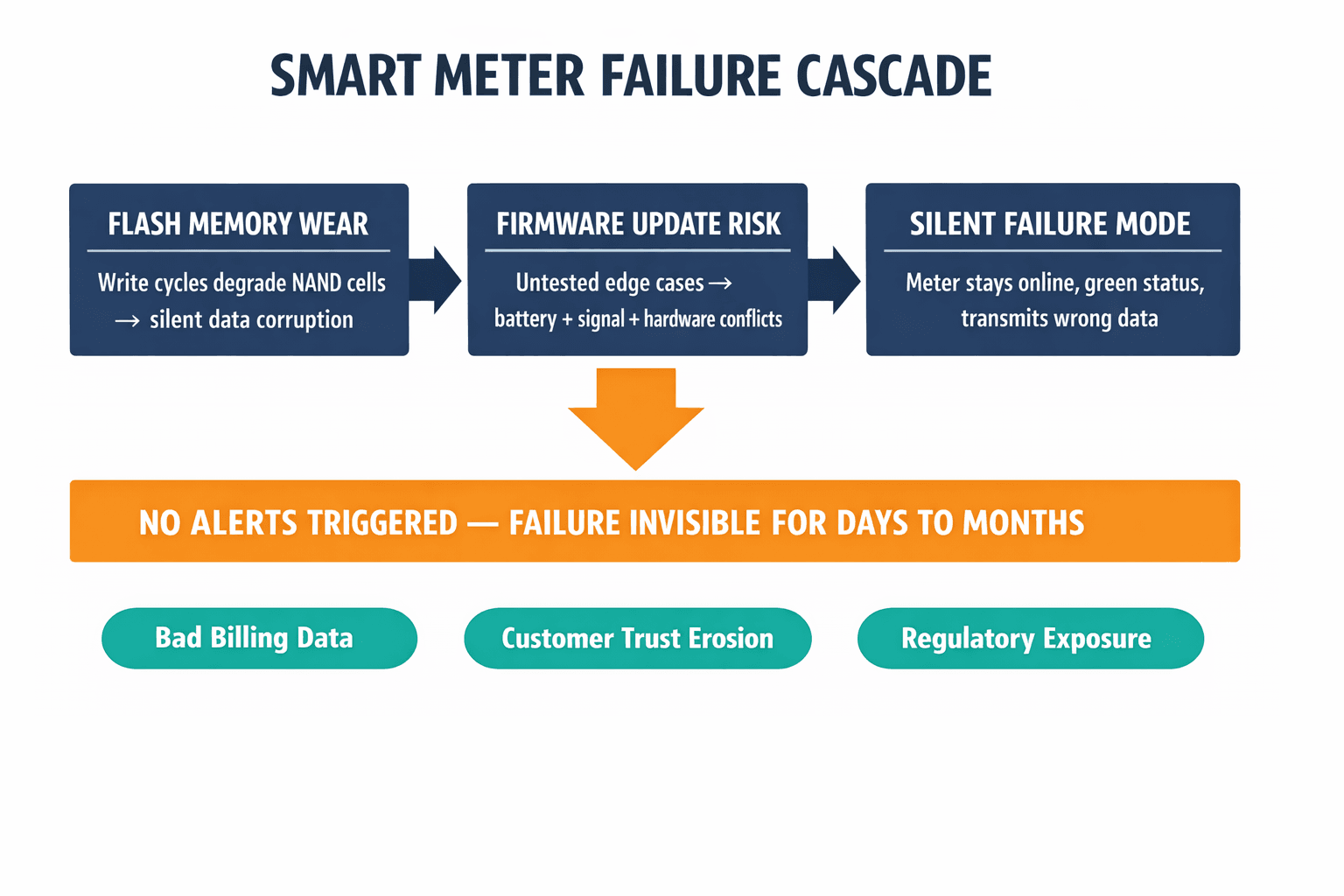
The flash memory issue is particularly insidious. Smart meters use NAND flash to store firmware and diagnostic logs. Every write operation generates obsolete data that gets cleared through a process called garbage collection, which physically wears down the memory cells. If the embedded file systems aren't optimized — and in many deployed meters, they aren't — the storage starts corrupting data years before the device's supposed end of life.
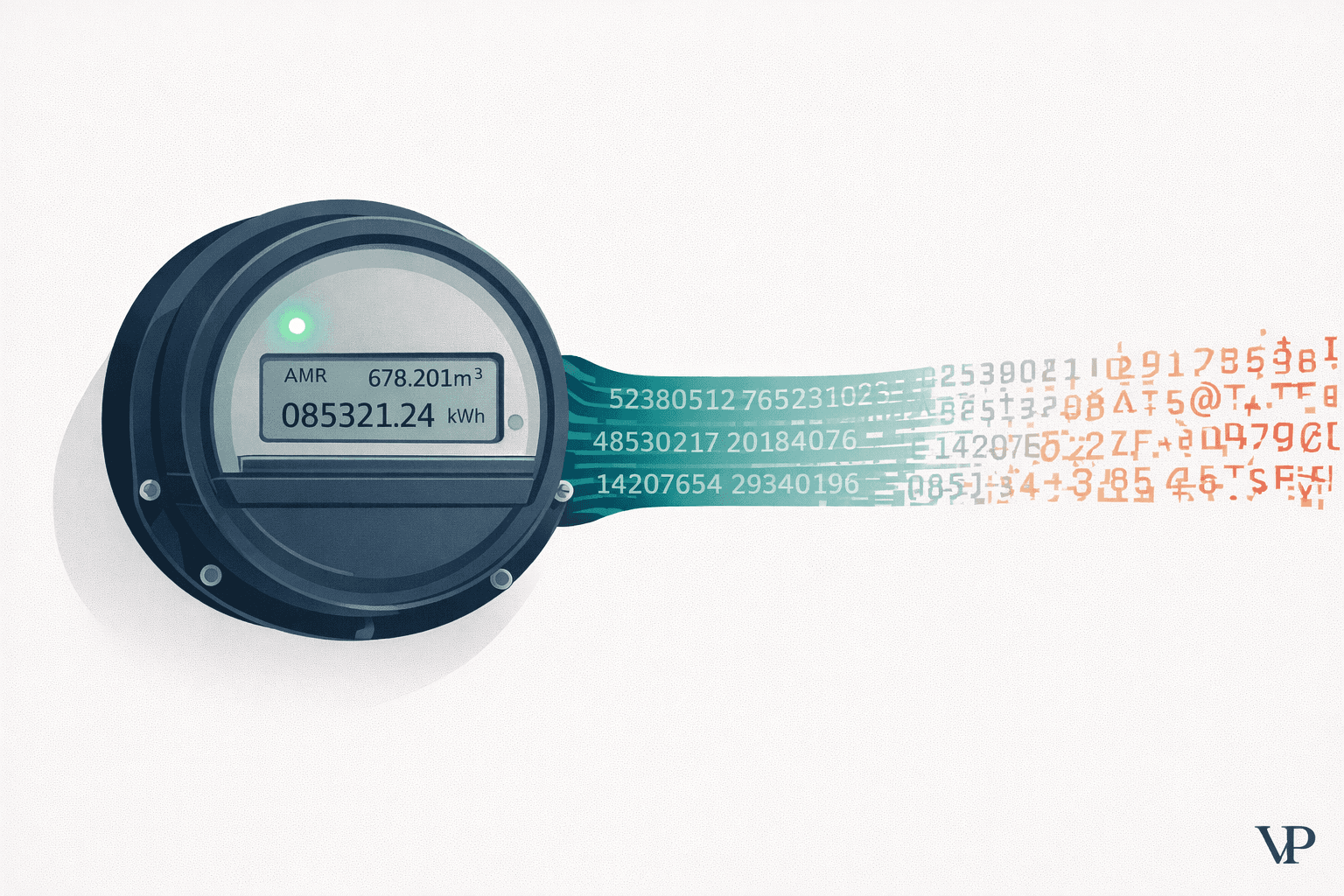
This is where my friend's Saturday morning call makes more sense. The corruption is often silent. The meter doesn't throw an error. It doesn't go offline. It just starts transmitting slightly wrong numbers. By the time anyone notices, you've got nine days — or nine months — of bad billing data and a customer trust problem that no firmware patch can fix.
Then there's the edge case crisis. Software complexity in smart meters has roughly doubled in recent years, but testing methodologies haven't kept pace. A firmware update works perfectly in the lab, but deploy it to a meter with a slightly degraded battery in a rural area with weak signal strength, and you get Plano.
One detail from the research that genuinely alarmed me: modern smart meters have a remote "OFF" switch built in for administrative convenience. If a firmware logic error accidentally triggers that switch at scale, you're not looking at billing inaccuracies — you're looking at millions of homes losing power simultaneously.
What Happens When Regulators Start Counting?
The UK's energy regulator Ofgem decided they'd seen enough. Starting February 2026, they're enforcing Guaranteed Standards of Performance that mandate automatic £40 payments to customers when smart meter service standards aren't met. Wait more than six weeks for an installation appointment? Automatic payment. Installation fails because the supplier showed up without the right equipment? Automatic payment. Meter fault reported and no resolution plan within five working days? Automatic payment.
This isn't a slap on the wrist. For a utility with millions of customers and a fleet of aging smart meters, the math gets terrifying fast. The compliance pressure has already driven the repair of over 900,000 previously non-operating meters in the UK.
I think Ofgem's move signals something bigger than one regulator getting tough. It's the formalization of a principle that should have been obvious from the start: if you deploy "smart" infrastructure, you're responsible for keeping it smart. The era of installing hardware, walking away, and hoping for the best is over.
If you deploy "smart" infrastructure, you're responsible for keeping it smart. The era of install-and-forget is over.
For utility leaders reading this, the implication is stark. The cost of maintaining a malfunctioning meter — in regulatory penalties, manual remediation, customer churn, and billing disputes — now exceeds the cost of implementing real-time, AI-driven diagnostics. The economics have flipped.
"Just Use GPT" — The Advice That Keeps Me Up at Night
After I published some early findings on smart meter fragility, I had a conversation with a potential investor that I still think about. He'd seen the data on firmware failures, agreed the problem was real, and then said: "So build a ChatGPT wrapper that analyzes meter data. Ship it in three months."
I tried to explain why that wouldn't work. He cut me off. "Every AI startup says they need to build custom models. Most of them are just overthinking it."
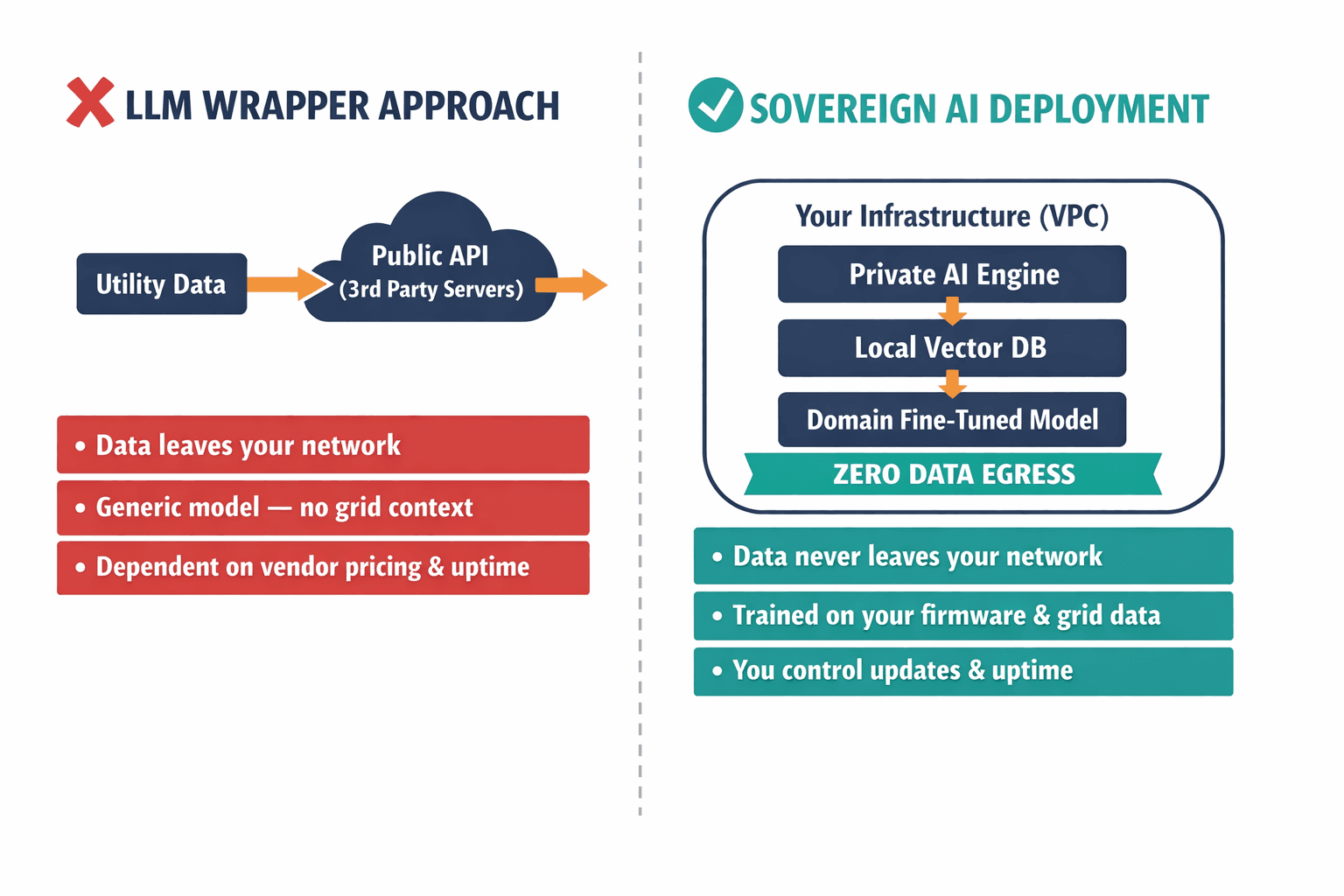
I understand his logic. The market is flooded with companies that are essentially thin interfaces over OpenAI or Anthropic APIs — what the industry calls "LLM wrappers." Some of them are genuinely useful for low-stakes applications. But for critical infrastructure? The approach is fundamentally broken, and I need to explain why.
Where Does the Data Go?
When you use a public AI API, your data leaves your network and enters a third-party's servers. For a utility, that data includes grid architecture, customer consumption patterns, proprietary firmware code, and potentially classified infrastructure vulnerabilities. This isn't hypothetical risk — it's exposure to the US CLOUD Act and whatever data retention policies the API provider happens to have this quarter.
I call this Security Theater. The tool looks and feels like a private enterprise application. The dashboard has your company logo on it. But the backend is a public utility, and your most sensitive operational data is flowing through someone else's infrastructure.
Can a Generic Model Understand Your Grid?
A public LLM has read the internet. It knows what a smart meter is in the abstract. What it doesn't know is the specific firmware version running on your Aclara meters in the northeast quadrant, the maintenance history of the transformers feeding that neighborhood, or the fact that your legacy billing system truncates decimal places in a way that masks small measurement errors.
The context window of a public API forgets the nuance of your specific infrastructure. It can't perform the binary analysis required to verify whether a firmware update is safe for a particular hardware revision deployed in a particular climate zone. Asking it to do so is like asking a tourist for directions — they might sound confident, but they don't actually know where they're going.
What Happens When the API Changes?
This is the part that utility leaders rarely think about until it's too late. If your "AI solution" is a prompt layer over someone else's model, you're dependent on their pricing, their model updates, their uptime, and their business decisions. When OpenAI changes their API structure or deprecates a model version, your critical infrastructure tool breaks until someone rewrites the prompts.
Critical infrastructure cannot depend on the business continuity of a Silicon Valley startup's API pricing page.
What Deep AI Actually Looks Like
After that investor conversation, I spent a week frustrated. Then I spent three months building what I think the answer actually is.
At Veriprajna, we don't resell API keys. We don't build wrappers. We deploy the full AI inference stack — engines like vLLM, Text Generation Inference, and BentoML — directly onto the client's own infrastructure. Their Kubernetes clusters. Their bare-metal GPUs. Their Virtual Private Cloud.
The first time we configured a zero-egress VPC for a utility client — meaning the network was physically configured so that data couldn't leave their environment even if someone misconfigured something — one of their security engineers looked at the architecture diagram and said, "This is the first time an AI vendor hasn't asked me to make an exception to our data policy." That moment told me we were on the right track.
Building a Semantic Brain
The context problem — the one that makes generic LLMs useless for real infrastructure work — we solve with what I think of as a "semantic brain." We ingest the utility's proprietary documents: technical manuals, historical maintenance reports, firmware source code, incident records. All of it gets indexed in local vector databases like Milvus or Qdrant, never leaving the client's environment.
But here's the part I'm proudest of: the system respects existing access controls. If an employee doesn't have permission to view a document in SharePoint, the AI won't retrieve that information to answer their query. We didn't bolt security on as an afterthought — we built the intelligence layer to inherit the organization's existing security posture.
The Last Mile of Accuracy
We take open foundation models like Llama 3 and fine-tune them on the utility's specific corpus using techniques like LoRA (Low-Rank Adaptation). The result is a bespoke model that understands the client's nomenclature, their legacy systems, their operational quirks. In our testing, this domain-specific fine-tuning increases accuracy for specialized tasks by up to 15% compared to the base model.
That 15% might sound incremental. It's not. In firmware verification, the difference between 85% and 100% accuracy is the difference between catching a dangerous update and letting it brick 73,000 meters.
How Do You Catch a Firmware Bug Before It Hits the Field?
This is the question that drove me after studying the Plano disaster. The firmware update that killed those meters wasn't malicious. It wasn't written by incompetent engineers. It just wasn't tested against the full range of real-world conditions it would encounter.
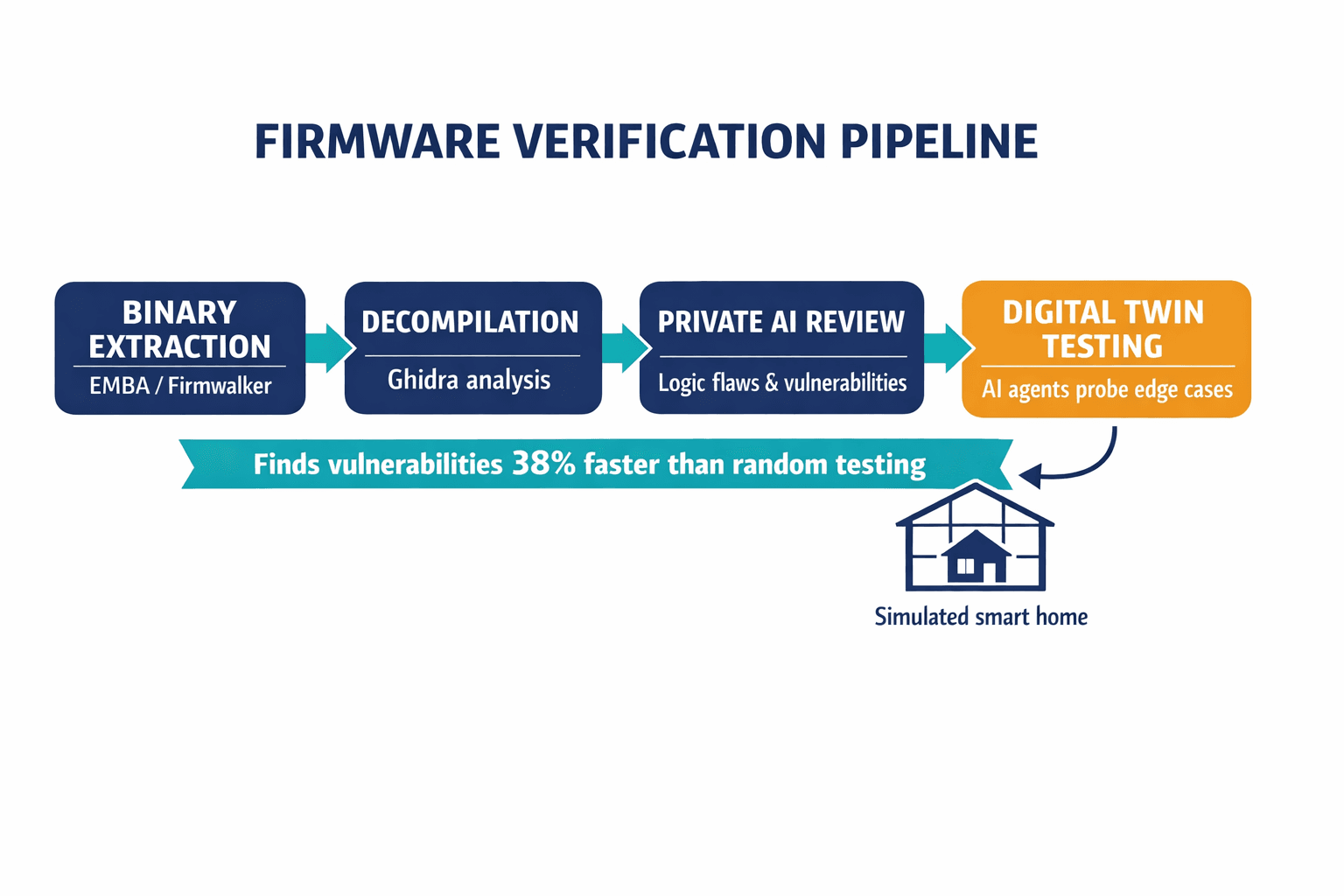
We built a pipeline for this. It starts with binary identification — using tools like EMBA and Firmwalker to extract and analyze firmware file systems, even when source code isn't available. Then we decompile the binary using Ghidra, and our private LLM analyzes the decompiled code for logic flaws, insecure practices, and potential vulnerabilities.
But the part that changed how I think about firmware safety is the digital twin approach. Testing firmware on physical devices in the field is slow, expensive, and risky. Instead, we build detailed virtual replicas of smart homes and grid segments, then deploy AI agents that use reinforcement learning to interact with these digital twins — systematically probing for the edge cases that human testers miss.
In our research, this method found vulnerabilities 38% faster than random testing approaches. For the full technical breakdown of the firmware verification pipeline and digital twin methodology, I'd encourage you to read the paper — but the key insight is this: we can now simulate the conditions that caused the Plano failure before the update ships.
We can now simulate the conditions that caused catastrophic firmware failures before the update ever ships to the field.
From Reactive to Predictive: What Changes When AI Watches the Grid
The traditional approach to utility maintenance is either reactive (fix it when it breaks) or scheduled (inspect it every X months whether it needs it or not). Both are expensive and both miss the failures that matter most — the slow, silent degradations that don't announce themselves until they've already caused damage.
Deep AI models trained on high-frequency sensor data learn what "normal" looks like for each device, each transformer, each grid segment. When something deviates — an unusual vibration pattern, a temperature fluctuation that doesn't match the weather, a fleet of meters all showing increased communication latency at the same time — the system flags it before it becomes a crisis.
There was a moment during our early testing when the anomaly detection system flagged a group of meters that all showed a subtle increase in response latency. Nothing dramatic — maybe 15 milliseconds slower than baseline. My team debated whether this was noise or signal. Our engineer argued it was environmental — temperature-related. I pushed to investigate further. It turned out to be an early indicator of flash memory degradation in a specific batch of devices. Left unchecked, those meters would have started corrupting data within months.
That's the kind of catch that justifies the entire investment. And the numbers back it up: AI-driven predictive maintenance has been shown to reduce infrastructure failures by 73%, cut maintenance costs by 18-25%, and extend asset lifespans by up to 40%.
The system also uses explainable AI — when it flags an anomaly, it shows the human operator why, using visualization tools like GradCAM. The operator can verify, correct, or override the AI's judgment. That feedback loop means the system gets smarter over time, reducing false positives and building the kind of institutional knowledge that usually lives only in the heads of senior engineers who are five years from retirement.
What About the ROI?
People always push back on the cost of deploying private AI infrastructure versus just using an API. It's a fair question. Running your own GPU clusters and maintaining your own models isn't cheap.
But consider what the alternative costs. Plano: $765,000 for manual meter readers, plus the $10.2 million original investment that's now significantly impaired. Memphis: $9 million repair fund. Toronto: $5.6 million and counting. UK utilities: the cumulative cost of 900,000 meter replacements plus the regulatory fines that are about to start hitting.
Industries report average outage costs of $125,000 per hour. A 30-50% reduction in downtime doesn't just pay for the AI — it transforms the utility's financial profile. When you add deferred capital expenditure from extending asset life by 40%, a 28% reduction in component supply chain delays, and a 40% reduction in safety incidents, the ROI calculation isn't close.
The question isn't whether utilities can afford sovereign AI infrastructure. It's whether they can afford another Plano.
The real moat for a utility isn't the AI model itself — you can download Llama 3 for free. The moat is the deep integration with proprietary data, the domain-specific fine-tuning, the institutional knowledge encoded into a system that lives on infrastructure you control. That's an asset that appreciates over time. An API subscription is a cost that can be taken away.
The Grid We're Building Toward
With IoT devices projected to exceed 30 billion by 2026, the complexity problem isn't going away. It's accelerating. The next frontier — and what my team is actively building toward — is agentic AI workflows: systems that don't just flag anomalies but take action. Automatically quarantining a compromised IoT device. Adjusting transformer parameters in real-time based on predicted load patterns. Executing firmware rollbacks the moment an update shows signs of causing problems.
Edge AI will push intelligence even further out — smart meters functioning as micro-decision engines, running local anomaly detection with sub-10-millisecond latency, making decisions without waiting for a round trip to the cloud.
But none of this works if the foundation is wrong. And right now, for most utilities, the foundation is wrong. They're running 21st-century infrastructure on 20th-century maintenance paradigms, and when they reach for AI, they're grabbing the cheapest, most convenient option — a wrapper around someone else's intelligence — instead of building sovereign capability.
The failures in Plano, Toronto, Memphis, and across the UK aren't technical glitches. They're the predictable result of a systemic mismatch between the complexity of modern infrastructure and the tools we're using to manage it. Every utility that deploys smart meters without investing in the intelligence to actually govern them is building a system designed to fail in ways it can't detect.
The choice facing utility leaders isn't between AI and no AI. That debate is over. The choice is between renting intelligence from providers who have no stake in your grid's reliability, or building sovereign capabilities that turn your operational data into your most valuable asset. One of those paths leads to the next Plano. The other leads to a grid that's genuinely as smart as we keep promising it is.