Southwest Airlines Lost Track of Its Own Pilots. That's When I Knew Chatbots Wouldn't Save Logistics.

The phone call that changed how I think about AI wasn't from a customer or an investor. It was from a friend — a pilot — who spent Christmas 2022 sleeping on the floor of Denver International Airport.
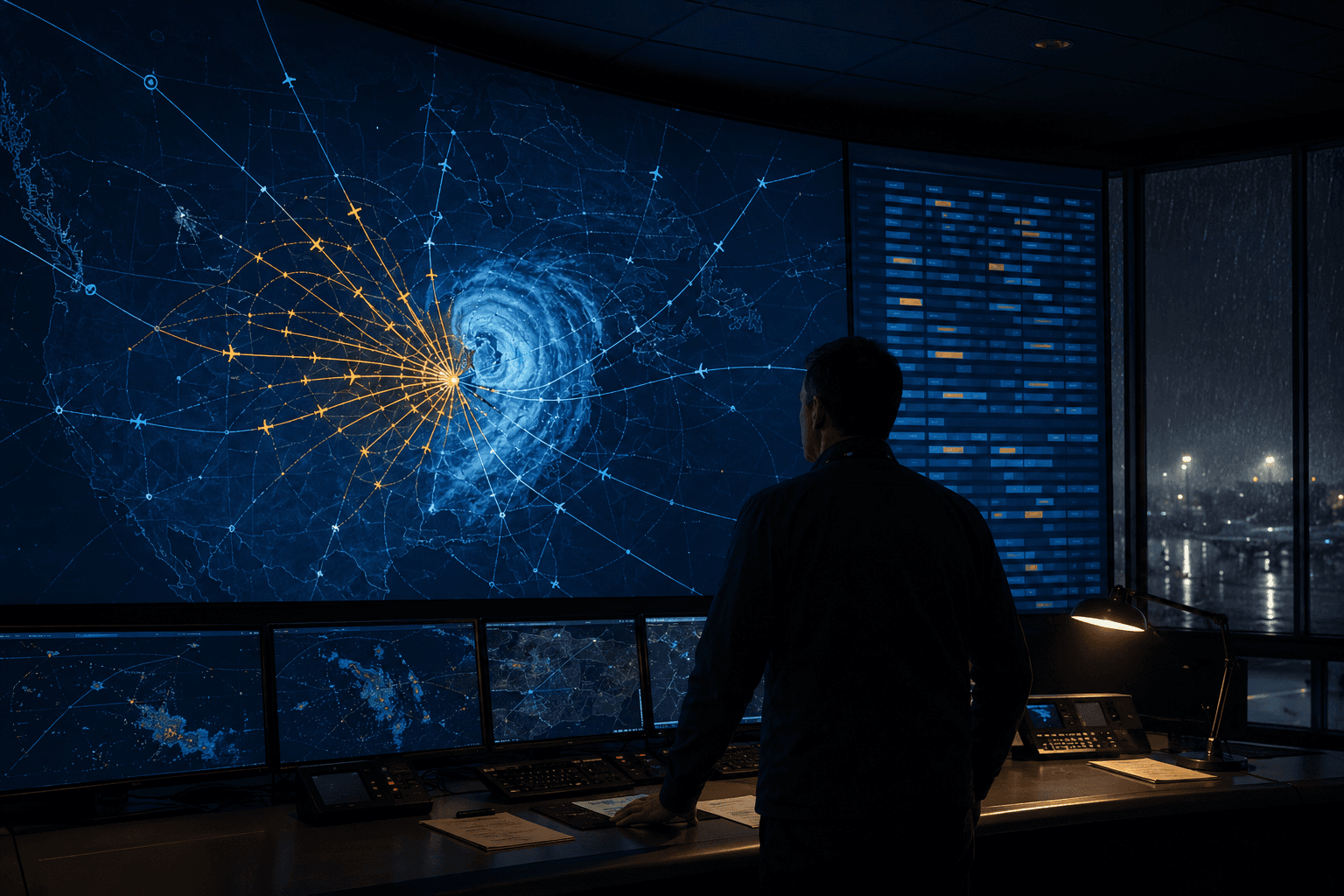
He wasn't stranded because of the weather. The storm had passed. He was stranded because Southwest Airlines had literally lost track of where he was. The airline's crew scheduling system — a legacy optimizer called SkySolver — was computing recovery plans based on crew positions that were hours out of date. It was generating schedules for a phantom airline. My friend called the scheduling hotline and waited on hold for eight hours. By the time someone picked up, the schedule they'd just computed was already wrong again.
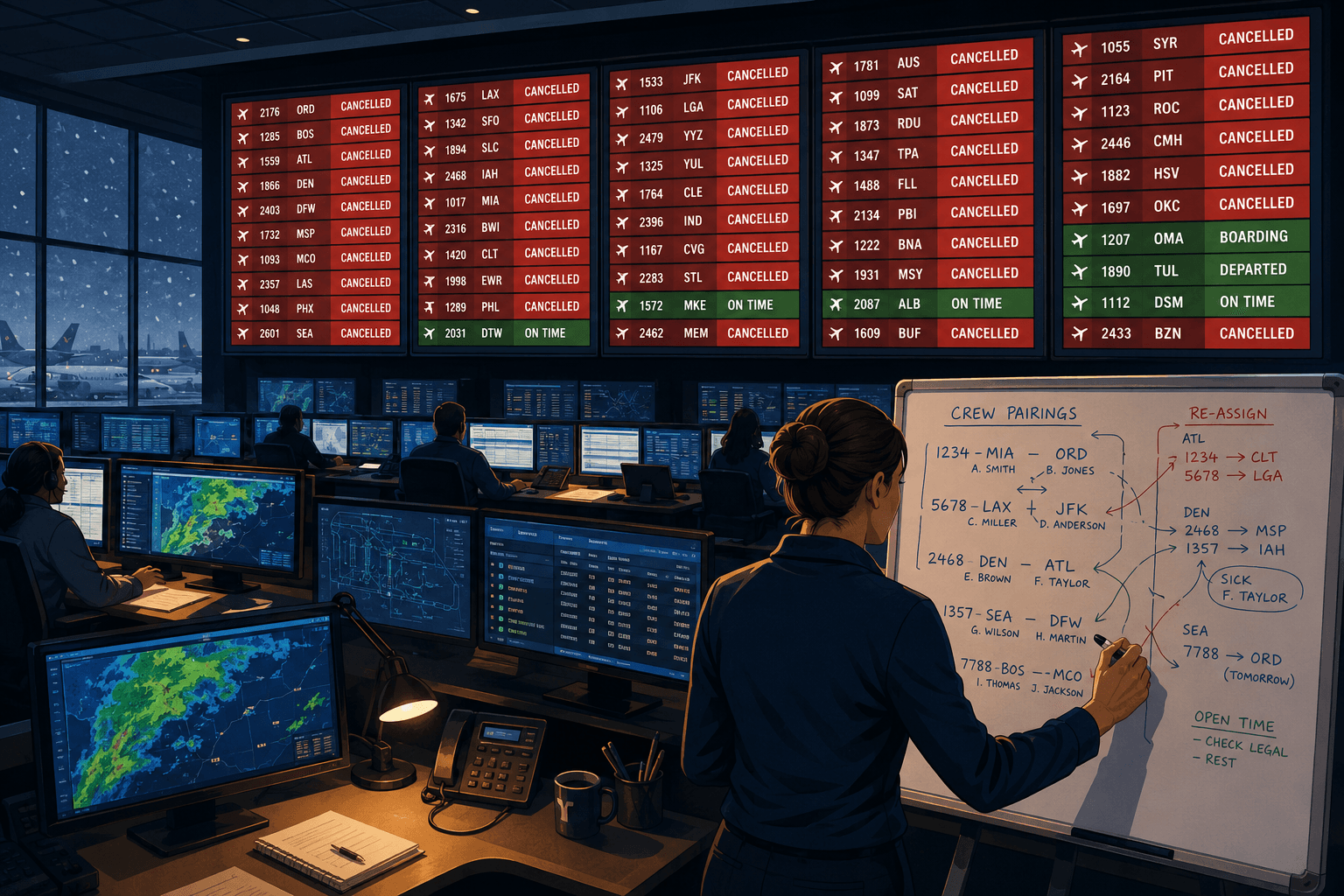
That week, Southwest cancelled over 16,900 flights. Two million passengers were stranded. The airline lost more than $1 billion. And here's the part that haunted me: every other major US carrier faced the same storm, the same frozen tarmacs, the same staff shortages. United, Delta, American — they all recovered within 48 hours. Southwest spiraled for a full week.
I kept coming back to a single question: why did one airline's software collapse while the others bent and recovered? The answer, I discovered, had nothing to do with the weather and everything to do with how we've been building the computational brains of complex operations for the past thirty years. That realization is what led me to build Veriprajna — and to write this research paper that lays out the full technical argument.
But the short version is this: we've been optimizing logistics for efficiency in a world that no longer rewards efficiency. We've been building systems that find the cheapest answer to a known question, when what we actually need are systems that find a survivable answer to an unknown one.
The Topology That Killed Christmas
To understand why Southwest broke, you need to understand a concept from graph theory — and I promise it's more interesting than it sounds.
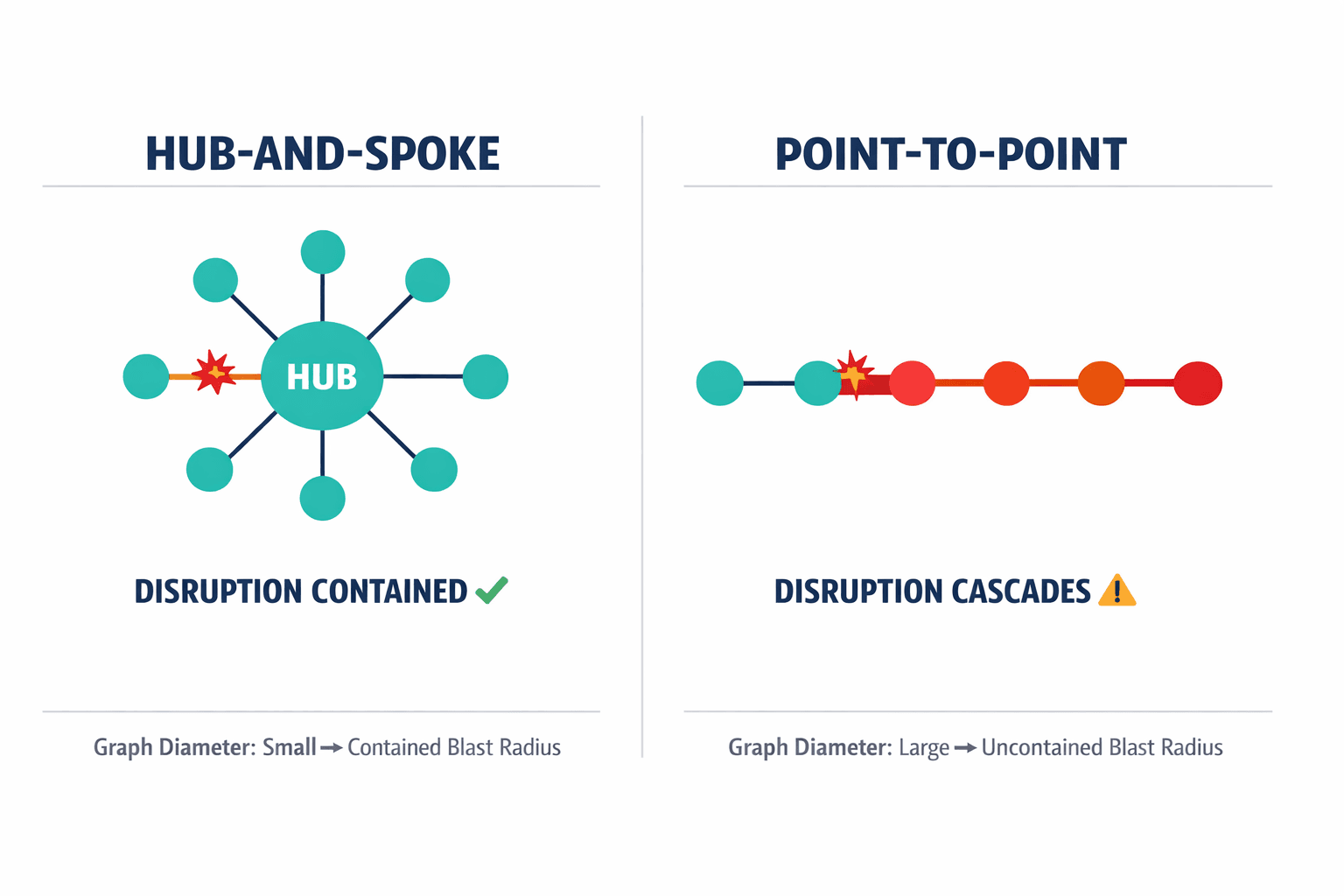
Delta, United, and American operate hub-and-spoke networks. Flights radiate out from central hubs like Atlanta or Newark. If a storm hits the Northeast, a hub-and-spoke carrier can "firewall" the damage — cancel all flights into Newark for a morning, reset the sub-graph, and resume. Crews and planes cycle back through the hub frequently, creating natural recovery points.
Southwest pioneered a different model: point-to-point. A plane and its crew fly a linear chain — Baltimore to Denver to San Diego to Phoenix to Sacramento. Economically brilliant. You squeeze more flying hours out of every aircraft. But mathematically? It's a house of cards. A delay on the first leg doesn't just affect the return — it cascades down the entire chain. The crew meant to fly San Diego to Phoenix is stuck in Denver. The plane waiting for them in San Diego is stranded.
In graph theory terms, the diameter of the dependency graph in a point-to-point network is vastly larger than in hub-and-spoke. The blast radius of a single disruption is uncontained.
I remember the night I first mapped this out on a whiteboard in our office. My team and I had been arguing about whether the Southwest failure was a software problem or a network design problem. One of my engineers, frustrated with my insistence that it was both, pulled up the actual flight data and started drawing the dependency chains. We watched the cascade unfold across the map. A delay in Baltimore rippled to Denver, which broke a connection to San Diego, which stranded a crew that was supposed to fly Phoenix, which…
"It's not a chain," he said. "It's a fracture."
He was right. And the fracture was invisible to the software that was supposed to fix it.
Why Did SkySolver Choke?
SkySolver is built on the same mathematical foundations that power most logistics optimization: Mixed-Integer Linear Programming and a technique called Column Generation. These are the workhorses of Operations Research, the field that has governed how we move atoms around the world since the 1950s.
Here's how it works in plain English: the system takes a snapshot of the world — where every crew member is, what every plane's status is — freezes time, and computes the mathematically cheapest way to cover all flights. For a major airline with 4,000 daily flights, the number of possible crew-to-flight combinations is effectively infinite. Column Generation handles this by iteratively generating "promising" combinations and narrowing the search.
It's elegant. It's powerful. And it has a fatal assumption baked into its DNA: the world holds still while it thinks.
During normal operations, a solver cycle of 30 to 60 minutes is fine. But during the meltdown, the state of Southwest's network was changing every few minutes. Crews couldn't report their positions because the phone lines were overwhelmed. The data feeding SkySolver was hours stale. The system was optimizing a world that no longer existed.
When the rate of disruption exceeds the velocity of information, optimization doesn't degrade gracefully. It collapses.
This is what I call the Optimization-Execution Gap — the lethal mismatch between how fast a solver can compute and how fast reality moves. And it's not unique to airlines. I've seen the same failure pattern in port logistics, rail dispatching, and manufacturing supply chains. The math is the same. The fragility is the same.
The Moment I Stopped Believing in Chatbots for Logistics
About six months after the Southwest crisis, I sat in a meeting with an investor who told me, with complete confidence, "Just use GPT. Fine-tune it on scheduling data. Problem solved."
I tried to explain why that wouldn't work. He interrupted me: "But it can reason. I've seen it solve math problems."
That conversation crystallized something I'd been struggling to articulate. The entire industry was making a category error — conflating the linguistic fluency of Large Language Models with the operational reasoning required to manage complex systems. Vendors were flooding the market with "AI Copilots" that put a chat interface over legacy solvers. A dispatcher asks, "How do we recover the Denver schedule?" and the LLM translates that into an API call to the same broken optimizer underneath.
It's a new coat of paint on a seized engine.
Here's the fundamental problem: LLMs are probabilistic engines designed to predict the next token in a sequence. They emulate the form of reasoning without possessing a world model. In cognitive science terms, they're massive System 1 engines — fast, intuitive pattern matching. Logistics optimization is a System 2 task — slow, deliberate, step-by-step verification of constraints.
And the constraint problem is where it gets dangerous. In creative writing, 99% accuracy is excellent. In crew scheduling, 99% accuracy is illegal. If an LLM generates a schedule that assigns a pilot with 7 hours and 59 minutes of rest to a flight requiring 8 hours, the entire schedule is invalid. LLMs don't naturally handle the strict binary nature of feasibility constraints. They prioritize linguistic coherence over logical correctness.
A chatbot that can explain a schedule is not the same as an agent that can repair one.
Benchmarks on combinatorial problems like the Traveling Salesman Problem confirm this at scale. As the number of nodes increases, LLMs "visit" cities twice, skip others entirely, and lose track of state over long sequences. They can't simulate branching futures or backtrack. They're blind to the butterfly effect — the reality that a small scheduling decision now can cause a catastrophe three days later.
What Actually Works: Teaching an AI to Think in Graphs
So if legacy solvers are too slow and LLMs are too unreliable, what do you build?
This is the question my team and I have spent years answering, and the architecture we arrived at is built on Graph Reinforcement Learning — a fusion of Graph Neural Networks (to understand network topology) and Reinforcement Learning (to learn dynamic decision policies). We moved from calculating a schedule to learning how to schedule.
The insight that unlocked everything was deceptively simple: logistics networks are not spreadsheets. They're graphs. Airports are nodes. Flights are edges. Warehouses are nodes. Trucks are edges. Traditional machine learning architectures — the kind designed for images or text — struggle with this relational structure. Graph Neural Networks are the native architecture for it.
We use Graph Attention Networks to encode the state of the entire logistics network. Every entity — pilot, plane, airport — becomes a node with a high-dimensional embedding that captures both static properties (aircraft type, crew qualifications) and dynamic state (current delay, maintenance status, accumulated fatigue). The connections between them carry information about flight duration, weather risk, and crew assignments.
The magic is in what's called message passing. When a blizzard closes Denver, the GNN updates Denver's embedding. That update flows along every connected edge — every inbound flight, every crew assignment. A pilot in Baltimore preparing to fly to Denver receives a "risk signal" in their embedding before they even depart. The system sees the connectivity. It understands blast radius. This kind of topological awareness is impossible in the flat, tabular data representations that legacy systems use.
On top of this graph perception layer, we run Reinforcement Learning agents. An RL agent observes the state, takes an action (swap crew, cancel flight, delay departure, deadhead a crew to a new position), and receives a reward. Over millions of training iterations, it learns a policy that maximizes long-term outcomes.
That phrase — long-term — is everything. A heuristic might say: "Don't cancel this flight, it loses revenue." Our RL agent learns: "If I don't cancel this flight, the crew gets stuck in Denver, and I lose ten flights tomorrow. Cancel it now." It learns strategic sacrifice for systemic survival.
How Do You Train an AI for Disasters That Haven't Happened Yet?
You obviously can't train a Reinforcement Learning agent on a live airline. Trial and error in the real world costs millions and creates safety risks. This is where the Digital Twin comes in — and I don't mean a dashboard with a 3D rendering of an airport.
Our Digital Twins are state-transition engines. We model every aircraft with tail-specific maintenance cycles, every gate, every crew member with individual fatigue counters and contract states. We digitize the rulebook — FAA Part 117, union contracts, maintenance manuals. Every state transition gets checked against these rules.
Then we inject chaos.
We use stochastic generators to simulate 10,000 years of operations in a week. We create super-storms, massive mechanical groundings, labor strikes. We start the agents on easy days — sunny weather, light schedules — and gradually ramp up the difficulty, introducing cascading failures that would make the Southwest meltdown look like a mild inconvenience.
I remember the first time we ran the December 2022 Southwest crisis through our simulator. We'd built a proxy of the legacy solver to benchmark against. The legacy solver did exactly what SkySolver did — it choked on the data latency, optimized for the wrong state, and produced the same tangled mess of stranded crews. Recovery time: seven simulated days.
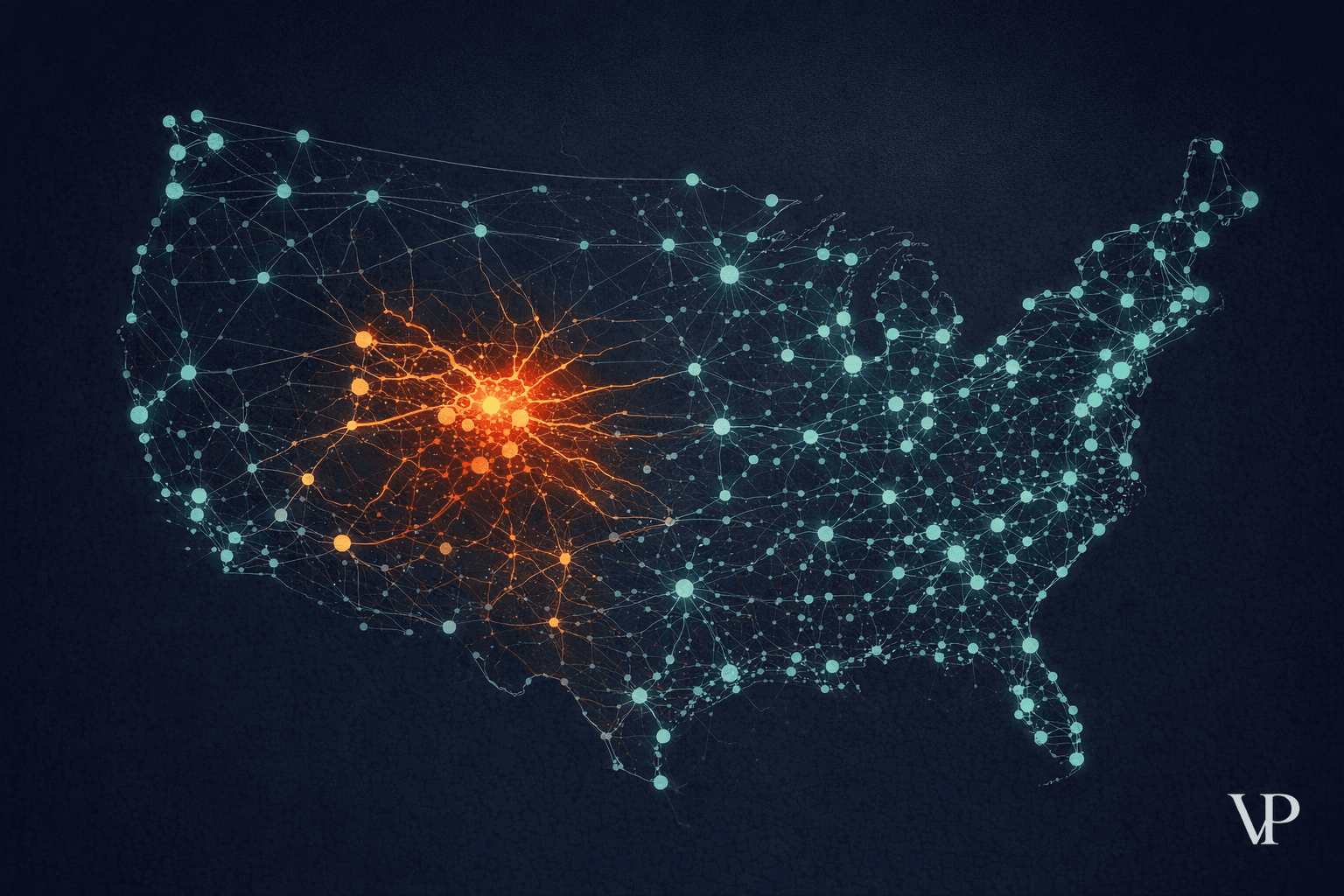
Our GRL agent did something none of us expected. It detected the point-to-point fracture pattern emerging in Denver hours before the full cascade. Then it executed what we now call a pre-emptive firewall strategy — it cancelled 20% of flights into Denver early, trapping the disruption locally, and deadheaded crews to Phoenix to create a secondary operational base.
The East Coast network remained 95% operational. Total cancellations dropped by 66%. The meltdown was contained to a regional disruption.
My engineer — the same one who'd drawn the fracture on the whiteboard — just stared at the screen. "It sacrificed Denver to save the network," he said. "No human dispatcher would have had the guts to do that at 6 AM on December 22nd."
He was right. And that's the point. The agent had "lived through" thousands of crises in simulation. It had explored the edges of the state space where legacy solvers crash, and it had learned what survival looks like. For the full technical breakdown of the architecture — the GAT embeddings, the PPO training loop, the action masking — I've published the complete research.
What About the Black Box Problem?
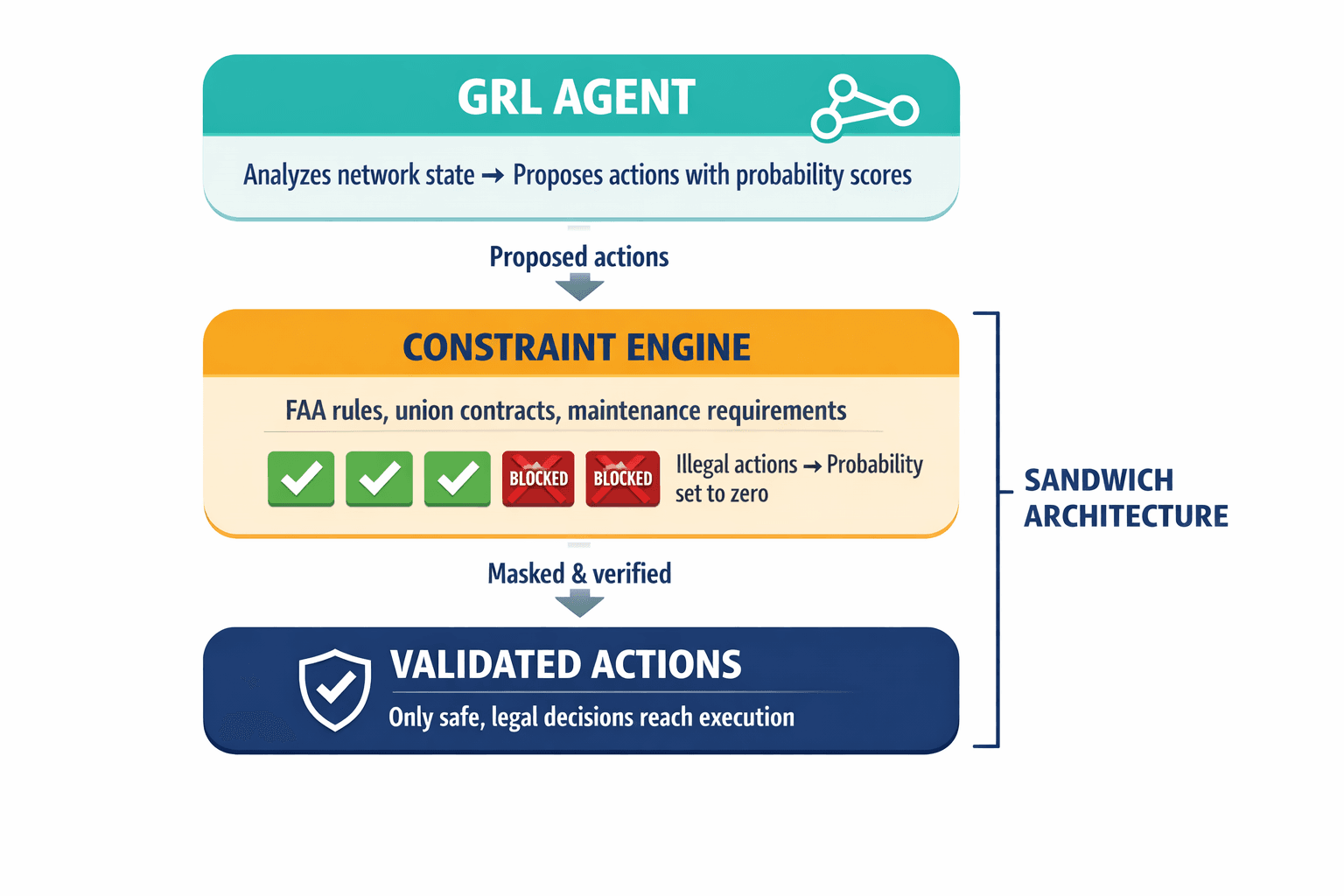
People always push back here, and they should. "You're telling me to hand control of an airline's operations to a neural network? How do I know it won't hallucinate an illegal schedule?"
This is the most important objection in safety-critical AI, and anyone who dismisses it isn't serious. Here's how we solve it.
We never let the neural network output the final decision directly. We use what we call a sandwich architecture — inspired by the NICE framework for reinforcement learning-guided integer programming. The neural layer (our GRL agent) analyzes the complex, noisy state and proposes a probability distribution over actions. Then a deterministic symbolic layer — a constraint engine that encodes every hard rule in the operation — applies a mask. If the neural network suggests an action that violates a regulation (pilot exceeds duty hours, aircraft flies with an open maintenance item), the symbolic layer sets that action's probability to zero.
The system cannot execute an illegal action. Not "probably won't." Cannot.
This gives us something remarkable: the optimality of learned AI policies with the safety guarantees of formal logic. And it solves the computational problem from the other direction too. Instead of the legacy solver searching a billion possibilities, the neural network prunes the tree down to the ten most promising branches. The solver only has to validate and fine-tune those few options. Computation time drops from hours to seconds.
This Isn't Just About Airlines
The Southwest meltdown is the most dramatic example, but the fragility it exposed is universal. We're adapting the same GRL + Digital Twin architecture for maritime ports and rail networks.
In ports, a delayed vessel misses its berth slot, cranes get reassigned, and trucks scheduled for container pickup queue for hours. We deploy agentic AI where an "Anchorage Agent" negotiates with a "Terminal Agent" in real time, smoothing the peaks and valleys of gate congestion as disruptions unfold.
In rail, where single-track bottlenecks mean one wrong "meet-pass" decision can gridlock trains hundreds of miles away, our GRL agents outperform human dispatchers and heuristic rules by 15-20% in delay reduction. They make non-intuitive moves — holding a freight train early to clear a path for an express train 50 miles upstream — that no rule-based system would consider.
The pattern is always the same: a complex network, hard constraints, cascading disruptions, and a decision window measured in minutes. Legacy solvers can't keep up. LLMs can't reason about it. Graph Reinforcement Learning can.
The Real ROI Isn't Efficiency — It's Survival
Southwest's one-week meltdown cost $1.2 billion. That single event erased years of efficiency gains from running a lean point-to-point network. A blocked Suez Canal costs the global economy billions per day. The tail risk — the catastrophic, "once in a decade" event that now seems to happen every year — is no longer a footnote in the risk register. Over a ten-year horizon, it's the dominant cost driver.
Our agents deliver 2-5% operational cost savings during normal operations through smarter buffer management and reduced crew overtime. That's table stakes. The real value is what doesn't happen: the meltdown that gets contained to a regional disruption, the cascade that gets firewalled before it reaches the East Coast, the billion-dollar week that never materializes.
Efficiency is a strategy for a stable world. We no longer live in a stable world.
The Era of Static Math Is Over
I started this essay with a pilot sleeping on the floor of Denver International Airport. He's still flying for Southwest. They've since invested heavily in upgrading their systems. But the deeper problem — the industry-wide reliance on deterministic solvers built for a world of predictable disruptions — remains largely unaddressed.
The rush toward Generative AI as a logistics savior worries me more than the legacy systems do. At least the people running SkySolver knew its limitations. The people deploying LLM wrappers over broken optimizers often don't. They see fluent text and mistake it for operational reasoning. They see a chatbot that can explain a schedule and assume it can repair one.
Building Veriprajna has taught me that the hardest part of this work isn't the math — it's the argument. Convincing an industry that the tools they've trusted for decades have a structural ceiling. That the shiny new thing (Generative AI) is aimed at the wrong problem. That the actual solution requires rethinking logistics as a graph, disruption as a learning signal, and resilience as something you train for — not something you hope for.
The future of logistics doesn't belong to systems that find the cheapest plan for a known world. It belongs to systems that find a survivable plan for an unknown one. That's not a maybe. That's what we're building.