Sports Illustrated Didn't Have an AI Problem. It Had a Truth Architecture Problem.

I remember the exact moment I stopped reading and started pacing.
It was late November 2023, and Futurism had just published its investigation into Sports Illustrated. The details were almost too absurd to be real: a 70-year-old media institution had been publishing product reviews written by people who didn't exist. "Drew Ortiz," a guy described as loving the outdoors, had a headshot bought from a marketplace that sells AI-generated faces. "Sora Tanaka," a supposed fitness guru, had a fabricated backstory about her love for food and drink. The content attributed to these phantoms included gems like "Volleyball is one of the most popular sports in the world, and for good reason" — a sentence so empty it practically echoes.
I wasn't pacing because I was shocked. I was pacing because I'd been warning enterprise clients about exactly this failure mode for months. Not about AI being dangerous in some abstract, Terminator sense — but about a very specific, very predictable architectural collapse. Sports Illustrated didn't get caught using AI. It got caught using AI without a truth system underneath it. And that distinction matters more than most people realize.
The fallout was swift and brutal. The Arena Group's stock dropped 27% in a single day. Authentic Brands Group revoked SI's publishing license. The SI Union reported that possibly all staff were laid off. A newsroom that had covered Muhammad Ali, the Miracle on Ice, and decades of American sports was hollowed out — not because AI replaced the journalists, but because management chose the cheapest possible AI architecture and called it a strategy.
That architecture has a name. We call it the "LLM Wrapper." And after spending years building the alternative, I'm convinced it's the single biggest threat to enterprise trust today.
What Exactly Is an "LLM Wrapper" — and Why Does It Break?
When I explain this to non-technical executives, I use an analogy. Imagine you hired the world's most eloquent speaker — someone who can talk about anything, in any style, for any audience. Impressive, right? Now imagine that speaker has no memory, no fact-checking department, and a pathological inability to say "I don't know." Instead, when they hit a gap in their knowledge, they just... make something up. Confidently. Fluently. In perfect prose.
That's a Large Language Model without grounding. It's a probabilistic reasoning engine — it predicts the next most likely word based on patterns in its training data. It doesn't "know" that Drew Ortiz doesn't exist. It knows that the pattern of a product review typically includes an author name and biography, so it fills in the template with statistically plausible details. To the model, "Drew Ortiz" isn't a lie. It's a successful pattern completion.
An LLM Wrapper is what you get when a company takes that eloquent, confabulating speaker and puts them on stage with nothing but a microphone and a keyword list. No notes. No editor in the wings. No one checking whether the things coming out of their mouth are true. The software layer around the model is thin — it passes in a prompt, gets back text, and publishes it. That's it.
AdVon Commerce, the third-party vendor behind SI's fake content, operated exactly this way. They had an internal tool called "MEL" — essentially a wrapper that ingested product keywords, ran them through a foundational model, and spit out structured reviews. The "human writers" were paid pittance rates to copy-paste the output into content management systems. They weren't editing. They weren't fact-checking. They were human middleware.
When the AI is the engine and the human is merely the lubricant, quality collapse isn't a risk — it's a schedule.
The Night I Realized "Good Enough" AI Wasn't Good Enough
There was a night — I think it was early 2024, a few weeks after the SI story broke — when my team and I were stress-testing a content generation pipeline for a client. We'd set up a standard Retrieval-Augmented Generation (RAG) system, the kind that's supposed to be the "responsible" way to deploy LLMs. You retrieve relevant documents, inject them into the model's context window, and tell it to only use those sources.
We ran a batch of 500 product descriptions. The results looked clean. Fluent. Professional. My lead engineer was ready to call it a night.
I said, "Run the hallucination check one more time."
He sighed. But he ran it.
Eighteen of the 500 descriptions contained claims that weren't in any source document. That's a 3.6% error rate — right in the range that research shows for state-of-the-art models, which hallucinate between 1.5% and 6.4% depending on domain. In specialized fields like law, it's even worse.
Eighteen doesn't sound like much. But scale it. If you're a publisher pushing 10,000 articles a year — and content farms absolutely operate at that volume — a 4% hallucination rate means 400 articles containing fabricated claims. Four hundred potential lawsuits, reputational crises, or trust-destroying moments. We've already seen lawyers sanctioned for citing nonexistent court cases that ChatGPT invented. The math is not on your side.
That night, I told my team: "We're not shipping anything that works on probability alone. We need a system that treats unverified claims the way a database treats null values — as the absence of knowledge, not an invitation to improvise."
Why Can't You Just Fix Hallucinations with Better Prompts?
People ask me this constantly. "Can't you just tell the model to be more careful? Add a system prompt that says 'don't make things up'?"
No. And here's why that question reveals a fundamental misunderstanding of the technology.
Hallucination isn't a bug you can patch with instructions. It's a structural property of how these models work. An LLM stores statistical relationships between tokens — words and sub-words — derived from training data. It has no internal database of facts. It has no concept of "true" versus "false." It has a concept of "probable" versus "improbable." When the probable completion of a pattern requires a fact the model doesn't have, it generates one that fits the pattern. Telling it "don't hallucinate" is like telling water "don't be wet."
There's also the context window problem. Even modern models with massive context windows hit a brick wall when you try to feed them an entire enterprise knowledge base. You can't paste your company's complete editorial guidelines, product database, author registry, and brand policies into every prompt. The model's internal knowledge — static, outdated, uncontrollable — fills the gaps.
And then there's the security dimension that almost no one in the "just use GPT" crowd talks about. Prompt injection attacks can manipulate inputs to bypass safety filters. Data poisoning can corrupt the web sources that RAG systems retrieve from. A new threat called "slopsquatting" exploits the fact that LLMs hallucinate software package names — attackers register those fake names and deliver malware to developers who copy-paste code suggestions. The attack surface of a thin wrapper is enormous.
I wrote about these architectural failure modes in depth in the interactive version of our research, but the core point is simple: you cannot prompt-engineer your way to truth. You need a different architecture entirely.
The Argument That Changed How We Build
We had a real fight about this inside Veriprajna. Not a polite disagreement — an actual argument, the kind where people raise their voices and someone eventually says "Can we just step back for a second?"
One camp on my team — smart people, experienced engineers — argued that we should focus on making RAG better. More sophisticated retrieval. Better chunking strategies. Fine-tuned embedding models. The incremental approach. "RAG works well enough for 96% of cases," they said. "Let's optimize the last 4%."
The other camp — and I was firmly in it — argued that "well enough" is a death sentence for enterprise trust. That 4% isn't randomly distributed across harmless typos. It clusters around exactly the claims that matter most: names, numbers, dates, causal relationships. The things that, when wrong, destroy credibility.
The turning point came when someone on the team pulled up the SI timeline on a whiteboard. November 2023: Futurism publishes the investigation. The Arena Group's stock drops 27%. Fake profiles are silently deleted — a move journalism ethics professors called "a form of lying." The "third-party defense" collapses when former AdVon employees confirm that "MEL" generated the content. Authentic Brands Group revokes the license. Staff are laid off. A 70-year-old institution is gutted.
"That," I said, pointing at the whiteboard, "is what 4% looks like at scale."
We stopped arguing about incremental RAG improvements that day. We started building something fundamentally different.
What Does a System That Can't Lie Actually Look Like?
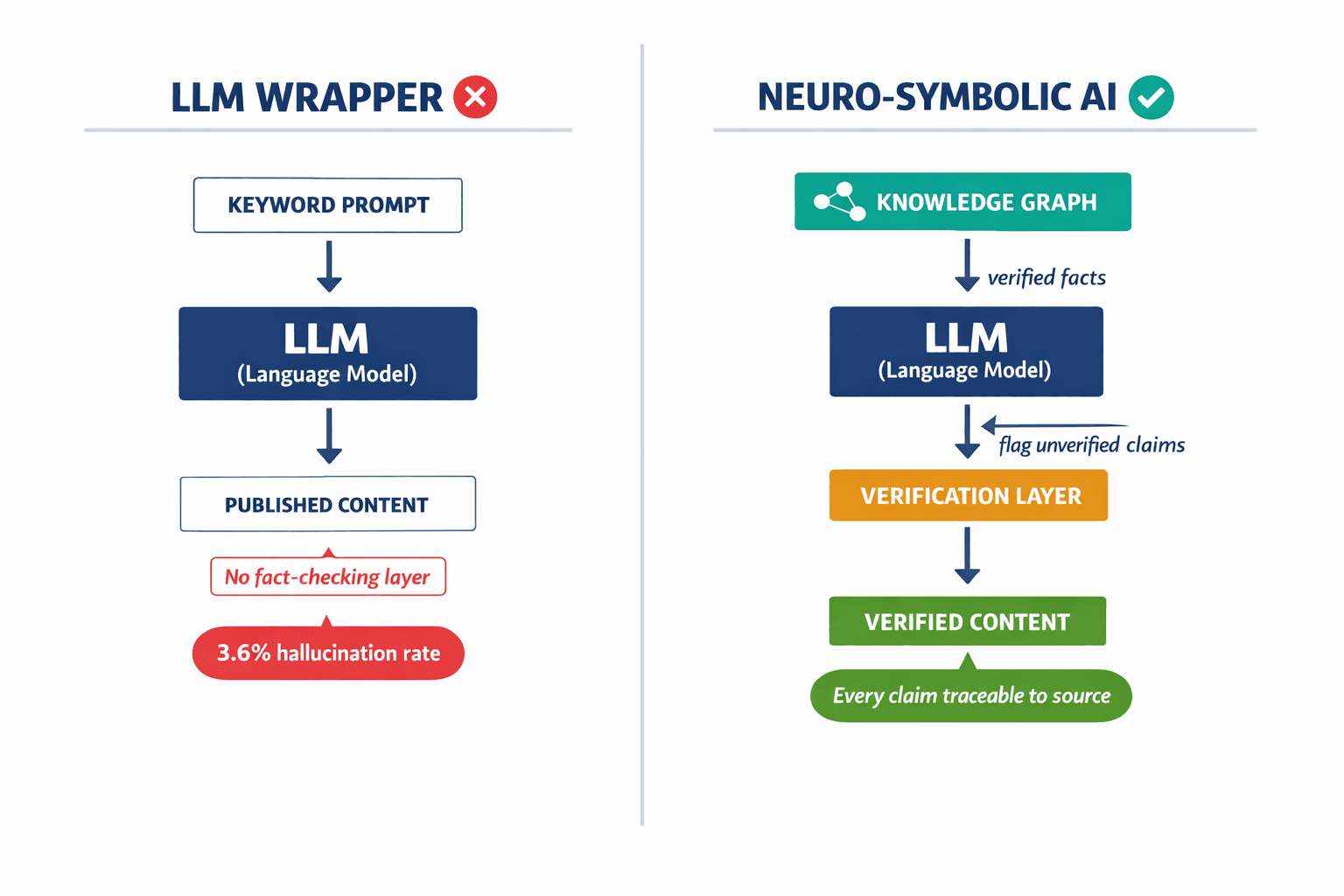
The answer is what the AI research community calls Neuro-Symbolic AI — a hybrid architecture that fuses two very different kinds of intelligence.
Think of it as two brain systems working together. The neural component — the LLM — handles language. It's brilliant at parsing messy text, understanding nuance, generating fluent prose. It's your intuition engine. But it has no relationship with truth.
The symbolic component — a Knowledge Graph — handles facts. It stores reality as structured relationships: entities connected by predicates. Wilson AVP → is_certified_by → FIVB. Jane Smith → is_author_of → Article_4521. These aren't probabilities. They're deterministic assertions. When you query a Knowledge Graph and the answer isn't there, you get null. Not a creative improvisation. Silence.
In the SI case, a neuro-symbolic system would have used the LLM to write the review — it's genuinely good at that — but relied on the Knowledge Graph to validate the author. If the graph didn't contain a verified entity for "Drew Ortiz," the system blocks the byline. Period. The ontology — the structural rules governing the graph — would enforce that a product review must be connected to a verified author. Making the fake byline scandal architecturally impossible.
A Knowledge Graph doesn't "invent" an author to fill the silence. It treats the absence of knowledge as the absence of knowledge. That single property is a firewall against hallucination.
The performance difference is measurable. Research shows that integrating Knowledge Graphs into the generation pipeline reduces hallucinations by 6% and cuts token usage by 80% compared to conventional RAG. In the medical domain, neuro-symbolic systems have achieved 100% precision in extracting clinical data, compared to 63–95% for standalone GPT-4. The model doesn't need to wade through noisy documents — it consumes precise, verified triples.
Building the Artificial Newsroom
Here's where it gets interesting — and where the Sports Illustrated story becomes not just a cautionary tale but a design specification.
What SI lacked wasn't AI capability. It was editorial architecture. A real newsroom has researchers who gather facts, writers who craft narratives, editors who verify claims, and a managing editor who oversees the workflow. AdVon's "MEL" tool collapsed all of those roles into a single prompt. One model doing everything. No checks. No balances. No accountability.
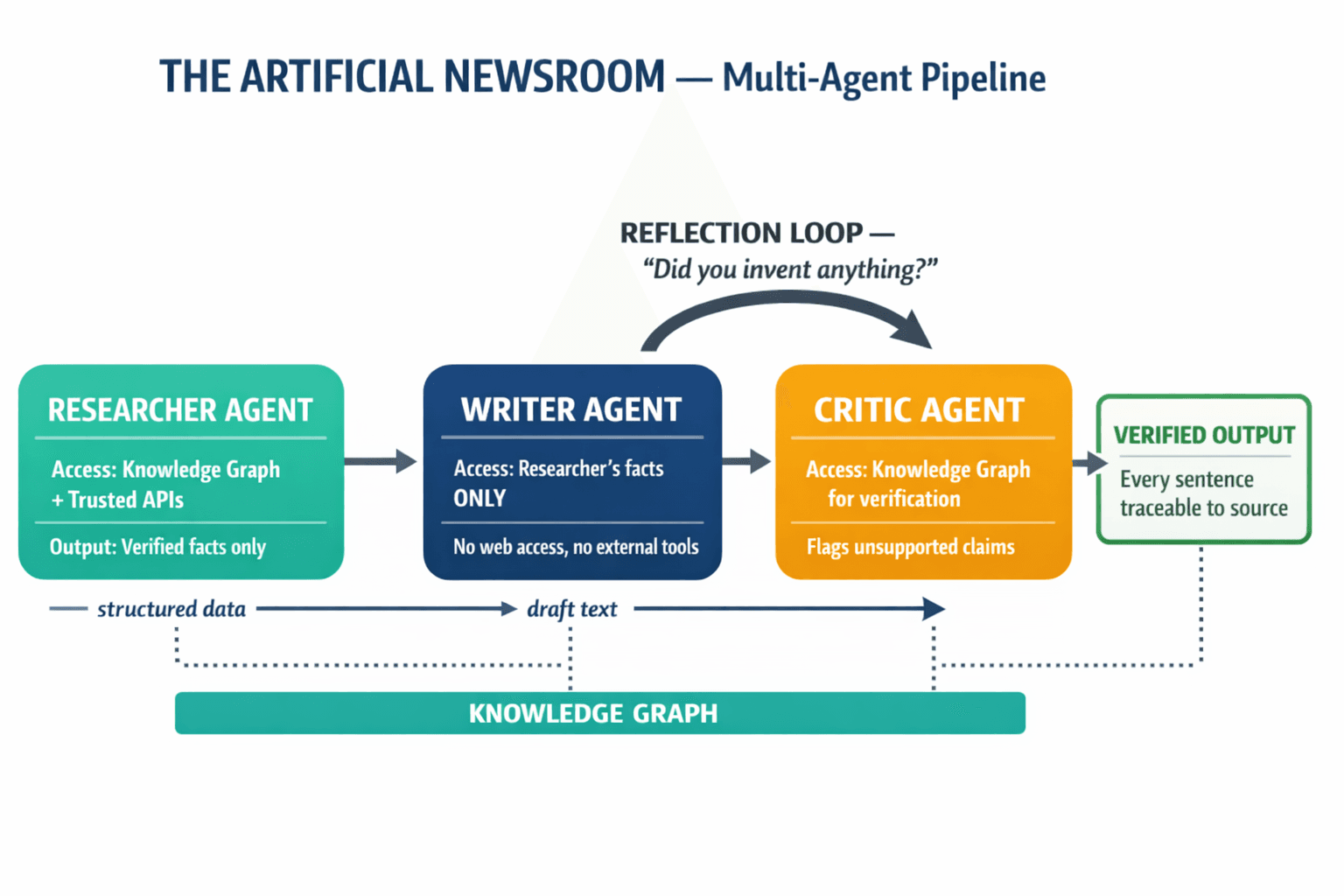
We rebuilt that entire editorial chain as a multi-agent system. Not one AI doing everything, but specialized agents with distinct roles and — this is critical — distinct permissions.
The Researcher Agent has access to the Knowledge Graph and trusted external APIs. Its only job is gathering verified facts. It produces structured data, not prose. The Writer Agent takes those facts and drafts the narrative. Crucially, it has no access to external tools or the web. It can't hallucinate new "facts" because it can't reach beyond what the Researcher provided. The Critic Agent reviews the draft adversarially — checking every claim against the Knowledge Graph, flagging unsupported assertions, evaluating tone and logic.
And then there's the Reflection loop. Most wrapper architectures take the first draft the AI produces. We don't. Our Critic prompts the Writer: "Review your previous answer. Did you cite sources? Are there logical gaps? Did you invent anything?" The Writer generates a self-critique, then uses that critique to produce a better draft. Research confirms this "Self-Refine" approach improves performance on complex tasks by over 20% and significantly reduces hallucination.
The result is a system where every sentence in the final output can be traced back to a node in the Knowledge Graph or a specific source document. Click a claim, see the data source. That's not a feature — it's the entire point.
For the full technical breakdown of this architecture, including the GraphRAG pipeline and the Critic-Actor verification model, see our detailed research paper.
"But Isn't This Just Slowing AI Down?"
I get this objection from investors and enterprise leaders who've been sold on the speed narrative. AI is supposed to be fast. Verification sounds like friction.
My answer: the Arena Group's stock lost 80% of its value over the course of the year the scandal unfolded. Staff were fired. The brand license was revoked. Tell me again how "fast" saved them money.
Speed without verification isn't efficiency. It's a deferred catastrophe. The question isn't whether you can afford the overhead of a truth architecture. The question is whether you can afford the liability of not having one.
There's a concept in information economics called a "lemons market" — when buyers can't distinguish quality from junk, they assume everything is junk and stop paying premium prices. That's what's happening to digital content right now. When a trusted brand like Sports Illustrated gets caught fabricating people, it validates the cynical assumption that all online content is potentially fake. The entire ecosystem loses value. High-quality journalism becomes indistinguishable from content farm slop.
If you build on LLM Wrappers, you are building on sand. The speed you gain today is the trust you lose tomorrow.
The enterprises that will survive this aren't the ones generating content fastest. They're the ones whose content carries a verifiable chain of custody — from source data to Knowledge Graph to generated text to human approval. That chain is the new competitive moat.
What the SI Collapse Actually Proved
I think about the SI journalists a lot. The ones who, as their union put it, "fought together to maintain the standard of this storied publication." They weren't replaced by AI. They were sacrificed by an architecture decision — management choosing the cheapest possible implementation of a technology that, deployed correctly, could have amplified their work instead of obliterating their jobs.
That's the tragedy people miss when they frame this as "AI versus humans." It was never AI versus humans. It was lazy AI architecture versus institutional trust. The AI didn't fail. The architecture failed. The governance failed. The decision to treat verification as optional failed.
The Sports Illustrated scandal proved something I'd suspected but couldn't articulate cleanly until I watched it unfold: the value of an enterprise in the age of AI is directly proportional to its ability to verify what its systems produce. Not the volume. Not the speed. The verifiability.
Every enterprise leader reading this is deploying AI right now, or planning to. The question isn't whether to use it — that ship has sailed. The question is whether your architecture treats truth as a structural constraint or an afterthought. Whether your system can explain why it generated what it generated. Whether, when someone asks "Who wrote this and is it true?", you have an answer that isn't "Well, the model said so."
Drew Ortiz didn't exist. But the damage he caused was very real. The next Drew Ortiz is being generated right now, somewhere, by a wrapper architecture that has no mechanism to stop it. The only question is whether it's being generated on your platform.