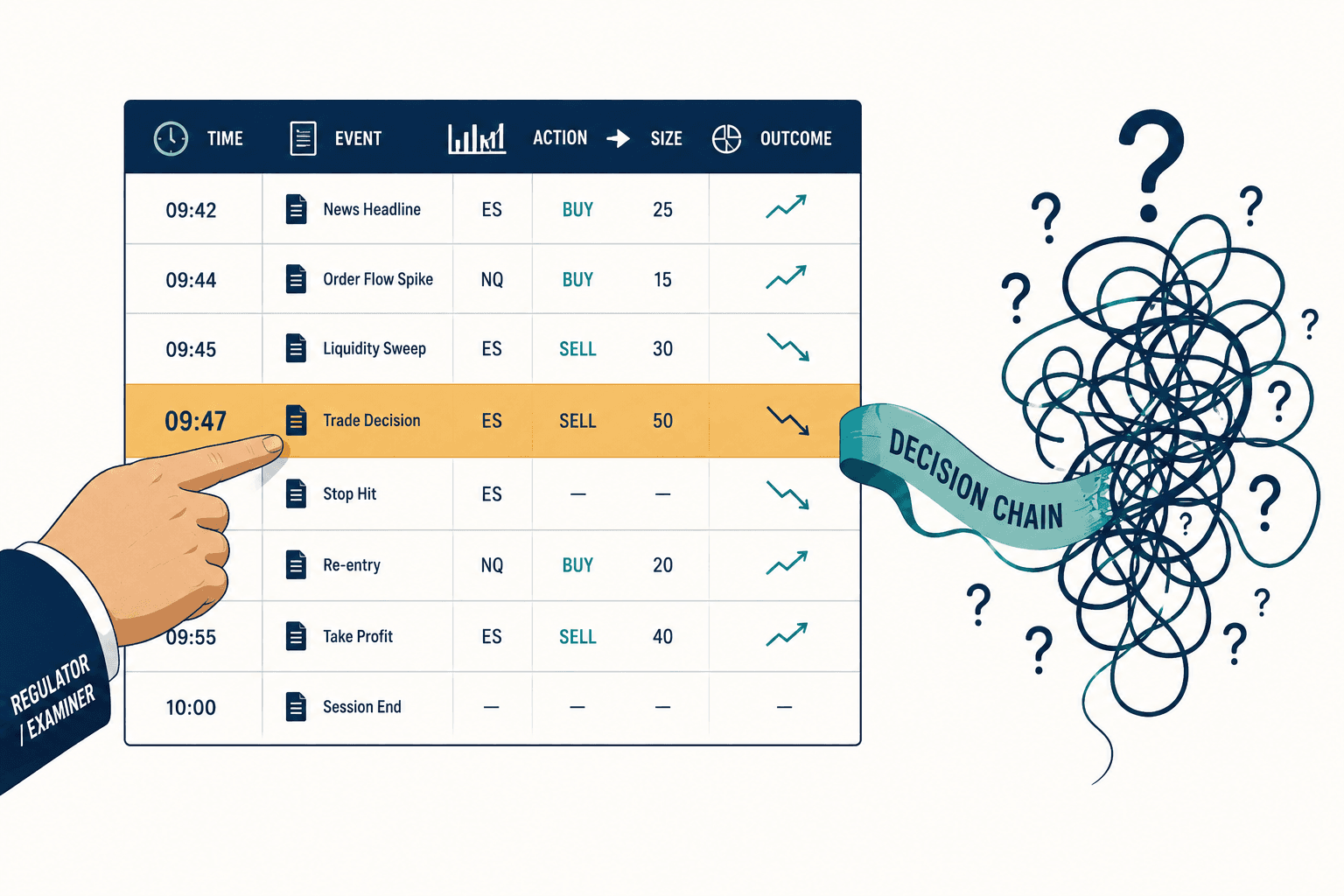
A trading gate can stay closed while its reason changes

The orders waiting at 06:18
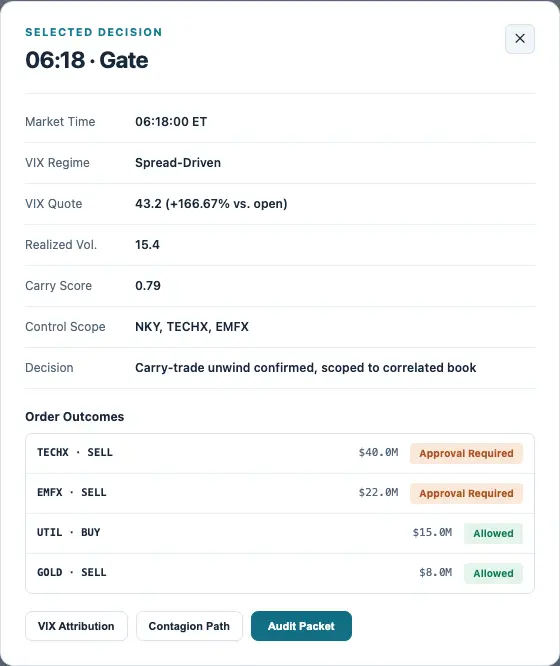
I see the same two synthetic sell orders requiring approval at 06:17 and 06:18 in AlgoTier, even though the carry signal crosses from ambiguous to confirmed between those observations. TECHX is a $40 million order and EMFX is a $22 million order; UTIL and GOLD remain allowed. An unchanged order status conceals a change in the justification I need to review.
The screen gives me a specific control scope: NKY, TECHX and EMFX. NKY has no sample order, which is an easy detail to lose if I treat the order table as the entire decision. The policy covers a set of instruments; the table shows what happens to the four illustrative orders supplied for this replay.
I am Ashutosh, founder of Veriprajna. In examining this demo, I find myself pulled toward the apparent clarity of that table. Orange means approval required. Green means allowed. I can read it quickly. Then I look at the preceding observation, and the clarity becomes less comfortable: the same orders already needed approval at 06:17, when the carry signal was still ambiguous.
That is where my attention settles. The control outcome stays the same while its supporting rationale changes. If I summarize both observations as “the system detected risk and gated the orders,” I erase the distinction I need to review.
The AlgoTier breakdown shows this fixed synthetic replay. Its market inputs, instrument labels and orders are illustrative. No exchange order is being held here. What I can examine is the relationship between evidence, policy and simulated order disposition.
The same gate, a different justification
I read the 06:17 record as a deliberate interruption of certainty: the carry-unwind score is 0.542, below the policy's confirmed threshold of 0.60, and the selected control is already GATE.
My first temptation, looking at the outcome alone, is to treat approval required as shorthand for a confirmed condition. Following that interpretation through the record makes it fall apart. The rule responsible for GATE here is R3, which covers scores from 0.30 up to, but excluding, 0.60. Its rationale calls for human proof. The policy explicitly assigns an action to ambiguity.
I have to revise the sentence forming in my head. “A confirmed carry condition holds these orders” is wrong for this observation. “An ambiguous carry signal routes these orders to review under R3” preserves what the record actually says. The difference feels small in prose and substantial in a review. The former borrows confidence from a later observation; the latter leaves the uncertainty visible.
At 06:18, the carry-unwind score reaches 0.7913. R2, the confirmed-carry rule, applies. NKY, TECHX and EMFX remain the scope; TECHX and EMFX still require approval, while UTIL and GOLD remain allowed. Confirmation changes the recorded justification without changing these order outcomes.
I resist calling that later observation a vindication of the earlier gate. These are fixture inputs, and the replay contains no independent evidence that this threshold is appropriate for real markets. More fundamentally, reviewing the earlier decision requires the information available in that earlier record. Letting the later signal explain it would make the policy appear more certain than it was.
I also find myself separating two questions that the orange status compresses. Is the carry signal strong enough to meet the confirmed condition? Does the policy permit the affected orders to proceed without review? At 06:17, the answers diverge. The score has not reached the confirmed threshold, and the policy still requires approval. I can debate whether that is a useful response to ambiguity only because I can see the band that triggers it. A label saying “uncertain” would leave me with less to examine if it concealed the action assigned to that uncertainty.
I can hold the output fixed and still argue about the reasoning behind it. The status alone cannot carry that argument. I need the time, the score, the rule and the scope together.
Following the boundary back into the policy
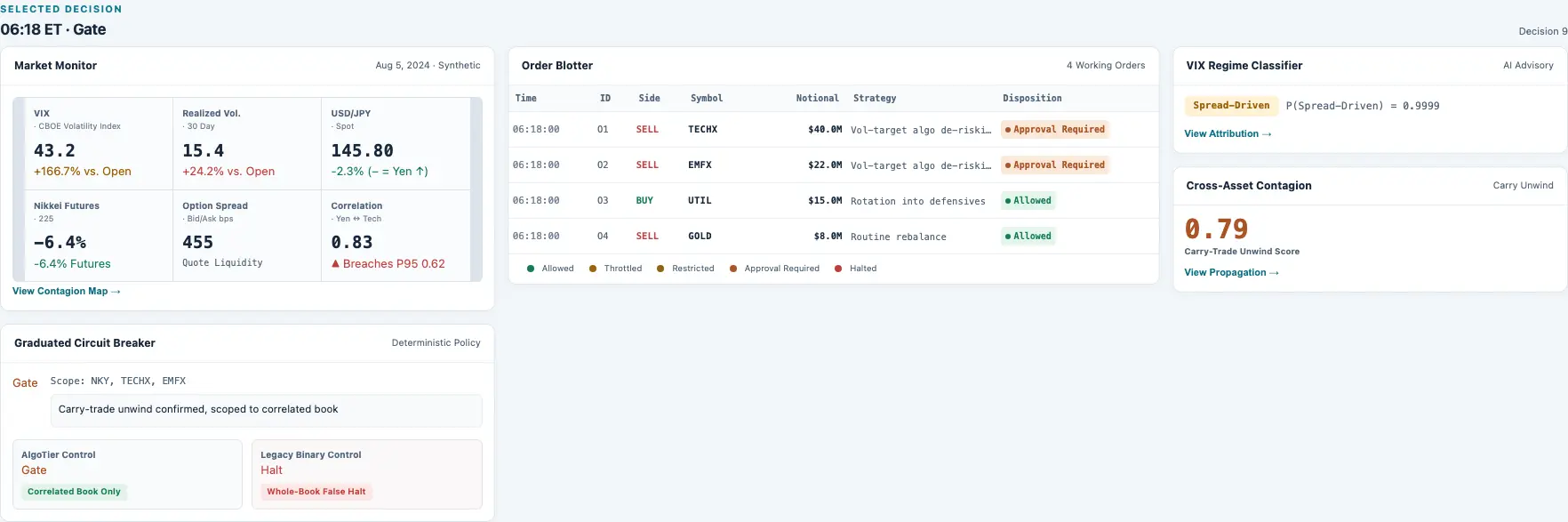
I return to the 06:18 screen and read across it, from the market inputs through the carry signal to the order table, because the boundary between the orange and green rows needs an explanation too.
The carry score combines clamped ramps for yen strength, Nikkei decline and correlation. The graph calculation then supplies stress values used for scope. In this fixture, stress at or above 0.25 puts an eligible instrument into that scope. The selected record has NKY at 0.3979, TECHX at 0.3645 and EMFX at 0.2990; UTIL and GOLD are at zero.
Those values let me trace the separation on the screen. They also make me reluctant to use the word “unaffected” too freely. It can imply an economic conclusion broader than the calculation supports. Here I can say that the UTIL and GOLD sample orders are outside this GATE scope and are allowed. That is a precise account of the demonstrated behavior.
I also have to follow the timeline backward before describing what stays active. At 06:13, an INDETERMINATE VIX label triggers THROTTLE across the book. At 06:14, the SPREAD-DRIVEN label continues that book-wide throttling. All four sample orders are throttled during that period. Scope changes with the selected control, so the allowed UTIL and GOLD rows at 06:18 cannot support a claim that these orders were always allowed.
Reading these observations together makes the design less tidy to describe and more useful to examine. I would rather keep the changing boundary visible than flatten the replay into a story about stopping risky orders while everything else continues normally. The evidence supports a sequence of particular responses. Each response needs its own account of who is included.
The rule that fires and the rule that wins
I carry the 06:18 explanation forward to 06:24, expecting the next difficulty to be another score, and instead find a question about rule priority.
At 06:24, realized volatility is 28.6. R4 proposes RESTRICT because its threshold is 25.0. The carry condition still meets R2, which proposes GATE. The policy's defined severity ordering puts GATE above RESTRICT, so the selected control stays GATE and the same sample orders still require approval.
This gives me another way to misread an unchanged status. If I inspect only the final tier, I cannot tell that an additional condition has become relevant. If I inspect only a list of rules that fired, I still need the ordering that selected the result. A fired rule and a selected decision are different facts, and I want both in the review.
I can defend the value of exposing this ordering without defending the ordering itself as universally right. It is a policy choice in a demonstration. So are the carry thresholds and the graph's stress cutoff. A reviewer might agree with the mechanism and disagree with a threshold, or accept the threshold and challenge how scope is derived. The record should give that disagreement a precise place to land.
I find that distinction useful when judging my own explanation of the demo. A clean diagram can make a chain of choices look inevitable: market input, score, rule, action. Reading the constants and competing candidates restores the choices. Someone selected a band for ambiguity. Someone decided that ambiguity should require review. Someone put GATE above RESTRICT.
For this replay, those decisions are demonstrative assumptions expressed in code. Reconstructability exposes the assumptions to challenge. It does not settle whether they are appropriate for a production trading policy. My confidence in being able to inspect the decision can be stronger than my confidence in the policy the demonstration happens to use.
That changes the review I would prepare. I would start with the selected outcome, trace the rule that produced it, and then identify the assumptions I want to question. If I disagree with the ambiguity band, I want that disagreement recorded as a policy concern. If I disagree with the instrument scope, I want to examine the graph assumptions. Keeping those objections specific helps me avoid asking a single status label to answer several different engineering questions.
Reading the green verification message carefully
I pause at the Audit Record's green “Chain Verified” message because it offers another tempting shortcut: treating a successful integrity check as approval of everything inside the record.
The unmodified chain verifies across all 12 replay decisions. Each in-memory entry includes its sequence, previous hash, payload and entry hash. The payload carries the market state, advisory outputs, evaluated rules, selected decision and simulated order dispositions, along with provenance fields. That gives me a structured record to return to when a concise description has lost something.
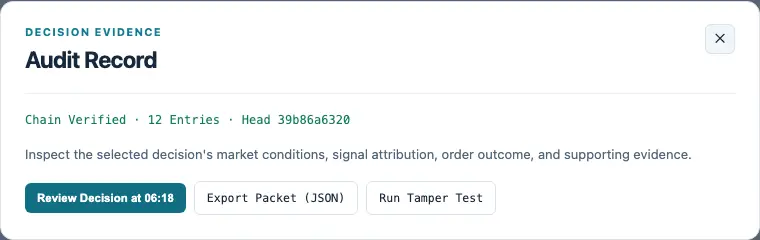
I read the JSON export and the printable HTML as complementary views. The JSON includes the order dispositions; the HTML does not separately tabulate them. If my question concerns which sample order required approval, I need to retain that distinction when choosing what to inspect or share. The selected export is one decision entry, rather than an export of the whole log.
The controlled tamper exercise makes the integrity claim concrete. Changing sequence 8's stored tier from GATE to HALT while leaving its hash unchanged produces an entry-hash mismatch at sequence 8. The check detects and locates that payload alteration.
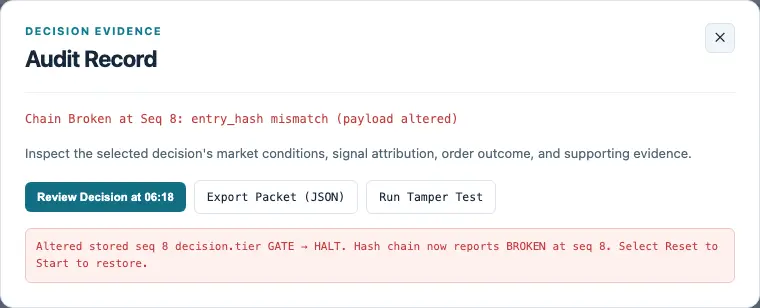
I want the red result and the limits beside each other. This log is in memory and resettable. It has no independent integrity anchor or digital signature, and someone able to rewrite the records and their hashes is outside what this exercise proves. The selected-constants configuration hash also does not authenticate every input or dependency. A verified chain leaves the substantive review open: I still have to ask whether the recorded policy was sensible and whether its scope was justified.
The explanation I can stand behind
I come back to 06:17 with a narrower sentence than the one I initially wanted to use: this policy requires review of the affected sample orders while the carry signal is ambiguous, and it records the rule and scope behind that requirement.
That sentence has useful friction. It prevents me from claiming that the system knows the market condition with certainty. It also prevents me from treating uncertainty as an absence of policy. Here, the ambiguity band has an explicit consequence. I can inspect it and disagree with it.
I would carry the same discipline into the words “Approval Required.” The application assigns that disposition; it has no approver identity, approve/reject action or real execution integration. The phrase describes a recorded requirement for review. Any production workflow would still need to define who can respond and what evidence their decision must preserve. Likewise, the packet's illustrative regulatory-reference mapping requires legal validation; it supplies no conclusion about legal sufficiency.
The full walkthrough puts these order outcomes and their evidence in view. My reason for returning to the earlier observation is less visual: I want to keep the uncertainty attached to the decision that was made under it.
I recorded this short founder walkthrough to show the same order outcomes and the evidence behind them.
At 06:18, the stronger signal makes the same gate easier to explain. It should not make me rewrite 06:17. The earlier decision deserves to be reviewed on its own terms, with its incomplete signal, explicit policy and bounded scope still intact. I trust my account of the demo more when I leave that discomfort visible.