ClaimLens · AI claim substantiation
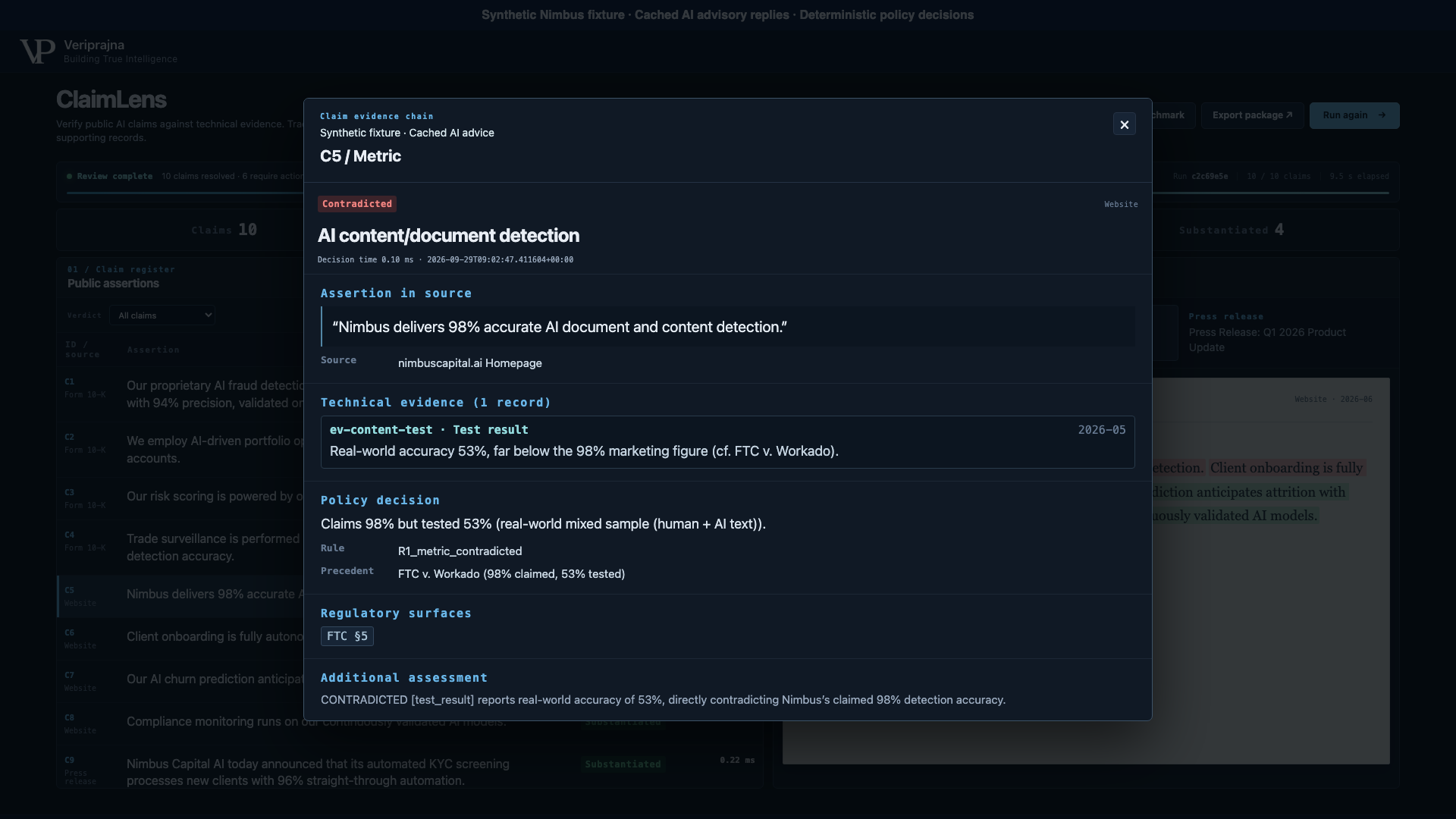
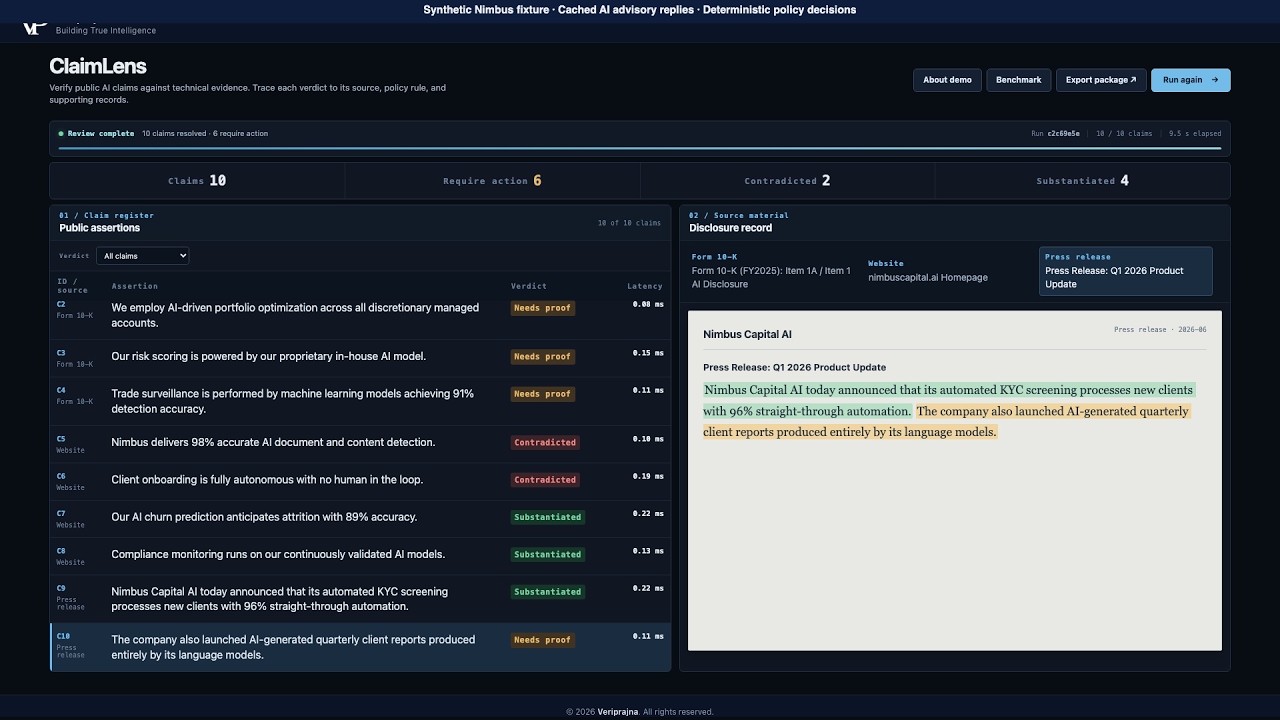
Synthetic Nimbus Capital AI advertises 98% content-detection accuracy. Its supplied test records 53%. ClaimLens keeps the sentence, evidence and deciding rule together so reviewers can inspect the gap.
6 min 56 sec · Synthetic records · Cached advisory replies
98% claimed
Content-detection accuracy
Synthetic Nimbus website assertion
53% recorded
Supplied mixed-text test result
Synthetic Nimbus test fixture
45-point gap
Exceeds the configured tolerance
Demo rule: more than 5 percentage points
A review of supplied records for legal, compliance, marketing and engineering teams. Demo verdicts do not establish legal compliance or independently validate the evidence.
An accuracy claim commits a team to a task and a measured result. A statement about full autonomy also makes a claim about human involvement. The review needs to preserve those commitments long enough to compare them with the records behind the wording.
In the Nimbus example, the important finding is the relationship between the advertised accuracy and the supplied test. A reviewer can see which sentence needs attention and why. The same record also makes the next question concrete: is the wording wrong, is the evidence incomplete, or does the underlying test need investigation?
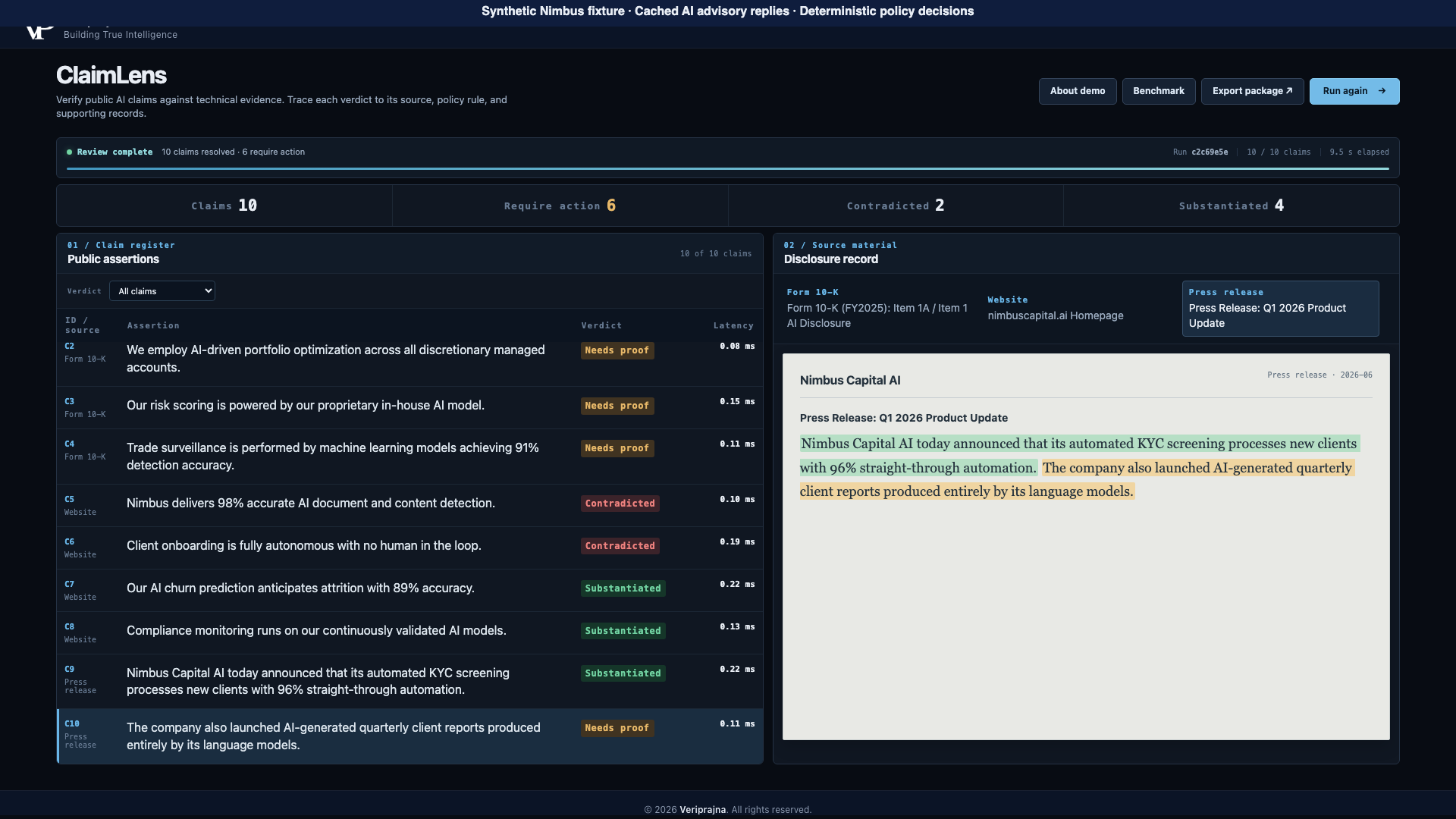
We demonstrate a bounded workflow over three synthetic disclosures and 14 supplied evidence records. It extracts ten claims, links their subjects to records and retains the reason for each configured verdict.
01 / EXTRACT
Deterministic sentence splitting and AI keyword or subject matching select claims from the bundled disclosures. The source wording stays visible.
02 / LINK
Retrieval matches a structured subject field to test and operational records. It does not perform semantic search or authenticate those records.
03 / DECIDE
Plain Python applies configured checks. A numeric gap over five percentage points yields CONTRADICTED in the demonstrated metric example.
The Substantiation Judge advises without changing the gate decision. The Adversarial Examiner runs on gate-substantiated claims and may downgrade them to PARTIALLY_SUBSTANTIATED when it returns REFUTED; it cannot upgrade them. The recording replays cached advisory replies while the deterministic checks execute. All four cached examiner replies uphold their supported results.
The completed run can export a JSON Substantiation Package. It retains the claim, source, verdict, rule, rationale and evidence identifiers for follow-up, plus summary and version information. It references the underlying records; it does not embed a complete evidence archive.
These views come from the local ClaimLens demonstration. Every Nimbus company, disclosure, test and operational record shown here is synthetic.
The separate onboarding assertion promises no human in the loop. Its synthetic operational log records 68% human intervention. The configured no-human rule returns CONTRADICTED above 10% intervention; that threshold is a demo choice, not a legally sufficient boundary.
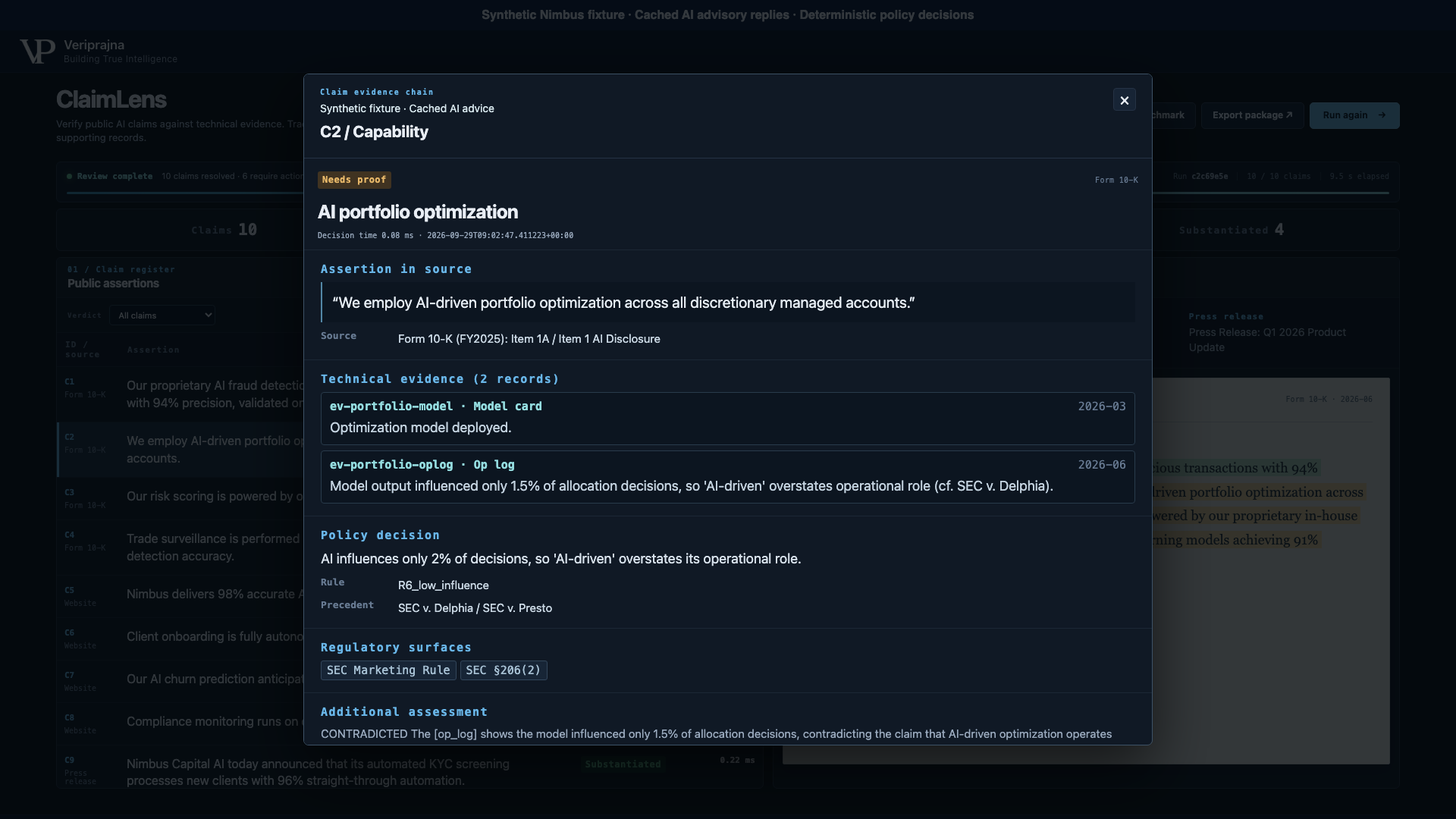
The portfolio model exists, but its supplied log records influence on only 1.5% of allocation decisions. The gate returns NEEDS_PROOF. The cached judge calls it contradicted, showing why an advisory opinion and a final outcome need separate labels.
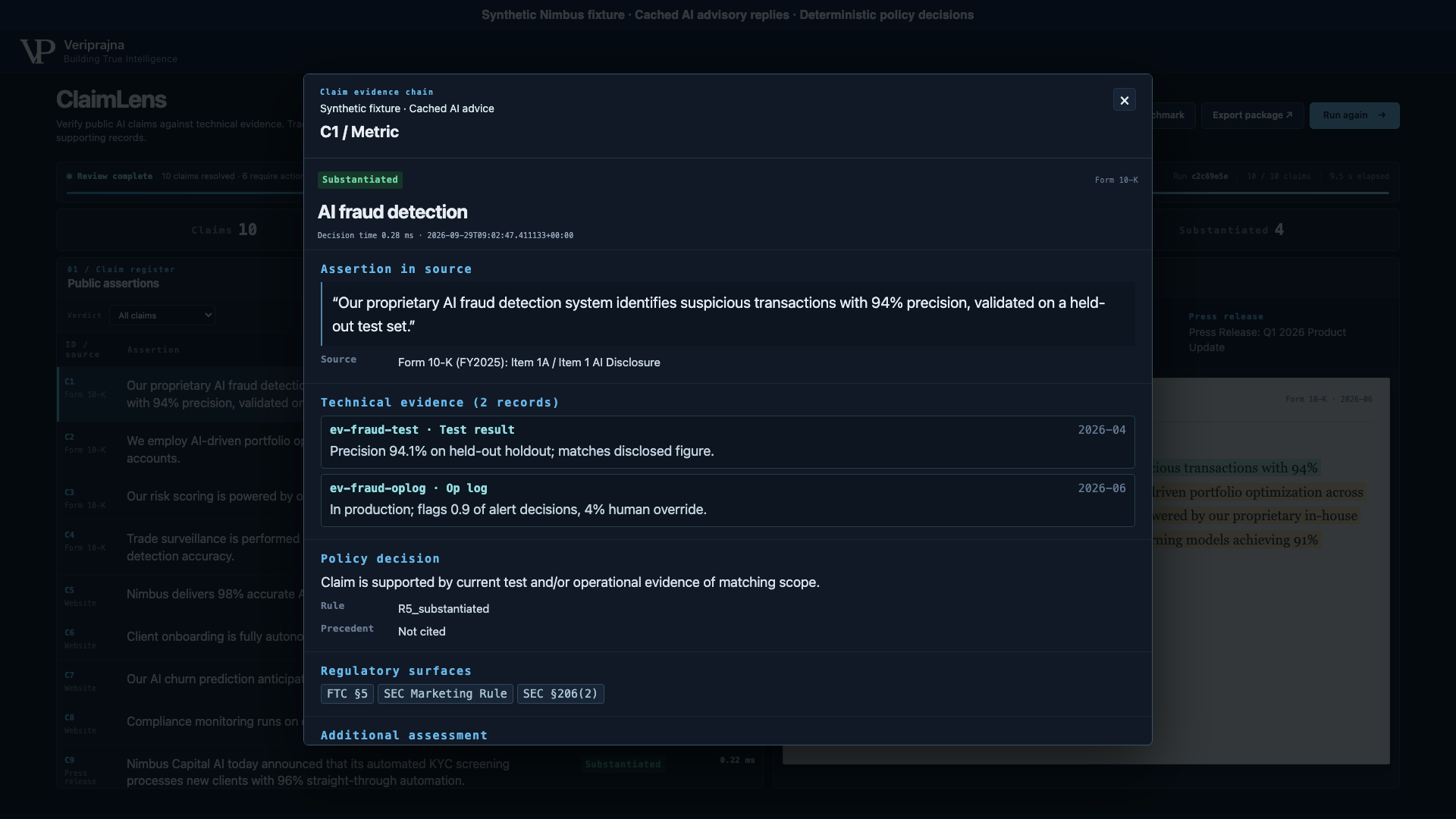
The synthetic fraud-detection claim remains substantiated with its disclosed 94% precision and supporting test and operational records. A supported fixture result is still a claim about supplied records. The reviewer must validate the real measurements and their relevance before relying on actual wording.
ClaimLens demonstrates a claim-to-record review. The table separates what the recorded workflow makes inspectable from the work a real review still requires.
| Review task | What this demonstration provides | What remains outside it |
|---|---|---|
| Find the commitment | A sentence linked to its supplied source | General document intake and complete claim discovery |
| Compare the support | Subject-based record linking and configured checks | Evidence authentication and independent test assessment |
| Understand the outcome | A verdict, deciding rule and rationale | Legal advice or regulatory approval |
| Hand off the review | A JSON package with evidence identifiers | A complete evidence archive or tamper-evident custody |
This is a local demonstration using bundled synthetic data. It has no live website or filing crawler, arbitrary document upload, production AIBOM or CI/CD integration, semantic retrieval, autonomous legal assessment or HTML binder export. Its thresholds do not establish statistical confidence or legal sufficiency. This page explains the recorded workflow; it does not provide access to the local application.
ClaimLens compares supplied wording and technical records using configured demo rules. A substantiated result is not legal clearance, and the regulatory labels shown in the interface are illustrative routing labels. Human review and validation of the underlying records remain necessary.
This demonstration uses the bundled synthetic Nimbus dataset. It does not accept arbitrary document uploads or crawl websites, filings or internal systems. The page shows the recorded workflow and its evidence views.
The demo links extracted sentences to supplied technical records through a structured subject field. Those records include tests and operational logs. The checks compare configured values and conditions; they do not authenticate the records or independently assess the test methodology.
The Substantiation Judge supplies advice without changing the policy gate decision. The Adversarial Examiner can downgrade a gate-substantiated claim when it returns a refutation, but it cannot upgrade a claim. In this recording, advisory replies are cached and all four examiner replies uphold the supported outcomes.
A model record establishes that a component is documented, while an operational claim also needs evidence of what it does. In the synthetic portfolio example, the supplied log records influence on 1.5% of allocation decisions. The configured gate returns NEEDS_PROOF, preserving that gap for review.
The browser Export button saves a JSON package from the completed run, with each claim, source, verdict, deciding rule, rationale and evidence identifiers. It also includes a summary, engine version and generation timestamp. It does not embed complete evidence records, advisory transcripts or a tamper-evident chain of custody.
Explore related research for broader context on this demonstration.
Discuss a claim-substantiation workflow with Veriprajna.
We can discuss the records, review boundaries and human decisions your team needs before defining an implementation.